6.7 Powerstroke CCV Filter Replacement: Step-by-Step Guide 2011–2024

A clogged CCV (Closed Crankcase Ventilation) filter on the 6.7 Powerstroke does not just trigger a check engine light. It builds crankcase pressure until oil pushes past the turbo seals, coats the intercooler piping in sludge, and in severe cases, cracks the DPF.
One owner on powerstroke.org documented three failed DPF units on a 2018 F-350 — all under 41,000 miles — traced back to a failed oil separator. The repair bill for a dealer CCV replacement runs $300–$500. The DIY cost is $80–$130 and takes under an hour.
This guide covers all three CCV hardware generations across the 2011–2024 Super Duty lineup, the correct part number for your year, real service intervals, step-by-step replacement instructions, and what to do if you received a P04DB check engine code.
What the CCV Filter Does on the 6.7 Powerstroke and Why It Fails
Recommended Best Deal Products
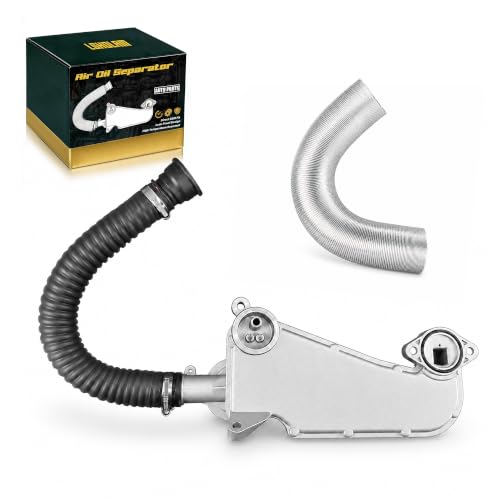


Every diesel engine produces blow-by gases — combustion pressure that escapes past the piston rings into the crankcase. Left unchecked, this pressure builds until it finds a weak point in the engine’s sealing system. The CCV system captures those gases before they cause damage, passes them through an oil separator (which catches the oil mist), and routes the cleaned gases back into the intake manifold.
On the 6.7 Powerstroke, the oil separator assembly sits directly on the valve cover and does the real work. Over time, the filter media inside the housing saturates with oil mist and particulate. Once it clogs, pressure has nowhere to go. It forces oil through the turbocharger seals first, then into the intercooler, then into the intake. From there, the oil-soaked air acts as unmetered fuel inside the combustion chamber — and the DPF gets the damage.
Trucks with high idle hours are most vulnerable. Fleet trucks, municipal vehicles, and any Super Duty that runs the engine at idle for extended periods accumulate blow-by much faster than highway-driven trucks. If your truck has significant idle hours in addition to mileage, cut the replacement interval in half.
For context on the broader failure patterns tied to this engine, the 6.7 Powerstroke CP4 pump failure guide covers another common maintenance-sensitive system worth tracking on the same service schedule.
Three CCV Designs Across 2011–2024: Which One Does Your Truck Have?
This is where most guides go wrong. Ford changed the CCV design three times across the 6.7 Powerstroke’s production run. Ordering the wrong part is easy if you do not know which generation you have.
6.7 Powerstroke CCV Housing: Three Generations (2011–2024)
| Generation | Years | Configuration | Serviceable? | OEM Part Number |
|---|---|---|---|---|
| Gen 1 | 2011–2016 | Rectangular plastic housing, 8mm bolts, driver-side valve cover | YES Internal filter replaceable | FC3Z-6A785-C or DC3Z-6A785-C — confirm by year range from motorcraftservice.com] |
| Gen 2 | 2017–2019 | Updated housing — varies by axle. DRW (F-350/F-450 dual rear wheel) has serviceable filter; SRW (single rear wheel) is sealed | DRW: YES / SRW: NO | Dorman 904-702 (2017–2019); GC4Z-6A785-D |
| Gen 3 | 2020–2024 | Smaller housing with integrated baffle + check valve. Eliminated CCV sensor. Fits as upgrade on 2011–2022 trucks | NO Full assembly replacement | Ford PC3Z-6A785-A / Motorcraft FL2171 |
CCV Filter Replacement Interval by Use Type
| Use Type | Inspect At | Replace By |
|---|---|---|
| Normal highway / light tow | 50,000 mi | 67,500 mi (Ford OEM interval) |
| Regular towing / moderate load | 35,000 mi | 50,000 mi |
| Fleet / high idle / severe duty | 20,000 mi | 30,000 mi |
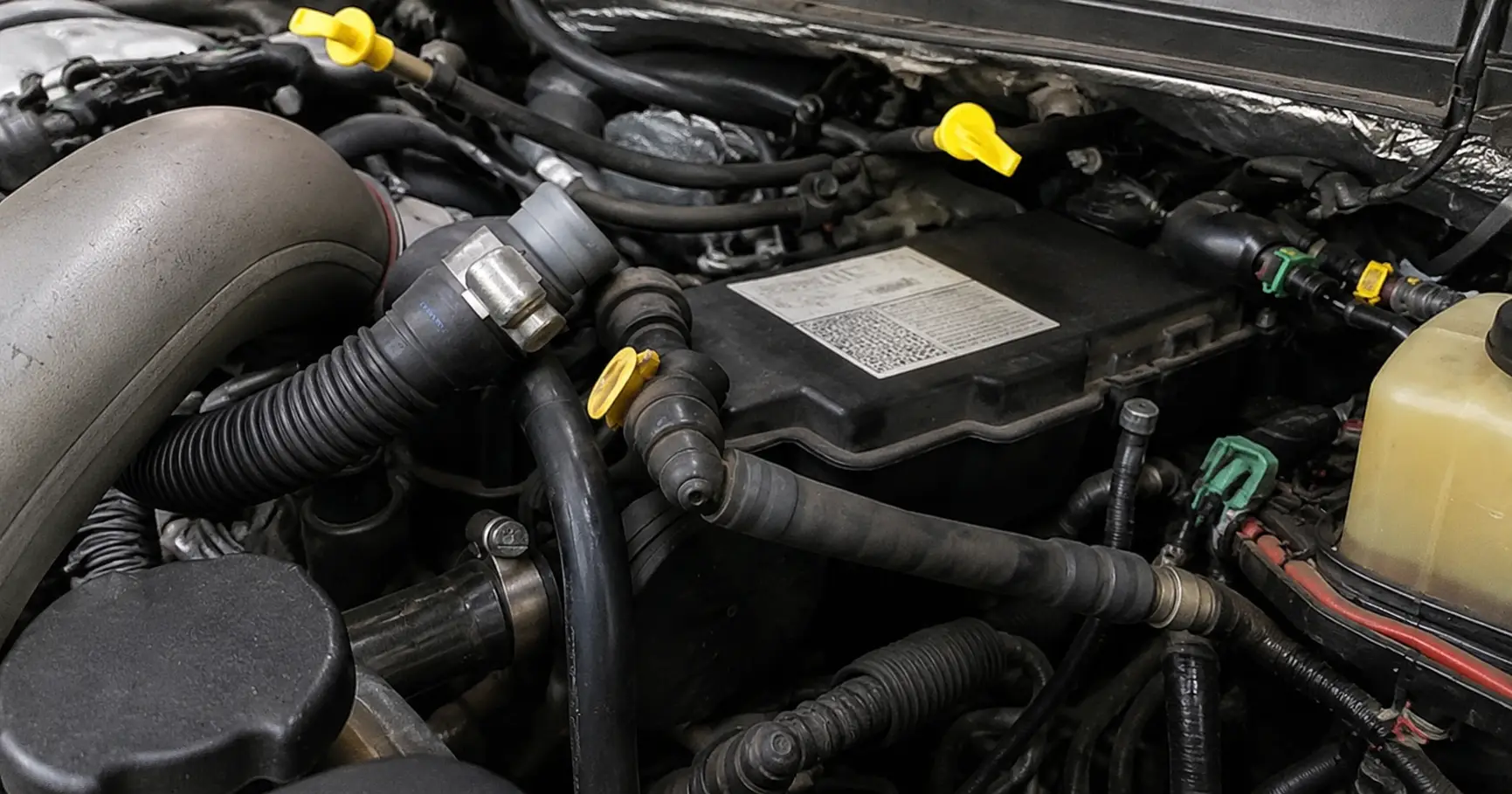
Here is how to confirm your design visually without a part number lookup. Open the hood and look for the rectangular black plastic box on top of the valve cover. Gen 1 housings (2011–2016) have visible 8mm bolt heads around the perimeter of the housing top. Gen 2 housings (2017–2019) vary by axle configuration — dual rear wheel (DRW) trucks have screws on the face of the housing making the internal filter serviceable, while single rear wheel (SRW) trucks have a sealed housing with no serviceable screws. Gen 3 housings (2020–2024) are smaller, have no visible perimeter bolts, and feature an integrated baffle and check valve.
If your 2017–2019 truck is an F-350 or F-450 DRW, the internal filter is replaceable without swapping the entire housing. If it is an SRW, the full assembly must be replaced.
6.7 Powerstroke CCV Filter Symptoms and OBD Codes
Recommended Best Deal Products


The first symptom most owners notice is blue or grey exhaust smoke during extended idling. Oil vapor is passing the turbo seals and burning in the combustion chamber. By that point, the filter has been restricted long enough to have already deposited oil film on the compressor wheel and intercooler piping.
The five symptoms to watch for, in order of typical appearance:
Oil residue around the turbo inlet or intercooler couplings is often the earliest physical sign. The engine will feel sluggish under load as intake restriction increases. Unexplained oil consumption without external leaks points to oil being drawn through the CCV path into combustion. Blue or grey smoke from the exhaust during idle or initial acceleration follows. Finally, the check engine light comes on with a P04DB code.
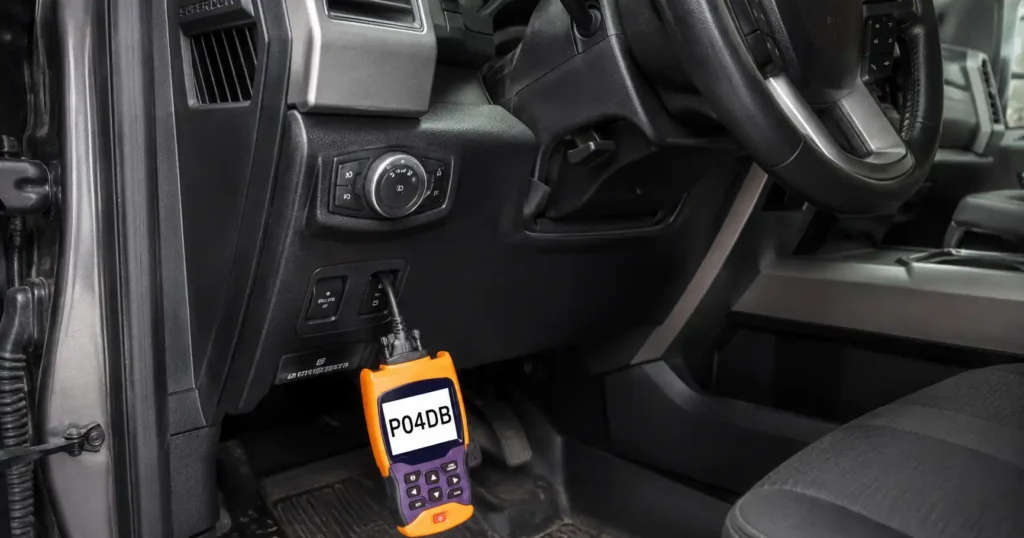
P04DB is defined by SAE J2012 as “Crankcase Ventilation System Disconnected.” On the 6.7 Powerstroke, the PCM monitors a hall-effect sensor on the CCV hose (2014–2019 trucks) and detects when crankcase pressure deviates significantly from intake manifold pressure. Companion codes P04E2 (CCV Hose Connection Sensor Circuit Low) and P04E3 (Circuit High) can appear alongside it to pinpoint whether the fault is electrical or pressure-related.
Ford Customer Satisfaction Program 17M04 — Read This Before Replacing Anything on a 2014–2016 Truck
If your 2014–2016 F-250 through F-550 (or 2016 F-650/F-750) threw a P04DB code, Ford has two overlapping programs addressing it. Customer Satisfaction Program (CSP) 17M04 makes the repair free for eligible owners — it covers 2014–2016 F-250/F-350/F-450/F-550 and 2016 F-650/F-750 with the 6.7L diesel, built on or before 11 November 2015.
TSB 18-2301 (published October 1, 2018) is the service procedure document dealers use: it calls for a PCM reflash to remove the CCV sensor from the PCM’s monitor list, plus installation of a permanent tamper-proof collar (Ford part FC3Z-6A603-A) in place of the quick-connect type.
One powerstroke.org owner reported being quoted $800 for a full CCV assembly replacement before invoking CSP 17M04 — and the dealer performed the fix for free once the program was identified. If you have not had this procedure performed, ask your dealer to look up CSP 17M04 and TSB 18-2301 before authorizing any CCV assembly replacement on a 2014–2016 truck.
Confirming the code yourself before any shop visit is straightforward. For readers who do not yet have a scanner that reads Ford manufacturer-specific codes, the best OBD2 scanner for the 6.7 diesel covers the options that pull P04DB and companion codes correctly.
When to Replace the 6.7 Powerstroke CCV Filter: Service Interval by Use Type
Ford’s published service interval is 67,500 miles. That figure applies to trucks with the serviceable Gen 1 filter. For sealed units (Gen 2 SRW and Gen 3), Ford does not publish a dedicated replacement interval in the owner’s manual.
Forum data from powerstroke.org tells a different story for hard-working trucks. Serviceable filters on trucks with regular towing loads or moderate idle time have been reported clogging as early as 30,000 miles. One powerstroke.org thread from a fleet technician noted that DOT and municipal trucks running full shift idles can clog the serviceable version before 20,000 miles.
One additional factor: if your 6.7 has any history of oil seeping from the upper oil pan gasket — a known weak point on this engine — the CCV filter will clog faster. Oil mist load in the crankcase increases proportionally with internal oil leaks. Inspect the upper oil pan area if you are replacing the CCV significantly ahead of the standard interval.
Tools and Parts You Need Before You Start
Recommended Best Deal Products

Tools required: a 10mm socket with a 1/4-inch drive extension bar (all three CCV designs use four 10mm mounting bolts), a T30 Torx bit (for the removable-lid design on 2018–2022 trucks if you need to inspect the lid), a torque wrench rated for inch-pounds, clean shop rags, nitrile gloves, and penetrating spray for any rusted fasteners.
You will also need a small pick, thin screwdriver, or two paperclips to unlock the CCV hose connector at the turbo inlet mouthpiece. This is a tamper-proof quick-connect that requires lifting the plastic locking tabs before the hose will release. Slide paperclips under at least two of the three tabs to hold them open, then pull the connector free. Attempting to yank the hose without releasing the tabs can crack the mouthpiece.
For parts, match your year to the correct assembly:
2011–2016 F-250/F-350/F-450/F-550 Super Duty pickups: OEM Ford DC3Z-6A785-C (cross-references FC3Z-6A785-C for 2015–2016). Aftermarket replacements on Amazon list this range at approximately $35–$65 for non-OEM. OEM from diesel specialty retailers runs approximately $239 list. The universal upgrade Motorcraft FL2171 (PC3Z-6A785-A) fits as a drop-in replacement and is available for approximately $79–$130.
2017–2019 F-250/F-350/F-450/F-550 Super Duty pickups: OEM Ford FC3Z-6A785-F (sealed, non-serviceable). For 2018–2022 trucks, LC3Z-6A785-C (filter-less with removable lid). Motorcraft FL2170 (LC3Z-6A785-C equivalent) lists at approximately $110.97 from diesel parts suppliers. Motorcraft FL2171 (PC3Z-6A785-A) is also compatible as an upgrade at approximately $79–$130.
2023–2024 F-250/F-350/F-450/F-550: OEM Ford PC4Z-6A785-A, list price approximately $244.60 from diesel parts suppliers.
The replacement assembly includes the new hose and O-rings. No separate O-ring purchase is needed. Lubricate the O-rings with clean motor oil before installation.
For owners keeping up with air intake maintenance at the same service interval, the best air filter for the 6.7 Powerstroke covers the top options for a full intake maintenance pass.
How to Replace the CCV Filter on a 6.7 Powerstroke: Step-by-Step (2011–2024)
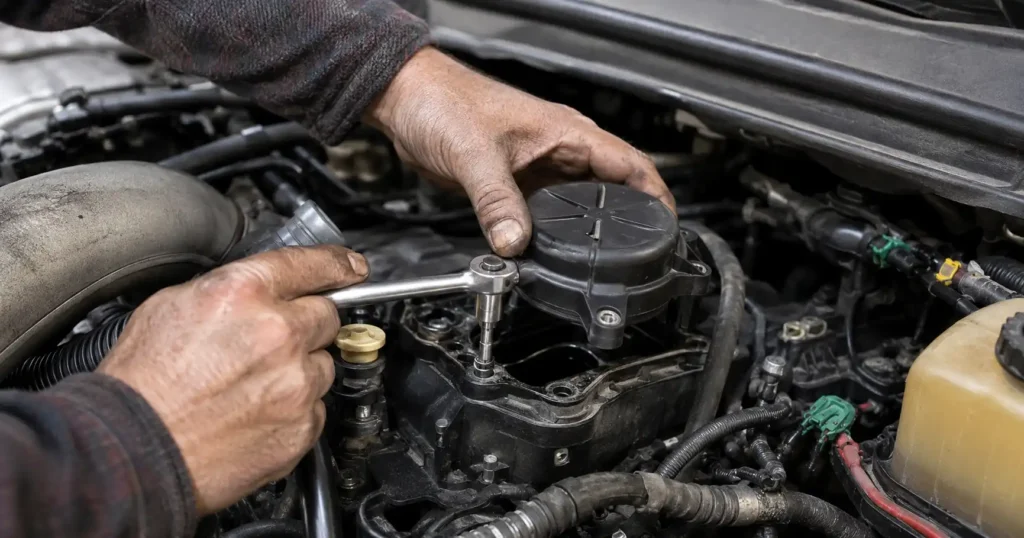
This procedure covers OEM assembly replacement. Reroute kit installation follows the same disassembly steps — refer to your kit’s instructions for the reinstallation portion.
Step 1. Park the truck and allow the engine to cool completely. Two hours minimum after last use. Hot oil and pressurized components cause serious burns on a diesel that has been running under load.
Step 2. Disconnect both negative battery cables before touching any electrical connectors near the CCV hose or sensor.
Step 3. On 2011–2016 trucks, remove the primary engine-mounted fuel filter. The CCV assembly sits directly behind the fuel filter canister, and the filter must come out for access to the front CCV mounting bolt. Plug the fuel lines to limit spillage and prevent contamination. On 2017-and-newer trucks, the layout changed and the fuel filter does not typically need to come out for CCV access — confirm visually before proceeding.
Step 4. Locate the plastic engine cover if present on your truck and remove it. Most use hand-tightened fasteners or twist-lock caps.
Step 5. Trace the corrugated outlet hose from the CCV housing to where it connects at the turbocharger compressor inlet mouthpiece. The hose has a heat-shrink sleeve over the connector at the mouthpiece end. Peel back the sleeve to expose the three plastic locking tabs on the connector.
Step 6. Use two paperclips or a thin pick to lift and hold at least two of the three locking tabs in the upward position. Pull the connector straight off the mouthpiece. Do not pry against the mouthpiece itself — it is cast into the turbo inlet and damage here is expensive.
Step 7. On 2014–2016 trucks with the hall-effect sensor: locate the sensor clipped to the CCV hose near the inlet mouthpiece. Disconnect the sensor electrical connector before moving the hose further. The connector is a standard push-tab type.
Step 8. Remove the four CCV mounting bolts using a 10mm socket. A 1/4-inch drive ratchet with an extension works best for the two rear bolts near the firewall — access is tight. Remove all four bolts in a cross pattern, starting from a corner and working diagonally.
Step 9. Lift the CCV assembly straight up and out. It will resist slightly as the O-ring seals release from the valve cover — a steady upward pull is correct. Do not pry sideways.
Step 10. Clean the valve cover mating surface completely with a dry shop rag. Pay particular attention to the forward drain opening — a thick, greasy buildup commonly accumulates there and must be thoroughly removed before the new assembly seats.
Step 11. Prepare the new assembly by lightly lubricating both O-rings with clean engine oil. Do not skip this step — a dry O-ring can roll out of its groove during seating and cause an immediate leak.
Step 12. Lower the new assembly straight down onto the valve cover, aligning both the primary inlet and drain tube with their respective valve cover openings. Seat it evenly.
Step 13. Thread the four 10mm mounting bolts by hand first, then tighten in a cross pattern. The CCV housing is plastic. The valve cover bolt specification for the 6.7 Powerstroke is 106 in-lb (12 Nm), confirmed across multiple sources referencing Ford service data. Apply this as the upper limit for the CCV housing bolts and do not exceed it. Do not use a full-size foot-pound torque wrench for this step — use an inch-pound wrench for accuracy.
Step 14. Push the new CCV hose connector onto the inlet mouthpiece until it clicks into the locked position. The new connector will push on without needing to manipulate any locking tabs — it locks automatically on seating.
Step 15. On 2014–2016 trucks: if the original hose had a sensor connector, the new assembly uses the tamper-proof collar type and eliminates the sensor. The PCM reflash from TSB 18-2301 is needed to remove the sensor from the PCM’s monitor list — this is dealer-only procedure that requires a Ford scan tool.
Step 16. Reinstall the fuel filter (2011–2016 trucks), reconnect both battery cables, and start the engine.
Step 17. Let the engine idle for two minutes. Inspect both CCV connection points — at the valve cover and at the turbo inlet mouthpiece — for any oil weeping. A properly seated assembly shows no leaks.
Step 18. If P04DB was stored before the replacement, clear it with your OBD scanner. If it returns immediately after clearing on a 2017-and-newer truck with no sensor, the connection at the mouthpiece has not fully locked. Push it in further until the click is confirmed.
CCV Reroute Kit: Is It Worth It on a 6.7 Powerstroke?
A CCV reroute kit replaces the OEM separator housing with a billet adapter that vents crankcase blow-by gases away from the intake — either through an external catch can or directly to atmosphere. The result is an intake system that never sees oil vapor again.
The intake cleanliness benefit is real. Turbo compressor wheels stay clean, intercooler piping stays free of oil film, and the MAP sensor does not foul. For a truck that has already experienced oil sludge in the intake or has been running with a restricted CCV for unknown miles, the reroute addresses the root cause permanently.
The tradeoff on 2014–2019 trucks is the hall-effect sensor. Those trucks have a sensor on the CCV hose that the PCM monitors. Removing the OEM system will trigger P04DB unless you either retain the sensor with a fooler cap (included in better kits) or have the PCM recalibrated to ignore the input. On 2020–2024 Gen 3 trucks, Ford eliminated the sensor, making a reroute simpler — though the owner assumes responsibility for emissions compliance.
We recommend the reroute for trucks past 100,000 miles that have experienced oil in the intake, or for dedicated work trucks with high idle time that would be replacing the OEM filter every 30,000–40,000 miles. For a daily-driven Super Duty under 80,000 miles in clean condition, OEM replacement is the cleaner and more cost-effective choice.
For owners who already have the delete information and want to see the full process, the site’s 6.7 Powerstroke crankcase filter delete guide covers the reroute installation in detail.
Frequently Asked Questions
How much does a 6.7 Powerstroke CCV filter replacement cost?
DIY cost ranges from $79 to $245 for the assembly depending on your model year and part choice, plus under two hours of labor. Taking the truck to a diesel shop or Ford service center typically runs $300–$500 total. The Motorcraft FL2171 universal assembly (PC3Z-6A785-A) at approximately $79–$130 is the most cost-effective OEM-quality option for trucks not requiring the model-year-specific chassis cab assembly.
Can I drive with a clogged CCV filter on a 6.7 Powerstroke?
The truck will continue to run, but the damage accumulates with every mile. Excess crankcase pressure forces oil past the turbo shaft seals, depositing it into the intercooler and DPF. The documented case on powerstroke.org — an 2018 F-350 on its third DPF under 41,000 miles due to oil separator failure — shows how quickly this failure chain accelerates. Do not defer this job once symptoms appear.
What is the P04DB code on a 6.7 Powerstroke?
P04DB means “Crankcase Ventilation System Disconnected.” The PCM detects a mismatch between crankcase pressure and intake manifold pressure readings. On 2014–2016 trucks, Ford issued CSP 17M04 to address false P04DB triggers caused by an incorrect PCM calibration. Check for that program before ordering parts.
Does the 6.7 Powerstroke CCV filter need to be replaced at every oil change?
No. Under normal use, Ford’s published interval is 67,500 miles for serviceable filter designs. Sealed units should be inspected in the 40,000–60,000 mile range and replaced proactively. If your truck tows regularly, idles frequently, or has high engine hours relative to mileage, move that inspection up to 30,000–40,000 miles.
Which part number fits my 2011–2024 6.7 Powerstroke?
The updated Ford OEM housing (Ford PC3Z-6A785-A / Motorcraft FL2171) fits all 2011–2024 Super Duty applications and is a direct upgrade over earlier-generation housings. Dorman 904-702 is the primary aftermarket option for 2017–2019 applications. Cross-reference your year against the generation table above before ordering.
The 6.7 Powerstroke CCV filter is one of the most straightforward preventive maintenance jobs on the Super Duty. The part is inexpensive, the procedure is clean, and the failure consequences of skipping it — a dead turbo or cracked DPF — are expensive. Identify your generation, order the correct housing, and do the job before symptoms appear. That is the difference between an $80 maintenance item and a $3,000 repair bill.