1989 Ford Econoline Interior: Dimensions & Layout Guide

The 1989 Ford Econoline interior is defined by its spacious third-generation layout and the iconic central engine doghouse. Whether you are planning a camper conversion or a factory restoration, understanding the 52-inch wheel well clearance and trim-specific features is vital for success.
🎯 Key Takeaways
Recommended Best Deal Products


- Floor width between wheel wells is approximately 52 inches for all models.
- Interior parts are largely compatible across the 1975-1991 E-Series generation.
- The Chateau trim offers premium captain’s chairs and upgraded insulation.
- Standard cargo length is roughly 122 inches from front seats to rear.
- Dashboard controls utilize a modular, driver-centric ‘square’ design common to the era.
The 1989 Ford Econoline offers a unique “brick-nose” era interior that balances utilitarian toughness with surprisingly generous floor space. If you are planning a camper conversion or a period-accurate restoration, you must account for the massive center engine cover—commonly known as the “doghouse”—and the 52.5-inch width between the rear wheel wells. These specific constraints dictate exactly where you can place cabinetry, bedding, or storage racks without compromising the structural accessibility of the cabin.

Prime for Young Adults — 6 Months Free
Students and 18–24s get six months of Prime free, then half price.
Start 6 Months Free As an Amazon Associate I earn from qualifying purchases.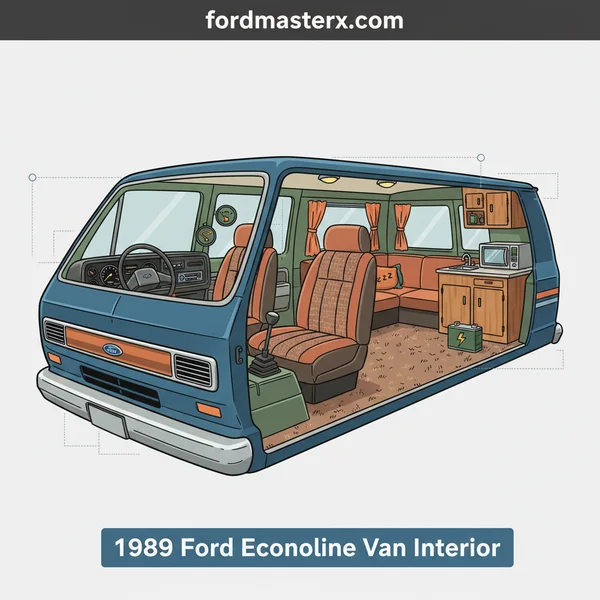
Understanding these layout nuances is critical because the 1989 model year features the classic vertical dashboard design that differs significantly from the rounded 1992 redesign. Mapping out the distance from the rear of the engine cover to the back doors allows you to maximize every square inch of this vintage heavy-hauler. Whether you are dealing with a stripped-out E-150 cargo van or a plush Club Wagon, these dimensions and visual cues are the foundation of your project.
Visual Breakdown of the 1989 Dash and Doghouse Layout
The Cockpit and Control Interface
The 1989 dashboard is defined by its “boxy” aesthetic and functional simplicity. The instrument cluster is housed in a rectangular binnacle directly in front of the driver, typically featuring a large central speedometer flanked by smaller gauges for fuel level, coolant temperature, and oil pressure. Unlike modern vans, the controls are tactile and mechanical. You will find pull-knob switches for the headlights and sliding levers for the heater and optional air conditioning system located to the right of the steering column.
📤 Share
💾 Download
- The Doghouse: The fiberglass engine cover protrudes significantly into the cab. It features two quick-release latches at the floor and two bolts at the top. On 1989 models, this cover often includes a built-in plastic tray with two shallow cup holders and a small storage bin.
- Radio Placement: The factory radio slot is a standard DIN-ish size located in the center-right of the dash, easily accessible but prone to glare from the large windshield.
- Ventilation: Four large, rectangular plastic vents dominate the face of the dash. These are notorious for becoming brittle over time, so handle them carefully during restoration.
Seating and Door Panel Styles
The 1989 interior atmosphere changes drastically depending on the original trim package. Cargo models usually feature basic low-back vinyl buckets with no armrests, while the XLT Club Wagon variants offer high-back “Captain’s Chairs” that can swivel 180 degrees to face the rear. These chairs are mounted on heavy-duty steel pedestals bolted directly through the floor pan.
Door panels in the 1989 model are functional but thin. The base models use a flat, single-piece stamped fiberboard covered in vinyl. Higher trims feature “padded” panels with integrated map pockets and wood-grain plastic accents. If you have power windows and locks, the switches are located on a raised plastic pod near the door handle. When planning your layout, remember that the front doors require about 4 inches of clearance for the window cranks or armrests when the doors are closed.
The Ultimate 1989 Ford Econoline Van Interior Walkthrough
Recommended Best Deal Products


The 1989 Ford Econoline, often referred to as the “brick nose” E-Series, is a legendary platform for van life enthusiasts, contractors, and vintage restorers. Because these vans feature a body-on-frame design with a cavernous, boxy interior, they offer a blank canvas for customization. This guide covers the complete process of stripping, prepping, and rebuilding a 1989 interior, whether you are aiming for a rugged mobile workshop or a cozy weekend camper. Following these specific steps ensures you address the common pain points of these 30-year-old vehicles, such as floor rust, brittle plastic trim, and outdated wiring, resulting in a professional-grade finish that lasts for decades.
Step 1: Demolition and Deep Cleaning
What you need: Socket set (specifically T40 to T55 Torx bits for seat belts), pry bar, heavy-duty degreaser, shop vacuum, and a heat gun.
Instructions: Start by removing the front captain’s chairs and any rear bench seats. In the 1989 model, seat bolts are often rusted through the chassis; use penetrating oil 24 hours in advance. Once the seats are out, pull up the original rubber mats or shag carpeting. Expect to find a layer of grime and potentially “mastic” (a black, tar-like sound dampener) on the wheel wells. Use a heat gun and a scraper to remove old adhesive. Vacuum every corner, including the “ribs” of the van walls where debris collects. This is the time to inspect for “through-holes” in the metal floor. If you find light surface rust, use a wire brush attachment on a drill to grind it down to bare metal before proceeding.
Pro Tip: Bag and label every single screw and bolt. The 1989 Econoline uses a mix of metric and imperial fasteners that are difficult to source at a modern hardware store.
Step 2: Rust Mitigation and Subfloor Prep
What you need: Rust-Oleum or Corroseal, metal primer, 1/2-inch or 3/4-inch Baltic birch plywood, and 1-inch foam board insulation.

Audible — Listen Free for 30 Days
One free credit a month and thousands of titles included.
Listen Free for 30 Days As an Amazon Associate I earn from qualifying purchases.Instructions: Treat any exposed metal with a rust converter like Corroseal, which turns iron oxide into a paintable black polymer. Once dry, paint the entire floor with a high-quality enamel. For the subfloor, the 1989 E-Series has a corrugated metal floor. Fill the “valleys” of the corrugation with strips of 1/2-inch XPS foam board to create a level surface. Lay your plywood sheets on top. You will likely need two 4×8 sheets to cover the main cargo area. Use a jigsaw to scribe the plywood around the wheel wells—the 1989 wheel wells are approximately 45 inches long. Secure the plywood to the metal ribs of the floor using self-tapping metal screws, ensuring you don’t puncture the fuel tank located beneath the driver-side mid-section.
Pro Tip: Apply a bead of silicone sealant around the perimeter of the plywood to prevent moisture from seeping under your subfloor and causing hidden rot.
Step 3: Sound Deadening and Insulation
What you need: Butyl rubber sound deadening sheets (e.g., Kilmat), 3M Thinsulate or Havelock Wool, and high-temp spray adhesive.
Instructions: These vintage vans are notorious for “echoing” and road noise. Apply butyl sheets to at least 25-50% of the flat metal surfaces on the walls and ceiling; you don’t need 100% coverage to stop the vibration. Next, tackle the thermal insulation. Unlike modern vans, the 1989 Econoline has large, deep structural ribs. Stuff these cavities with Thinsulate or wool. For the large wall panels, use spray adhesive to attach your insulation. Avoid fiberglass batts, as they retain moisture and will cause your van walls to rust from the inside out. Pay special attention to the area above the cab (the “headliner” area), as this is where the most heat transfer occurs during the summer.
Pro Tip: Use a wooden roller to apply the butyl sheets. If the foil backing isn’t pressed flat, the sound-deadening properties are significantly reduced.
Step 4: Electrical Rough-In and Wiring
What you need: 12-gauge and 14-gauge marine-grade wire, split loom tubing, a fuse block, and a deep-cycle house battery.
Instructions: Before the walls go up, you must run your wires. Plan for at least four overhead LED puck lights, a 12V fridge outlet, and USB charging ports. Run your wires through the structural ribs of the 1989 chassis to protect them from chafing. Always use split loom tubing for an extra layer of protection against the sharp metal edges of the van’s frame. Label both ends of every wire with masking tape. Terminate all wires at a central location—typically behind the driver’s seat or under the bed platform. Since the 1989 alternator is lower output than modern ones (usually 60-100 amps), consider adding a battery-to-battery charger to ensure your house battery tops up without straining the vintage starting system.
Pro Tip: Run a “pull string” through the ribs along with your wires. If you ever want to add a backup camera or a solar panel later, you can use the string to pull new wires through the finished walls.
Step 5: Wall and Ceiling Paneling
What you need: 1/4-inch cedar tongue-and-groove planks or birch plywood, 1-inch self-tapping screws, and a miter saw.
Instructions: The 1989 Econoline has a slight curve to the walls, so thin material is essential. Start from the bottom of the walls and work your way up. Screw the planks directly into the horizontal metal “hat channels” of the van. For the ceiling, find the center point of the roof and work outward to the edges to ensure a symmetrical look. You will need to “scribe” the final boards where the wall meets the ceiling to account for the van’s natural taper. Because this era of Ford used a lot of plastic trim around the doors, you may need to decide whether to keep the original plastic or build custom wooden frames. Most builders opt to remove the brittle 80s plastic and create clean transitions with 1×2 pine trim.
Audible Premium Plus — Annual Membership
12 audiobook credits up front, plus the full Audible catalogue.
See Annual Plans As an Amazon Associate I earn from qualifying purchases.Pro Tip: Pre-drill every hole in your wood panels. The metal ribs of an ’89 Ford are surprisingly thick, and you will snap screw heads off if you try to drive them through the wood and metal simultaneously without a pilot hole.
Step 6: Cabinetry and Bed Platform Construction
What you need: 2×2 structural lumber, 3/4-inch plywood, pocket hole jig (Kreg), and heavy-duty L-brackets.
Instructions: For a standard “East-West” bed (sleeping across the van), the 1989 Econoline is approximately 72 inches wide at its widest point. Build a frame using 2×2 lumber, securing it directly to the wall ribs and the subfloor. A height of 18-22 inches for the bed platform allows for “garage” storage underneath while still providing enough headroom to sit up. For cabinetry, keep the weight over the rear axle as much as possible. Use pocket-hole joinery for a clean look without exposed screw heads. If you are installing a galley, ensure it is on the driver’s side to allow for easy access through the side barn doors. Secure all furniture using L-brackets through the floor and into the wall studs; a 60mph collision can turn unsecured cabinets into dangerous projectiles.
Pro Tip: The 1989 fuel filler neck enters the body on the driver-side rear. Make sure your cabinetry or bed frame does not pinch or rub against the rubber housing of the fuel neck inside the van wall.
Step 7: Finished Flooring and Trim
What you need: Luxury Vinyl Plank (LVP) or coin-grip rubber flooring, transitions, and construction adhesive.
Instructions: Now that the heavy construction is done, lay your finished floor. LVP is a favorite for the ’89 Econoline because it is waterproof and handles the temperature fluctuations of a vehicle. Start at the side “barn door” entrance and work your way back. Use a mallet to click the planks together, leaving a 1/4-inch gap around the perimeter for expansion. Once the floor is down, install aluminum “stair nosing” or edge trim at the side and rear doors. This protects the edges of your plywood and vinyl from chipping as you climb in and out. Re-install your front seats at this stage, ensuring the sliding tracks are greased and the bolts are torqued to factory specifications (usually 45-60 ft-lbs for this era).
Pro Tip: If your 1989 van has the original engine doghouse (the cover between the front seats), consider upholstering it with marine-grade vinyl or a heat-resistant carpet to further reduce cabin heat and noise.
✅ Final Checklist
- Check all electrical connections with a multimeter to ensure 12V-14V output and no ground faults.
- Verify that the bed platform and all cabinetry are rock-solid by giving them a “shake test.”
- Ensure all LED lights and USB ports are functioning and correctly fused.
- Inspect the door seals; 1989 seals are often dry-rotted and may need replacement to prevent water from ruining your new wood.
- Test the swivel or sliding mechanism of the front seats to ensure they don’t hit the new cabinetry.
Important Notes:
- Safety: Always wear a respirator when removing 30-year-old insulation or grinding rust, as these vans may contain legacy fibers or lead-based contaminants.
- Professional Help: Seek a professional mechanic if you need to relocate the fuel filler neck or if you are uncomfortable tapping into the vehicle’s main fuse block.
- Estimated Time: 40-80 hours for a full interior conversion.
- Estimated Cost: $1,500 – $5,000 depending on materials and electrical components.
Technical Interior Dimensions for Cargo and Conversions
Vertical and Horizontal Clearances
For anyone building a sleeper platform or installing shelving, the “usable” width of the 1989 Econoline is the most important metric. While the van feels cavernous, the inward curve of the side walls significantly reduces your overhead space compared to your floor space. You should measure your build-out based on the distance between the metal ribs, as these provide the most secure mounting points for your furring strips or panels.
📤 Share
💾 Download
- Maximum Interior Width: Approximately 72 inches at the widest point (mid-height).
- Width Between Wheel Wells: Exactly 52.5 inches. This is wide enough to fit a standard 4×8 sheet of plywood flat on the floor.
- Floor-to-Ceiling Height: Approximately 52 to 54 inches in a standard-roof model. If your van has a factory headliner, subtract 1.5 inches for the backing material and insulation.
- Wall-to-Wall (Mid-Window Height): Approximately 68 inches, which is where most “sideways” sleeping platforms are attempted.
Total Floor Length by Chassis Type
The 1989 Econoline was produced in two primary lengths: the standard E-150/E-250 and the “Super Van” (extended) version. The difference in living space is substantial, especially when you factor in the space lost to the front seats and the engine cover. Note that the “doghouse” extends roughly 12 inches past the back of the front seats, creating a bottleneck in the center of the van.
- Standard Length: Behind the driver’s seat to the rear doors, you have roughly 122 inches of floor length. However, the usable “flat” floor behind the engine cover is closer to 110 inches.
- Super Van (Extended): These models add 20 inches to the rear overhang. This brings the total interior cargo length to approximately 142 inches.
- Dash to Rear Door: For long-form storage (like lumber or kayaks), the total distance from the dashboard to the rear doors is roughly 158 inches, provided the item can rest on top of the engine cover.
When calculating your floor plan, always measure from the base of the rear door sill to the vertical line of the B-pillar. In the 1989 model, the fuel filler neck housing creates a small bump-out on the interior driver-side wall just behind the wheel well, which you will need to box around if you are installing a subfloor.
Material and Feature Differences Across Trim Levels
Recommended Best Deal Products


The 1989 Ford Econoline wasn’t a one-size-fits-all vehicle. Depending on whether the original owner wanted a rugged mobile workshop or a plush family cruiser, the interior materials varied significantly. Understanding these trim levels—typically categorized as XL, XLT, and the premium Club Wagon variants—is essential when you are sourcing replacement parts or planning a restoration.
From Utility Vinyl to Family Comfort
The base XL trim was designed for durability and ease of cleaning. If you have a former work van, you likely have the “hoses-out” interior. In contrast, the XLT trim introduced a level of 1980s sophistication that felt more like a passenger car than a commercial box.
- Floor Coverings: Base models featured heavy-duty black textured rubber mats, while XLT and Eddie Bauer editions came with thick, color-keyed nylon carpeting.
- Seating Upholstery: You’ll find everything from “Knit Vinyl” (which could get quite hot in the summer) to high-quality cloth with striped inserts or “Captain’s Chairs” featuring fold-down armrests.
- Door Panels: Lower trims used simple hard plastic or thin pressboard panels. Higher trims included padded vinyl, integrated map pockets, and wood-grain accents.
The Luxury of the Late ’80s: The Eddie Bauer Edition
For those looking for the peak of 1989 luxury, the Eddie Bauer trim offered a distinct look that is highly sought after by collectors today. These interiors featured unique tan and brown color palettes, specialized “outdoor-themed” cloth patterns, and upgraded insulation packages. If you are lucky enough to find one of these in a salvage yard, the extra sound-deadening material behind the panels is a massive upgrade for any 1989 E-Series project.
Component Interchangeability within the Third-Generation E-Series
One of the greatest advantages of owning a 1989 Econoline is its place within the Third-Generation E-Series, which ran from 1975 all the way to 1991. This long production run means that many interior components are “Lego-like” in their compatibility, allowing you to mix and match parts from different years to suit your needs.
Parts Swapping Across the 1975-1991 Era
Because Ford maintained a consistent body shell for over 15 years, the structural mounting points for the interior remained largely unchanged. This is a goldmine for anyone looking to modernize or repair a 1989 model using parts from an older or slightly newer donor van.
- The Doghouse (Engine Cover): The fiberglass engine cover stayed remarkably consistent. You can often swap a 1989 cover for one from an early ’80s model, though you should check for changes in the glove box or cup holder configurations.
- Dash Components: While the wiring changed slightly over the years, the physical dimensions of the instrument cluster housing and the ventilation registers remained compatible throughout the late ’80s.
- Seating Tracks: The floor mounting points for the driver and passenger seats are generally identical across E-150, E-250, and E-350 models from this era, making seat upgrades a breeze.
What to Watch Out For
While most parts are interchangeable, there are a few exceptions. In 1992, Ford launched the fourth generation, which featured a completely different body style. Virtually no interior parts from a 1992 or newer Econoline will fit your 1989 model without heavy fabrication. Additionally, window regulators and door lock actuators can vary slightly between “power” and “manual” versions, so always bring your old part to the yard for a side-by-side comparison.
Conclusion
The 1989 Ford Econoline interior is a masterclass in utility and 1980s charm. Whether you are dealing with the stripped-back XL work trim or the plush, carpeted Eddie Bauer edition, understanding the dimensions and layout is the first step toward a successful project. With its generous interior volume and the incredible parts interchangeability of the Third-Generation E-Series, this van remains one of the most versatile platforms for restorers and van-lifers alike.
Your next step should be to grab a tape measure and verify your specific floor plan, as conversion van layouts can vary from the factory standard. Once you have your numbers, head to a local salvage yard to see what “new-to-you” upgrades you can find. It’s time to take that classic Ford interior and make it your own!
❓ Frequently Asked Questions
What are the specific dimensions of the 1989 Ford Econoline cargo area?
For the standard wheelbase, the floor length from the back of the front seats to the rear doors is roughly 122 inches. The extended ‘Super Van’ version increases this length to approximately 142 inches, while the maximum interior width remains about 72 inches.
How do the Custom, XL, and XLT trim levels differ internally?
The Custom trim is utilitarian with vinyl mats and basic benches. The XL adds partial carpeting and improved cloth, while the XLT features full carpeting, power windows/locks, and more comfortable plush seating options.
Can I swap a dashboard from a 1992 Econoline into a 1989 model?
No, the 1992 model year began the fourth generation which featured a completely redesigned dashboard, wiring harness, and mounting points that are not compatible with the 1989 interior.
What are the common wear points in a 1989 Econoline interior?
The most frequent issues include cracked dash pads due to UV exposure, sagging foam-backed headliners, and worn weatherstripping around the large side and rear doors.
Is the floor of the 1989 Econoline flat for building a camper?
The floor is mostly flat but features structural ridges; you will also need to build around the wheel well protrusions and the step-well at the side barn doors or sliding door.
What characterizes the ‘Chateau’ interior package?
The Chateau was the top-tier luxury package, often featuring four captain’s chairs, thick shag or high-pile carpeting, woodgrain accents, and enhanced sound deadening throughout the cabin.