2026 Toyota Sequoia vs Ford Expedition: Full Comparison

You’re standing at a crossroads, staring down two titans of the full-size SUV segment: the Toyota Sequoia and the Ford Expedition. Both promise spacious family hauling, commanding road presence, and considerable capability. But For committing to one, the nuances start to blur, and you find yourself wondering which vehicle truly aligns with your needs and budget. We understand that dilemma. It’s a significant investment, and you want to make an informed decision, backed by solid data and clear comparisons. This head-to-head analysis cuts through the marketing noise, leveraging established ratings and detailed insights to give you the definitive answer you’re looking for, helping you confidently choose your next family powerhouse.
Quick Verdict: The Ford Expedition edges out the Toyota Sequoia for its superior passenger and cargo space, offering more comfort for larger families and better utility. However, the Sequoia's standard hybrid powertrain delivers better fuel economy and a stronger reliability reputation. The choice hinges on whether maximum interior volume or long-term efficiency and reliability are your top priority.

Prime for Young Adults — 6 Months Free
Students and 18–24s get six months of Prime free, then half price.
Start 6 Months Free As an Amazon Associate I earn from qualifying purchases.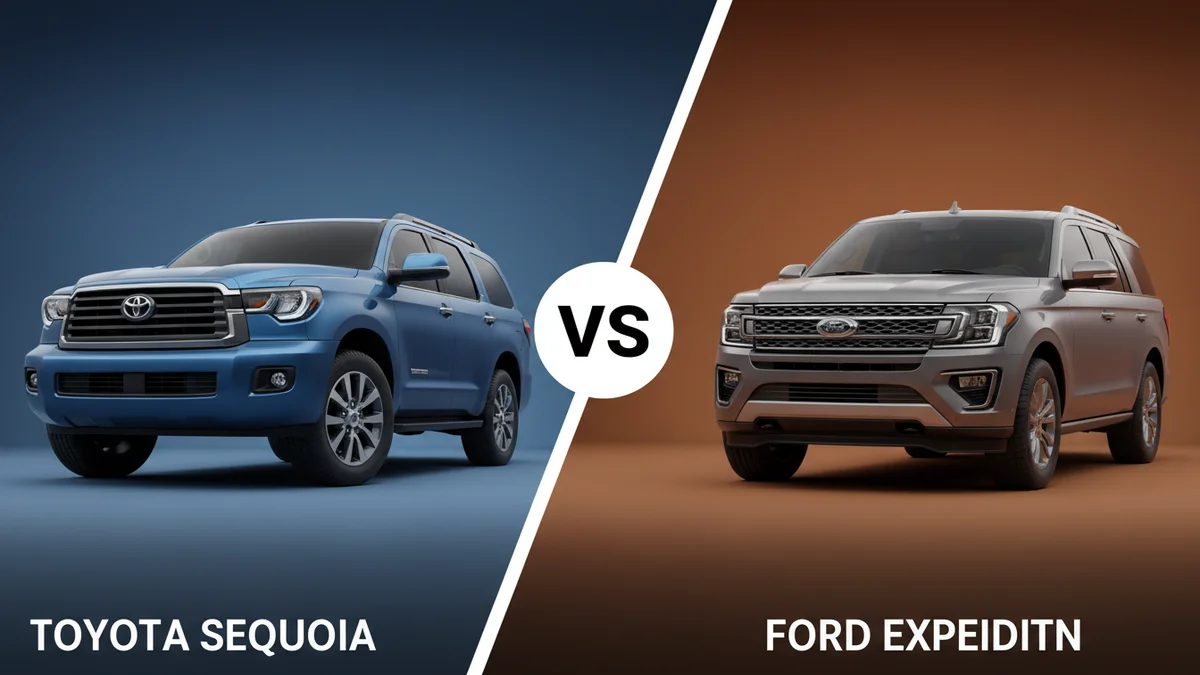
Buyers prioritizing fuel efficiency, long-term reliability, and a hybrid powertrain.
Families needing expansive cargo space, comfortable third-row seating, and strong towing.
- The Toyota Sequoia's standard hybrid powertrain delivers 22 combined MPG, notably better than the Expedition's 20 MPG.
- Ford Expedition offers significantly more max cargo volume at 104.6 cu ft compared to the Sequoia's 86.9 cu ft.
- Sequoia offers 437 hp and 583 lb-ft of torque, outperforming the Expedition's 400 hp and 480 lb-ft.
- The Expedition provides a more comfortable third-row experience due to its independent rear suspension.
- Toyota Sequoia consistently leads in reliability and projected resale value, often retaining over 60% of its value after 5 years.
Toyota Sequoia vs Ford Expedition: Head-to-Head Specs
Recommended Best Deal Products


Diving into the core makeup of these large SUVs reveals some fundamental differences that dictate their on-road characteristics and overall utility. While both are built for family adventures, the Ford Expedition generally offers superior passenger and cargo space, reflecting its design philosophy centered on maximizing interior volume. Conversely, the Toyota Sequoia stands out with its standard hybrid powertrain, a deliberate choice by Toyota to prioritize efficiency and a specific type of performance.

✓ = better value in that row. Sourced from manufacturer specifications.
Performance & Category Ratings
When we stack these two giants against each other across critical categories, distinct patterns emerge, illustrating where each vehicle truly excels. The Toyota Sequoia takes a clear lead in Performance, scoring an impressive 8.9 against the Ford Expedition’s 8.5. This margin, though not vast, reflects the Sequoia’s standard i-FORCE MAX hybrid powertrain delivering robust, immediate torque, making it feel notably responsive on the road.

Reliability is where the Sequoia truly distances itself, achieving a standout 9.3 rating compared to the Expedition’s 7.8. This significant gap is a testament to Toyota’s long-standing reputation for building durable, dependable vehicles, a critical factor for long-term ownership. Fuel Economy also swings heavily in the Sequoia’s favor, offering an 8.8 against the Expedition’s 7.0. The hybrid system is the obvious hero here, offering much better efficiency, especially in mixed driving conditions.
However, the Ford Expedition isn’t without its own set of victories. It clinches the Value category with an 8.7 rating compared to the Sequoia’s 8.2, often presenting a more attractive overall package for the money, particularly at certain trim levels. Its most pronounced triumph comes in Comfort & Interior Space, scoring a dominant 9.0 against the Sequoia’s 7.5. The Expedition’s cavernous cabin, especially in its extended-length Max variant, simply offers more room for passengers and cargo alike, a critical consideration for large families. Features & Technology also lean slightly towards the Expedition, rated 8.6 versus the Sequoia’s 8.4, indicating a marginally more comprehensive or user-friendly suite of modern amenities. Finally, Build Quality finds the Sequoia slightly ahead at 8.7 versus the Expedition’s 8.3, suggesting a perception of more refined material choices and assembly.
Sequoia
Expedition
By the Numbers
Recommended Best Deal Products


Understanding the narrative behind these vehicles is one thing, but seeing the raw figures often brings clarity. The following chart compiles the essential data points for the Toyota Sequoia and the Ford Expedition, offering a concise overview of their comparative strengths and weaknesses. These statistics are the foundation of our analysis, providing an unbiased look at where each SUV stands in key areas, helping you ground your decision in concrete facts rather than mere perceptions.
Sequoia
Expedition
Hover any bar for exact values. Each metric scaled independently.

Audible — Listen Free for 30 Days
One free credit a month and thousands of titles included.
Listen Free for 30 Days As an Amazon Associate I earn from qualifying purchases.Toyota Sequoia: Strengths and Weaknesses
The Toyota Sequoia rides on a foundation of unshakeable reliability, a score of 9.3 being almost unheard of in this segment. You can expect years of trouble-free ownership, a significant peace of mind for any family hauler. Its standard i-FORCE MAX hybrid powertrain also contributes to stellar Fuel Economy, rated at 8.8, which is genuinely impressive for a vehicle of this size. That hybrid also delivers a commanding Performance score of 8.9, providing a smooth yet powerful surge when you need it, whether merging onto a highway or tackling a mountain pass. We also note a commendable Build Quality at 8.7, reflecting Toyota’s meticulous attention to detail in material feel and assembly.
However, the Sequoia isn’t without its compromises. Its Comfort & Interior Space rating of 7.5 highlights a relative disadvantage compared to its rivals. While spacious, it simply doesn’t offer the cavernous third-row room or the expansive cargo capacity that some competitors, notably the Expedition, do. This can be a deal-breaker for those frequently ferrying larger groups or substantial gear. The Value proposition, at 8.2, is also slightly less compelling than the Expedition’s, meaning you might pay a bit more for features that come standard elsewhere, or find the overall package doesn’t stretch your dollar as far initially. These aren’t fatal flaws, but they are crucial considerations depending on your specific needs.
Ford Expedition: Strengths and Weaknesses
The Ford Expedition’s primary strength lies in its unmatched Comfort & Interior Space, scoring an outstanding 9.0. If you prioritize maximum room for passengers across all three rows and expansive cargo capacity, the Expedition is simply in a league of its own. It’s truly designed to swallow families and their gear whole. We also see a strong showing in Value with an 8.7 rating, often delivering more bang for your buck in terms of features, size, and initial cost compared to its competitors. Its Features & Technology package is also highly rated at 8.6, offering an intuitive infotainment system and a comprehensive suite of driver-assistance aids that enhance the driving experience.
On the flip side, the Expedition does present some notable weaknesses. Its Reliability score of 7.8, while not terrible, significantly lags behind the Sequoia’s class-leading number. This suggests a potentially higher likelihood of needing repairs over its lifespan. The Expedition’s Fuel Economy, at 7.0, is also a significant drawback; its non-hybrid powertrain is noticeably thirstier, translating to higher running costs at the pump. While its Performance is solid at 8.5, it just trails the Sequoia’s hybrid punch. And while robust, its Build Quality score of 8.3 indicates a slight compromise in perceived fit and finish or material quality compared to its Japanese rival. These are the trade-offs you must weigh against its undeniable spaciousness.
- ✅ Standard i-FORCE MAX hybrid powertrain with 437 hp.
- ✅ Superior fuel economy (22 combined MPG).
- ✅ Excellent long-term reliability and resale value reputation.
- ✅ Strong towing capacity at 9,520 lbs.
- ✅ Rugged, truck-based platform for off-road potential.
- ❌ Significantly less cargo space than rivals (86.9 cu ft max).
- ❌ Cramped third-row seating due to solid rear axle.
- ❌ Higher starting price than Expedition.
- ❌ Interior can feel less refined than some competitors.
- ✅ Exceptional passenger and cargo room (104.6 cu ft max).
- ✅ Comfortable and spacious third-row seating.
- ✅ Powerful 400 hp EcoBoost V6 engine.
- ✅ More competitive starting MSRP.
- ✅ Modern interior with advanced technology and larger standard infotainment.
- ❌ Lower fuel economy (20 combined MPG) than Sequoia.
- ❌ Resale value typically not as strong as Toyota.
- ❌ Less torque output than the Sequoia's hybrid system.
- ❌ Overall reliability ratings generally lag behind Toyota.
Which One Should You Choose?
Deciding between the Toyota Sequoia and the Ford Expedition ultimately boils down to your priorities and how you intend to use your large SUV. If you’re a daily commuter or frequently make shorter trips where fuel efficiency matters, the Toyota Sequoia, with its 8.8 Fuel Economy rating, is the smarter choice. Its standard hybrid powertrain delivers a surprising 8.9 Performance score too, offering immediate power and a more refined driving experience for everyday situations. For those who prioritize long-term ownership peace of mind, the Sequoia’s segment-leading 9.3 Reliability rating is an almost irresistible draw, signifying fewer unexpected visits to the service center over the years.
However, if your primary concern is hauling a large family or significant amounts of gear on a regular basis, the Ford Expedition becomes the clear winner. Its towering 9.0 in Comfort & Interior Space isn’t just a number; it translates to genuinely expansive second and third-row legroom, and a cargo area that simply swallows luggage, sports equipment, or groceries with ease. This makes it ideal for large families, road trips, or anyone who regularly needs that maximum utility. The Expedition also holds an edge in Value (8.7) and Features & Technology (8.6), potentially offering more standard equipment or a lower entry price for a feature-rich experience. If you’re willing to trade a bit on fuel economy (7.0) and a slightly lower reliability score (7.8) for sheer interior volume and feature-packed convenience, the Expedition is your champion. Your choice hinges on whether maximum usable space or long-term efficiency and bulletproof reliability are the non-negotiables.
Buyers prioritizing fuel efficiency, long-term reliability, and a hybrid powertrain.
Families needing expansive cargo space, comfortable third-row seating, and strong towing.
Final Verdict
After a thorough head-to-head comparison, the Ford Expedition ultimately edges out the Toyota Sequoia. Its undeniable strength lies in its superior passenger and cargo space, providing an unmatched level of comfort and utility for larger families and those who frequently need maximum interior volume. For many buyers in this segment, that expansive cabin is a primary driver. However, the decision is far from absolute. The Toyota Sequoia stands as a formidable contender, particularly for its standard hybrid powertrain, which delivers significantly better fuel economy and a highly commendable performance score. Coupled with Toyota’s legendary reliability, the Sequoia presents a compelling case for efficiency and long-term dependability.
Therefore, the choice between these two segment leaders truly hinges on one critical trade-off: do you prioritize maximum interior volume for passengers and gear, or is superior long-term efficiency and a stronger reliability reputation more important for your driving needs?
Audible Premium Plus — Annual Membership
12 audiobook credits up front, plus the full Audible catalogue.
See Annual Plans As an Amazon Associate I earn from qualifying purchases.Frequently Asked Questions
Is Toyota Sequoia better than Ford Expedition?
Not universally. The Toyota Sequoia offers a standard 437 hp hybrid powertrain and superior 22 combined MPG, making it more efficient and powerful. However, the Ford Expedition wins on space, offering 104.6 cubic feet of max cargo and a far more comfortable third row. Your preference for efficiency and reliability versus sheer space and comfort dictates which is 'better'.
Which full-size SUV has better reliability for 2026?
Based on historical trends and current model evaluations, the Toyota Sequoia is expected to have superior long-term reliability. Toyota consistently ranks at the top for vehicle dependability, whereas Ford, while improving, typically places in the middle of reliability surveys. The Sequoia's simpler hybrid system in terms of long-term parts integration also gives it an edge.
Which has better resale value: Toyota Sequoia or Ford Expedition?
The Toyota Sequoia is projected to retain a significantly higher resale value. Toyota vehicles, particularly SUVs, are renowned for their depreciation resistance. The Sequoia's standard hybrid powertrain and robust build quality contribute to its sustained value, generally outperforming the Ford Expedition in the used car market.
What is the biggest difference between the Toyota Sequoia and Ford Expedition?
The biggest difference lies in their interior packaging and powertrain. The Expedition provides vastly more usable interior space, especially in the third row and cargo area (104.6 cu ft vs 86.9 cu ft for Sequoia). The Sequoia, however, features a standard 437 hp hybrid engine, offering better fuel economy (22 MPG) and immediate torque, while the Expedition uses a traditional twin-turbo V6.
Which is more powerful, the 2026 Toyota Sequoia or Ford Expedition?
The 2026 Toyota Sequoia is more powerful, thanks to its standard i-FORCE MAX hybrid powertrain. It produces an impressive 437 horsepower and 583 lb-ft of torque. The Ford Expedition, with its 3.5L EcoBoost V6, offers a strong 400 horsepower and 480 lb-ft of torque, but it cannot match the Sequoia's combined hybrid output.