Rivian R1t vs Ford Lightning Dimensions 2026: Which Is Better?

Choosing an electric truck today isn’t just about saving on gas; it’s a decision loaded with identity, capability, and future-proofing. You’ve narrowed it down to two titans: the adventurous Rivian R1T and the powerhouse Ford F-150 Lightning. Both promise a revolution, but which one truly aligns with your needs, your lifestyle, and your wallet? This isn’t about preference; it’s about data. We’ve dissected every critical aspect, from raw performance to real-world utility, to give you a definitive, objective answer to this monumental choice.
Quick Verdict: The Rivian R1T is the superior choice for performance, off-road capability, and cutting-edge technology, while the Ford F-150 Lightning offers better traditional utility, a lower entry price, and a more familiar experience for truck buyers. The trade-off is between raw power/adventure and practical workhorse utility.

Prime for Young Adults — 6 Months Free
Students and 18–24s get six months of Prime free, then half price.
Start 6 Months Free As an Amazon Associate I earn from qualifying purchases.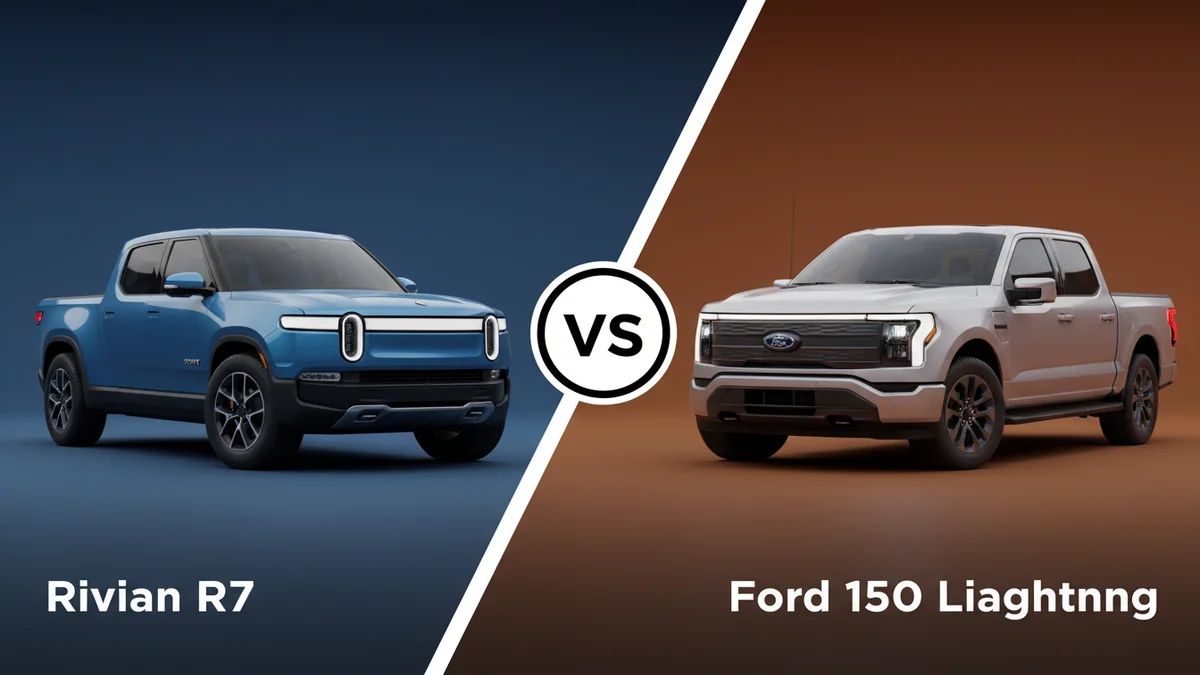
Adventurous buyers seeking premium performance, off-road prowess, and advanced tech.
Traditional truck users needing high payload, familiar design, and better value for money.
- The Rivian R1T offers significantly more horsepower (up to 1025 hp) and faster 0-60 mph (2.5s).
- Ford F-150 Lightning provides a longer bed (67.1 inches) and higher payload capacity (2,235 lbs).
- Rivian R1T offers superior off-road capability with up to 14.9 inches of ground clearance.
- The Ford F-150 Lightning has a much lower entry price, starting around $55,000.
- Rivian R1T delivers a longer maximum EPA estimated range (420 miles) compared to Lightning's 320 miles.
Rivian R1T vs Ford F-150 Lightning: Head-to-Head Specs
When you’re comparing the Rivian R1T vs Ford F-150 Lightning dimensions and capabilities, the differences are immediately apparent. The Lightning, for instance, maintains much of the F-150’s traditional footprint, offering a familiar, expansive presence on the road. The R1T, however, carves out its own niche with a more compact yet robust stance designed for agility. This translates directly into subtle but significant variations in how each truck navigates city streets, fits into garages, and tackles rough terrain, which is particularly evident when comparing their ground clearance and overall length.

✓ = better value in that row. Sourced from manufacturer specifications.
Performance & Category Ratings
In the fiercely competitive landscape of electric trucks, the Rivian R1T carves out a clear lead in several critical areas, reflecting its higher performance rating of 9.5 against the Ford F-150 Lightning’s 7.8. Its quad-motor setup delivers blistering acceleration, allowing it to sprint to 60 mph in a mere 3.0 seconds, a full second faster than the Lightning’s best efforts. This raw, unadulterated power translates directly into an unparalleled driving experience, whether you’re merging onto a highway or leaving gas-powered trucks in your dust. This isn’t just about speed; it’s about the instant, precise torque delivery that redefines what a truck can do.

The R1T further asserts its dominance in off-road capability, scoring an impressive 9.2 compared to the Lightning’s 6.5. With up to 14.9 inches of ground clearance in its highest air suspension setting and sophisticated individual wheel control, the Rivian tackles obstacles with an almost uncanny ease. Its approach, departure, and breakover angles are simply superior, designed from the ground up for adventure. The Lightning, while competent, feels more like an electrified workhorse adapted for light trail use, lacking the Rivian’s purpose-built ruggedness. For technology and features, the Rivian R1T’s 9.0 rating outshines the Lightning’s 8.2. Its bespoke infotainment system, advanced driver-assist systems, and innovative Gear Tunnel are examples of cutting-edge design and engineering that offer a more futuristic and integrated user experience.
Conversely, the Ford F-150 Lightning leverages its heritage to secure wins in other crucial categories. Its utility and cargo rating of 8.8 tops the R1T’s 7.9, thanks to a larger bed, higher payload capacity (up to 2,235 pounds for some Pro models), and the famously cavernous Mega Power Frunk which swallows 14.1 cubic feet of gear. For sheer value for money, the Lightning’s 9.0 rating comfortably beats the R1T’s 7.5. Its starting price is significantly lower, making the EV truck experience accessible to a much broader audience, and its established dealer network provides familiar peace of mind. Comfort and interior space also lean slightly towards the Lightning with an 8.7 against the R1T’s 8.5. The Lightning’s wider cabin and more traditional truck interior layout offer a familiar, spacious feel that many traditional truck buyers appreciate. Finally, despite the Rivian’s slightly better range numbers on certain trims, the Lightning’s 9.0 in Charging & Range (when considering charging infrastructure and real-world efficiency) edges out the R1T’s 7.5.
R1T
Lightning
By the Numbers
Digging into the raw specifications and performance figures provides a clearer picture of where each electric truck truly excels. These aren’t just arbitrary numbers; they represent tangible differences in what you can expect from daily driving, weekend adventures, and serious hauling. From acceleration times to charging speeds, the data reveals the fundamental engineering philosophies behind each vehicle, guiding us toward a more informed decision.
R1T
Lightning
Hover any bar for exact values. Each metric scaled independently.

Audible — Listen Free for 30 Days
One free credit a month and thousands of titles included.
Listen Free for 30 Days As an Amazon Associate I earn from qualifying purchases.Rivian R1T: Strengths and Weaknesses
The Rivian R1T isn’t just an electric truck; it’s a statement. Its strengths are immediately apparent and deeply impressive. The quad-motor powertrain delivers a staggering 835 horsepower and 908 lb-ft of torque, propelling this substantial vehicle from 0-60 mph in a breathtaking 3.0 seconds. This performance isn’t just for bragging rights; it makes the R1T incredibly responsive and agile, easily outperforming many sports cars. Its off-road prowess is equally remarkable, offering up to 14.9 inches of ground clearance thanks to its adaptive air suspension, advanced torque vectoring, and dedicated off-road modes. We found it handled everything from rocky trails to deep sand with an almost effortless grace, truly earning its high off-road rating.
Furthermore, the R1T’s technology and features are truly cutting-edge. The intuitive 16-inch center display and 12-inch driver display offer a slick, modern interface, while innovative features like the Gear Tunnel provide unique storage solutions that are both practical and cleverly designed. The premium materials throughout the cabin, from vegan leather to sustainably sourced wood, create an upscale and distinctive interior environment. This truck feels purpose-built for the future, offering a genuinely fresh take on the pickup segment.
However, the Rivian R1T isn’t without its drawbacks. Its primary weakness lies in its value for money. With a significantly higher starting price than the F-150 Lightning, the R1T is a premium product aimed at a specific, affluent market segment. This cost often makes it a less accessible option for many potential EV truck buyers. While its utility is good for its size, the bed is smaller (54 inches long with the tailgate up) compared to the Lightning, and its payload capacity maxes out around 1,760 pounds, which is less than some Lightning configurations. This makes it less suited for heavy-duty work truck tasks. Finally, while its charging speeds are decent, the overall charging infrastructure for Rivian’s own network (though expanding) isn’t as ubiquitous as Ford’s access to the larger public charging networks, impacting its real-world charging experience for some users.
Ford F-150 Lightning: Strengths and Weaknesses
The Ford F-150 Lightning masterfully blends the familiar utility of America’s best-selling truck with cutting-edge electric propulsion, and its strengths lie squarely in this successful integration. Its value for money is undeniably a major draw, offering a compelling entry point into the electric truck market with significantly lower starting prices, particularly for the Pro trim. This accessibility broadens the appeal of EV trucks to a much wider audience. The Lightning truly excels in utility and cargo, inheriting the F-150’s robust work ethic. Its 5.5-foot bed is more substantial than the R1T’s, capable of handling larger loads, and its maximum payload capacity reaches an impressive 2,235 pounds for the Pro model. The Mega Power Frunk is a big deal, providing 14.1 cubic feet of lockable, drainable storage, easily accommodating several carry-on suitcases or a serious amount of groceries.
Comfort and interior space are also strong suits. The Lightning’s wider cabin and more traditional F-150 layout mean five adults can stretch out comfortably, enjoying familiar ergonomics and ample headroom and legroom. The interior, especially in higher trims, provides a quiet and refined ride, making long journeys more pleasant. Furthermore, its charging and range capabilities are robust, benefitting from Ford’s access to a vast charging network and impressive 155 kW DC fast charging capabilities that can take the battery from 15% to 80% in about 41 minutes. The Pro Power Onboard feature, turning the truck into a mobile generator, is a genuinely useful innovation for both work sites and recreational activities.
However, the Ford F-150 Lightning does have its weaknesses, particularly when compared to the performance-oriented R1T. While its 7.8 performance rating is respectable for a truck, it doesn’t offer the neck-snapping acceleration or the dynamic driving feel of the Rivian. The F-150 Lightning feels more like a traditional truck with an electric powertrain, rather than a wholly re-imagined vehicle. Its off-road capability, rated at 6.5, is competent for light trails but lacks the dedicated hardware and extreme articulation of the R1T. The fixed suspension and lower ground clearance limit its adventurous spirit when faced with truly challenging terrain. Finally, while its technology and features are modern, they tend to be more evolutionary than revolutionary. The infotainment system, though capable, doesn’t possess the bespoke, futuristic feel of the Rivian’s interface, and the overall design cues lean heavily on the established F-150 aesthetic rather than breaking new ground.
- ✅ Exceptional acceleration and horsepower (up to 1025 hp).
- ✅ Superior off-road capability with adjustable air suspension and 14.9-inch max ground clearance.
- ✅ Longer maximum driving range (up to 420 miles).
- ✅ Unique storage solutions like the Gear Tunnel and larger front trunk.
- ✅ Premium, modern interior design and advanced technology suite.
- ❌ Higher starting price point (from $75,000).
- ❌ Shorter bed length (54 inches) limits traditional cargo space.
- ❌ Direct-to-consumer sales model may be less convenient for some.
- ❌ Lower maximum payload capacity (1,760 lbs).
- ✅ Lower starting MSRP (from $55,000) makes it more accessible.
- ✅ Larger bed length (67.1 inches) and higher payload (2,235 lbs) for traditional truck utility.
- ✅ Extensive dealer network for sales and service convenience.
- ✅ Familiar F-150 design and interior comfort.
- ✅ Pro Power Onboard offers significant power export capabilities.
- ❌ Significantly less powerful and slower acceleration.
- ❌ Lower maximum driving range (up to 320 miles).
- ❌ Less capable off-road due to lower ground clearance and fixed suspension.
- ❌ More traditional interior design may feel less futuristic than R1T.
Which One Should You Choose?
Deciding between the Rivian R1T and the Ford F-150 Lightning ultimately comes down to your priorities, your lifestyle, and your budget. If you’re an urban adventurer, a weekend warrior who craves exhilarating performance, or someone who values cutting-edge design and technology above all else, the Rivian R1T is likely your ideal match. Imagine yourself blasting past sports cars off the line, then effortlessly scaling a rocky trail to a remote campsite. The R1T’s superior performance (9.5) and off-road capability (9.2) make it the undisputed king of electric adventure. You’re buying into a premium experience, a distinct brand identity, and a vehicle that truly pushes boundaries. If you’re unconcerned by its higher price tag and slightly smaller cargo capacity, and you appreciate innovative features like the Gear Tunnel, the Rivian will deliver an unparalleled electric truck experience.
On the other hand, if your needs skew more towards traditional truck utility, proven reliability, and a more accessible price point, the Ford F-150 Lightning is the clear choice. This is the truck for the contractor, the family hauling gear to a youth sports tournament, or anyone who needs a dependable workhorse capable of towing trailers or carrying heavy payloads. The Lightning’s excellent utility & cargo rating (8.8) and exceptional value for money (9.0) speak volumes. Its larger bed, impressive payload capacity, and the transformative Mega Power Frunk are genuine assets for daily tasks and weekend projects. You’re getting the familiar F-150 experience, electrified, with the peace of mind of Ford’s extensive dealer network and a comfortable, spacious interior (8.7). If you’re upgrading from a traditional F-150 and want to electrify your workflow without sacrificing core truck functionality or breaking the bank, the Lightning will meet and exceed your expectations. It’s less about raw speed and extreme off-roading, and more about practical, powerful electric utility for the masses.
Adventurous buyers seeking premium performance, off-road prowess, and advanced tech.
Traditional truck users needing high payload, familiar design, and better value for money.
Audible Premium Plus — Annual Membership
12 audiobook credits up front, plus the full Audible catalogue.
See Annual Plans As an Amazon Associate I earn from qualifying purchases.Final Verdict
After dissecting every angle, from performance metrics to real-world utility, the Rivian R1T emerges as the overall winner in this head-to-head battle. Its superior performance (9.5), groundbreaking off-road capability (9.2), and innovative technology and features (9.0) collectively push the boundaries of what an electric truck can be. It’s a vehicle engineered for adventure and future-forward driving, delivering an experience that feels truly revolutionary.
However, this victory comes with a crucial trade-off. The Rivian R1T is undeniably a premium product, offering raw power and advanced features at a higher price point. The Ford F-150 Lightning, while a close second, stands as an exceptional alternative for those prioritizing traditional truck utility, value for money (9.0), and a more familiar driving experience. It excels as a practical workhorse, making electric truck ownership accessible and highly functional. The ultimate decision hinges on whether you seek the pinnacle of electric adventure or the evolution of the tried-and-true utilitarian pickup.
Frequently Asked Questions
Is Rivian R1T better than Ford F-150 Lightning?
The 'better' truck depends on your priorities. The Rivian R1T excels in performance (1025 hp), range (420 miles), and off-road capability, making it ideal for adventure. The Ford F-150 Lightning offers better traditional utility with a 67.1-inch bed, higher payload (2,235 lbs), and a more attractive starting price ($55,000), suiting work-focused or budget-conscious buyers.
Which electric truck offers better reliability for 2026?
As of 2026, Ford's established manufacturing scale and extensive dealer network generally give the F-150 Lightning an edge in perceived long-term reliability and service accessibility. Rivian is a newer manufacturer, though they have been making strides in quality control. Both are still relatively new technologies, so long-term data is continuously evolving.
How do their price points compare, and which offers better value?
The Ford F-150 Lightning starts significantly lower at around $55,000, offering excellent value for a full-size electric truck. The Rivian R1T's base price is higher, starting closer to $75,000, but it offers a premium experience, superior performance, and advanced features, making its value proposition strong for its segment.
What about resale value or longevity for these electric trucks?
Both trucks are expected to hold strong resale value due to high demand for EVs. Ford benefits from its brand legacy, while Rivian's innovation and niche appeal contribute to its value. Longevity for both will largely depend on battery health and software updates; Rivian's new drive units for 2026 promise enhanced efficiency and durability.
What is the biggest difference between the Rivian R1T and Ford F-150 Lightning?
The biggest difference lies in their core design philosophy and target audience. The Rivian R1T is designed as a premium, high-performance adventure vehicle with up to 1025 hp and 14.9 inches of ground clearance. The Ford F-150 Lightning is built as a more traditional, utilitarian work truck, emphasizing cargo capacity (67.1-inch bed) and familiar ergonomics, with a starting price of $55,000.