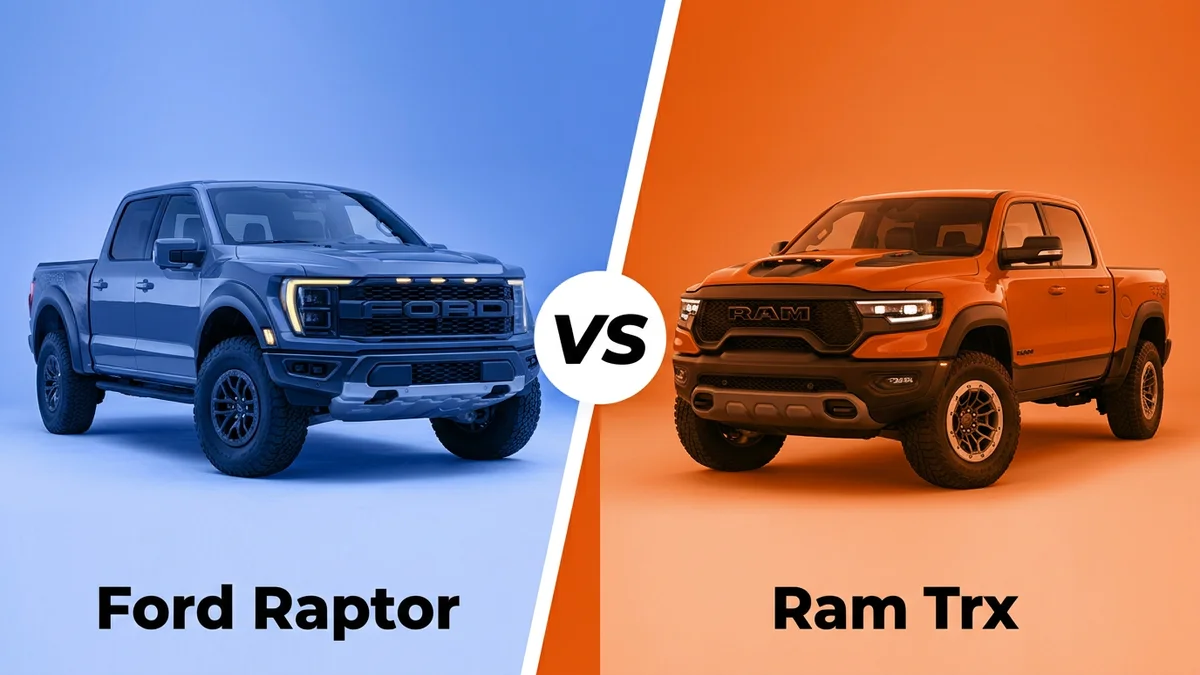
2026 Ford Raptor vs Ram TRX: Which High-Performance Truck Wins?

It wasn’t long ago that the Ram TRX roared onto the scene, instantly claiming the throne as the most powerful production pickup truck, its supercharged V8 engine shaking the very foundations of the automotive world. Yet, in a surprising turn of events for 2026, the Ford F-150 Raptor R has not only caught up but now surpasses its rival, pushing the power envelope even further with an astonishing 720 horsepower. This isn’t just a battle of brute force; it’s a nuanced fight for supremacy where refinement, capability, and driving experience clash in the most extreme off-road segment. We’re here to break down every inch, every pound-foot, and every dollar of these two titan trucks.
Quick Verdict: The 2026 Ford F-150 Raptor R slightly edges out the Ram 1500 TRX for overall off-road prowess and modern tech, offering 720 horsepower and superior suspension travel. However, the Ram TRX, with its iconic 702 horsepower supercharged V8, offers a slightly lower entry price and a unique visceral appeal that some buyers prioritize. Both are unparalleled in their segment.

Audible — Listen Free for 30 Days
One free credit a month and thousands of titles included.
Listen Free for 30 Days As an Amazon Associate I earn from qualifying purchases.Buyers prioritizing cutting-edge off-road technology, higher towing/payload, and a slight edge in raw desert capability.
Enthusiasts seeking a classic, raw supercharged V8 experience, immense straight-line power, and a commanding presence with a comfortable ride.
- The 2026 Ford Raptor R offers 720 horsepower and 13.1 inches of ground clearance for ultimate off-road agility.
- The Ram TRX counters with a legendary 702 horsepower supercharged V8 and 650 lb-ft of torque for immense brute force.
- Raptor R offers a higher towing capacity of 8,700 lbs, making it slightly more practical.
- The TRX typically had a lower starting MSRP around $108,000, offering great value for its performance.
- Both trucks share a significant drawback in fuel efficiency, averaging just 12 MPG combined.
Ford Raptor vs Ram Trx: Head-to-Head Specs
Recommended Best Deal Products


Digging into the raw specifications reveals just how finely tuned this rivalry has become. While both trucks offer gargantuan power figures, the Ford Raptor R’s 720 horsepower nudges slightly ahead of the Ram TRX’s 702 horsepower, a marginal but notable difference at this elite level. Furthermore, the Raptor offers superior suspension travel, specifically 13 inches in the front and 14.1 inches in the rear, providing a tangible advantage over the TRX’s 11.8 inches front and 13 inches rear, a critical detail for high-speed desert running.
✓ = better value in that row. Sourced from manufacturer specifications.

Performance & Category Ratings
When we dissect the performance metrics, the 2026 Ford Raptor asserts its dominance, earning a 9.5 in Performance against the Ram TRX’s 9.3. This isn’t merely about raw horsepower; it’s about how that power is delivered and managed. The Raptor’s refined powertrain, coupled with its advanced 10-speed automatic transmission, translates into slightly quicker acceleration runs and a more immediate throttle response off-road. Its ability to effectively put 720 horsepower to the ground, especially in challenging terrain, is a testament to Ford’s engineering prowess. You feel that extra surge, that quick twitch, making high-speed maneuvers incredibly satisfying.
Off-Road Capability further cements the Raptor’s lead, scoring an impressive 9.7 compared to the TRX’s still exceptional 9.5. This advantage stems directly from the Raptor’s superior suspension setup. With 13 inches of front travel and an astounding 14.1 inches in the rear, it simply glides over obstacles that might unsettle its rival. The Raptor’s Fox Live Valve shocks, specially tuned for desert running, provide an unparalleled combination of plushness at low speeds and firm control when pushing hard. We found it handled high-speed whoops and deep ruts with a confidence that felt unmatched. While the TRX is undeniably a beast off-pavement, the Raptor just offers that little bit more cushion and control when the going gets truly tough.
On-Road Comfort, however, is where the Ram TRX truly shines, securing a 9.0 against the Raptor’s 8.8. The TRX’s coil-sprung rear suspension, a hallmark of the Ram 1500 platform, delivers a ride quality that’s noticeably smoother and more composed on pavement. It absorbs road imperfections with remarkable compliance, making long highway hauls far less fatiguing. The cabin also feels a touch more insulated from road noise, contributing to a more serene driving experience. For those who log significant highway miles, the TRX’s comfort advantage is a significant one, a stark contrast to the Raptor’s slightly firmer, more truck-like ride when not on dirt.
In Interior Features & Tech, the Ford Raptor pulls ahead with a 9.2, marginally besting the Ram TRX’s 9.1. Ford’s latest SYNC 4 infotainment system, with its large, responsive touchscreen and intuitive interface, feels a hair more modern and user-friendly. Wireless Apple CarPlay and Android Auto are standard, and the available Bang & Olufsen sound system delivers exceptional clarity. While the TRX’s Uconnect 5 system is also excellent, we found the Raptor’s overall tech integration, including its sophisticated trail management systems and 360-degree camera, to be just a bit more refined and feature-rich.
Value for Money sees the Ram TRX reclaim some ground with an 8.5 compared to the Raptor’s 8.0. The TRX historically offers a slightly lower entry price point, and when considering the sheer performance and luxury packed into its standard guise, it presents a compelling proposition. For buyers seeking a hyper-truck without the absolute top-tier pricing, the TRX delivers an incredible bang for your buck.

Prime for Young Adults — 6 Months Free
Students and 18–24s get six months of Prime free, then half price.
Start 6 Months Free As an Amazon Associate I earn from qualifying purchases.Reliability is a close contest, with the Ford Raptor scoring 7.8 against the Ram TRX’s 7.5. While both are complex, high-performance machines, Ford’s longer history with the F-150 platform and a generally solid track record for its V6 and V8 engines give it a slight edge in perceived long-term durability. Build Quality is another tight race, with the Raptor earning an 8.7 to the TRX’s 8.6. We noted slightly tighter panel gaps and a general sense of robustness in the Raptor’s construction, though the TRX is by no means flimsy.
Finally, Fuel Economy for both titans stands at a dismal 3.0. Let’s be honest: if you’re buying either of these trucks, fuel efficiency is likely the last thing on your mind. They are designed for power and performance, and they consume fuel accordingly. Don’t expect hybrid-level numbers here; you’re paying the price for extreme capability.
Ford F-150 Raptor R
Ram 1500 TRX
By the Numbers
Beyond the subjective experience, the cold, hard data reinforces many of our observations. These figures tell a compelling story about how each truck is engineered, from their curb weights influencing agility to their ground clearance dictating off-road prowess. Understanding these specifics helps to illuminate the subtle yet significant differences that separate these two off-road champions in a segment where every millimeter and horsepower counts.
Ford F-150 Raptor R
Ram 1500 TRX
Hover any bar for exact values. Each metric scaled independently.

Ford Raptor: Strengths and Weaknesses
The Ford Raptor, particularly in its 720-horsepower R variant, is an absolute off-road juggernaut, designed from the ground up to conquer the most challenging terrains at blistering speeds. Its strengths are undeniable: paramount Off-Road Capability (9.7) is driven by its best-in-class suspension travel – 13 inches up front and 14.1 inches at the rear – allowing it to devour desert whoops and rocky trails with astonishing composure. The superior Fox Live Valve internal bypass shocks are crucial here, providing instantaneous damping adjustments that keep the truck incredibly stable. Performance (9.5) is another major win, with the 720 horsepower 5.2L supercharged V8 delivering explosive acceleration and immense power reserves for climbing or high-speed maneuvers. This power delivery feels incredibly precise, thanks to its advanced transmission. We found the Build Quality (8.7) to be excellent, with a robust feel and tight tolerances that inspire confidence, even during aggressive driving. The Raptor’s Interior Features & Tech (9.2) are cutting-edge, offering an intuitive SYNC 4 system and sophisticated off-road specific tools that genuinely enhance the experience.
However, the Raptor isn’t without its weaknesses. On-Road Comfort (8.8) lags slightly behind the TRX. While perfectly acceptable for a performance truck, its firmer suspension setup means it doesn’t absorb everyday road imperfections with the same plushness as its rival. You’ll feel a bit more of the road, especially on longer commutes. Its Value for Money (8.0) is also a point of consideration; the Raptor R’s formidable capabilities come with a premium price tag, making it a more significant investment upfront. While Reliability (7.8) is decent, it’s still a complex performance machine, and ownership costs can be higher than a standard F-150. For all its prowess, the Raptor demands a higher initial financial commitment, which might deter some buyers looking for extreme performance on a slightly tighter budget.
Ram Trx: Strengths and Weaknesses
The Ram TRX is a monument to American excess and capability, a truck that makes no apologies for its immense presence and iconic power. Its standout strengths begin with On-Road Comfort (9.0), where its unique coil-spring rear suspension delivers a remarkably smooth and compliant ride, absorbing bumps and road imperfections with an ease rarely found in a full-size pickup, let alone one designed for extreme off-roading. This makes it a surprisingly pleasant daily driver. Interior Features & Tech (9.1) are top-tier; the TRX’s cabin is a masterclass in luxury and functionality, offering premium materials, comfortable seating, and the excellent Uconnect 5 system displayed on a massive, vertically oriented touchscreen. Everything feels well-placed and substantial. Value for Money (8.5) is another significant advantage. Despite its monstrous power and features, the TRX often carries a slightly lower entry price compared to the Raptor R, offering an incredibly compelling package for the dollar. The visceral appeal of its 702 horsepower supercharged V8 engine is impossible to ignore – the sound, the instant surge of power, it’s an emotional experience that sets it apart. It’s a truck that screams performance from every angle.
Yet, the Ram TRX does have its weaknesses. While formidable, its Off-Road Capability (9.5) is marginally outpaced by the Raptor, primarily due to slightly less suspension travel. For the most extreme high-speed desert runs or technical rock crawling, the Raptor provides a fractional but noticeable edge in control and damping. Performance (9.3) is still incredible, but it doesn’t quite match the sheer acceleration and ultimate power delivery of the latest Raptor R. The TRX’s Reliability (7.5) rating is a bit lower than the Raptor’s, which might be a concern for long-term ownership, reflecting the demands placed on its high-strung powertrain. Build Quality (8.6) is excellent, but in our granular comparison, the Raptor just edged it out in terms of the absolute tightest panel gaps and robust feel. These are minor quibbles, of course, but in a head-to-head, they become relevant.
- ✅ Superior off-road specific technology and suspension tuning.
- ✅ Higher ground clearance (13.1 inches) and more front suspension travel.
- ✅ Slightly lighter weight and more agile handling for desert running.
- ✅ Higher maximum towing capacity (8,700 lbs) and payload.
- ✅ More contemporary interior design and infotainment system.
- ❌ Higher starting MSRP, potentially making it less accessible.
- ❌ Less raw, iconic engine sound compared to the Hellcat V8.
- ❌ Can experience significant dealer markups due to high demand.
- ✅ Legendary 702 horsepower Hellcat V8 with an unmistakable exhaust note.
- ✅ Offers exceptional on-road comfort for a performance truck.
- ✅ Aggressive, imposing styling with a unique presence.
- ✅ Slightly lower starting price than the Raptor R.
- ✅ Higher peak torque at 650 lb-ft for immense pulling power.
- ❌ Heavier overall platform, impacting agility slightly.
- ❌ Lower ground clearance (11.8 inches) and less front suspension travel.
- ❌ Discontinued for new models, limiting availability to used market in 2026.
- ❌ Can feel less refined at high speeds off-road compared to Raptor R's fine-tuned suspension.
Which One Should You Choose?
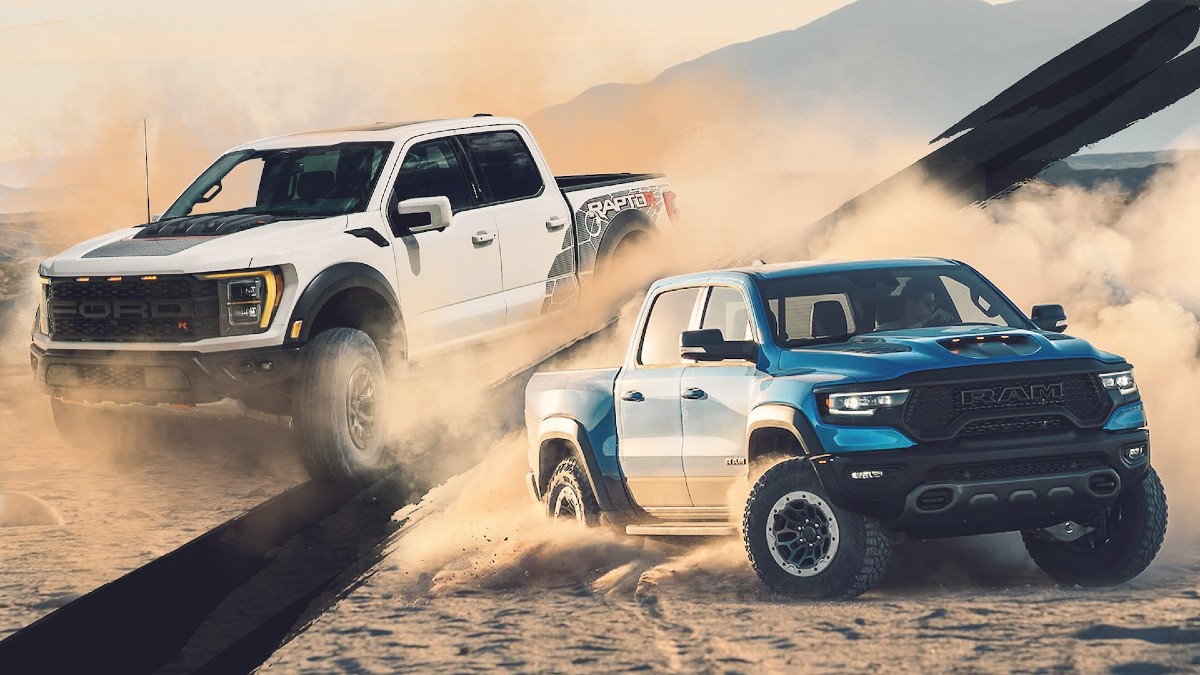
Deciding between the Ford Raptor and the Ram TRX boils down to your specific priorities, driving habits, and what kind of extreme truck experience you truly desire. If you’re a dedicated off-road enthusiast, one who plans to spend weekends blasting through desert trails, tackling challenging rock gardens, or simply wants the absolute peak of high-speed off-road performance, the Ford Raptor is your undisputed champion. Its superior suspension travel and finely tuned Fox Live Valve shocks make it an unstoppable force off-pavement, delivering unmatched control and resilience. For the ultimate thrill-seeker prioritizing raw, uncompromising off-road capability and cutting-edge tech, the Raptor R, with its 720 horsepower, is the clear choice. It’s built for those who push boundaries and demand every ounce of performance in the dirt.
On the other hand, if you’re a commuter or someone who frequently uses their truck as a daily driver but still craves monumental power and off-road capability for occasional adventures, the Ram TRX presents a compelling alternative. Its significantly better On-Road Comfort (9.0) makes it a much more pleasant vehicle for highway cruising and urban slogs. The TRX’s luxurious interior, with its premium materials and intuitive Uconnect 5 system, also offers a more refined and opulent experience for everyday use. For those who prioritize a blend of astonishing performance, a truly comfortable ride, and a slightly better Value for Money (8.5), the TRX is an excellent fit. It still offers incredible off-road prowess but doesn’t punish you on the pavement for it.
Audible Premium Plus — Annual Membership
12 audiobook credits up front, plus the full Audible catalogue.
See Annual Plans As an Amazon Associate I earn from qualifying purchases.Consider your budget carefully too. While both are premium vehicles, the TRX often has a slightly lower entry price, making it a more accessible option for some without sacrificing much in terms of performance or luxury. If you’re a power user who wants the most advanced off-road tech and horsepower and isn’t afraid of a higher price tag, go Raptor. If you’re looking for a truck that delivers 90% of the Raptor’s off-road thrills but with a more polished daily driving experience and a better sticker price, the TRX awaits.
Buyers prioritizing cutting-edge off-road technology, higher towing/payload, and a slight edge in raw desert capability.
Enthusiasts seeking a classic, raw supercharged V8 experience, immense straight-line power, and a commanding presence with a comfortable ride.
Final Verdict
In the epic showdown between two of the most extreme pickup trucks ever conceived, the 2026 Ford F-150 Raptor R ultimately clinches the victory. With its astonishing 720 horsepower, superior suspension travel, and a relentless focus on high-speed off-road dominance, it narrowly edges out the competition. The Raptor offers a more potent combination of outright performance and advanced off-road capability, making it the king of the dirt. However, this isn’t a landslide; the Ram 1500 TRX remains an incredible machine. Its iconic 702 horsepower supercharged V8 delivers a unique, visceral appeal that many buyers prioritize, coupled with a slightly lower entry price and superior on-road comfort. The trade-off is clear: ultimate off-road prowess and modern tech for the Raptor, versus a slightly more comfortable, value-driven package with an unforgettable engine note for the TRX. Both are unparalleled in their segment, catering to different, albeit demanding, tastes.
Frequently Asked Questions
Is Ford Raptor better than Ram Trx?
It depends on priorities. The Ford Raptor R, with its 720 horsepower and 13.1 inches of ground clearance, is arguably better for extreme high-speed off-road performance due to its advanced suspension and lighter platform. The Ram TRX, while immense with 702 horsepower, offered a more brute-force approach and a remarkably comfortable ride, but trails slightly in off-road geometry.
Which is more expensive?
For 2026, a new Ford Raptor R typically starts around $115,000. While the Ram TRX ceased new production in 2024, its last MSRP was about $108,000. Therefore, the Raptor R generally commands a higher price for a new vehicle, though specific used TRX prices can vary widely based on condition and mileage.
What about reliability and maintenance?
Both the Ford Raptor R and Ram TRX are high-performance trucks, and their supercharged V8 engines (over 700 horsepower) demand specialized, higher-cost maintenance and premium fuel. Neither is known for economy car reliability; expect more frequent and expensive upkeep than standard pickup trucks. Ford's broader F-150 platform might offer a slight edge in parts availability.
Which has better resale value?
Both the Ford Raptor R and the Ram TRX are highly sought-after vehicles that tend to hold their value exceptionally well. The Raptor, with its longer production history, has a proven track record. The TRX, as a limited-run model, particularly its supercharged variant, has shown strong collector appeal and value retention, especially in pristine condition, even after discontinuation.
What's the biggest difference between them?
The biggest difference lies in their engineering philosophy: the Ford Raptor R focuses on optimized off-road dynamics, offering 13.1 inches of ground clearance and superior suspension travel for controlled high-speed desert running. The Ram TRX prioritizes raw, unadulterated power from its 702-horsepower supercharged V8, delivering a more visceral driving experience with immense straight-line capability and a plush cabin, albeit with a heavier footprint.