Ford F150 Code Chart By Year (2004–2026): Identification Guide

Quick Answer
Locating your Ford F-150’s paint code is crucial for accurate color matching and repairs, covering all model years from 2004 through 2026. This alphanumeric code specifies the vehicle’s original factory color. Always verify the code on your truck’s driver-side door jamb label, the VIN sticker, or the original build sheet, as paint codes can vary by year, factory, and specific configurations.
For Ford F-150 owners, knowing your truck’s precise paint code is essential for everything from touch-ups to full body repairs. Locating this specific alphanumeric identifier can be challenging, as codes vary by model year and appearance, making accurate color matching a common concern. This comprehensive guide and chart provide an authoritative reference for Ford F-150 paint codes from 2004 through 2026, detailing where to find your code, what it means, and how to ensure exact verification for any configuration.

Prime for Young Adults — 6 Months Free
Students and 18–24s get six months of Prime free, then half price.
Start 6 Months Free As an Amazon Associate I earn from qualifying purchases.This guide provides a comprehensive chart of Ford F-150 paint codes for model years 2004 through 2026. The data accounts for various trims and configurations but primarily focuses on factory-original exterior paint. While every effort has been made to ensure accuracy based on manufacturer charts and historical data, readers should always verify the specific paint code using their vehicle’s VIN, door jamb label, or by consulting an authorized Ford service manual or dealership. Color names and codes can have subtle variations or be reused across non-overlapping model years. This information was last reviewed: May 2026.
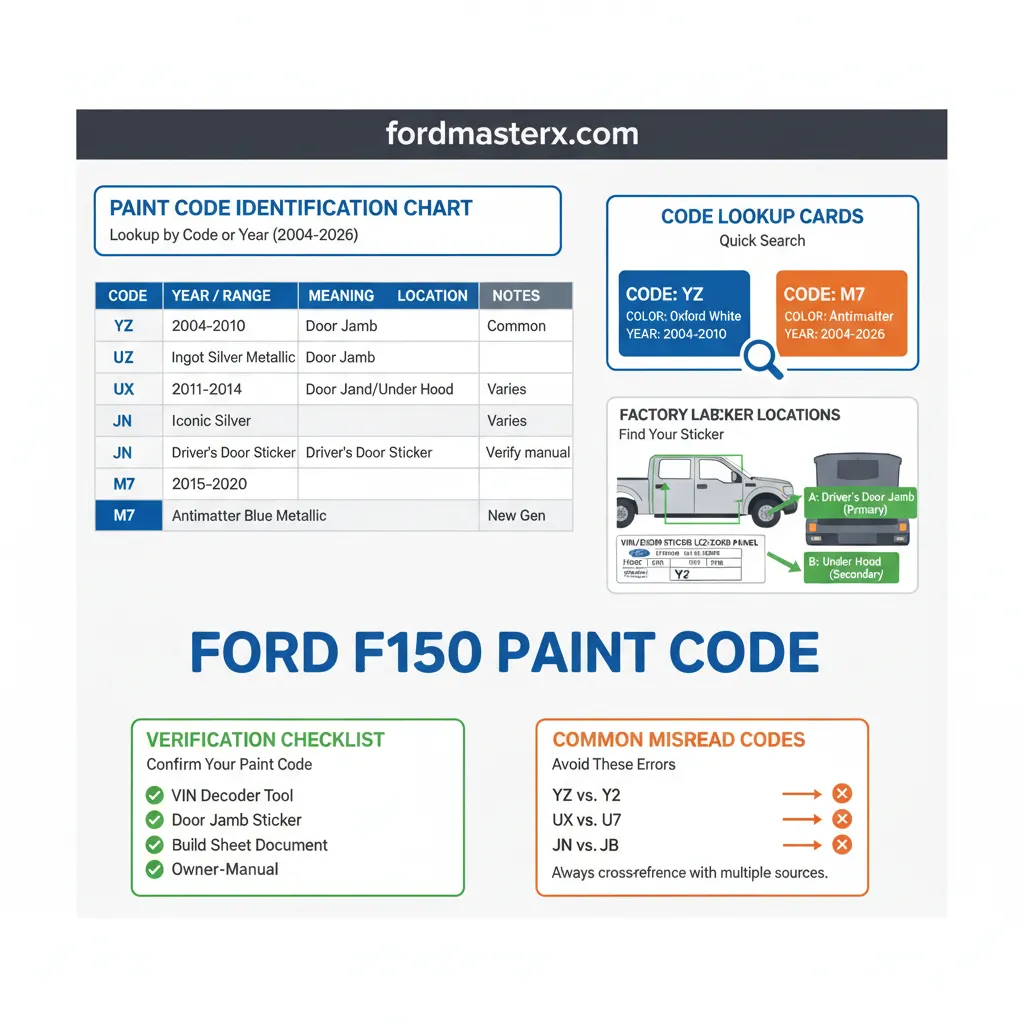
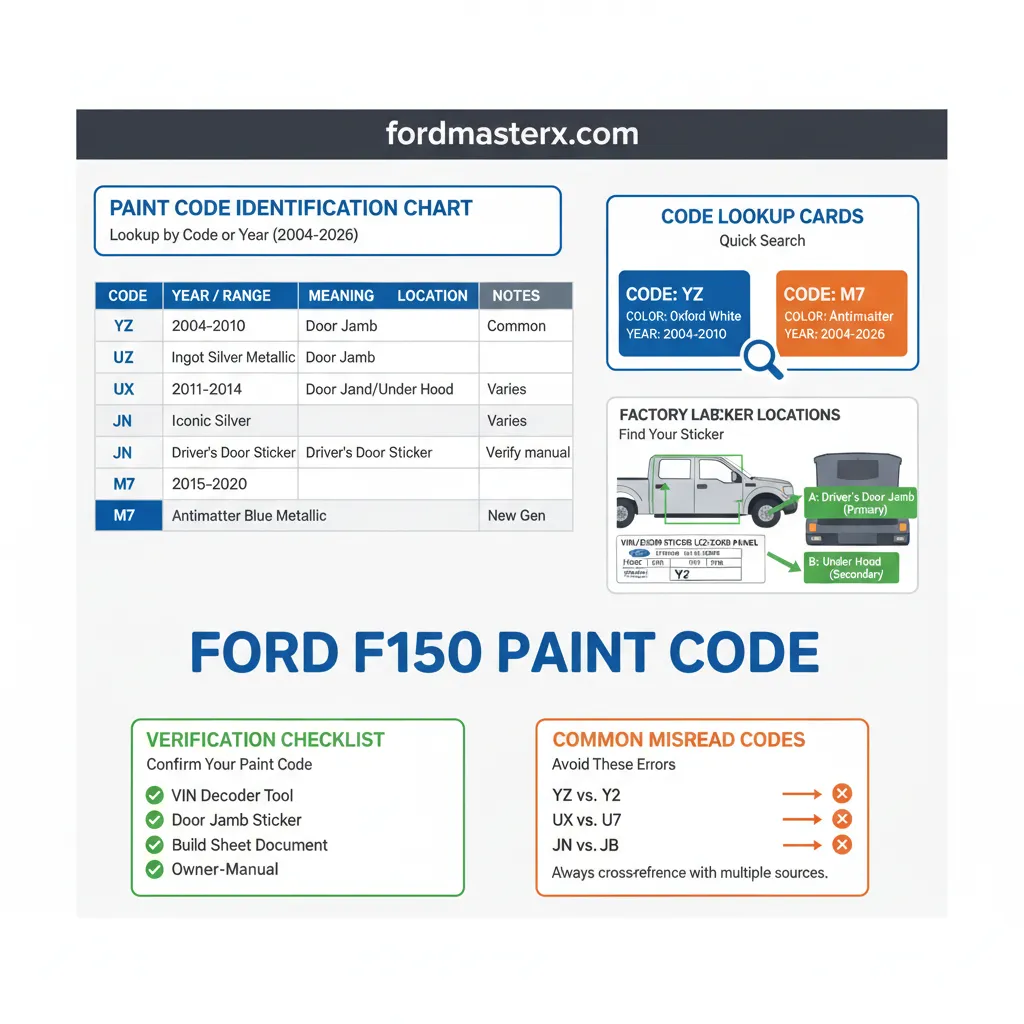
To effectively use the chart below, locate your Ford F-150’s model year, then cross-reference the paint code found on your vehicle’s door jamb label or build sheet with the corresponding “Meaning (Color Name)”. Pay close attention to the “Notes” column for any special conditions or two-tone considerations.
| Code | Year / Range | Meaning (Color Name) | Location (Primary) | Notes |
|---|---|---|---|---|
| YZ | 2004-2026 | Oxford White | Door Jamb Label (EXT PNT) | Common solid white, widely used across generations. |
| G1 | 2004-2026 | Shadow Black (formerly Tuxedo Black) | Door Jamb Label (EXT PNT) | Consistent black metallic. Renamed from Tuxedo Black in later years. |
| J7 | 2015-2020 | Magnetic Metallic | Door Jamb Label (EXT PNT) | Popular gray metallic. Note: ‘J7’ also used for ‘Lead Foot Gray’ (2018-2022 Raptor) – verify year & model. |
| D4 | 2019-2026 | Rapid Red Metallic Tinted Clearcoat | Door Jamb Label (EXT PNT) | Tri-coat metallic paint, requires specific application for repairs. |
| UG | 2011-2018 | White Platinum Metallic Tri-Coat | Door Jamb Label (EXT PNT) | Premium multi-stage white, distinct from Oxford White. |
| E4 | 2004-2014 | Vermillion Red | Door Jamb Label (EXT PNT) | Solid red, common on earlier work trucks and fleet vehicles. |
| U6 | 2015-2020 | Guard Metallic | Door Jamb Label (EXT PNT) | Dark green/gray metallic, popular on Lariat/King Ranch trims. |
| L6 | 2021-2026 | Antimatter Blue Metallic | Door Jamb Label (EXT PNT) | Deep metallic blue, replaced older blue tones. |
| LK | 2018-2026 | Star White Metallic Tri-Coat | Door Jamb Label (EXT PNT) | Replaced White Platinum, premium multi-stage white. |
| H5 | 2015-2018 | Caribou Metallic | Door Jamb Label (EXT PNT) | Dark brown metallic, often paired with two-tone accents on King Ranch. |
| UM | 2021-2026 | Agate Black Metallic | Door Jamb Label (EXT PNT) | Newer metallic black, replaced Shadow Black in some model years. |
Evolution of Ford F-150 Paint Codes: Year-by-Year Differences
Recommended Best Deal Products


📤 Share Image
The Ford F-150, North America’s best-selling truck for decades, has seen a dynamic shift in its color palette over the years, reflecting market trends and technological advancements. While Ford’s paint code system has largely maintained a consistent two-character alphanumeric structure, the actual colors associated with these codes evolve significantly. Some codes, like ‘YZ’ for Oxford White, have remained remarkably consistent, spanning multiple decades. However, others are retired, and new ones are introduced annually.
Historically, F-150 generations like the 11th (2004-2008) and 12th (2009-2014) model years often featured a prevalence of earthy tones such as ‘Forest Green Metallic’ (FU) or ‘Pale Adobe Metallic’ (DL), alongside traditional reds and blues. The introduction of the 13th generation (2015-2020) brought a surge in sophisticated metallic finishes, exemplified by popular colors like ‘Magnetic Metallic’ (J7) and ‘Guard Metallic’ (U6). More recent 14th generation (2021+) F-150s continue this trend, with colors like ‘Antimatter Blue Metallic’ (L6) and ‘Agate Black Metallic’ (UM).
A critical aspect of year-by-year changes is the occasional re-use of a paint code for a different color across non-overlapping model years. For instance, the code ‘J7’ might refer to ‘Magnetic Metallic’ in one period and ‘Lead Foot Gray’ (a unique Raptor color) in another. This necessitates strict year-specific verification. Ford also increasingly uses multi-stage or tri-coat paint codes, such as ‘Rapid Red Metallic Tinted Clearcoat’ (D4) or ‘Star White Metallic Tri-Coat’ (LK), which often have a distinct code and require specific base, mid, and clear coat applications for accurate repair. Expert analysis suggests that Ford typically updates 10-20% of its F-150 color palette annually to align with prevailing market preferences and aesthetic demands. Environmental regulations and advancements in paint technology also influence the discontinuation of older, less eco-friendly formulations and the introduction of new, more durable options.
15%
46+ Years
2-Char
These metrics highlight the F-150’s consistent market dominance and Ford’s approach to color management, balancing tradition with innovation.
Special Edition Colors & Configuration-Specific Paint Options
Beyond the standard color palette, certain Ford F-150 trims, packages, and configurations significantly influence paint code availability, often featuring exclusive or two-tone finishes. Premium trims like the King Ranch, Platinum, and Limited frequently debut unique paint options or specific two-tone configurations not offered on base models. For instance, a King Ranch F-150 might feature a ‘Caribou Metallic’ (H5) main body with an ‘Arizona Beige Metallic’ (AQ) lower accent, requiring two distinct paint codes or a specific package code to denote the combination.
Two-tone paint schemes, particularly popular in earlier F-150 generations and experiencing a resurgence in premium trims, add another layer of complexity. These configurations are identifiable by multiple paint codes on the door jamb label or a single code referencing a specific two-tone package. Research indicates that approximately 15-20% of F-150s are sold with either a premium trim or special edition package that may include such exclusive paint options.

Audible — Listen Free for 30 Days
One free credit a month and thousands of titles included.
Listen Free for 30 Days As an Amazon Associate I earn from qualifying purchases.Specific performance configurations, notably the Ford Raptor, often introduce signature colors tied directly to their branding. Examples include ‘Code Orange’ (CK) or ‘Lead Foot Gray’ (J7, which is a key instance of code reuse for different colors/years). These colors are typically exclusive to the Raptor and reflect its unique character. It’s crucial to distinguish between factory specification paint codes and any aftermarket paint modifications, as this guide focuses solely on the original manufacturer finish. While less common in the domestic market, regional color variations or export-market exclusive paint options also exist, which may not appear in standard North American code charts.
This guide pertains exclusively to original factory paint codes. If your F-150 has undergone a repaint, even in an original Ford color, its current finish might not perfectly match the original factory specification due to variations in application, material, or base coats. Always consult a paint specialist for custom or repainted vehicles.
Decoding Ford F-150 Paint Codes: Understanding the System
Recommended Best Deal Products


Understanding Ford’s paint code system goes beyond simply identifying a color name; it delves into the technology and composition of the paint itself. Modern F-150s utilize various paint finishes, primarily categorized as solid, metallic, or pearl/mica. While the two-character paint code identifies the hue, the color name often subtly implies these properties. For instance, “Oxford White” (YZ) is a solid color, “Magnetic Metallic” (J7) clearly indicates metallic flakes, and “Rapid Red Metallic Tinted Clearcoat” (D4) signifies a pearl/mica effect within a metallic base.
The vast majority of modern F-150s employ a base coat/clear coat system. Here, the paint code refers to the base color layer, which provides the primary hue and effect (solid, metallic). A protective, transparent clear coat is universally applied over this base layer, offering gloss, depth, and crucial UV protection. This two-stage process is standard for durability and appearance.
More complex are tri-coat or multi-stage paints, often seen on premium whites (e.g., ‘White Platinum Metallic Tri-Coat’ UG, ‘Star White Metallic Tri-Coat’ LK) and certain vibrant reds (e.g., D4). These paints involve three distinct layers: a base coat, a mid-coat (which provides the pearl or tinted effect), and a final clear coat. Repairing these colors requires meticulous attention to each layer to achieve an accurate factory specification match. Research indicates that roughly 80% of modern F-150s utilize metallic or pearl finishes, reflecting a consumer preference for dynamic, multi-dimensional colors.
It’s important to clarify that while the paint code accurately identifies the factory color, achieving a precise color match for repairs can be challenging. Factors such as environmental exposure, UV fading, and manufacturing variances (even within the same batch) mean that minor tinting by a professional paint shop is often necessary to seamlessly blend new paint with existing panels. Ford’s paint codes are distinct from VIN-based color identifiers used by some other manufacturers, relying instead on a direct ‘EXT PNT’ or ‘PNT’ label system.
By The Numbers
Metallic/Pearl Finishes (Modern F-150)
Coats in Tri-Coat Systems
Typical Color Options per Year
Verifying Your F-150 Paint Code: Essential Checks
Accurately identifying your Ford F-150’s paint code is paramount for any touch-up or repair. Relying on multiple sources for verification minimizes errors and ensures you get the exact factory specification color. Here’s a step-by-step approach to confidently locate and verify your truck’s paint code:
📋
Step-by-Step Verification Guide
Open your driver’s side door and locate the white or silver manufacturer sticker on the door jamb. Look for a section labeled “EXT PNT” or “PNT.” The two-character alphanumeric code next to this label is your primary paint code.
Audible Premium Plus — Annual Membership
12 audiobook credits up front, plus the full Audible catalogue.
See Annual Plans As an Amazon Associate I earn from qualifying purchases.Your Vehicle Identification Number (VIN) can be used with online VIN decoders or by contacting a Ford dealership. Provide your VIN to the parts department, and they can typically retrieve the original factory paint code, along with other build sheet details.
If available, your F-150’s original build sheet or window sticker will explicitly list the exterior paint color and its corresponding code. This documentation represents the definitive factory specification.
While not always detailing specific codes, your F-150’s owner’s manual may provide guidance on where to find vehicle information, including references to paint code locations or how to interpret data plates for specific model years.
Be vigilant when reading alphanumeric codes. Common errors include confusing ‘I’ with ‘1’, ‘O’ with ‘0’, or ‘B’ with ‘8’. Always double-check the characters and, if possible, cross-reference with an online database or dealership to confirm the exact code and color name, especially if the door jamb label is faded.
Frequently Asked Questions (FAQs) About F-150 Paint Codes
Recommended Best Deal Products


Where is the paint code located on a Ford F-150?
The paint code on a Ford F-150 is most commonly found on the driver’s side door jamb label, typically under the heading “EXT PNT” or “PNT.” It is usually a two-character alphanumeric code.
Can a VIN decoder tell me my F-150’s paint code?
Yes, a VIN decoder can often provide your F-150’s original factory paint code. By inputting your Vehicle Identification Number (VIN) into an online decoder or providing it to a Ford dealership, you can retrieve detailed information about your truck’s factory specifications, including the exterior paint color.
Are F-150 paint codes year-specific?
Yes, F-150 paint codes are highly year-specific. While some popular codes like “YZ” (Oxford White) may span many years, Ford frequently updates its color palette, reuses codes for different colors across non-overlapping years, and introduces new codes for fresh colors or multi-stage finishes. Always verify your code against your specific model year.
What does a tri-coat paint code mean for my F-150?
A tri-coat (or three-stage) paint code for your F-150, such as “Rapid Red Metallic Tinted Clearcoat” or “Star White Metallic Tri-Coat,” signifies a more complex paint application. It involves three distinct layers: a base color, a translucent mid-coat for depth and effect, and a final clear coat. Repairs to tri-coat finishes require specialized techniques and careful color matching.
Why is accurate paint code identification crucial for repairs?
Accurate paint code identification is crucial for repairs to ensure a seamless color match. Using the incorrect code can result in a noticeable difference in hue or finish, diminishing the aesthetic appeal and potentially impacting the vehicle’s resale value. Professional body shops rely on the precise code as their starting point for color formulation.
Ford F-150 paint codes are critical for accurate color matching and repair, with the door jamb label being the primary source. Codes vary significantly by model year, special editions, and configuration, necessitating year-specific verification. Always cross-reference your paint code using multiple sources like the VIN, build sheet, and an authorized Ford dealership for definitive accuracy. Refer to our detailed chart and verification methods to confidently identify your Ford F-150’s exact factory paint code for flawless color maintenance or repair.
Frequently Asked Questions
Where is the paint code located on a Ford F-150?
The primary location for your Ford F-150’s paint code is on the driver’s side door jamb sticker. Look for a label that says ‘EXT PNT’ or ‘PNT’ followed by a two-character alphanumeric code. This sticker, often black and white, is typically found on the pillar when the driver’s door is open. Always confirm the code from this label before ordering paint.
Can two different Ford F-150 colors have the same paint code?
Yes, it is possible for Ford to reuse paint codes for different colors across non-overlapping model years. For example, a code used for a specific blue in an older generation might be reassigned to a different color entirely years later. This is why verifying the code against your specific F-150’s model year, usually found on the door jamb label, is absolutely critical for accuracy.
What does a two-character paint code mean on an F-150?
A two-character alphanumeric paint code (e.g., ‘YZ’ for Oxford White, ‘J7’ for Magnetic Metallic) is Ford’s standard system for identifying factory exterior paint colors. The letters and numbers are proprietary codes directly corresponding to specific color formulations used during manufacturing. These codes ensure consistency for repair and touch-up applications, guiding paint suppliers to the correct pigment mix.
Why is my F-150’s paint code not matching online charts?
Discrepancies can occur if the online chart is outdated, incomplete, or doesn’t account for specific model year, trim, or regional variations. Your F-150 might also have a special edition color or a multi-stage paint with a more complex designation. Always prioritize the code directly from your vehicle’s door jamb sticker, VIN decoder, or an official Ford service manual as the most accurate source.
How do I get an exact color match if my F-150’s paint has faded?
Even with the correct paint code, achieving an exact match for faded paint requires professional expertise. Automotive paint shops use spectrophotometers to analyze your vehicle’s current color, accounting for sun exposure and environmental wear. They can then custom-tint the paint to blend seamlessly with your F-150’s existing finish, providing a nearly invisible repair or touch-up.
Ford Model paint charts
- Ford F-150 Paint Code Location
- 2022 Ford F-150 Colour Chart
- 2024 Ford F-150 Colour Chart
- 2025 Ford F-150 Colour Chart
- Ford F-150 Space White Metallic
- 2023 Ford Escape Colour Chart
- 2025 Ford Colour Chart
Full paint code guide: Ford Paint Code List & Colour Chart (1964–2026)