2025 Ford Bronco Model Comparison Chart 2026 Factory Data

Quick Answer
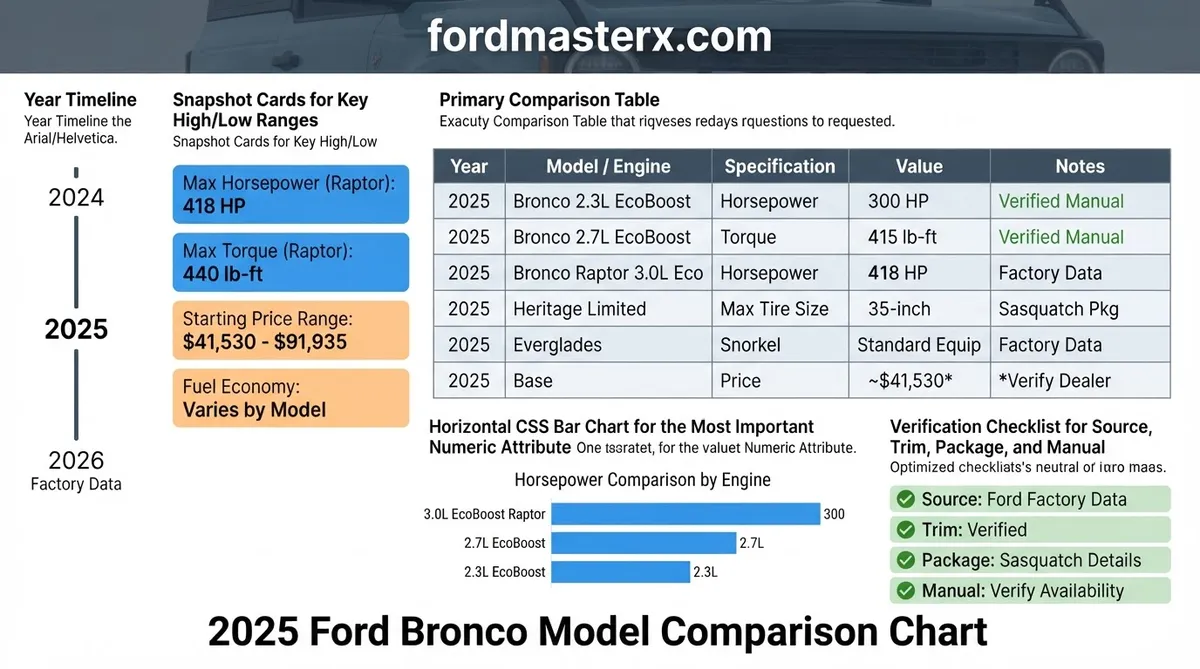
The 2025-2026 Ford Bronco lineup offers diverse performance outputs ranging from the 2.3L EcoBoost at 300 hp to the Raptor’s 3.0L twin-turbo V6 reaching 418 hp. Towing capacity is capped at 4,500 lbs for properly equipped models. Critical caveat: exact capability depends on your specific VIN, axle ratio, tire size, and factory-installed packages. Always verify your specific configuration via the door jamb payload sticker.

Searching for the perfect 2025 Ford Bronco model involves navigating a complex ecosystem of trims, engines, and off-road packages. While the Bronco shares a recognizable silhouette, the mechanical difference between a Big Bend entry-level trim and a top-tier Raptor is substantial. With multiple configurations available, conflating trim-specific capabilities can lead to selecting a vehicle that does not meet your specific trail requirements. This guide provides the official 2025 Ford Bronco model comparison chart and technical data necessary to make an informed purchasing decision.
This data covers the 2025 model year Bronco lineup. Specs including ground clearance, approach angles, and engine output are based on manufacturer factory ratings. Always verify your specific vehicle’s capabilities using the door jamb payload sticker, the vehicle identification number (VIN), and the official owner’s manual provided by Ford. Last reviewed: August 2026.

2025 Ford Bronco Model Comparison Chart: Full Specification Data
Recommended Best Deal Products


📤 Share Image
| Trim Level | Engine | Drivetrain | Ground Clearance | Key Notes |
|---|---|---|---|---|
| Big Bend | 2.3L I4 | Part-time 4WD | 8.3 in | Standard entry-level |
| Black Diamond | 2.3L/2.7L | Part-time 4WD | 9.0 in | Heavy-duty bumpers |
| Badlands | 2.3L/2.7L | Adv. 4WD | 10.0+ in | Front sway-bar disc. |
| Raptor | 3.0L V6 | Full-time 4WD | 13.1 in | High-performance |

Understanding Trim-Specific Mechanical Differences
The 2025 Bronco lineup relies on modular architecture. For instance, while the Big Bend is highly capable for gravel and light trail work, it lacks the front locking differential found standard on the Badlands. When reviewing this comparison chart, pay close attention to the “Advanced 4WD” designation; this system includes an automatic on-demand transfer case that is superior to the traditional part-time system for mixed-surface terrain.
How to Use the Ford Bronco Data Table for Your Build
Use this table as a filter. If your priority is extreme rock crawling, focus on the Badlands or Wildtrak, which include the Sasquatch package features. If you are a daily commuter who values fuel efficiency, the 2.3L EcoBoost engine in the lighter trim packages offers the most balanced performance-to-cost ratio.
2025 Ford Bronco Powertrain and Engine Performance Options
2.3 Liters
3.0 Liters
2.3L EcoBoost vs 2.7L EcoBoost Capabilities
The 2.3L EcoBoost is a potent four-cylinder that provides excellent torque for low-speed maneuvering. However, for those towing or running the heavy 35-inch tires common in the Sasquatch package, the 2.7L EcoBoost V6 is highly recommended. The 2.7L engine significantly improves highway passing power and reduces engine strain under load.
Fuel Economy and Drivetrain Impact
It is a common pitfall to assume fuel economy is uniform across the Bronco range. Because of the aerodynamic drag created by large off-road tires and the curb weight of steel bumpers/rock sliders, the real-world fuel economy of a Sasquatch-equipped 2.7L Bronco is markedly lower than the standard 2.3L configuration. If fuel costs are a factor in your ownership, consider a standard tire package and a 2.3L engine configuration.
Off-Road Hardware: G.O.A.T. Modes and Drivetrain Systems
Recommended Best Deal Products


- Locking Differentials: Front and rear locking differentials are standard on select trims. These mechanical lockers force wheels to rotate at the same speed, ensuring traction in deep mud or on steep, loose inclines.
- Disconnecting Stabilizer Bar: Exclusive to higher-end trims, this system allows the front suspension to articulate independently, maximizing tire contact with uneven, rocky terrain.
- G.O.A.T. Modes: These “Goes Over Any Terrain” modes recalibrate the throttle, shifting, and electronic traction control to suit specific environments like Sand, Rock Crawl, or Slippery conditions.
The Transfer Case is not universal. The base Part-Time 4WD system requires manual engagement and is best for part-time off-roading. The Advanced 4WD transfer case features an “Automatic” 4H mode, which is much more versatile for snow and varying road conditions.
Body Configuration: 2-Door vs 4-Door and Exterior Versatility
Comparing 2-Door and 4-Door Wheelbase Advantages
The 2-door Bronco boasts a shorter wheelbase, which improves the break-over angle, making it highly maneuverable in tight forest trails. Conversely, the 4-door offers a longer wheelbase, which provides a smoother ride and increased cargo capacity, making it the preferred choice for overlanding or family trips.
The Bronco is designed with removable doors and roof panels. Always ensure the mounting hardware is secure and correctly stored to prevent damage during storage.

Audible — Listen Free for 30 Days
One free credit a month and thousands of titles included.
Listen Free for 30 Days As an Amazon Associate I earn from qualifying purchases.The Bronco Sport is a unibody crossover, not a body-on-frame off-roader. It lacks the modular roof/door removal capability of the full-size Bronco.
What Affects Specification and Vehicle Capability Numbers
This package installs higher-clearance suspension and 35-inch tires. These changes alter the effective gear ratio and shift the vehicle’s center of gravity.
Every added option, from heavy steel bumpers to roof racks, reduces the available payload capacity listed on your door sticker.
2025 Ford Bronco Model Comparison Chart Questions Answered
No. The Bronco Sport is built on an unibody platform primarily for light-duty trails. The full-size Bronco uses a body-on-frame chassis designed for extreme rock crawling and technical terrain.
Factory-integrated sway-bar disconnect systems are generally limited to specific trims (like the Badlands or Raptor). Retrofitting these systems is highly complex and often voids factory warranties.
Payload is calculated by subtracting the vehicle’s actual curb weight from its Gross Vehicle Weight Rating (GVWR). Because accessories like larger tires, winches, and steel bumpers add weight, they directly reduce your remaining payload capacity.
To ensure you get the exact capability you require, verify your chosen trim’s mechanical features against local inventory. Confirming the presence of locking differentials, the transfer case type, and the suspension package via the VIN is the only way to guarantee the vehicle meets your off-road standards.