Ford Bronco vs Bronco Sport 2026: Which Is Better?

You’re staring at two iconic badges, two rugged names, two adventurous spirits, but a significant choice looms: the Ford Bronco or the Bronco Sport? Both wear the legendary bucking horse, yet they cater to distinctly different desires and lifestyles. You’re likely caught between the allure of ultimate off-road prowess and the practicalities of daily comfort and economy. We get it. This isn’t just about picking a vehicle; it’s about choosing an extension of your life’s adventures. To cut through the marketing buzz and help you make an informed decision, we’ve meticulously compared these two siblings, delving deep into their performance, features, and value. Our data-backed analysis promises to clarify which Bronco truly belongs in your garage.
Quick Verdict: The Ford Bronco is the clear overall winner for extreme off-road capability and rugged adventure, while the Bronco Sport triumphs in daily drivability and affordability. The core trade-off is body-on-frame toughness versus unibody comfort and efficiency.

Prime for Young Adults — 6 Months Free
Students and 18–24s get six months of Prime free, then half price.
Start 6 Months Free As an Amazon Associate I earn from qualifying purchases.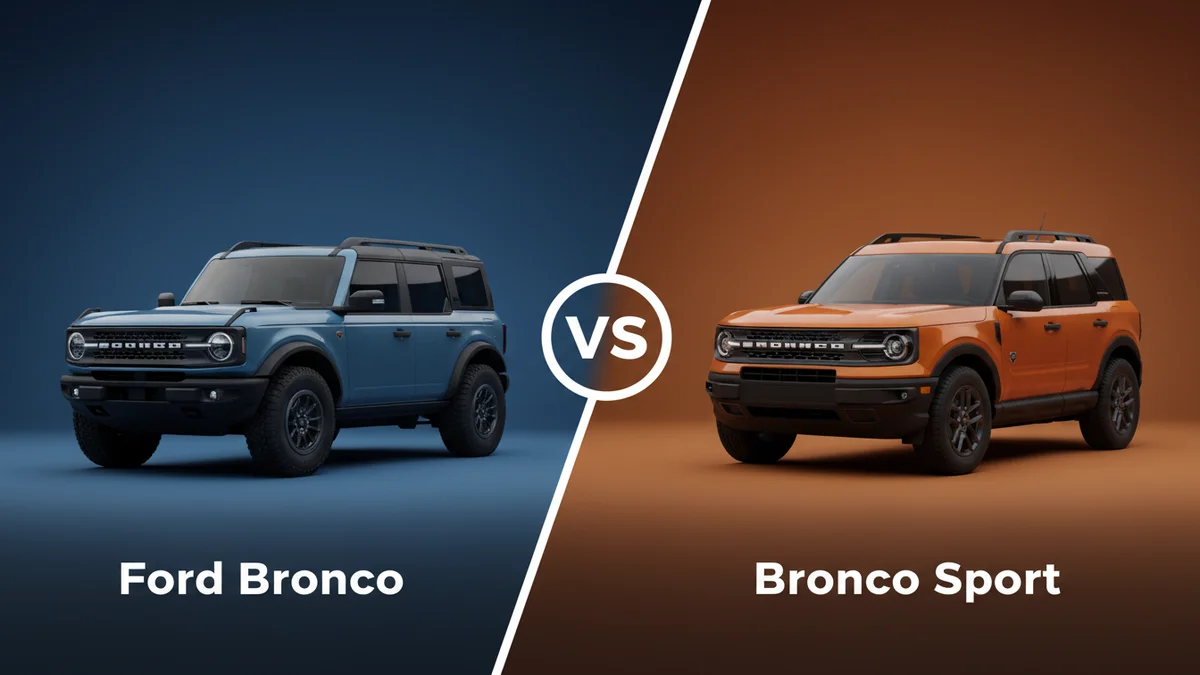
Serious off-roading, customizable adventure, and a truly rugged driving experience.
Urban commuting, light trail use, fuel efficiency, and a more comfortable ride.
- The Ford Bronco offers a maximum of 13.1 inches of ground clearance, significantly more than the Bronco Sport's 8.8 inches.
- Bronco Sport offers superior fuel efficiency, achieving up to 26 MPG combined, compared to the Ford Bronco's best of 20 MPG.
- The Ford Bronco's maximum towing capacity is 3,500 lbs (4,500 lbs for Raptor), while the Bronco Sport is limited to 2,200 lbs.
- The Ford Bronco is body-on-frame, enhancing off-road ruggedness, whereas the Bronco Sport is a unibody crossover, prioritizing on-road comfort.
- Entry-level pricing for the Ford Bronco is approximately $38,500 in 2026, while the Bronco Sport starts around $32,500, making it more accessible.
Ford Bronco vs Bronco Sport: Head-to-Head Specs
Recommended Best Deal Products


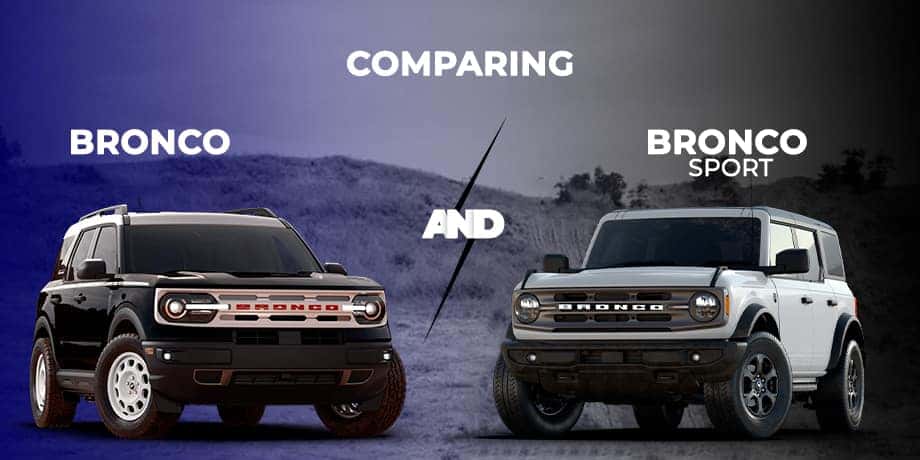
While both vehicles proudly bear the Bronco name, a glance at their fundamental specifications immediately reveals their divergent philosophies. The full-size Ford Bronco stands on a robust body-on-frame chassis, a stark contrast to the Bronco Sport’s car-based unibody construction. This foundational difference translates directly into disparities in engine options, where the Bronco offers potent V6 powerplants that aren’t available on its smaller sibling.
✓ = better value in that row. Sourced from manufacturer specifications.
Performance & Category Ratings
Our comprehensive analysis reveals distinct strengths for each Bronco variant. For off-road capability, the Ford Bronco stands head and shoulders above, earning a formidable 9.5 rating against the Bronco Sport’s respectable 7.0. This isn’t surprising; the full-size Bronco, with its body-on-frame design, massive ground clearance, available disconnectable sway bars, and low-range gearing, is engineered from the ground up for extreme trail conquering. Its larger tires and more aggressive G.O.A.T. Modes truly shine when the pavement ends. The Bronco Sport, while offering intelligent 4×4 and competent G.O.A.T. Modes, ultimately can’t match its big brother’s articulation or sheer ruggedness over serious obstacles.

Switching to on-road comfort, the tables turn decisively. The Bronco Sport takes a commanding 8.5, leaving the Ford Bronco at 7.0. The Sport’s unibody construction, independent rear suspension, and smaller tires contribute to a significantly smoother, quieter, and more car-like ride. You’ll appreciate its composure on daily commutes and long highway stretches. The full-size Bronco, with its heavy-duty suspension and all-terrain tires, delivers a much firmer, sometimes jarring, ride, accompanied by noticeable wind and road noise – a direct consequence of its off-road focus.
Value for money is a close contest, with the Bronco Sport nudging ahead at 8.0 compared to the Ford Bronco’s 7.5. The Sport’s lower starting price and superior fuel efficiency make it a more budget-friendly option for many buyers. While the Ford Bronco offers immense capability for its price point, its higher entry cost and expensive customization options can quickly drive up the total investment. Fuel efficiency is another category where the Bronco Sport dominates, scoring an impressive 8.5 against the Ford Bronco’s 6.0. Its smaller, more efficient engines and lighter curb weight mean fewer trips to the pump – a significant ongoing cost saving you’ll certainly notice.
In terms of interior space and practicality, the Ford Bronco leads slightly at 8.0 versus the Bronco Sport’s 7.5. The larger Bronco offers more generous passenger room, especially in the rear, and its removable roof and doors provide an open-air experience the Sport can’t replicate. While the Bronco Sport offers clever storage solutions and an upright seating position, its overall cargo volume and passenger legroom are a bit more constrained. Technology and features see the Ford Bronco with an 8.5, just ahead of the Bronco Sport’s 8.0. The full-size Bronco often comes with larger infotainment screens, a more advanced suite of off-road cameras, and specialized features like Trail Turn Assist. The Sport provides excellent SYNC infotainment and Ford Co-Pilot360, but lacks some of the hardcore trail tech. Finally, build quality stands even at 8.0 for both. Ford has invested in making both vehicles feel robust; the Bronco’s quality leans towards rugged durability, while the Sport’s feels more refined for everyday use.
Full-size Bronco
Bronco Crossover
By the Numbers
Recommended Best Deal Products


Diving deeper into the raw statistics behind these vehicles paints an even clearer picture of their intended roles and capabilities. These figures aren’t just arbitrary numbers; they directly influence everything from your monthly fuel budget to the most challenging terrain you can confidently tackle. Understanding these metrics is crucial for aligning your expectations with reality, ensuring the Bronco you choose truly meets your needs.

Audible — Listen Free for 30 Days
One free credit a month and thousands of titles included.
Listen Free for 30 Days As an Amazon Associate I earn from qualifying purchases.
Full-size Bronco
Bronco Crossover
Hover any bar for exact values. Each metric scaled independently.
Ford Bronco: Strengths and Weaknesses
The Ford Bronco is, without a doubt, a purpose-built adventure machine. Its most undeniable strength is its virtually unmatched off-road capability. With features like available 35-inch tires, advanced G.O.A.T. (Goes Over Any Type of Terrain) modes, a body-on-frame design, high ground clearance, and available front and rear locking differentials, it can conquer trails that would leave most SUVs stranded. The removable doors and roof panels offer an unparalleled open-air experience, connecting you directly with nature in a way few other vehicles can. Its powerful engine options, including the 2.7L EcoBoost V6 making 330 horsepower and 415 lb-ft of torque, provide ample power for both highway passing and rock crawling. The Bronco’s iconic, retro-inspired styling also turns heads wherever it goes, blending heritage with modern ruggedness. You’ll find it incredibly customizable, with a vast aftermarket ready to transform it into your ultimate rig.
However, this extreme capability comes with trade-offs. Its most significant weakness is its compromised on-road comfort. The sturdy suspension, larger tires, and overall rugged build translate to a firmer, sometimes bouncy ride on pavement, and you’ll notice more wind and road noise in the cabin. Fuel efficiency is another considerable drawback; the larger engines and heavier chassis mean more frequent stops at the gas station, a tangible hit to your wallet. The starting price is also significantly higher than its Sport sibling, and options can quickly inflate the cost. We also found some of the interior plastics, while durable, feel a bit cheaper than you might expect for the price point, particularly in lower trims. Maneuvering the larger Bronco in tight urban spaces or parking lots can be a challenge due to its size and larger turning radius, making it less practical for daily city driving.
Bronco Sport: Strengths and Weaknesses
Recommended Best Deal Products

The Bronco Sport shines as a highly versatile and practical compact SUV that admirably bridges the gap between daily usability and adventurous spirit. Its primary strength lies in its excellent on-road comfort and refined driving dynamics. Thanks to its unibody construction and independent suspension, it delivers a smooth, quiet, and composed ride that’s perfect for commutes, errands, and long highway journeys. Fuel efficiency is another major win, with its smaller engines (like the 1.5L EcoBoost turbo-three) offering significantly better MPG than its larger sibling, saving you money at the pump. The Bronco Sport is also notably more affordable, making it an accessible entry point into the Bronco family. Its compact size makes it agile and easy to maneuver in urban environments, from tight parking lots to congested streets.
Inside, the Bronco Sport offers a remarkably practical and thoughtfully designed interior. Clever storage solutions, like the Molle straps on the seatbacks and under-seat storage, enhance its utility for outdoor enthusiasts. It’s also surprisingly capable off the beaten path for its class, with intelligent 4×4, respectable ground clearance, and various G.O.A.T. Modes allowing it to confidently tackle moderate trails, gravel roads, and snowy conditions – far more than most crossover SUVs. Ford Co-Pilot360 technology provides a comprehensive suite of safety and driver-assist features, adding peace of mind to every journey.
However, the Bronco Sport’s strengths come with inherent limitations. Its biggest weakness is its less extreme off-road capability compared to the full-size Bronco. While competent, its unibody chassis, lower ground clearance, and lack of advanced off-road hardware (like disconnectable sway bars or truly locking differentials) mean it simply cannot tackle the same formidable obstacles as its rugged counterpart. Power output is also more modest; while adequate for most situations, you won’t find the same thrilling acceleration or towing capacity as in the larger Bronco. Its styling, while attractive, doesn’t possess the same iconic, rugged presence as the original. Ultimately, if your dream involves serious rock crawling or extreme overlanding, the Bronco Sport will eventually reach its limits where the Ford Bronco is just getting started.
- ✅ Unmatched off-road capability with advanced 4×4 systems and G.O.A.T. Modes.
- ✅ Highly customizable with removable doors, roof panels, and vast aftermarket support.
- ✅ Rugged, iconic styling with significant road presence.
- ✅ Stronger engine options, including the powerful 418 hp Raptor.
- ✅ Higher max towing capacity, up to 3,500 lbs (4,500 lbs for Raptor).
- ❌ Higher starting price and overall cost of ownership.
- ❌ Less comfortable and refined on-road ride due to body-on-frame construction.
- ❌ Lower fuel economy, with a max of 20 MPG combined.
- ❌ Can be more challenging to maneuver and park in urban environments.
- ✅ More comfortable and quieter on-road driving experience.
- ✅ Superior fuel efficiency, achieving up to 26 MPG combined.
- ✅ More affordable starting price, offering better value for daily use.
- ✅ Easier to maneuver and park in city settings due to smaller footprint.
- ✅ Standard AWD provides confident all-weather capability.
- ❌ Significantly less off-road capable than the full-size Ford Bronco.
- ❌ Lower towing capacity, limited to 2,200 lbs.
- ❌ Less powerful engine options, with a max of 250 hp.
- ❌ Lacks the rugged, customizable, and iconic aesthetic of its larger sibling.
Which One Should You Choose?
Deciding between the Ford Bronco and Bronco Sport ultimately boils down to your priorities, lifestyle, and how you envision using your vehicle. If you’re an avid off-roader, a dedicated weekend warrior who dreams of conquering challenging trails, or someone who cherishes the freedom of open-air motoring, the full-size Ford Bronco is your undisputed champion. It’s built for rugged adventure, offering unparalleled capability, extensive customization, and an iconic presence. You’re willing to trade some on-road comfort and fuel efficiency for supreme articulation and ground clearance. For you, the Bronco isn’t just transportation; it’s a statement, a tool for exploration, and an experience.
Conversely, if your daily life involves navigating city streets, commuting to work, and occasional weekend trips to trailheads or campsites, the Bronco Sport is the far more sensible and comfortable choice. It excels in on-road comfort, delivering a smooth, quiet ride that won’t punish you on long drives. Its superior fuel economy will be a welcome relief at the gas pump, and its more compact dimensions make it agile and easy to park. While it won’t tackle Moab’s toughest trails, the Bronco Sport is remarkably capable for light-to-moderate off-roading, gravel roads, and snowy conditions – more than enough for the vast majority of drivers who enjoy outdoor activities. If you prioritize affordability, practicality, and everyday drivability with a dash of adventure, the Bronco Sport is perfectly aligned with your needs. Think of it as the highly capable, comfortable daily driver with a keen adventurous spirit.
Consider your budget, too. If you’re looking for a more affordable entry into the Bronco family and want to minimize ongoing running costs, the Sport is the clear winner. If you have a more flexible budget and are prepared for a higher purchase price and increased fuel expenses in exchange for ultimate capability and customization, the Ford Bronco is your premium adventure option. Whether you’re a power user seeking peak performance or a beginner wanting reliable capability without compromise, there’s a Bronco for you.
Serious off-roading, customizable adventure, and a truly rugged driving experience.
Audible Premium Plus — Annual Membership
12 audiobook credits up front, plus the full Audible catalogue.
See Annual Plans As an Amazon Associate I earn from qualifying purchases.Urban commuting, light trail use, fuel efficiency, and a more comfortable ride.
Final Verdict
After dissecting every aspect, the Ford Bronco emerges as the clear overall winner in this head-to-head comparison, especially for those seeking raw, unadulterated off-road capability and a truly rugged adventure vehicle. It embodies the spirit of the original, built to conquer the wildest terrains and offer an unmatched open-air driving experience. However, its victory isn’t absolute. The Bronco Sport triumphs emphatically in daily drivability, affordability, and fuel efficiency, making it the superior choice for most consumers who prioritize comfort and practicality in their everyday lives.
The core trade-off remains unequivocally clear: the Ford Bronco offers body-on-frame toughness and extreme off-road prowess, while the Bronco Sport provides unibody comfort, superior efficiency, and urban agility. Your choice hinges entirely on which side of this fundamental divide your priorities fall. Both are excellent vehicles, but they cater to very different definitions of adventure.
Frequently Asked Questions
Is Ford Bronco better than Bronco Sport?
The Ford Bronco is better for serious off-road adventures, offering 13.1 inches of ground clearance and 418 horsepower in its Raptor trim. The Bronco Sport is better for daily driving and light trails, providing a more comfortable ride and up to 26 MPG combined. Your definition of 'better' depends on your primary use case.
What is the biggest difference between Ford Bronco and Bronco Sport?
The biggest difference is their fundamental platform and intended purpose. The Ford Bronco is a body-on-frame SUV designed for extreme off-roading with removable parts, while the Bronco Sport is a unibody crossover, sharing a platform with the Ford Escape, optimized for on-road comfort and light trail capability, making it more practical for daily urban life.
Which Bronco is better for beginners or city driving?
The Bronco Sport is significantly better for beginners and city driving. Its smaller size, unibody construction, and more car-like handling make it much easier to maneuver and park in urban environments. It also offers better fuel economy at up to 26 MPG combined, which is ideal for daily commutes.
Which Ford Bronco model is more reliable?
Both the Ford Bronco and Bronco Sport generally offer similar reliability ratings typical of Ford vehicles. However, the Bronco Sport, with its less complex unibody design and fewer specialized off-road components, might experience fewer issues related to extreme use over time compared to a frequently pushed off-road Bronco. Both come with a 3-year/36,000-mile bumper-to-bumper warranty.
Which is more expensive, the Ford Bronco or Bronco Sport?
The Ford Bronco is significantly more expensive. The estimated base price for a 2026 Ford Bronco starts around $38,500, while the Bronco Sport is more affordable, with an estimated base price of approximately $32,500. Fully loaded, the Ford Bronco can easily exceed $80,000, whereas the Bronco Sport typically tops out around $45,000.