
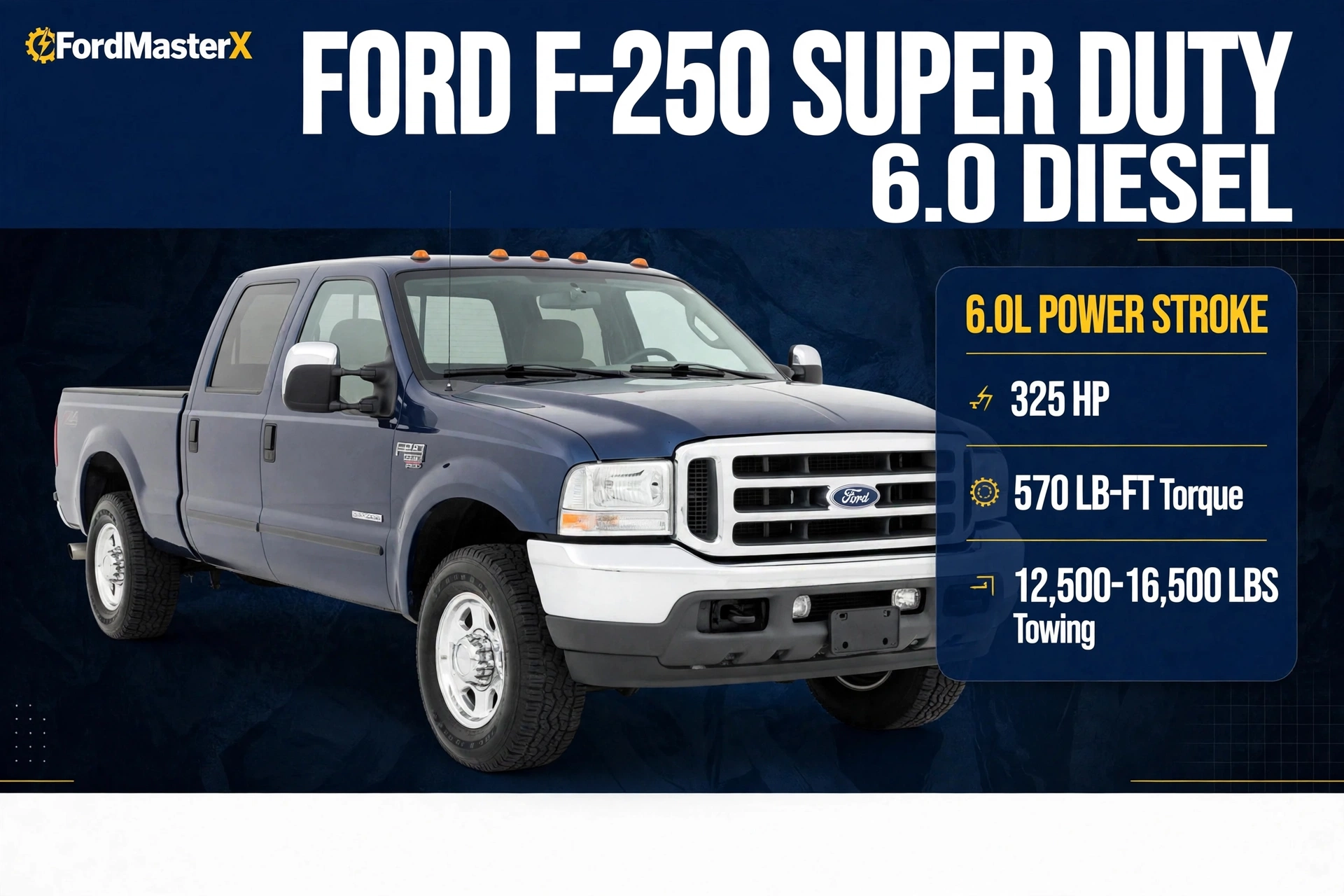
2007 Ford F-250 Super Duty 6.0 Diesel 2026 Complete Guide

The 2007 Ford F-250 Super Duty 6.0 diesel is the last year of the 6.0L Power Stroke, and it makes 325 horsepower and 570 lb-ft of torque. It is the most sorted year of the 6.0L run, but it still carries the same known failure points, so a pre-purchase check is not optional.
This guide gives you the direct answer first, then the full specs, the towing limits, and the six problems that decide whether a 2007 truck is a good buy or a money pit. Every figure comes from a verified source, and every problem comes with its fix.
If you are shopping for one of these trucks, read the buying checklist near the end before you hand over any money. It takes ten minutes, and it can save you thousands in repairs.
The Short Answer in 4 Facts
Four facts answer the question for most buyers. The table below holds them, and the infographic after it gives you the same facts to save or share.
| Fact | What it means for your 2007 F-250 |
|---|---|
| Last year of the 6.0L | 2007 was the final model year, and the 6.4L Power Stroke replaced it in 2008 |
| 325 hp and 570 lb-ft | Power peaks at 3,300 rpm and torque peaks at 2,000 rpm |
| Towing up to 16,500 lbs | Fifth-wheel towing for an F-250, while conventional towing tops out at 12,500 lbs |
| Known problems decide the buy | Oil cooler, EGR cooler, head bolts, FICM, STC fitting, and turbo wear |
2007 F-250 6.0 Diesel At a Glance
The final year of the 6.0L Power Stroke, with its power, towing, and the parts to check before you buy.
| Measure | Verified figure | Result |
|---|---|---|
| Engine | 6.0L Power Stroke V8 turbo diesel, Navistar-built | Final year 2007, replaced by the 6.4L in 2008 |
| Horsepower | 325 hp at 3,300 rpm | Same as every 6.0L year |
| Torque | 570 lb-ft at 2,000 rpm | Up 10 lb-ft over the 2003 to 2004 trucks |
| Towing, F-250 | 12,500 lbs conventional, 16,500 lbs fifth-wheel | Check the door sticker for your cab and axle |
| Oil capacity | 15 quarts with filter | HEUI injectors run on high-pressure engine oil |
| Watch list | Oil cooler, EGR cooler, head bolts, FICM, STC fitting, turbo | Ask for receipts for every fix |
Direct answer: The 2007 F-250 6.0 diesel is the best year of the 6.0L, with 325 hp and 570 lb-ft. Buy it only with proof that the oil cooler, EGR cooler, head bolts, FICM, and STC fitting were fixed.
Sources: Truck Insiders, MotorBiscuit, Diesel Power Products, and Diesel World.
One fact on its own can mislead. Knowing the power figures is not enough, because a truck with a clogged oil cooler can still make full power right up until it fails.
The rest of this guide fills in the detail. You will see how each part of the engine works, where it fails, and what a fixed truck looks like.
2007 F-250 Super Duty 6.0 Diesel Specs
The 2007 F-250 Super Duty 6.0 diesel runs the Navistar-built 6.0L Power Stroke V8, a direct-injection turbo diesel with four valves per cylinder. It was the last year of an engine that ran from 2003 through 2007, and it replaced the 7.3L Power Stroke that came before it.
Ford paired the engine with a 5-speed TorqShift automatic or a ZF 6-speed manual. The automatic is the one most buyers will find, and it has proven reliable even with moderate power upgrades.
| Specification | 2007 F-250 6.0L Power Stroke |
|---|---|
| Engine | 6.0L Power Stroke V8 turbo diesel |
| Builder | International Navistar |
| Model years | 2003 to 2007, with 2007 as the final year |
| Displacement | 6.0 liters, 365 cubic inches |
| Horsepower | 325 hp at 3,300 rpm |
| Torque | 570 lb-ft at 2,000 rpm for 2005 to 2007 trucks |
| Bore and stroke | 3.74 by 4.13 inches, or 95 by 105 mm |
| Compression ratio | 18.0 to 1 |
| Valvetrain | 32 valves, 4 per cylinder, single cam |
| Fuel injection | HEUI, high-pressure oil fired injectors, up to 26,000 psi |
| Turbocharger | Garrett GT3782VA variable geometry turbo, air-to-air intercooler |
| Engine oil capacity | 15 quarts with filter |
| Coolant capacity | 27.5 quarts |
| Transmissions | 5-speed 5R110W TorqShift automatic, ZF 6-speed manual |
| Fuel tank | 29 or 38 gallons |
The 2005 to 2007 trucks gained 10 lb-ft over the 2003 to 2004 trucks, which made 560 lb-ft. The 2005 trucks also gained a coil spring front suspension and chassis changes that improved ride and towing.
Truck Insiders lists the full spec sheet in its 2003 to 2007 Ford 6.0L Powerstroke guide, and the figures there match the factory ratings. The Diesel Power Products 6.0 Powerstroke buyer guide confirms the same split, with 2005 to 2007 trucks rated at 570 lb-ft.
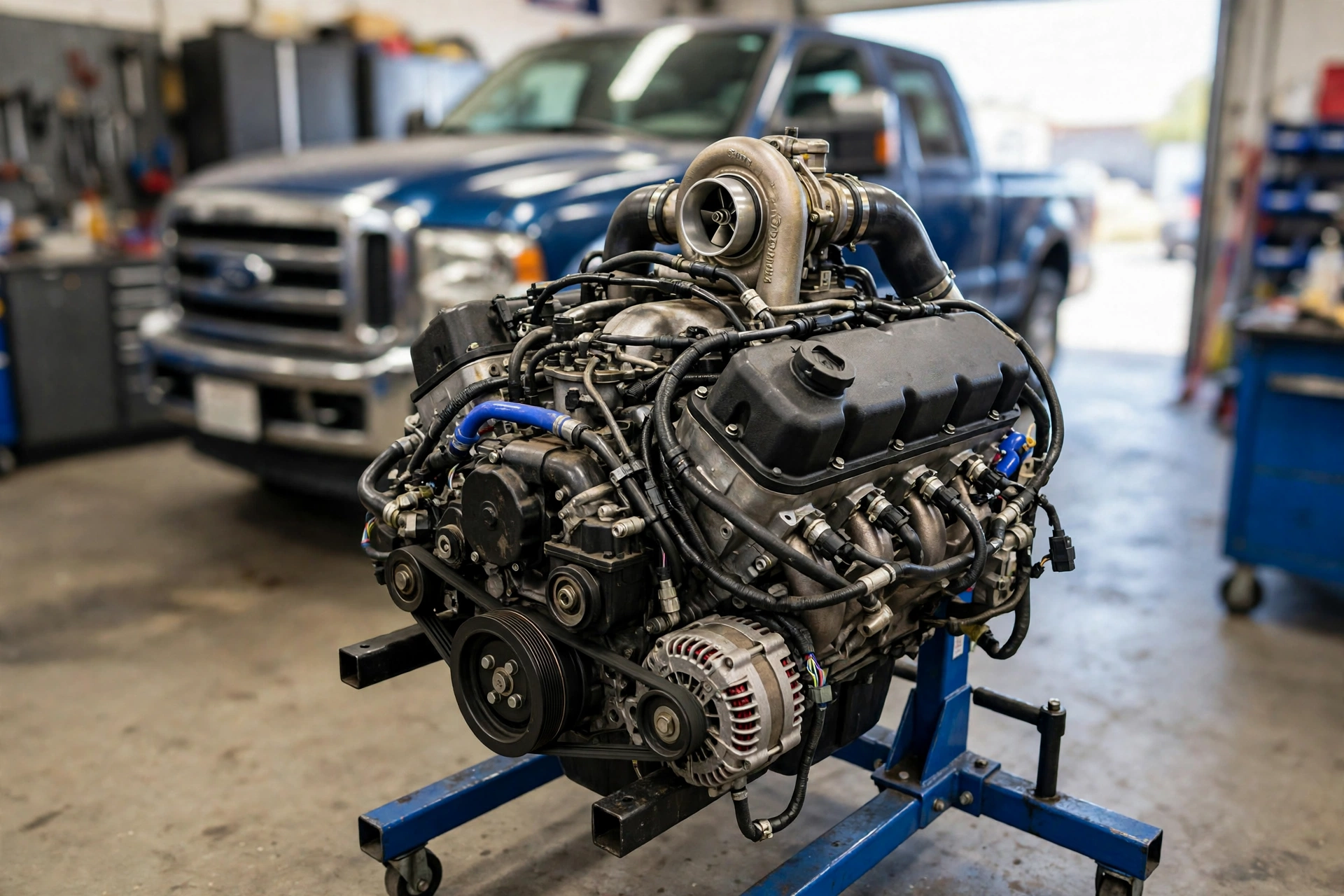
AI-generated illustration: a Ford 6.0L Power Stroke diesel V8 engine on a stand in a workshop with a blue Super Duty truck behind it.
Oil choice matters on this engine, because the HEUI injectors run on high-pressure engine oil. Our Ford diesel oil capacity chart lists the 15 quart fill for the 6.0L alongside the other Power Stroke engines, so you can check your fill at a glance.
Towing and Payload
The 2007 F-250 Super Duty 6.0 diesel tows up to 12,500 lbs with a conventional hitch, and up to 16,500 lbs with a fifth-wheel or gooseneck setup. The exact limit depends on cab, bed, drive type, and axle ratio, so check the door sticker on the truck you are buying.
The wider Super Duty range runs to 19,200 lbs, but that figure belongs to an F-350 dual rear wheel truck with the 4.30 limited slip max tow package. Do not quote it for an F-250, because an F-250 cannot reach it.
| F-250 setup, automatic, 2007 | Max towing |
|---|---|
| Conventional, 4×2 | 12,500 lbs |
| Conventional, 4×4 | 12,500 lbs |
| Fifth-wheel or gooseneck, 4×2, regular cab | 16,500 lbs |
| Fifth-wheel or gooseneck, 4×2, SuperCab | 16,100 lbs |
| Fifth-wheel or gooseneck, 4×2, Crew Cab | 15,900 lbs |
| Fifth-wheel or gooseneck, 4×4, regular cab | 15,800 lbs |
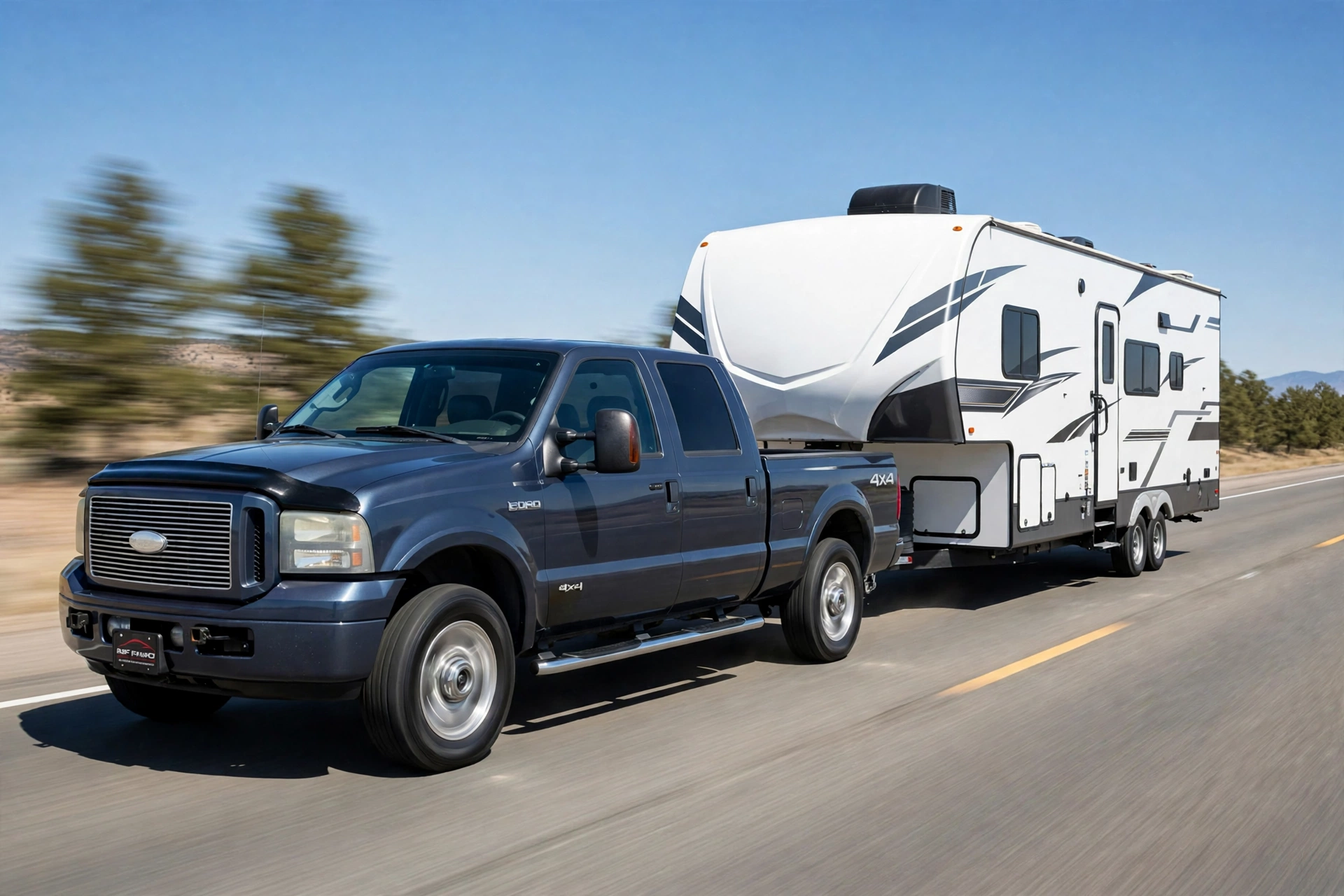
AI-generated illustration: a dark blue 2007 Ford F-250 Super Duty crew cab towing a white fifth-wheel travel trailer on a highway.
Tow ratings assume the truck is in stock form with the right axle ratio and cooling. A truck with oversized tires, a lift, or a heavy aftermarket bumper tows less than the chart says, so treat the chart as a ceiling, not a promise.
If you want the full picture across models, our Ford truck bed dimensions chart helps you match cab and bed to your trailer. Bed length decides which fifth-wheel hitches fit, and that matters as much as the tow rating.
The 6 Most Common 6.0 Problems
The 6.0L has a short list of failures that every buyer must know. Most of them trace back to heat, oil, or coolant, and most of them can be fixed for good with upgraded parts.
MotorBiscuit reports that by February 2007, the 6.0L was only 10 percent of Ford engines made, yet it made up over 80 percent of warranty spending. That record is why these trucks are cheap, and why a careful buyer can still win.
1. Clogged Oil Cooler
The oil cooler sits in the valley of the engine, and its narrow coolant passages clog with casting sand and debris over time. When flow drops, oil temperature climbs, and the EGR cooler downstream is the next part to fail.
Watch the gap between oil temperature and coolant temperature. If the oil runs much hotter than the coolant under load, the cooler is clogged, and it needs to be replaced before it takes the EGR cooler with it.
Diesel World lists the oil cooler first in its rundown of the 6.0L most common problems, and it calls the cooler the root of most 6.0L failures. That matches what shops see every day.
2. Failed EGR Cooler
The EGR cooler cools exhaust gas before it is fed back into the intake, and it lives on coolant flow from the oil cooler. When that flow is starved, the cooler cracks, and coolant leaks into the intake and the cylinders.
White smoke from the exhaust and coolant loss with no visible leak are the classic signs. Left alone, a cracked EGR cooler can hydrolock the engine, which turns a cooler job into an engine job.
Our 6.0 Powerstroke EGR valve location guide shows where the EGR parts sit, so you know what you are looking at under the hood.
3. Stretched Head Bolts and Blown Head Gaskets
Each cylinder is clamped by only four 14 mm torque-to-yield head bolts, which is fewer and smaller than other diesels of the time. Under heavy towing or tuning, the bolts stretch, clamping force drops, and the head gasket blows.
Coolant pushing out of the degas bottle, a sweet smell from the exhaust, and white smoke all point to this failure. The permanent fix is ARP head studs with new gaskets, and it is the single most valuable upgrade on a 6.0L.
Our 6.0 Powerstroke head bolt torque guide covers the factory bolt spec, and it explains why studs hold where the factory bolts stretch.
4. FICM Failure
The fuel injection control module, or FICM, supplies 48 volts to fire the injectors. Heat and vibration wear it out, and low battery voltage makes the problem worse.
A weak FICM causes hard starts, rough idle, misfires, and loss of power. Test FICM voltage with a scan tool before you buy, because a failing module looks like bad injectors and costs far less to fix.
5. HPOP and STC Fitting Leaks
The high-pressure oil pump fires the HEUI injectors, and the 2005 to 2007 trucks use a snap-to-connect, or STC, fitting on the pump outlet. The fitting seal wears as the branch tubes flex, and oil leaks past it.
The tell is a truck that starts fine when cold but cranks long or will not start when warm. MotorBiscuit notes the STC fitting saw a 100 percent failure rate and was discontinued in 2007, so check whether the update was done.
Ford sells an update kit that replaces the fitting with a solid threaded part, and shops fit it whenever the turbo, pump, or coolers are out. The MotorBiscuit guide to the 6.0-liter flaws covers the STC failure in full, with the same hot no-start symptom.
6. Sticking VGT Turbo
The Garrett variable geometry turbo uses vanes that adjust to control boost, and carbon or rust buildup can make those vanes stick. A stuck turbo causes low power, overboost, or a check engine light with code P0299.
Short trips and long idle time make the buildup worse, because the vanes never sweep through their full range. A truck that is driven hard on the highway keeps the vanes moving, and that is one reason highway trucks age better.
If the turbo is noisy or the truck surges under throttle, budget for a cleaning or a replacement. Turbo work is not cheap, but it is far cheaper than the engine damage a failed turbo can cause.
What Is Bulletproofing a 6.0
Bulletproofing means replacing the known weak parts with upgraded ones, and the term comes from Bulletproof Diesel, the company that made the kits famous. A bulletproofed truck has head studs, an upgraded EGR cooler or delete, an upgraded oil cooler, and a repaired FICM.
Ask for receipts, not claims. A seller who says bulletproofed but has no paperwork may have done none of it, and the price should reflect that.
A monitor that shows oil and coolant temperature together is part of the package. It lets you spot a clogged oil cooler early, before it costs you an EGR cooler and a head gasket.
Our guide to Ford diesel engines to avoid puts the 6.0L in context against the other Power Stroke engines, so you can see where a fixed 6.0L stands.
2007 vs Earlier 6.0 Years
The 2007 truck is the best year of the 6.0L, but it is not a different engine. Ford fixed small things year by year, and the late trucks carry those fixes from the factory.
| Year | Power | What changed |
|---|---|---|
| 2003 to 2004 | 325 hp, 560 lb-ft | First years, round EGR cooler in 2003, most early faults |
| 2005 | 325 hp, 570 lb-ft | Torque up 10 lb-ft, coil spring front suspension, chassis changes |
| 2006 | 325 hp, 570 lb-ft | Large tow capacity increase in dual rear wheel models |
| 2007 | 325 hp, 570 lb-ft | Final year, STC fitting discontinued, most factory fixes included |
Diesel Power Products puts it plainly: if you are shopping used, the 2005 to 2007 models are typically a safer bet. The 2007 truck is the safest bet of all, because it carries every running change Ford made.
That does not make a 2007 truck safe on its own. A late truck with no maintenance records can be worse than an early truck with full records and the fixes done.
The next engine in line was the 6.4L, and our 6.4 Powerstroke torque specs guide shows what replaced the 6.0L. If you want to compare generations, our 7.3 Powerstroke years to avoid guide covers the engine the 6.0L replaced.
What to Check Before You Buy
Run these checks in order, and walk away if the seller will not let you. A seller with nothing to hide will let you test the truck properly.
- Start it cold. A cold start should be quick and smooth, with no long crank and no rough idle. Hard cold starts point to injectors, glow plugs, or a weak FICM.
- Restart it hot. Drive the truck until it is fully warm, shut it off, and restart it after five minutes. A long crank when hot points to the STC fitting or a high-pressure oil leak.
- Compare oil and coolant temperature. Watch both readings on a monitor under load. A large gap between them means the oil cooler is clogged.
- Check for coolant loss. Look at the degas bottle level, and look for white residue around the cap. Coolant loss with no visible leak points to the EGR cooler or head gaskets.
- Scan for codes and check FICM voltage. Pull codes with a scan tool, and confirm FICM voltage holds near 48 volts. Stored codes tell you what the seller is not telling you.
- Ask for receipts. Head studs, coolers, FICM work, and the STC update should all have paperwork. No receipts means no proof, and the price should drop to match.
- Check for rust. Look at cab corners, rocker panels, bed arches, and the frame. Rust repair costs more than most engine fixes on these trucks.
If the truck passes all seven checks, it is worth a professional inspection. A diesel shop can pressure test the cooling system and check the injectors, and that inspection is the best money you will spend.
Electrical gremlins can hide behind engine faults, so check the basics too. Our 2004 F-250 fuse box diagram helps you trace blown fuses on the same generation, and our F-250 alternator amp chart covers charging output by year and engine.
Is the 2007 F-250 6.0 Diesel Worth Buying
Yes, if the price reflects the risk and the truck has records. A 2007 truck with head studs, upgraded coolers, and a healthy FICM is a strong tow rig for far less money than a newer diesel.
No, if the truck is untouched, has no records, and the seller wants top money. That truck will hand you the full repair bill, and the bill can run higher than the purchase price.
Buy the truck, not the story. Records, test results, and a clean inspection matter more than a fresh detail and a good sales pitch.
Running costs are part of the answer too. The 6.0L takes 15 quarts of oil per change, so budget for that, and our best oil for Ford diesel guide explains what good diesel oil looks like across the Power Stroke range.
Questions Ford Owners Ask About the 2007 F-250 6.0 Diesel
Is the 2007 F-250 6.0 Diesel Reliable
It is reliable once the known weak parts are fixed, and it is not reliable before that. The engine design is sound, but the factory coolers, bolts, and fittings are not.
How Much Horsepower Does the 2007 6.0 Have
The 2007 6.0L makes 325 horsepower at 3,300 rpm and 570 lb-ft of torque at 2,000 rpm. Those are the same figures as the 2005 and 2006 trucks.
What Is the Towing Capacity
An F-250 with the 6.0L tows up to 12,500 lbs with a conventional hitch and up to 16,500 lbs with a fifth-wheel setup. Cab, drive type, and axle ratio move the exact number.
What Does Bulletproofed Mean
Bulletproofed means the weak parts were replaced with upgraded ones, usually head studs, an upgraded EGR cooler, an upgraded oil cooler, and a repaired FICM. Always ask for receipts before you pay a bulletproofed price.
Should I Buy a 2007 6.0 or a 7.3
The 7.3L is simpler and tougher, but it is older, slower, and harder to find in good shape. The 2007 6.0L is stronger and more refined, but only a fixed one is a safe buy.
How Long Does a 6.0 Last
There is no fixed lifespan, because maintenance and repairs decide it. A truck with the fixes done and strict oil and coolant service can run for many years, while a neglected one can fail at any mileage.
Your 5 Step Check Before You Buy a 2007 F-250 6.0 Diesel
The 2007 Ford F-250 Super Duty 6.0 diesel is the best year of a troubled engine, with 325 horsepower, 570 lb-ft of torque, and towing up to 16,500 lbs. It is a good truck when the known problems are fixed and proven with paperwork.
Run the five step check before you buy. Start it cold, restart it hot, compare oil and coolant temperature, check for coolant loss, and demand receipts for the studs, coolers, and STC update.
That check costs you an hour. It keeps you out of the most expensive mistake in used diesel buying, and it leaves you with a truck you can trust to tow.