
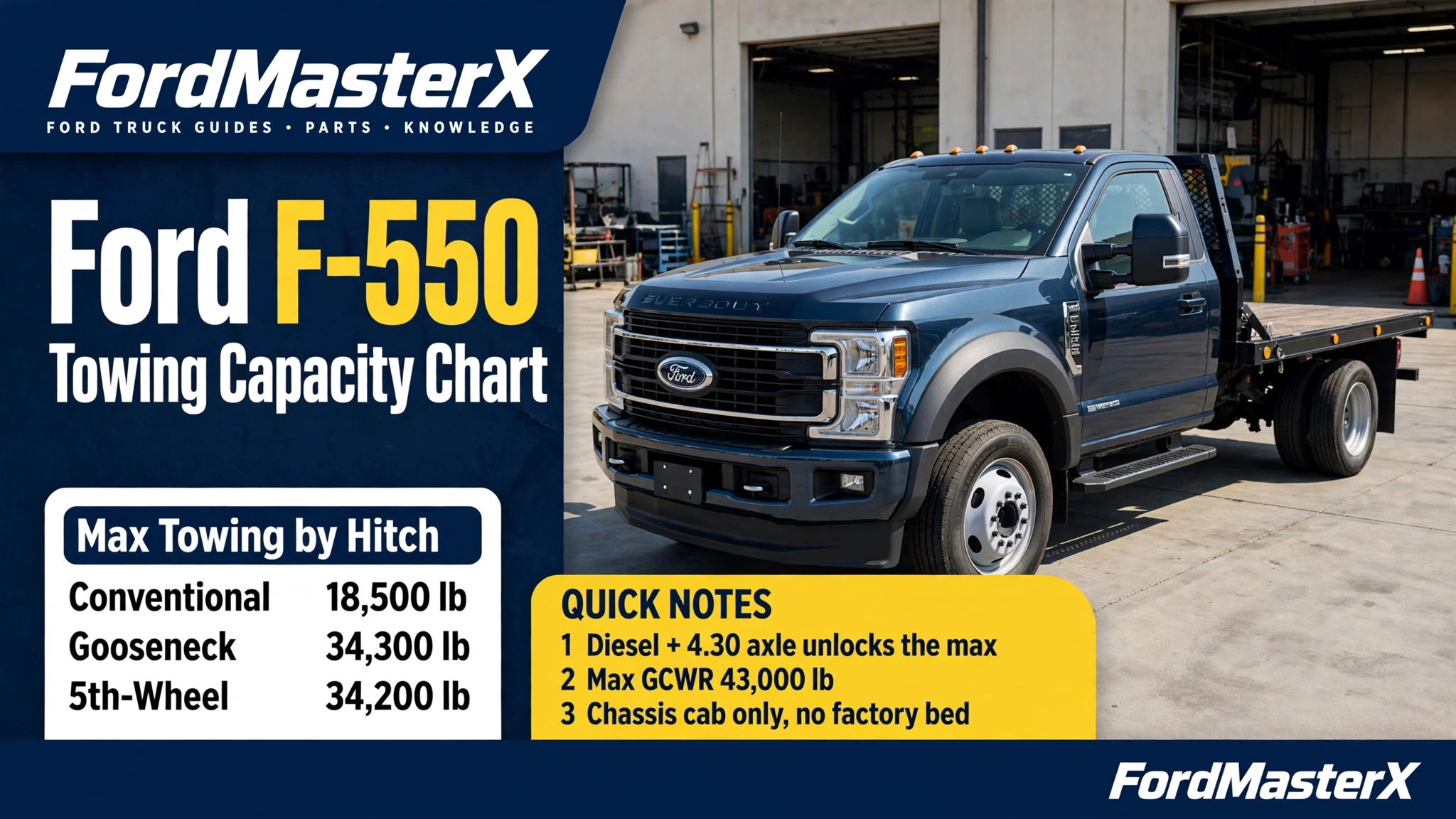
Ford F550 Towing Capacity Chart 2026: Complete Guide

The Ford F550 towing capacity chart shows a maximum conventional rating of 18,500 lb and a maximum gooseneck rating of 34,300 lb on a properly equipped 2023 or newer diesel chassis cab. Those two numbers sit at opposite ends of a wide range. Your exact rating depends on model year, engine, axle ratio, hitch type, and tow package.
Ford F550 Towing Capacity at a Glance
If you only need the headline numbers, this table has them. The conventional maximum has stayed at 18,500 lb across every year band below. The gooseneck and 5th-wheel maximums are what changed.
| Model years | Conventional max | 5th wheel max | Gooseneck max | Max GCWR |
|---|---|---|---|---|
| 2017 to 2019 | 18,500 lb | 31,800 to 31,900 lb | 31,800 to 31,900 lb | 40,000 lb |
| 2020 to 2022 | 18,500 lb | 31,600 lb | 31,600 lb | 40,000 lb |
| 2023 to 2026 | 18,500 lb | 34,200 lb | 34,300 lb | 43,000 lb |
All figures above are maximums for properly equipped trucks with the 6.7L Power Stroke diesel. Gas-engine maximums are lower for 5th-wheel and gooseneck towing.
Ford’s 2026 commercial selector also lists a 19,500 lb conventional figure in its top diesel rows. For the lighter Super Duty pickup, see our F-350 towing capacity chart PDF guide.
Ford F-550 Max Towing at a Glance
Properly equipped chassis cab • Diesel figures shown unless noted
| Model years | Engine | Conventional | 5th-wheel | Gooseneck | Max GCWR |
|---|---|---|---|---|---|
| 2017 to 2019 | 6.7L diesel | 18,500 lb | 31,900 lb | 31,900 lb | 40,000 lb |
| 2017 to 2019 | 6.8L V10 gas | 18,500 lb | 20,700 lb | 20,700 lb | 40,000 lb |
| 2020 to 2022 | 6.7L diesel | 18,500 lb | 31,600 lb | 31,600 lb | 40,000 lb |
| 2020 to 2022 | 7.3L V8 gas | 18,500 lb | 20,400 lb | 20,400 lb | 28,000 lb |
| 2023 to 2026 | 6.7L diesel | 18,500 lb | 34,200 lb | 34,300 lb | 43,000 lb |
| 2023 to 2026 | 7.3L V8 gas | 18,500 lb | 22,000 lb | 22,100 lb | 28,000 lb |
How to read it: the 34,200 lb and 34,300 lb diesel figures need the 6.7L diesel, the 4.30 axle ratio, and High-Capacity Trailer Tow Package 535 together. Ford’s 2026 selector also lists 19,500 lb conventional towing in its top diesel rows. The F-550 is a chassis cab only, and Ford offers no factory-installed conventional hitch receiver. Max payload is 12,750 lb on recent models. Source: Ford RV & Trailer Towing Guides.
What Makes the F550 Different From a Pickup
The F-550 is a chassis cab only, and Ford has never sold it with a factory pickup bed. It leaves the factory as a bare frame with a cab, and an upfitter adds a service body, flatbed, or dump bed.
That design changes how you read its towing chart. The published ratings assume a completed truck with a second-unit body installed.
Ford’s 2026 selector tables assume a body of 715 to 1,115 lb. A heavier body cuts into the usable rating, so check the door jamb sticker on your finished truck.
The F-550 comes standard with dual rear wheels. It offers Regular Cab, SuperCab, and Crew Cab layouts with wheelbases from 145.3 to 205.3 inches.
Its gross vehicle weight rating tops out at 19,500 lb. Payload is the real strength here, with a maximum of 12,750 lb on recent models.
One more difference matters for your hitch plans. Ford does not offer a factory-installed conventional hitch receiver on Super Duty chassis cabs.
Your receiver is an aftermarket or upfit part, and its own rating can sit below the truck’s 18,500 lb conventional maximum. Our Ford Transit towing capacity chart shows how the same rules work on a smaller commercial chassis.
2023 and Newer F550 Towing Capacity Chart
The 2023 redesign brought the current Super Duty chassis cab, and its ratings still stand for 2024 through 2026 models. Two engines are offered, and both use chassis-cab tunes that are milder than the pickup versions.
The 7.3L V8 gas engine makes 335 hp and 468 lb-ft of torque in the chassis cab. The 6.7L Power Stroke diesel makes 330 hp and 950 lb-ft of torque.
Do not use pickup horsepower figures for this truck. The 500 hp and 1,200 lb-ft High Output diesel is a pickup-only tune. Our 7.3L Godzilla torque specs page covers the gas engine in detail.
| Engine | Conventional | 5th wheel | Gooseneck | Max GCWR | Axle for max |
|---|---|---|---|---|---|
| 7.3L V8 gas, 335 hp | 18,500 lb | 22,000 lb | 22,100 lb | 28,000 lb | 4.88 |
| 6.7L Power Stroke diesel, 330 hp | 18,500 lb | 34,200 lb | 34,300 lb | 43,000 lb | 4.30 plus package 535 |
The 34,200 lb and 34,300 lb diesel figures need three things at once: the 6.7L diesel, the 4.30 axle ratio, and the High-Capacity Trailer Tow Package, code 535, which lifts GCWR to 43,000 lb. The same diesel with a 4.10 axle sits at a 34,500 lb GCWR, and its in-bed ratings fall to roughly 24,700 to 25,800 lb.
Ford’s 2026 commercial selector adds one update. Its top diesel rows list 19,500 lb for conventional towing on 43,000 lb GCWR configurations, while 5th-wheel stays at 34,200 lb and gooseneck at 34,300 lb.
A review of Ford’s 2026 commercial towing selector confirms those cells sit on Regular Cab 4×2 rows with the diesel, 4.30 axle, and packages 535 and 68M. Figures here trace to the Ford 2025 RV and Trailer Towing Guide and the Ford 2024 RV and Trailer Towing Guide.
2020 to 2022 F550 Towing Capacity Chart
The 2020 model year brought the 7.3L gas V8 and the 10-speed TorqShift automatic. The 6.2L V8 was never offered in the F-550, so these two engines are the only choices for this band.
The gas engine made 350 hp and 468 lb-ft of torque in these years. The 6.7L Power Stroke diesel made 330 hp and 825 lb-ft of torque.
| Engine | Conventional | 5th wheel | Gooseneck | Max GCWR | Axle for max |
|---|---|---|---|---|---|
| 7.3L V8 gas, 350 hp | 18,500 lb | 20,400 lb | 20,400 lb | 28,000 lb | 4.88 |
| 6.7L Power Stroke diesel, 330 hp | 18,500 lb | 31,600 lb | 31,600 lb | 40,000 lb | 4.88 |
Conventional towing stayed flat at 18,500 lb for both engines. The diesel’s advantage shows up only in the bed.
A diesel F-550 with the 4.88 axle and a 40,000 lb GCWR tows 31,600 lb on a 5th-wheel or gooseneck. The gas truck stops at 20,400 lb, a gap of 11,200 lb.
Payload matched the current truck at 12,750 lb, and Crew Cab trucks rate a few hundred pounds below Regular Cab trucks.
If you own a 2020 to 2022 truck, the diesel is also the engine to watch for long-term upkeep. Our 6.7L Power Stroke problems by year guide lists the issues owners report most.
2017 to 2019 F550 Towing Capacity Chart
The 2017 to 2019 trucks ran the previous chassis cab with a 6-speed TorqShift automatic. The gas engine was the 6.8L SOHC V10 at 362 hp and 460 lb-ft of torque. The diesel was the 6.7L Power Stroke in its chassis-cab tune, and pickup output figures do not apply here.
| Engine | Conventional | 5th wheel | Gooseneck | Max GCWR | Axle for max |
|---|---|---|---|---|---|
| 6.8L V10 gas, 362 hp | 18,500 lb | 20,600 to 20,700 lb | 20,600 to 20,700 lb | 40,000 lb | 4.88 |
| 6.7L Power Stroke diesel | 18,500 lb | 31,800 to 31,900 lb | 31,800 to 31,900 lb | 40,000 lb | 4.88 |
The small range in the diesel column reflects model year. The 2017 diesel tops out at 31,800 lb for 5th-wheel and gooseneck towing, and the 2019 diesel reaches 31,900 lb.
The gas V10 tops out near 20,600 to 20,700 lb. Maximum payload was 12,730 lb here, just 20 lb below the later trucks.
These older trucks are now common buys on the used market, and their chart is easy to misread. Match the engine code on the truck in front of you to the row above.
The figures here come from the Ford 2017 RV and Trailer Towing Guide and the 2019 F-550 year charts published by TheCarTowing.
Conventional vs Gooseneck vs Fifth Wheel Towing
Your hitch type decides which column of the chart applies, and the gap between columns is huge. Conventional towing connects the trailer to a receiver at the rear of the truck, while gooseneck and 5th-wheel towing connect it over the rear axle.
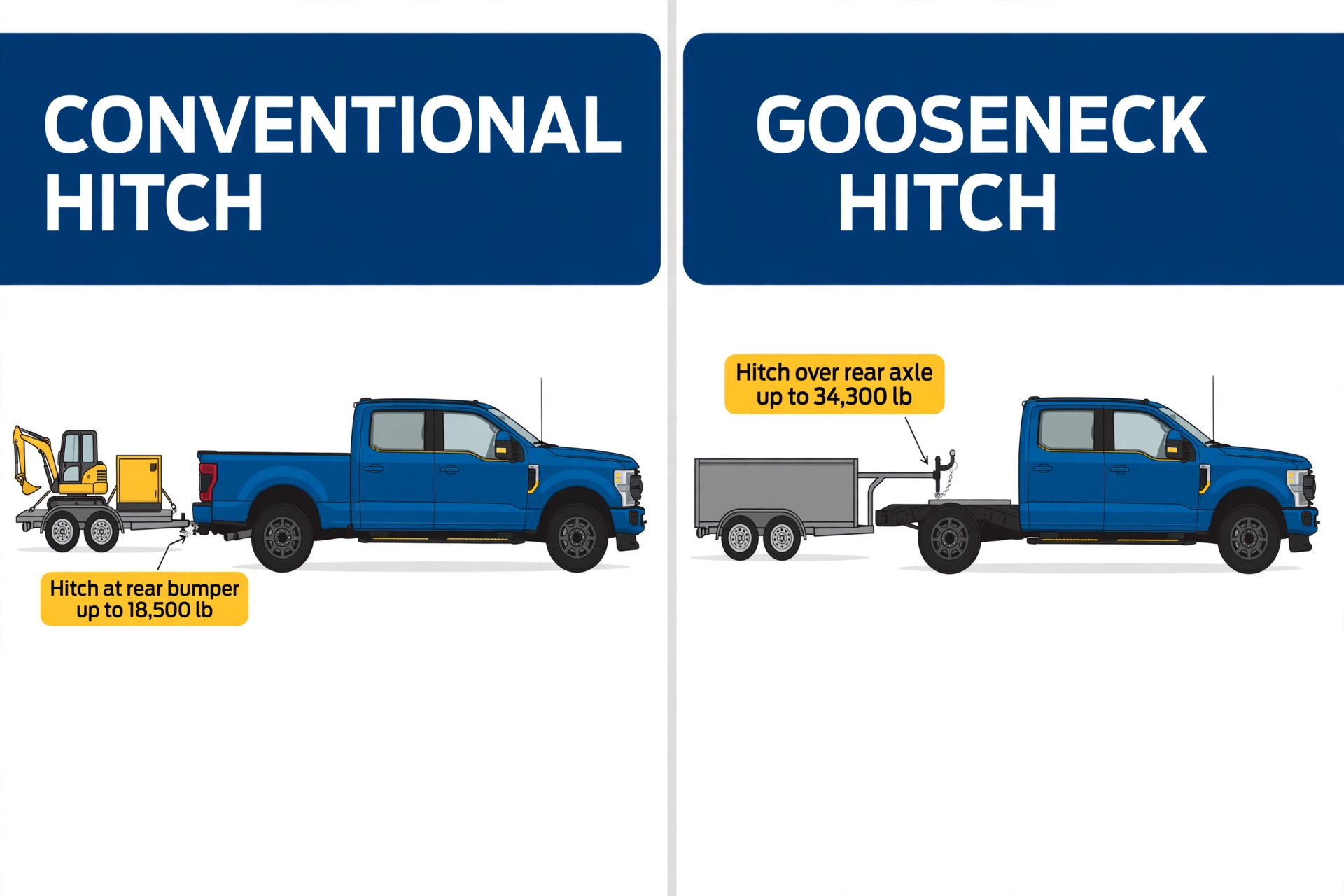 Generated diagram: conventional hitch at the rear bumper rates up to 18,500 lb, while a gooseneck hitch over the rear axle rates up to 34,300 lb on a properly equipped diesel F-550.
That position over the axle steadies the trailer and lets Ford certify a far higher rating. Conventional towing fits lighter equipment, utility, and boat trailers, with a tongue weight near 10 percent of the loaded trailer weight.
Gooseneck towing fits the heaviest loads, from large equipment trailers to big livestock trailers. The coupler sits on a ball mounted in the bed, over the rear axle.
Fifth-wheel towing works the same way with a kingpin and jaw hitch instead of a ball. Its rating sits 100 lb below the gooseneck figure on current diesel trucks.
5 Factors That Change Your F550 Tow Rating
No single number describes an F-550. Five factors decide which chart cell is yours.
Engine Choice
The diesel costs more up front, and it earns that money only when you tow heavy in the bed. On a 2023 or newer truck it adds about 12,200 lb of gooseneck capacity over the gas engine.
Axle Ratio
A numerically higher axle ratio raises the certified tow rating. The 4.30 ratio unlocks the top diesel ratings on current trucks, while the 4.10 ratio drops the same truck into a lower GCWR band.
GCWR and Tow Package
GCWR is the maximum combined weight of your loaded truck and your loaded trailer. It is the ceiling that no hitch rating can exceed.
Package 535, the High-Capacity Trailer Tow Package, lifts a current diesel F-550 to a 43,000 lb GCWR. Our 2024 F-250 towing capacity chart shows the same pairing on the lighter Super Duty.
Cab and Wheelbase
A heavier cab or a longer wheelbase adds curb weight, and that weight comes straight out of your available capacity. Regular Cab trucks hold the highest ratings, and Crew Cab trucks rate a few hundred pounds lower.
Installed Body Weight
Your upfit body is part of the truck once it is bolted on. A steel service body weighs far more than an aluminum flatbed, and Ford’s tables assume a body of only 715 to 1,115 lb.
How to Read Your F550 Towing Chart in 4 Steps
Follow these steps with your own truck to land on one exact number instead of a range.
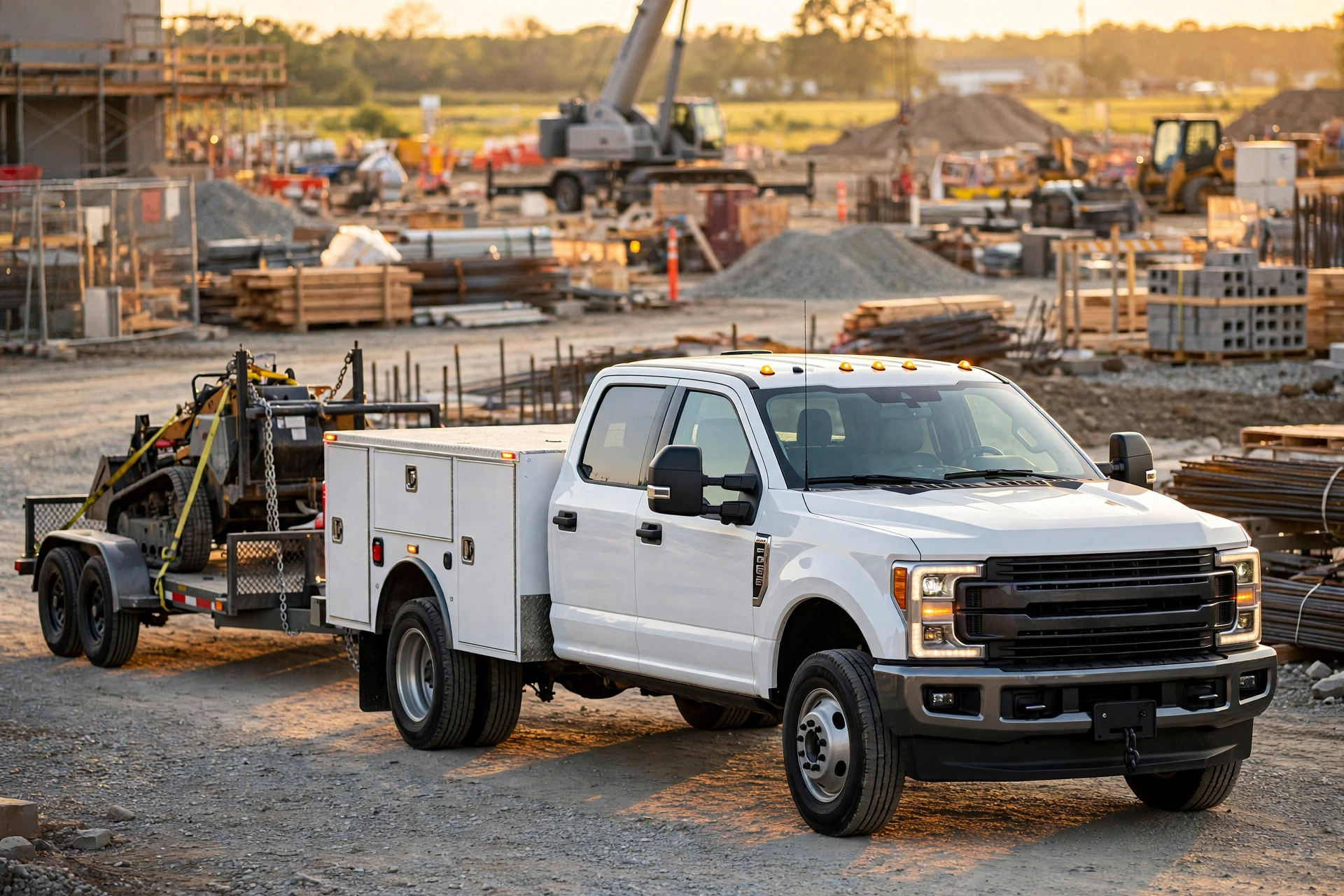 Generated photo: an F-550 chassis cab with a utility service body towing an equipment trailer at a construction site.
Step 1. Find your truck’s facts. Read the door jamb sticker for the axle code, GVWR, and payload. Note the model year, engine, cab, drive type, and wheelbase.
Step 2. Open the guide for your model year. Ford publishes one RV and Trailer Towing Guide per year, so use the guide that matches your truck.
Step 3. Match your configuration in the chassis cab tables. Find the F-350, F-450, F-550, and F-600 Chassis Cab section. Read down to your engine and axle ratio, then across to your cab and wheelbase.
Step 4. Read the column for your hitch and check the real weights. Take the figure from the column for your hitch. Then subtract your actual body weight above Ford’s assumption, and confirm your receiver or gooseneck ball is rated at least that high.
Payload and GCWR Limits You Must Not Ignore
Towing capacity and payload are independent ratings, and you can break one while obeying the other. Payload covers everything the truck carries, including passengers, tools, the upfit body, and trailer pin weight. A gooseneck trailer at 34,300 lb can press more than 5,000 lb onto the pin.
The F-550 carries a maximum payload of 12,750 lb on recent models and a 19,500 lb GVWR. That is a large margin, yet a heavy steel body plus a full crew can still reach it. Weigh the truck loaded for work if you tow near the maximum.
GCWR is the other hard ceiling. A current diesel F-550 tops out at 43,000 lb of combined truck and trailer.
A 2017 to 2022 diesel tops out at 40,000 lb. Your loaded truck plus your loaded trailer must stay under that number, even if each one sits under its own rating.
Trailers also carry a frontal area limit of 75 square feet for 5th-wheel and gooseneck combinations and 60 square feet for other trailers.
F550 vs F450 Towing Compared
Buyers often compare these two trucks: the F-450 pickup tows more, while the F-550 chassis cab carries more and adapts to more jobs.
| Rating | F-450 pickup | F-550 chassis cab |
|---|---|---|
| Max gooseneck towing | 40,000 lb | 34,300 lb |
| Max conventional towing | 21,000 lb | 18,500 lb |
| Max payload | About 6,000 lb | 12,750 lb |
| Factory pickup bed | Yes | No, chassis cab only |
The F-450 pickup wins on pure trailer weight, with a 40,000 lb gooseneck maximum. The F-550 wins on payload by more than double, and it accepts bodies the F-450 cannot.
Our best Ford truck for towing guide ranks the whole Super Duty range, and our F-450 towing capacity page has the F-450 chart in full.
Common F550 Towing Mistakes to Avoid
Using pickup ratings for a chassis cab. The F-450 pickup’s 40,000 lb gooseneck figure does not apply here. The F-550 maximum is 34,300 lb.
Forgetting the body weight. A heavy upfit body eats payload and GCWR headroom. Ford’s tables assume a 715 to 1,115 lb body.
Ignoring the receiver rating. The F-550 has no factory receiver, so the upfit receiver sets the conventional limit. A 10,000 lb receiver caps you at 10,000 lb even though the chart says 18,500 lb.
Assuming the top rating applies to every diesel. The 34,300 lb figure needs the diesel, the 4.30 axle, and package 535 together. A diesel with the 4.10 axle rates near 25,000 lb on a gooseneck.
Skipping the GCWR math. Add your loaded truck weight to your loaded trailer weight. If the sum passes 43,000 lb on a current diesel or 40,000 lb on an older one, you are over the limit.
Frequently Asked Questions
What is the maximum towing capacity of a Ford F-550? A properly equipped 2023 or newer diesel F-550 tows up to 34,300 lb on a gooseneck and 18,500 lb on a conventional hitch. That needs the 6.7L diesel, 4.30 axle, and High-Capacity Trailer Tow Package.
Can a Ford F-550 tow 40,000 lb? No. The 40,000 lb gooseneck figure belongs to the F-450 pickup, not the F-550. The F-550 chassis cab tops out at 34,300 lb on a gooseneck hitch and 34,200 lb on a 5th-wheel hitch.
Is the Ford F-550 a pickup truck? No. The F-550 is sold only as a chassis cab, with no factory bed. It leaves the factory as a frame and cab so an upfitter can add a service body, flatbed, or dump bed.
Which F-550 engine tows the most? The 6.7L Power Stroke diesel tows the most in every year band, reaching 34,300 lb on a gooseneck against 22,100 lb for the 7.3L gas V8.
What is the GCWR of a Ford F-550? Maximum GCWR is 43,000 lb on a 2023 or newer diesel with the 4.30 axle and package 535. Diesel trucks from 2017 to 2022 top out at 40,000 lb; gas trucks sit near 28,000 lb.
The Bottom Line on F550 Towing
The Ford F550 towing capacity chart gives you one clear headline and a set of conditions behind it. A current diesel chassis cab with the right axle and tow package pulls 34,300 lb on a gooseneck and 18,500 lb on a conventional hitch.
Older trucks pull less in the bed but hold the same 18,500 lb conventional figure. Match your model year, engine, axle ratio, and hitch type to the tables above, then confirm the real weights on your finished truck.