
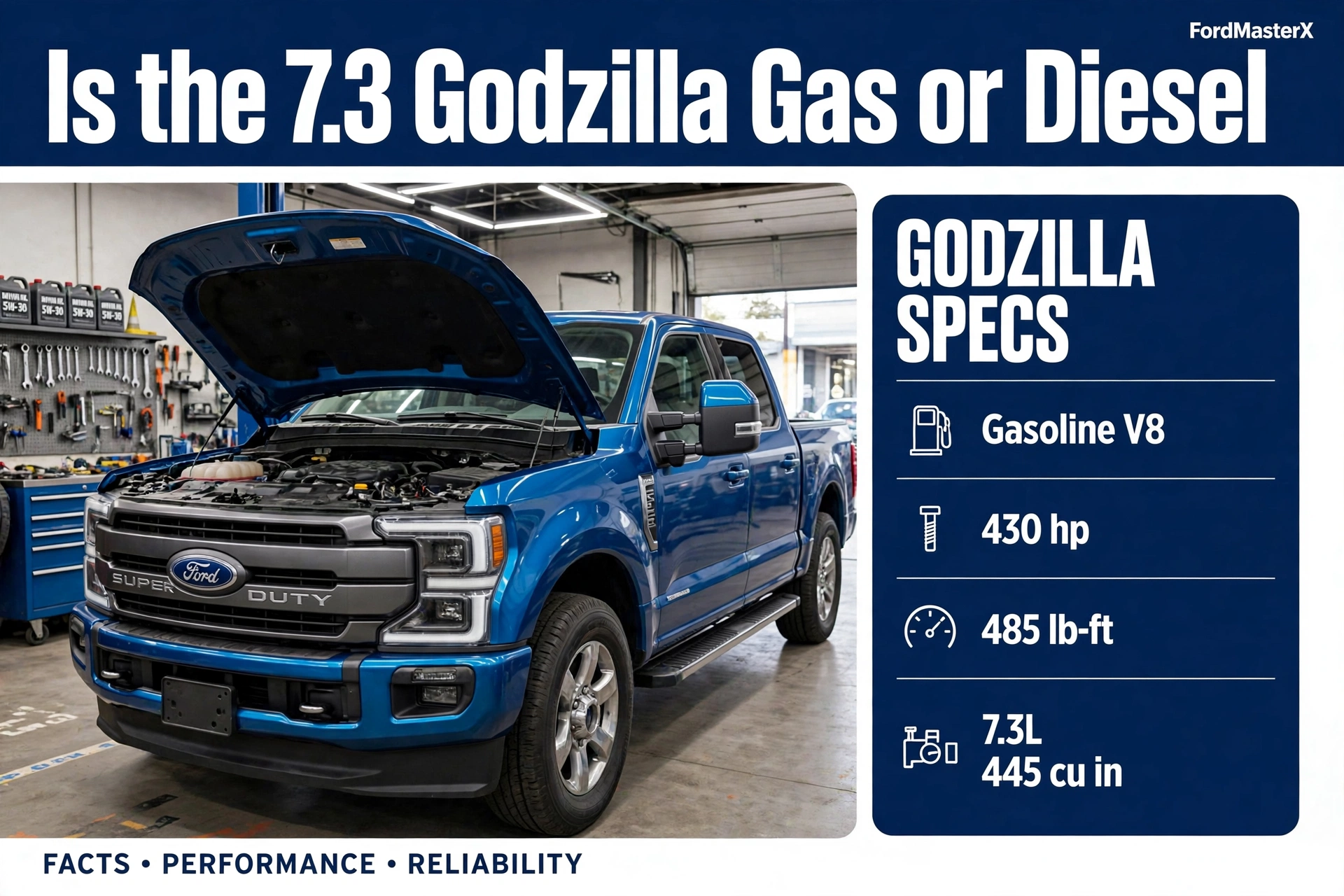
Is the 7.3 Godzilla Gas or Diesel 2026 Definitive Answer

Is the 7.3 Godzilla gas or diesel? It is gasoline. The 7.3 liter Godzilla is a gasoline burning pushrod V8 that Ford builds for Super Duty trucks, and it has never burned diesel fuel.
The confusion is easy to understand, and it trips up a lot of buyers. Ford sold a famous 7.3 liter diesel for 15 years before this engine existed, so the number 7.3 sounds like diesel to anyone who grew up around Ford trucks.
This guide gives you the direct answer first, then the proof. You will see the real specifications, why the two 7.3 liter engines share nothing but a number, and how to tell them apart in 30 seconds at a dealership or a fuel pump.
The Short Answer in 6 Facts
Six facts settle the question for most buyers. The table below holds them, and the infographic after it gives you the same facts to save or share.
| Fact | What it means for your Ford |
|---|---|
| Fuel type is gasoline | The Godzilla runs on regular unleaded gasoline, not diesel, and it has no diesel exhaust fluid tank |
| 430 horsepower | Peak power arrives at 5,500 rpm in Super Duty pickups, which is the most powerful gas engine in the Super Duty lineup |
| 485 lb-ft of torque | Peak torque arrives at 4,000 rpm in 2023 to 2026 pickups, while 2020 to 2022 pickups are rated at 475 lb-ft |
| 445 cubic inches | The 7.3 liter pushrod V8 uses a 4.22 inch bore and a 3.976 inch stroke with a 10.5 to 1 compression ratio |
| Port fuel injection | Fuel is injected into the intake ports, not directly into the cylinders, which is a gasoline engine design |
| The old 7.3 was a diesel | Ford sold 7.3 liter diesels from 1988 to 2003, with the Power Stroke name from mid-1994, and that older engine family is the whole reason for the confusion |
Godzilla Gas or Diesel At a Glance
The direct answer and the verified specifications, as published in November 2026.
| Measure | Verified figure | Result |
|---|---|---|
| Fuel type | Regular unleaded gasoline | Not a diesel engine |
| Peak power | 430 hp at 5,500 rpm | Most powerful gas Super Duty engine |
| Peak torque | 485 lb-ft at 4,000 rpm | 2023 to 2026 pickup rating |
| Earlier torque rating | 475 lb-ft at 4,000 rpm | 2020 to 2022 pickup rating |
| Displacement | 7.3 liters, 445 cubic inches | Pushrod V8 with a 10.5 to 1 ratio |
| Fuel system | Port fuel injection | Gasoline injection design |
| Old 7.3 diesel | 1988 to 2003 7.3 diesel (Power Stroke from mid-1994) | Different engine, same displacement |
Direct answer: The 7.3 Godzilla is gasoline. It is a 7.3 liter pushrod V8 that makes 430 horsepower and 485 lb-ft of torque on regular unleaded fuel, and it shares nothing with the old 7.3 liter Power Stroke diesel except the displacement number.
Sources: Wikipedia Ford Godzilla engine, Holley, Hot Rod, and Jalopnik.
One fact on its own can mislead, because a single number never tells the whole story. Knowing that the Godzilla runs on gasoline is the answer, but knowing why the name causes trouble is what keeps you from making a costly mistake.
The rest of this guide fills in the detail. You will see what the engine is made of, how it differs from every diesel Ford sells, and which truck to buy if you want one.
Why So Many People Ask This Question
The question sounds simple, but the history behind it is not. Ford used the 7.3 liter size for a diesel engine for a decade and a half, and that engine became one of the most loved diesels ever put in a pickup truck.
When Ford announced a brand new 7.3 liter engine in 2019 for the 2020 Super Duty, many owners heard the number and assumed it was a new diesel. The nickname Godzilla made it worse, because the name sounds big and heavy, and big and heavy sounds like diesel to a truck buyer.
Dealers hear the question every week, and forums are full of it. A buyer shopping for a used F-250 sees a 7.3 badge and wants to know whether the truck needs diesel fuel, diesel exhaust fluid, and diesel maintenance prices.
The answer matters at the fuel pump more than anywhere else. Putting diesel fuel into a gasoline engine, or gasoline into a diesel engine, is an expensive mistake that can cost thousands of dollars to fix.
It also matters at the time of purchase. A gas truck and a diesel truck cost different amounts to buy, to fuel, and to maintain, so buying the wrong one means living with the wrong running costs for years.
The Number Is the Only Thing the Two Engines Share
Two engines can share a displacement number and share nothing else. Displacement is only a measure of size, and Ford has reused sizes across very different engines for decades.
The old 7.3 liter diesel was built by Navistar, starting with indirect injection in the IDI and moving to direct injection with a turbocharger and a 17.5 to 1 compression ratio in the Power Stroke. The new 7.3 liter Godzilla was designed by Ford, uses port fuel injection, runs at a 10.5 to 1 compression ratio, and has no turbocharger at all.
They do not share a block, a head, a fuel system, or a single major part. They do not even share the same bore and stroke, because the diesel measured 4.11 inches by 4.18 inches while the Godzilla measures 4.22 inches by 3.976 inches.
Think of it like two houses with the same street number on different streets. The number matches, but nothing else does, and going to the wrong one gets you nowhere.
What the 7.3 Godzilla Actually Is
The Godzilla is a gasoline V8 that Ford designed from a clean sheet for heavy duty work. It arrived for the 2020 model year in Super Duty pickups, and it replaced the 6.8 liter Triton V10 that had powered big Ford trucks since 1997.
Ford went back to a pushrod design with the camshaft inside the block, which surprised the whole industry. Most modern engines use overhead camshafts, but Ford chose pushrods because they are simple, compact, cheap to build, and easy to service in a work truck.
The engine is built around a cast iron block with a forged steel crankshaft held by cross bolted main caps. The cylinder heads are aluminum, the valves are large, and a single cam phaser gives the engine variable cam timing.
That combination is why the engine makes so much low end torque. Hot Rod notes that the Godzilla makes more than 400 lb-ft of torque from 1,500 rpm all the way to 5,500 rpm, so the truck pulls hard without needing to rev high.
The Wikipedia page for the Ford Godzilla engine lists the full family, including the 6.8 liter version and the high output Megazilla crate engine. The pickup version is the one most buyers meet, and it is the strongest gasoline engine Ford offers in a Super Duty.
The Numbers That Matter
The table below lists the Godzilla ratings by year and application, because Ford does not sell one single tune. The pickup tune makes the most power, while vans, chassis cabs, and medium duty trucks trade peak power for low rpm torque and economy.
| Application | Years | Horsepower | Torque |
|---|---|---|---|
| Super Duty pickup | 2020 to 2022 | 430 hp at 5,500 rpm | 475 lb-ft at 4,000 rpm |
| Super Duty pickup | 2023 to 2026 | 430 hp at 5,500 rpm | 485 lb-ft at 4,000 rpm |
| Super Duty pickup | 2027 | 420 hp at 5,350 rpm | 445 lb-ft at 4,250 rpm |
| Chassis cab and medium duty | 2020 to 2026 | 335 hp at 3,750 rpm | 468 lb-ft at 3,750 rpm |
| E-Series van, economy tune | 2021 to 2023 | 300 hp at 3,750 rpm | 425 lb-ft at 3,250 rpm |
| E-Series van, premium tune | 2021 and later | 325 hp at 3,750 rpm | 450 lb-ft at 3,750 rpm |
| 6.8 liter Mini-Zilla gas V8 | 2023 and later | 405 hp at 5,000 rpm | 445 lb-ft at 4,000 rpm |
Two details in that table catch buyers by surprise. First, the torque rating rose from 475 to 485 lb-ft for the 2023 model year, so a 2023 or newer pickup has the strongest factory Godzilla tune. Second, Ford retuned the engine down to 420 horsepower and 445 lb-ft for 2027 to meet newer emissions rules, and the Godzilla became the only gas engine in the Super Duty lineup that year.
The engine is paired with a 10 speed TorqShift automatic transmission in Super Duty pickups. The transmission keeps the engine in its strong torque range, which is why the truck tows well even though the engine has no turbocharger.
Hot Rod calls the Godzilla a modern primitive small block, and the label fits. It is a big, simple, naturally aspirated V8 in a world of turbocharged and hybrid engines, and that simplicity is the whole point of the design.
The Hot Rod deep dive on the Godzilla explains how Ford built the engine for maximum durability in harsh conditions. The article quotes Ford engineers who say the engine was designed for customers who live and work with their trucks every day.
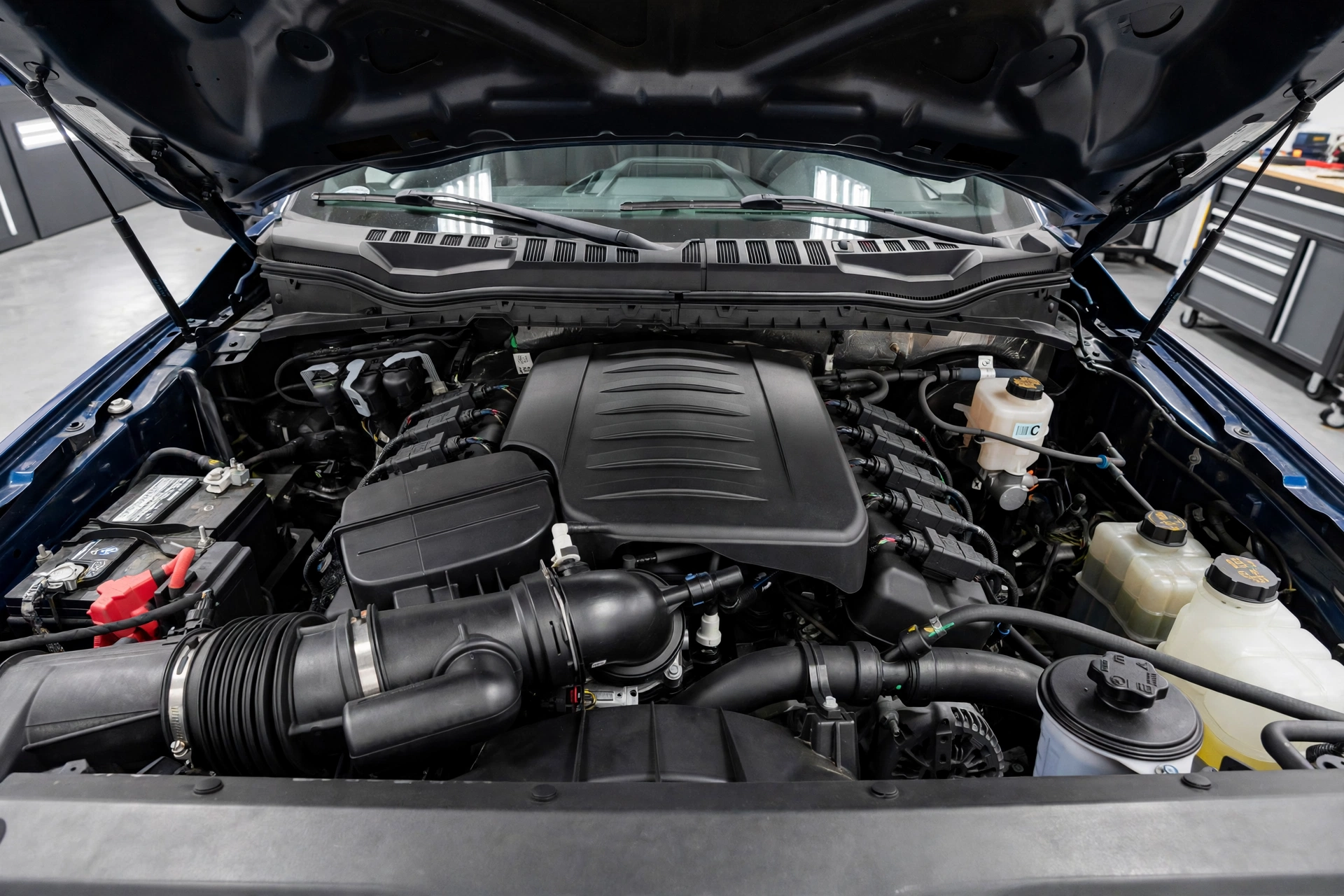
AI-generated illustration: a Ford 7.3L Godzilla V8 gasoline engine in an F-250 Super Duty engine bay.
Why Ford Built a Pushrod Gas V8 in 2020
Ford built the Godzilla because Super Duty buyers wanted a strong gas engine without the price and complexity of a diesel. The old V10 was thirsty and aging, and the 6.2 liter Boss V8 was not strong enough for the heaviest gas trucks.
A pushrod engine is narrower than an overhead cam engine, so it fits easily in a truck engine bay and leaves room for service work. It also has fewer moving parts in the valve train, which means fewer parts to wear out and lower repair bills.
The design also makes the engine cheap to rebuild, which matters to fleet buyers who run trucks for hundreds of thousands of miles. Ford has said the engine is easier and more cost effective to rebuild than the V10 it replaced.
The engine responds well to simple modifications, and a cam, intake, and exhaust are the usual first steps. That aftermarket support is a bonus, but the stock engine is already strong enough for most towing work.
The Holley guide to the 7.3L Godzilla covers the block, the heads, and the rotating assembly in detail. It confirms the 445 cubic inch displacement, the 4.22 inch bore, the 3.976 inch stroke, and the cast iron block with cross bolted mains.
Our guide to the best Ford gas engine for towing puts the Godzilla at the top of the gas list for heavy trailers. If your trailer is heavy enough to need a Super Duty, the Godzilla is the gas engine to shop for.
Gas or Diesel: How to Tell in 30 Seconds
You do not need a mechanic to answer this question on a real truck. Five quick checks tell you the fuel type in less than a minute, and they work on any Super Duty on a dealer lot.
Start with the fuel door. A gasoline Super Duty has a fuel filler sized for a gasoline nozzle, and the fuel cap or door often says unleaded fuel only. A diesel Super Duty has a larger filler neck, a green diesel cap in many years, and a separate smaller cap nearby for diesel exhaust fluid.
Next, look under the hood for the engine cover and the badges. The Godzilla wears a 7.3L gas V8 identity in Ford literature, while a diesel truck carries Power Stroke badges on the fenders and the tailgate. A truck with a Power Stroke badge is a diesel, and a truck with no Power Stroke badge and a 7.3 liter gas engine is a Godzilla.
Then listen to the engine at idle. A diesel Power Stroke has a distinct clatter at idle that comes from compression ignition, while the Godzilla idles with the smooth, low sound of a gasoline V8. The difference is obvious once you have heard both, and a dealer will start the truck for you if you ask.
Check the window sticker or the build sheet if the truck is new or certified. The sticker lists the engine by name, and it will say 7.3L gas V8 for a Godzilla truck or 6.7L Power Stroke diesel V8 for a diesel truck. Never trust a sales listing alone, because listings mix the two engines up more often than you would expect.
Finally, look at the exhaust. A diesel Super Duty has a diesel particulate filter and a diesel exhaust fluid system, and the exhaust tip and the fluid filler are the visible signs. A Godzilla truck has a plain gasoline exhaust with no fluid tank and no regeneration cycle.
- Open the fuel door. A gasoline filler and an unleaded fuel label mean gas, while a large filler plus a fluid cap means diesel.
- Read the badges. Power Stroke on the fender means diesel, and no Power Stroke badge with a 7.3 liter engine means a Godzilla gas V8.
- Listen at idle. A diesel clatters, and a gas V8 rumbles smoothly, so the sound alone settles most arguments.
- Read the window sticker. The sticker names the engine exactly, and it is the most reliable check on a truck for sale.
- Look for the fluid tank. A diesel exhaust fluid filler near the fuel door means diesel, and its absence means gas.
Run all five checks when you shop, not just one. A debadged truck or a swapped engine cover can fool a single check, but five checks together will not lie.
The Old 7.3 Power Stroke Diesel Explained
The old 7.3 liter diesel is the reason this question exists at all, and it deserves its own section. Ford started putting 7.3 liter diesel engines in its trucks in 1988, and the engine stayed in production in one form or another until 2003.
The first version was the 7.3 liter IDI, which stands for indirect injection. It was a naturally aspirated diesel built by Navistar, and it made 180 horsepower and 338 lb-ft of torque. A turbocharged version followed in 1993 with 190 horsepower and 388 lb-ft.
Halfway through the 1994 model year, Ford replaced the IDI with the 7.3 liter Power Stroke. The Power Stroke was a direct injection turbo diesel with a HEUI fuel system, which used high pressure engine oil to fire the injectors, and it made 210 horsepower and 425 lb-ft of torque at launch.
Ford improved the Power Stroke over the years, adding an intercooler and better injectors. By the end of production in 2003, the manual transmission version made 275 horsepower and 525 lb-ft of torque, while the automatic version made 250 horsepower and 505 lb-ft.
The engine earned a reputation for exceptional durability, and it is still one of the most loved diesels Ford ever sold. Nearly 2 million were built, and clean low mileage examples now sell for a premium because owners trust them to last.
The 7.3 Power Stroke was replaced by the 6.0 liter Power Stroke during the 2003 model year, and the 6.0 had a very different reputation. Our guide to Ford diesel engines to avoid explains which later diesels caused owners trouble, and it is worth reading before you shop for any used diesel Ford.
That history is why the name causes so much confusion. For 15 years, saying 7.3 in a Ford truck meant diesel, and it meant a specific, beloved diesel. The Godzilla reused the number in 2020, and a whole generation of buyers had to relearn what 7.3 means.
Godzilla vs the Old 7.3 Diesel Side by Side
The table below puts the two engines next to each other so the differences are easy to see. Every row is a real difference, and any single row is enough to tell them apart.
| Feature | 7.3 Godzilla, 2020 and later | 7.3 diesel, 1988 to 2003 (Power Stroke from mid-1994) |
|---|---|---|
| Fuel type | Gasoline, regular unleaded | Diesel fuel only |
| Builder | Ford | Navistar, built for Ford |
| Displacement | 7.3 liters, 445 cubic inches | 7.3 liters, 444 cubic inches |
| Bore and stroke | 4.22 by 3.976 inches | 4.11 by 4.18 inches |
| Compression ratio | 10.5 to 1 | 17.5 to 1 |
| Fuel system | Port fuel injection | Direct injection, HEUI on Power Stroke |
| Forced induction | None, naturally aspirated | Turbocharger on Power Stroke |
| Peak power | 430 hp at 5,500 rpm | 210 to 275 hp by year |
| Peak torque | 475 to 485 lb-ft at 4,000 rpm | 425 to 525 lb-ft by year |
| Emissions system | Standard gasoline catalyst | No diesel particulate filter, no fluid tank |
| Vehicles | Super Duty, E-Series, chassis cab | F-Series, E-Series, Excursion |
The compression ratio row is the clearest technical proof. A diesel engine needs very high compression to ignite fuel without a spark plug, so the old 7.3 ran at 17.5 to 1. The Godzilla runs at 10.5 to 1, which is a normal gasoline ratio, and it uses spark plugs like any other gas engine.
The fuel system row is just as clear. Port fuel injection sprays gasoline into the intake port at low pressure, while the Power Stroke used a high pressure oil system to fire diesel injectors directly into the cylinders. Those are two different worlds of engineering.
The power figures also tell the story. The Godzilla makes far more horsepower than the old diesel ever did, but the old diesel made its torque much lower in the rev range. That is the classic gas versus diesel split, and it is still true today.
Godzilla vs the 6.7 Power Stroke Diesel
The real choice for a new Super Duty buyer is not Godzilla versus the old 7.3 diesel. It is Godzilla versus the 6.7 liter Power Stroke diesel, which is the diesel Ford sells today, and the two engines suit different buyers.
The 6.7 liter Power Stroke makes 475 horsepower and 1,050 lb-ft of torque in standard form. The High Output version makes 500 horsepower and 1,200 lb-ft of torque, which is more than double the torque of the Godzilla.
That torque gap shows up when you tow heavy. A properly equipped Super Duty with the High Output diesel can tow up to 40,000 pounds with a gooseneck hitch, while a Godzilla truck tops out far lower. If you tow a heavy fifth wheel every week, the diesel is the right tool.
The Godzilla fights back on price and simplicity. It costs thousands of dollars less than the diesel option on the window sticker, and it has no turbocharger, no diesel particulate filter, and no diesel exhaust fluid to buy or refill.
Fuel economy splits the same way. Owner reports commonly put 6.7 liter diesel trucks between 12 and 18 miles per gallon, while Godzilla trucks land between 8 and 14 miles per gallon. The diesel goes further on a gallon, but diesel fuel often costs more per gallon than gasoline, so the per mile cost is closer than the raw numbers suggest.
Our guide to how much horsepower the 6.7 Power Stroke has covers the current diesel ratings in full. Read it next to this article if you are choosing between the two engines for a new truck.
Maintenance is where the gas engine wins for many owners. A Godzilla oil change uses standard gasoline engine oil and a standard filter, and the service is quick and cheap. A diesel oil change uses more oil, costs more, and comes with fuel filters, a fluid system, and emissions parts that the gas truck simply does not have.
Our guide to the best oil for the Ford 6.7 diesel shows what diesel maintenance looks like in practice. Compare that with a Godzilla service, and the simplicity of the gas engine becomes obvious.
Reliability is a draw so far, with a small edge to the gas engine on repair costs. The Godzilla is a young engine with a simple design, and its most common complaints are minor, while the 6.7 diesel is proven but carries expensive emissions parts that can fail out of warranty.
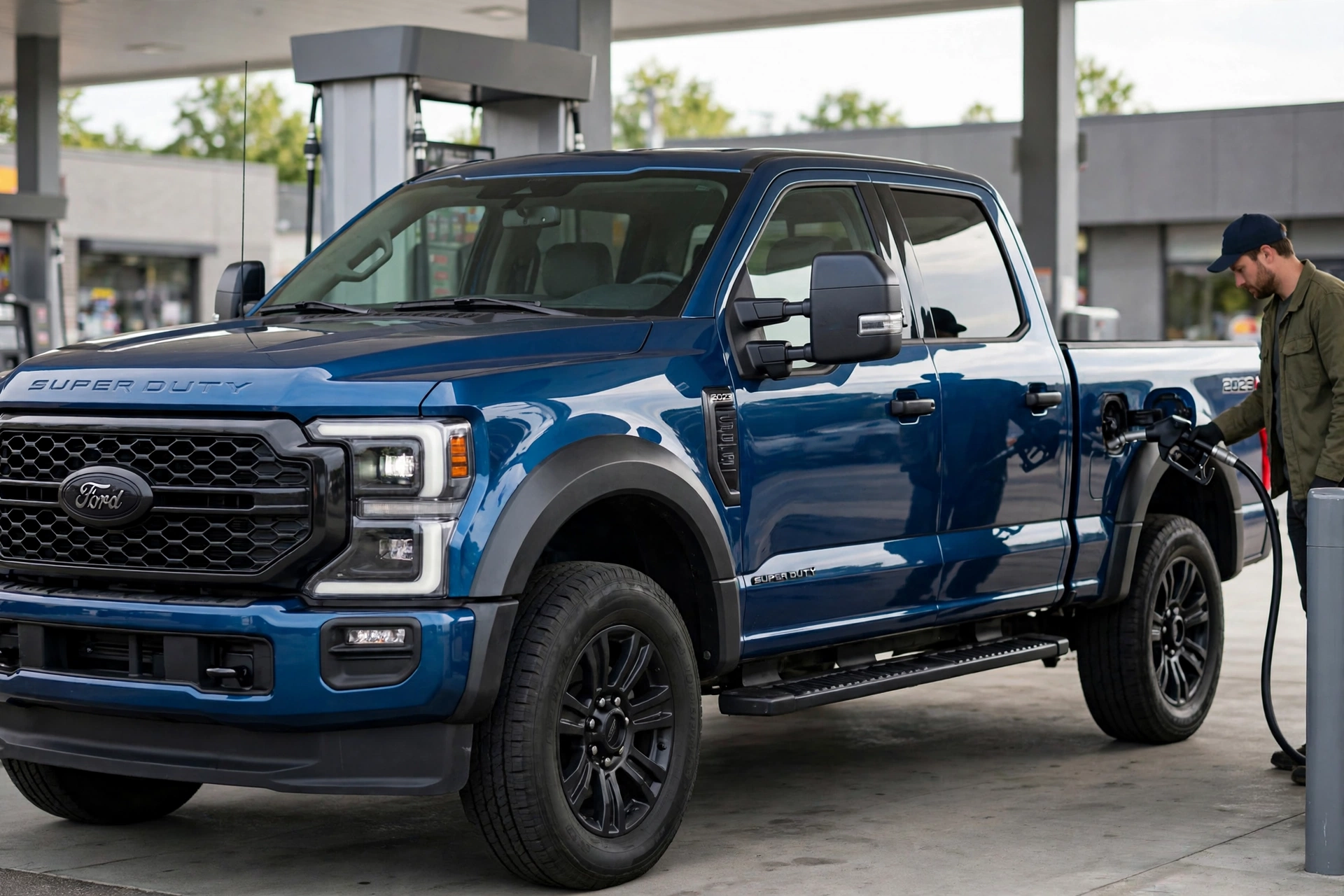
AI-generated illustration: a blue Ford F-250 Super Duty filling up with regular unleaded gasoline at a fuel pump.
Who Should Pick the Gas Engine
Pick the Godzilla if you tow occasionally, drive mostly unloaded, or keep trucks for a long time and want low repair bills. The gas engine is the better choice for a truck that works hard on weekends and commutes during the week.
Pick the diesel if you tow heavy trailers often, tow at high altitude, or run a truck commercially with a loaded trailer every day. The diesel torque, the exhaust brake, and the fuel economy under load are worth the extra purchase price in that use.
There is no wrong answer for a buyer who is honest about the workload. The mistake is buying a diesel for a job a gas truck would do, or buying a gas truck for a job that needs a diesel, so match the engine to the trailer before you sign anything.
Godzilla vs the 6.8 Mini-Zilla
Ford sells two gas V8 engines in the Super Duty, and buyers often mix them up too. The 6.8 liter V8 is the standard gas engine on XL, XLT, and Lariat trims, while the 7.3 liter Godzilla is standard on King Ranch and Platinum and optional on the lower trims.
The 6.8 liter engine is a smaller version of the same Godzilla family, and Ford fans call it the Mini-Zilla. It makes 405 horsepower and 445 lb-ft of torque, which is 25 horsepower and 40 lb-ft less than the Godzilla in the 2023 to 2026 pickup tune.
The two engines share a 4.22 inch bore, but the 6.8 uses a shorter 3.68 inch stroke and a higher 10.8 to 1 compression ratio. Both use a cast iron block, pushrods, and port fuel injection, so they feel similar to drive and service.
Jalopnik explains the difference clearly in its comparison of the two engines. For 2026, the 6.8 is the value gas engine and the 7.3 is the stronger gas engine, and the upgrade costs about 1,500 dollars on trims where it is optional.
The Jalopnik comparison of the 6.8 and 7.3 Godzilla V8 engines is the best single source for the two engines side by side. It confirms the 2026 ratings, the price of the upgrade, and the shared pushrod design.
Choose the 6.8 if your trailer is light and your budget is tight, because it does the same work for less money. Choose the 7.3 if you tow near the limits of a gas truck, because the extra torque shows up on every hill and every highway merge.
Ford also makes smaller gas engines for its lighter trucks, and they work very differently from the Godzilla. Our guide to the 2.3 liter EcoBoost four cylinder shows how a small turbocharged gas engine makes its power, which is the opposite approach to the big naturally aspirated Godzilla.
Which Trucks Get the Godzilla
The Godzilla is a Super Duty engine first, and that is where most buyers will find it. It is available in the F-250, F-350, F-550, and F-600, and in F-450 chassis cabs, and it is the strongest gasoline engine in that lineup.
The engine is also available in the E-Series vans and cutaways, where it powers delivery vans, shuttle buses, and motorhome chassis. The van tunes make less peak power, but they are built for low rpm torque and long service life in commercial use.
Ford Performance sells the Godzilla as a crate engine for swaps and custom builds, and the aftermarket has embraced it. Builders have put the engine into Mustangs, Broncos, older F-Series trucks, and even Cobra replicas, because the pushrod design is narrow and simple to fit.
The Godzilla is not available in the F-150, the Ranger, the Bronco, or the Mustang from the factory. The F-150 uses smaller gas engines and the 3.5 liter EcoBoost V6, while the Ranger uses four cylinder engines, so a Godzilla badge on a light truck means a swap, not a factory engine.
Our guide to whether the Ford Ranger is a good truck covers the small end of the Ford truck range. It is a useful contrast, because the Ranger is built for light work while the Godzilla is built for the heaviest gas towing Ford offers.
When you shop, check the trim and the window sticker together. A King Ranch or Platinum Super Duty carries the Godzilla as standard equipment, while an XL, XLT, or Lariat may carry the 6.8 gas V8 or a 6.7 diesel instead, so the trim alone never proves the engine.
Bed and cab choices do not change the engine, but they change what the truck can tow and carry. Our Ford truck bed dimensions chart helps you match the bed length to your trailer and your cargo before you choose an engine.
Gas or Diesel: Which Should You Buy
The choice comes down to three questions, and you should answer all three before you visit a dealer. How heavy is your trailer, how often do you tow it, and how long will you keep the truck.
A trailer under 12,000 pounds towed a few times a month is Godzilla territory. The gas engine pulls it easily, costs less to buy, and costs less to maintain, so the diesel advantage never pays for itself.
A trailer over 15,000 pounds towed every week is diesel territory. The 6.7 liter Power Stroke tows it with less strain, holds speed better on grades, and returns better fuel economy under load, so the higher purchase price earns its keep.
Daily driving favors the gas engine. Short trips and cold starts are hard on a diesel emissions system, because the particulate filter needs long hot runs to clean itself, while a gas engine does not care about trip length at all.
Long highway towing favors the diesel engine. The turbo diesel holds speed on grades with less effort, and the exhaust brake helps control a heavy trailer on long descents, which is a real safety advantage with a big load.
Resale value favors the diesel slightly, because used diesel Super Duty trucks hold their value well when they are well maintained. The Godzilla holds its value well too, and its simpler design may age better as emissions rules get stricter.
Our Ford F-150 towing capacity chart is worth a look if you are cross shopping a half ton truck against a Super Duty. Many buyers find that a well equipped F-150 tows their trailer, and that saves them from buying a Super Duty at all.
If a Super Duty is more truck than you need, a lighter used truck can be the smarter buy. A used 2012 Ford F-150 FX4 shows what a half ton off road package offers, and it costs far less than any new Super Duty while still towing a useful load.
What Towing With a Godzilla Feels Like
A Godzilla truck tows with a relaxed, old school feel. The engine makes its torque low in the rev range, so it pulls away from a stop without drama, and the 10 speed transmission keeps it in the strong part of the power band on the highway.
On a steep grade the engine will rev higher than a diesel, and that surprises drivers who are used to turbo diesels. The higher revs are normal, and the engine is built to sustain them, so do not back off the throttle just because the sound changes.
Fuel stops come more often when you tow with gas. A Godzilla truck towing a heavy trailer can use fuel at a fast rate, so plan fuel stops on long trips and keep the tank above a quarter full in remote areas.
The 10 speed transmission does a lot of the work for you. Tow Haul mode changes the shift points, holds gears longer on grades, and adds engine braking on descents, so switch it on every time you hook up a trailer.
Maintenance and Running Costs
A Godzilla service is simple and cheap by Super Duty standards. The engine uses standard 5W-30 motor oil, a standard oil filter, and spark plugs that last for a long service interval, and there is no diesel exhaust fluid to buy.
Our guide to how much an oil change costs covers typical prices for a Ford truck service. A Godzilla oil change sits at the low end of the Super Duty range, while a diesel service sits at the high end.
Fuel costs depend on where you live and how you drive. Gasoline is usually cheaper per gallon than diesel, and the Godzilla runs happily on regular unleaded, so you never pay for premium fuel or for diesel exhaust fluid.
Insurance and registration costs are similar for gas and diesel trucks of the same trim, so the running cost gap comes from fuel and maintenance, not from paperwork. The purchase price gap is the biggest difference, and it is the one to weigh first.
Common Mistakes and Myths
The most expensive mistake is putting the wrong fuel in the tank. Diesel fuel in a gasoline engine, or gasoline in a diesel engine, can damage the fuel system and the engine, and the repair bill can run into thousands of dollars.
If you ever put the wrong fuel in, do not start the engine. Call for a tow, have the tank drained, and have the fuel system flushed before you drive the truck again.
Another myth is that the Godzilla is a reworked old 7.3 diesel. It is not, and no part from the old engine fits the new one. The two engines were designed 30 years apart by different teams for different fuels.
Some buyers also believe that a bigger engine always tows more, and that is not true either. Towing capacity depends on the truck, the axle ratio, the hitch, and the cooling system, not just the engine, so always check the rating for the exact truck you are buying.
A final myth is that gas engines cannot tow heavy loads. The Godzilla tows up to 22,000 pounds with a conventional hitch when properly equipped in an F-350 dual rear wheel truck, which covers most travel trailers, boat trailers, and equipment trailers that private owners actually pull.
Questions Ford Owners Ask About the 7.3 Godzilla
Is the 7.3 Godzilla Gas or Diesel
It is gasoline. The 7.3 liter Godzilla is a gasoline burning pushrod V8 with port fuel injection, and it runs on regular unleaded fuel.
Is the 7.3 Godzilla a Power Stroke
No, it is not a Power Stroke. Power Stroke is the name Ford uses for its diesel engines, and the Godzilla is a gasoline engine with no connection to the Power Stroke family.
What Fuel Does the 7.3 Godzilla Take
It takes regular unleaded gasoline. It does not take diesel fuel, and it does not use diesel exhaust fluid.
How Much Horsepower Does the 7.3 Godzilla Have
It makes 430 horsepower at 5,500 rpm in Super Duty pickups. Chassis cab and medium duty versions make 335 horsepower, and E-Series van versions make 300 or 325 horsepower.
How Much Torque Does the 7.3 Godzilla Have
It makes 485 lb-ft of torque at 4,000 rpm in 2023 to 2026 pickups, and 475 lb-ft in 2020 to 2022 pickups. The 2027 pickup is rated at 445 lb-ft.
Is the 7.3 Godzilla Reliable
Early reports are good, and the simple pushrod design has fewer parts to fail than a turbocharged engine. The engine has had minor complaints, but no widespread failure pattern has emerged in its first years.
Does the 7.3 Godzilla Need Premium Fuel
No, it runs on regular unleaded gasoline. Premium fuel adds no benefit in a stock Godzilla, so save your money for maintenance instead.
Can You Get the Godzilla in an F-150
No, Ford does not offer the Godzilla in the F-150 from the factory. It is a Super Duty, E-Series, and chassis cab engine only.
Is the 7.3 Godzilla Good for Towing
Yes, it is the strongest gas engine Ford offers in a Super Duty, and it tows travel trailers, boats, and equipment trailers well. For the heaviest fifth wheel trailers, the 6.7 liter diesel is the stronger choice.
What Replaced the 7.3 Godzilla
Nothing has replaced it yet. Ford retuned it for 2027 and made it the only gas engine in the Super Duty lineup, so the Godzilla is still the gas choice for heavy duty Ford trucks.
Your 5 Step Check Before You Buy a 7.3 Truck
Is the 7.3 Godzilla gas or diesel? It is gasoline, and now you know how to prove it and how to choose between it and the diesel.
Run the five step check before you buy. Open the fuel door and confirm a gasoline filler, read the badges and confirm there is no Power Stroke name, listen to the engine and confirm a smooth gas V8 idle, read the window sticker and confirm it says 7.3L gas V8, and look for the absence of a diesel exhaust fluid filler.
Then match the engine to your trailer. Pick the Godzilla for occasional towing, daily driving, and low running costs, and pick the 6.7 liter diesel for heavy weekly towing and the highest tow ratings.
That check costs you a few minutes at the dealership. It keeps you from buying the wrong fuel type, it keeps you from paying diesel prices for a gas job, and it leaves you with the right truck for the work you actually do.