
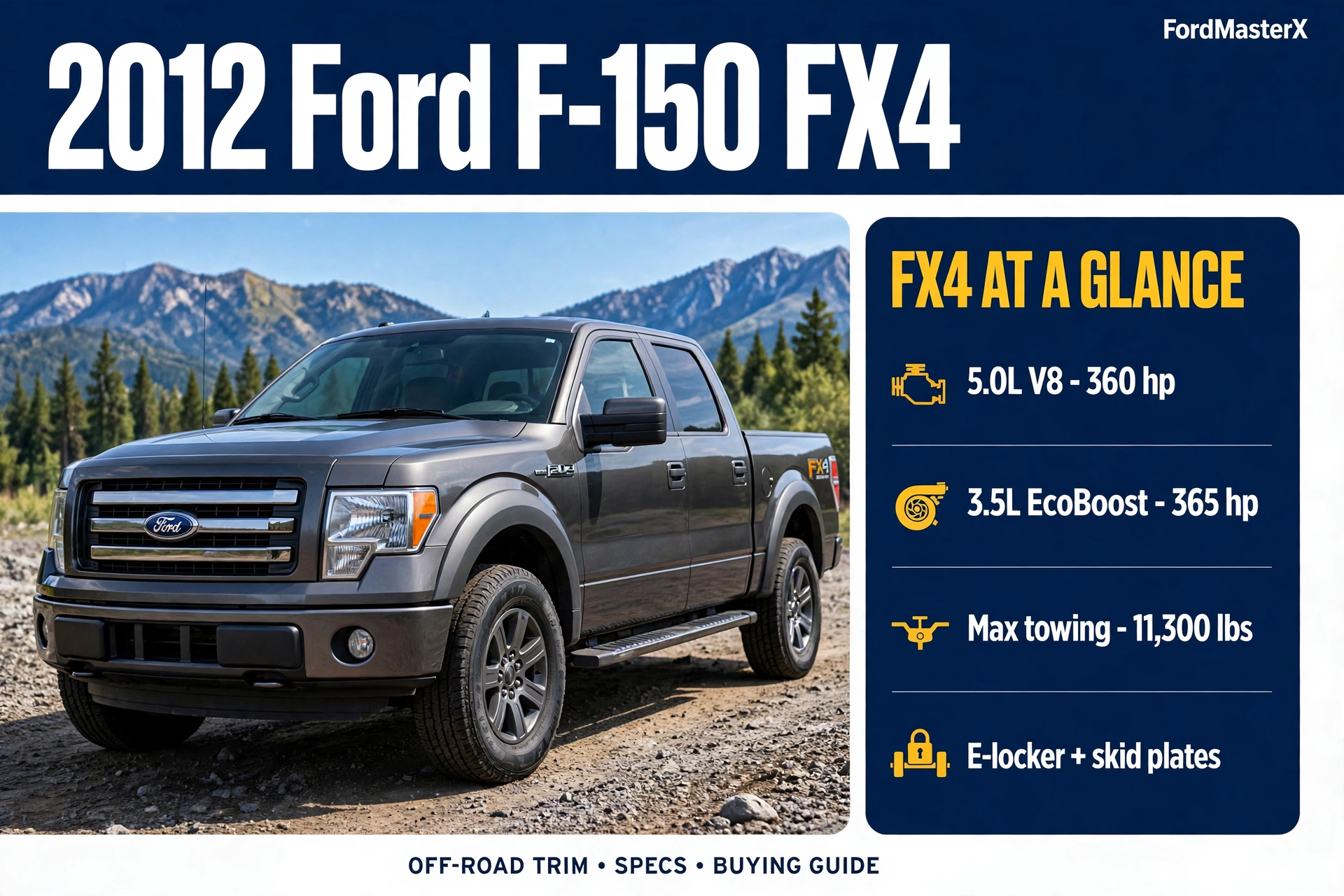
2012 Ford F-150 FX4 2026 Complete Guide

The 2012 Ford F-150 FX4 is Ford’s factory off-road trim of the twelfth-generation F-150, and it is a strong used buy if you want real off-road hardware without paying for a Raptor. It comes only with four-wheel drive, only in SuperCab and SuperCrew cabs, and only with two engines: the 5.0 liter V8 as standard or the 3.5 liter EcoBoost V6 as an option.
FX4 is more than a badge. It adds steel skid plates, an electronic locking rear differential, off-road tuned shocks, Hill Descent Control, all-terrain tires, and front tow hooks, all fitted at the factory. That hardware is what separates an FX4 from an ordinary 4×4 XLT, and it is why used FX4 trucks still carry a price premium over the same truck without the package.
This guide covers the whole trim in one place. It explains what the FX4 package adds, compares the two engines, lists towing and payload figures, names the common problems to check, and gives used prices with a pre-purchase checklist.
The Short Answer: What the 2012 F-150 FX4 Is
The 2012 F-150 FX4 is the off-road trim of the 2012 F-150, built on the twelfth-generation truck that Ford sold from 2009 to 2014. It sits above the XLT in the lineup and below the luxury Lariat, King Ranch, and Platinum trims, and it is the only 2012 F-150 trim that bundles the full factory off-road package as standard equipment.
| Fact | 2012 F-150 FX4 |
|---|---|
| Drive | Four-wheel drive only |
| Cabs | SuperCab and SuperCrew only, no Regular Cab |
| Standard engine | 5.0 liter V8, 360 hp, 380 lb-ft |
| Optional engine | 3.5 liter EcoBoost V6, 365 hp, 420 lb-ft |
| Transmission | 6-speed automatic |
| Key hardware | Skid plates, electronic locking rear differential, off-road shocks, Hill Descent Control |
| Maximum towing | 11,300 lbs when properly equipped |
| Used price | About 10,000 to 13,550 dollars |
2012 Ford F-150 FX4 At a Glance
The factory off-road trim, its two engines, and what it can tow, as observed in November 2026.
| Measure | Observed figure | Result |
|---|---|---|
| What FX4 is | Factory off-road trim, 4WD only | Skid plates, e-locker, off-road shocks |
| Standard engine | 5.0L V8, 360 hp | 380 lb-ft of torque |
| Optional engine | 3.5L EcoBoost V6, 365 hp | 420 lb-ft of torque |
| Maximum towing | 11,300 lbs when properly equipped | Needs the Max Trailer Tow package |
| Recorded FX4 towing | 9,100 to 9,400 lbs | Depends on cab and bed length |
| Used price | About 10,000 to 13,550 dollars | KBB Fair Purchase Price, varies by cab |
Direct answer: The 2012 Ford F-150 FX4 is the factory off-road trim of the F-150, sold only with four-wheel drive in SuperCab and SuperCrew cabs. It adds skid plates, an electronic locking rear differential, off-road shocks, and Hill Descent Control, and it comes with the 5.0L V8 as standard or the 3.5L EcoBoost as an option.
Sources: 2012 Ford F-150 brochure and source book; MotorTrend 2012 F-150 review; Kelley Blue Book FX4 pricing; towingcap.com recorded FX4 configurations. Prices are US observations from November 2026 and vary by mileage, condition, and region.
Two points in that table catch most buyers by surprise. First, the FX4 never came with the base 3.7 liter V6 or the big 6.2 liter V8, so a truck advertised with either engine and an FX4 badge is not a factory FX4. Second, the 11,300 pound towing maximum needs the Max Trailer Tow package, and a base FX4 without it tows less, as the towing section below shows.
The rest of this guide works through each part of the truck in turn. It starts with the package itself, since that is what you are paying for.
What the FX4 Package Adds
FX4 stands for the factory off-road package, and on the 2012 F-150 it was a full trim level, not a dealer add-on. Ford had offered the FX4 name since the early 2000s, and by the twelfth generation it had grown into a distinct trim with its own equipment, its own interior touches, and its own place in the lineup between the XLT and the Lariat.
The hardware is the heart of the package. Three steel skid plates guard the front differential, the transfer case, and the fuel tank, which are the three underbody parts most likely to hit a rock on a trail. The electronic locking rear differential locks both rear wheels together at the push of a button, so the truck keeps moving when one wheel loses grip in mud, snow, or sand.
The shocks are tuned for off-road use, with monotube rear shocks that resist fading when they cycle hard over rough ground. Hill Descent Control holds a slow, steady speed on steep downhills without the driver touching the brake pedal. All-terrain tires and two front tow hooks finish the package, along with FX4 badging and a bedside decal that mark the truck at a glance.
| FX4 feature | What it does | Why it matters |
|---|---|---|
| Skid plates, three piece set | Steel plates guard the front differential, transfer case, and fuel tank | Stops rocks from cracking expensive parts |
| Electronic locking rear differential | Locks both rear wheels together on command | Keeps the truck moving on mud, snow, and sand |
| Off-road tuned shocks | Firmer damping, monotube rear shocks | Controls the truck over bumps without fading |
| Hill Descent Control | Holds a slow speed on steep downhills | Safer descents without riding the brakes |
| All-terrain tires | Deeper tread than highway tires | Better grip off the pavement |
| Front tow hooks, two | Recovery points on the front bumper | Lets another truck pull you out |
| FX4 badging and decal | Badges and a bedside FX4 graphic | Marks the truck, but badges can be faked |
New for 2012, Ford added the FX appearance package to the FX2 and FX4 trucks. It brought flat black accents on the fenders and the tailgate, plus red stitching and red lettering inside the cabin. The MotorTrend 2012 F-150 review notes the appearance package as one of the few changes for the 2012 model year, along with neutral tow capability for four-wheel-drive trucks and an electronic locking rear axle on most EcoBoost and 5.0 liter models.
Two optional extras matter for buyers. A 4.10 axle ratio was optional on the FX4, and it is the axle to look for if you plan to tow heavy or run larger tires. The 36 gallon fuel tank was standard on EcoBoost four-wheel-drive trucks, which gives the EcoBoost FX4 a longer highway range than the 5.0 liter truck with its smaller tank.
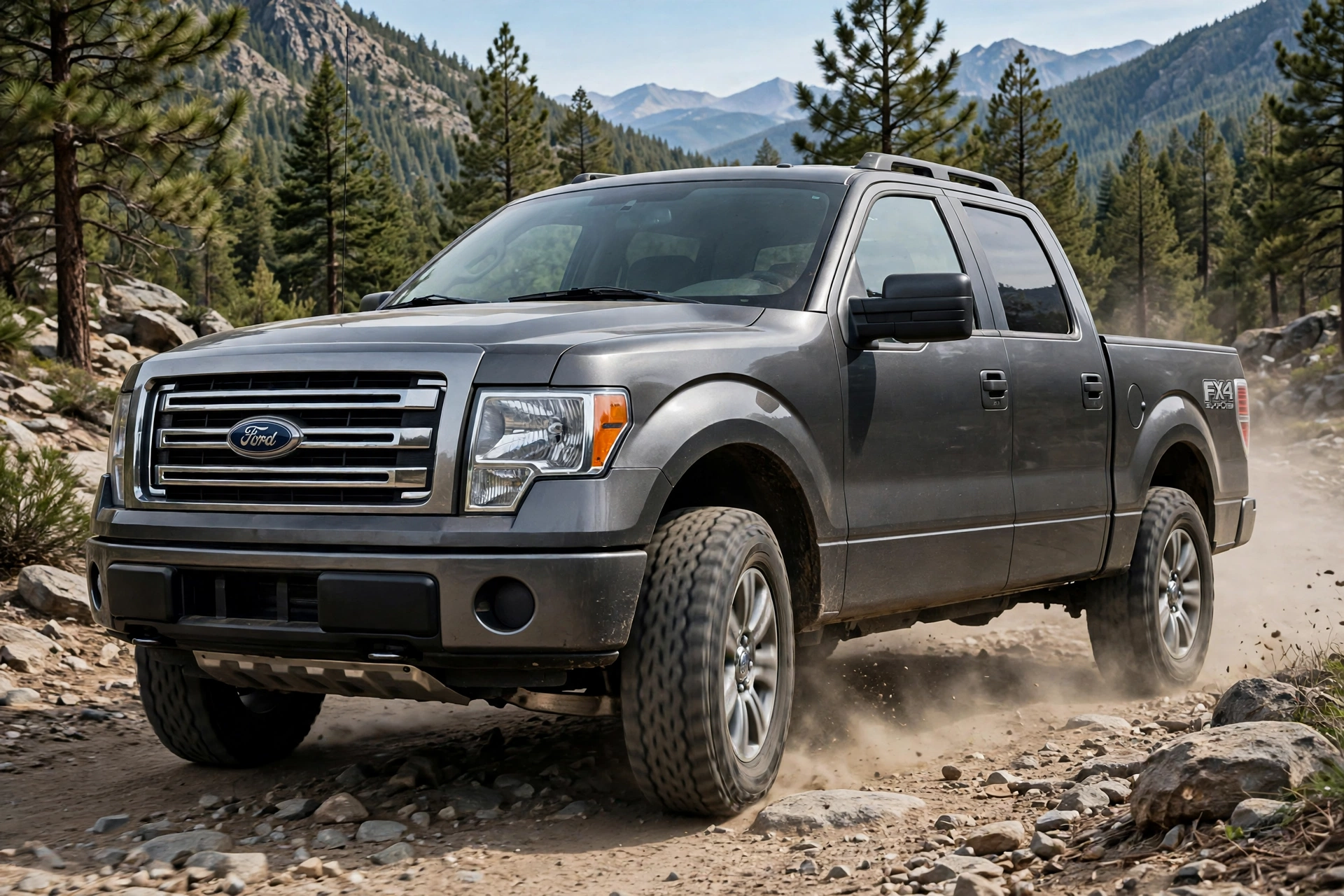
AI-generated illustration: a 2012 Ford F-150 FX4 on a rocky dirt trail, showing its all-terrain tires, FX4 badging, and underbody skid plate.
FX4 vs FX2 vs XLT 4×4
Buyers often confuse the FX4 with its two closest relatives, the FX2 and the XLT 4×4, so the table below draws the line. The FX2 is the two-wheel-drive twin of the FX4, with the same sporty styling but no four-wheel drive and no off-road hardware. The XLT 4×4 has four-wheel drive, but it lacks the skid plates, the locking differential, and the off-road shocks unless those were ordered separately.
| Feature | FX4 | FX2 | XLT 4×4 |
|---|---|---|---|
| Drive | 4WD | 2WD | 4WD |
| Skid plates | Standard | No | No |
| Electronic locking rear differential | Standard | Optional | Optional |
| Off-road shocks | Standard | No | No |
| Hill Descent Control | Standard | No | No |
| All-terrain tires | Standard | Standard | No |
| Tow hooks | Standard | No | Standard on 4×4 |
The rule is simple: every FX4 is a 4×4, but not every 4×4 is an FX4. A badge alone proves nothing, since badges can be bought and stuck on any truck, so the checklist later in this guide shows how to confirm the real factory equipment by VIN and window sticker.
One more distinction matters. The FX4 is not a Raptor, and it was never meant to be one. It has no suspension lift, no wide track, and no high-speed desert running gear.
It is a working truck with factory armor, built for trails, job sites, and bad weather rather than for jumping dunes.
2012 F-150 FX4 Engines: 5.0 V8 vs 3.5 EcoBoost
The 2012 F-150 came with four engines, but the FX4 could only have two of them. The 5.0 liter V8 was standard on every FX4, and the 3.5 liter EcoBoost twin-turbo V6 was the only option. The base 3.7 liter V6 and the big 6.2 liter V8 were not offered on the FX4 at all, which the 2012 Ford source book confirms in its powertrain availability table.
That narrow choice makes the engine decision easy to frame. The 5.0 liter V8 is the simple, proven choice, and the 3.5 liter EcoBoost is the stronger towing choice. Both use the same 6-speed automatic transmission, and both are four-wheel drive only in the FX4, so the difference comes down to power delivery, fuel economy, and long-term repair risk.
| Engine | Power | Torque | FX4 availability |
|---|---|---|---|
| 5.0 liter V8, standard | 360 hp at 5,500 rpm | 380 lb-ft at 4,250 rpm | Standard on all FX4 trucks |
| 3.5 liter EcoBoost V6, optional | 365 hp at 5,000 rpm | 420 lb-ft at 2,500 rpm | Optional on all FX4 trucks |
| 3.7 liter V6 | 302 hp at 6,500 rpm | 278 lb-ft at 4,000 rpm | Not offered on FX4 |
| 6.2 liter V8 | 411 hp at 5,500 rpm | 434 lb-ft at 4,500 rpm | Not offered on FX4, Raptor and Harley-Davidson only |
The 5.0 liter V8, known as the Coyote, is the engine most FX4 buyers should pick. It makes 360 horsepower and 380 pound-feet of torque, it revs cleanly, and it has a simple port-injected design with no turbos to fail. It is also the engine with the cheaper repair bills, since a timing chain job and a turbo replacement are very different jobs in both cost and complexity.
The 3.5 liter EcoBoost makes 365 horsepower and 420 pound-feet of torque, and its torque peaks at just 2,500 rpm, which is far lower than the V8. That low-end torque is why the EcoBoost tows better and feels stronger in daily driving, and it is also why it carries the highest maximum towing rating in the 2012 F-150 lineup. Our guide to the best Ford gas engine for towing compares the same two engines for trailer work, and the EcoBoost wins on pulling power.
Fuel economy favors the EcoBoost by a small margin. An FX4 4×4 with the 5.0 liter V8 is rated at 14 mpg in the city and 19 mpg on the highway, while the same truck with the EcoBoost is rated at 15 mpg in the city and 21 mpg on the highway. The gap is worth about one mile per gallon in the city and two on the highway, so it will not decide the purchase on its own.
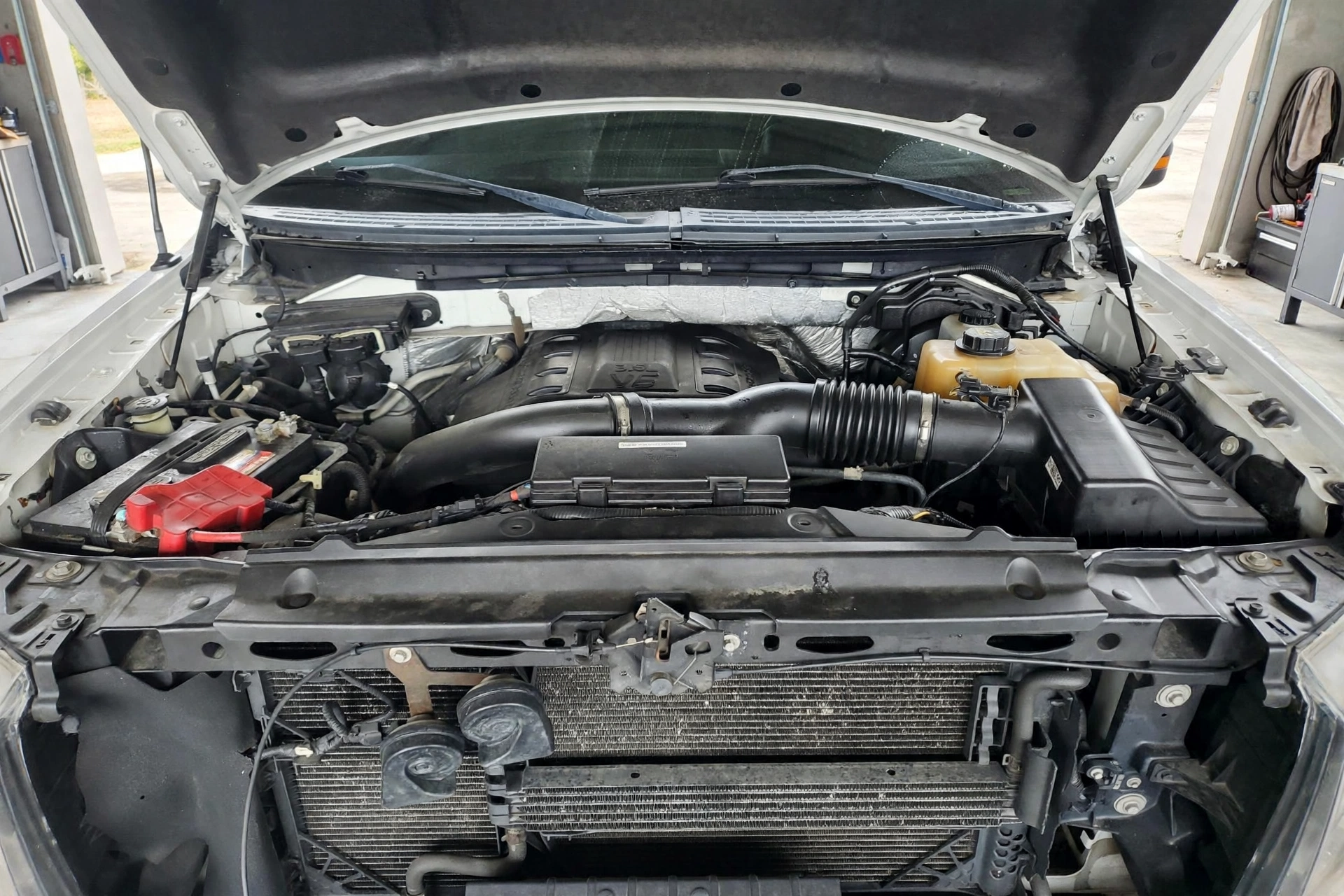
AI-generated illustration: the engine bay of a 2012 Ford F-150 with the 5.0 liter V8 engine.
Which Engine Should You Pick
Pick the 5.0 liter V8 if you want the lowest repair risk and the simplest ownership. It is the right pick for a buyer who plans to keep the truck for years, tow a moderate trailer, and do basic maintenance at home. It is also the right pick if the truck you find has high mileage, since a high-mileage V8 is a safer bet than a high-mileage twin-turbo engine with unknown service history.
Pick the 3.5 liter EcoBoost if you tow heavy trailers often and want the strongest low-end pull. It is the right pick for a buyer who tows a travel trailer or a boat every weekend, and who has a service history showing regular oil changes. The EcoBoost rewards good maintenance and punishes neglect, so a full service record matters more with this engine than with the V8.
Either way, check the engine code before you buy. Our guide to the best Ford F-150 engine covers the same four engines across the whole F-150 lineup, and it is a useful second read once you have narrowed the choice to these two. The engine in the truck should match the window sticker, and a mismatch is a reason to walk away.
Towing and Payload
Towing is where the FX4 earns its keep, but the numbers need care. The headline figure for the 2012 F-150 is 11,300 pounds of maximum towing, and that figure is real, but it applies only to a truck with the Max Trailer Tow package. A base FX4 without that package tows less, and the figures recorded by towingcap.com for FX4 configurations show the real range.
| FX4 configuration | Axle ratio | Recorded towing |
|---|---|---|
| FX4 SuperCab, 6.5 foot bed | 3.73 | 9,400 lbs |
| FX4 SuperCrew, 5.5 foot bed | 3.73 | 9,300 lbs |
| FX4 SuperCrew, 6.5 foot bed | 3.73 | 9,100 lbs |
| 2012 F-150 maximum, properly equipped | With Max Trailer Tow package | 11,300 lbs |
Payload is the other number to check, and it is the one buyers forget. The FX4 SuperCab with the 6.5 foot bed carries a payload of 1,830 pounds, which covers passengers, cargo, and trailer tongue weight together. The maximum payload for a properly equipped 2012 F-150 is 3,120 pounds, but the FX4 cannot reach that figure because the Heavy-Duty Payload Package was not available with the FX4 trim.
Always check the door sticker, not the brochure. The sticker on the driver door jamb lists the exact payload for that truck, and it is the only number that counts for the truck in front of you. Our Ford F-150 towing capacity chart lists the full year-by-year towing figures, and it is the right place to compare this truck against other F-150 model years.
Two factory details raise the FX4 towing figure. The Max Trailer Tow package adds the larger mirrors, the upgraded cooling, and the integrated trailer brake controller, and it is the package that unlocks the 11,300 pound maximum. The optional 4.10 axle ratio also helps, since a shorter axle multiplies the torque at the wheels, which matters most when pulling a heavy trailer up a grade.
Fuel Economy and Running Costs
The 2012 FX4 is not a fuel-efficient truck, and no honest guide should pretend otherwise. It is a full-size four-wheel-drive pickup with a V8 or a twin-turbo V6, and its fuel economy reflects that. The figures below are the EPA ratings for the four-wheel-drive FX4, and they are the numbers to budget around.
| FX4 engine, 4×4 | City | Highway |
|---|---|---|
| 5.0 liter V8 | 14 mpg | 19 mpg |
| 3.5 liter EcoBoost V6 | 15 mpg | 21 mpg |
Range is better than the mileage suggests, because the EcoBoost four-wheel-drive trucks came with a 36 gallon fuel tank as standard. A full tank on the highway gives the EcoBoost FX4 more than 750 miles of range, which is a real advantage on long trips and in areas where fuel stops are far apart.
Running costs are mostly about oil and tires. Both engines take 5W-20 oil, and our Ford engine oil recommendation chart lists the exact grade for each engine, while our Ford F-150 oil capacity by year guide gives the fill amount. All-terrain tires cost more than highway tires and wear faster on pavement, so budget for a set when the tread runs low.
One more cost deserves a line. A used FX4 at this age may need its shocks, its brakes, and its front-end parts replaced, and those are wear items, not defects. Price them into the purchase, and treat a fresh set of shocks as a bonus rather than a reason to pay more.
Common Problems to Check Before You Buy
The 2012 F-150 FX4 is a solid truck, but it is now a fourteen-year-old truck, and the two engines have known weak points. None of these problems should scare you away on its own, but each one should be checked before money changes hands. A cold-start listen and a look underneath will catch most of them.
3.5 EcoBoost Problems
The EcoBoost is the more complex engine, and its problem list is longer. The most reported issue is timing chain tensioner wear, which shows up as a rattle on cold start, engine misfires, and a check engine light. A worn tensioner lets the chain go slack, and a slack chain can jump timing, so a cold-start rattle on an EcoBoost is a reason to get a mechanic involved before you buy.
- Timing chain tensioner wear. Rattle on cold start, misfires, and a check engine light. A shop job, not a driveway fix.
- Turbocharger failure. Loss of power, unusual whistling or grinding noises, and a check engine light. Turbos are expensive to replace.
- Oil consumption. Frequent need for oil top-ups, blue smoke from the exhaust, and an oil warning light. Check the oil level on the dipstick before every test drive.
- Fuel injector problems. Rough idling, poor fuel economy, and engine misfires. Direct injection runs at very high pressure, so injector work is a shop job.
- Overheating. A high temperature gauge, steam, or a loss of power. Overheating can warp heads and blow gaskets, so a truck that runs hot is a truck to avoid.
Carbon buildup is a related EcoBoost issue, since direct injection does not wash fuel over the intake valves. Our guide to the 2.3 liter EcoBoost engine explains how carbon builds up on direct-injection Ford engines, and the same process applies to the 3.5 liter V6. A rough idle and a loss of power on a high-mileage EcoBoost can point at carbon, and a cleaning is the fix.
5.0 V8 Problems
The 5.0 liter Coyote is the simpler engine, and its problem list is shorter, but it has one issue that buyers must know about. The timing chain tensioners wear on the first-generation Coyote, which covers the 2011 to 2014 trucks, and the symptom is a metallic rattle at idle from the front of the engine. Ford issued technical service bulletin 12-3-1 for this exact problem, so a rattle on a 2012 5.0 liter truck is a known fault with a known fix.
- Timing chain tensioner wear. Metallic rattle at cold start or warm idle, mainly on 2011 to 2014 trucks. The MotorVerso guide to 5.0 engine problems puts a timing chain job at around 2,000 dollars.
- Typewriter tick. A light, random tick at warm idle, common on all Coyote engines. Ford service message SSM 52334 calls this normal, and it needs no repair.
- Intake manifold runner control failure. Codes P2004 to P2007 with hesitation at low rpm, mostly on late first-generation trucks. The fix is an actuator, linkage, or manifold.
- Head gasket oil leak. Oil leaking from the right side head gasket, sometimes onto the starter motor. Fix it promptly, since a leak left alone can damage the gasket.
- Spark plug misfires. Worn plugs cause misfires and rough running. Plugs are a cheap fix, but a misfire ignored can damage the catalytic converter.
One caution about oil consumption: Ford documents an oil use threshold of more than one quart per 3,000 miles, but that bulletin covers the third-generation Coyote in 2018 to 2020 trucks, not the 2012 engine. Do not let a seller or a forum post tell you that heavy oil use is a documented 2012 defect, and do not accept it either. Check the oil level yourself and watch for blue smoke.
Body, Frame, and 4×4 Wear
The engines get the attention, but the body and the four-wheel-drive system decide whether the truck is worth its price. Rust is the biggest threat on a 2012 truck, and it starts in the same places on every F-150 of this generation. Check the rocker panels, the cab corners, the bed sides above the rear wheels, and the frame rails, and look underneath with a flashlight.
Test the four-wheel drive on the test drive. Shift into four-high on a loose surface, listen for grinding or clunking, and confirm that the electronic locking rear differential engages and releases cleanly.
A locker that will not engage is a repair, and a transfer case that grinds is a bigger one. Our guide to Ford transmission identification helps you name the gearbox in the truck, which matters when you price a transmission repair.
Check the suspension and the steering the same way. Worn ball joints, tie rods, and wheel bearings are common at this mileage, and they show up as looseness in the steering, a clunk over bumps, or a humming noise that grows with speed. These are wear items, and they are fixable, but they are also bargaining points.
How Much Does a 2012 F-150 FX4 Cost in 2026
Used prices for the 2012 FX4 have settled into a narrow range, and Kelley Blue Book gives the clearest picture. The table below uses KBB Fair Purchase Prices and Edmunds figures observed in November 2026, and the spread between the SuperCab and the SuperCrew is the main thing to notice. The four-door SuperCrew costs more, and it is also the truck most buyers want.
| FX4 configuration | Original MSRP when new | Used price now |
|---|---|---|
| FX4 SuperCab, 6.5 foot bed | About 38,000 dollars | About 9,950 to 11,000 dollars |
| FX4 SuperCrew, 5.5 foot bed | About 40,235 dollars | About 13,550 dollars |
| FX4 SuperCrew, 6.5 foot bed | About 40,535 dollars | About 12,250 dollars |
KBB private party values for the FX4 SuperCrew with the 6.5 foot bed run from about 8,930 dollars in fair condition to 11,430 dollars in excellent condition, with trade-in values from 6,105 to 7,930 dollars. Edmunds lists the used price range for the 2012 F-150 overall at 10,400 to 13,990 dollars, which lines up with the KBB figures. The KBB page for the 2012 FX4 SuperCrew carries the full value breakdown by condition, and it is worth checking before you make an offer.
Four things move the price more than anything else. Low mileage adds value, a full service history adds value, a clean frame with no rust adds value, and the EcoBoost engine adds a small premium over the 5.0 liter V8. A truck with a rebuilt title, a rusty frame, or a cold-start rattle is worth far less than the table suggests, no matter what the asking price says.
One note on the original prices: sources disagree slightly on the SuperCrew FX4 sticker price when new, with Edmunds listing the FX4 SuperCab from 38,005 dollars and iSeeCars listing the SuperCrew from 40,235 dollars. This guide uses those figures, and it does not use the higher KBB original MSRP figure for the SuperCrew, which conflicts with both. The Edmunds 2012 F-150 review lists the FX4 SuperCab starting price and gives the full trim walk, and it is a good second source for pricing.
How to Check a Used FX4 Before You Buy
A used FX4 is only a good buy if the factory equipment is still there and the engine is healthy. The checklist below takes about an hour, and it is the cheapest insurance you will ever buy. Bring a flashlight, an OBD scanner if you have one, and a friend to watch the truck while you work the controls.
- Pull the window sticker by VIN. Confirm the truck left the factory as an FX4, with the skid plates and the electronic locking rear differential listed as factory equipment. Badges can be swapped, but the window sticker cannot.
- Start it cold. Listen for a rattle in the first minute, on both the EcoBoost and the 5.0 liter V8. A cold-start rattle points at the timing chain tensioners.
- Check the oil. Pull the dipstick and read the level and the color, then look for blue smoke on startup. Low oil or blue smoke means the engine is using oil.
- Test the locker and the 4×4. Engage the electronic locking rear differential and shift into four-high on a loose surface. Both should engage cleanly with no grinding.
- Look underneath. Count the skid plates, check the frame rails and rocker panels for rust, and look for fresh undercoating that may hide rust.
- Scan for codes. Read the stored codes and look for misfire codes, P2004 to P2007 intake codes, and any transmission codes. A seller who refuses a scan is a seller to avoid.
- Check the hours and the miles. High idle hours wear an engine without adding miles, so read our guide to average engine hours for 100,000 miles and compare the truck against it.
Two small checks finish the job. Open the cabin air filter housing and look at the filter, since a filthy filter tells you how the last owner treated maintenance, and our guide to the 2012 F-150 cabin air filter location shows where it sits. Then compare the truck against a base trim in our guide to the 2010 Ford F-150 XL, which shows what a plain work truck looks like next to a loaded FX4.
Questions Buyers Ask About the 2012 F-150 FX4
Is the 2012 Ford F-150 FX4 a Good Truck
Yes, it is a good truck, and it is one of the better used buys in the 2012 F-150 lineup. It pairs a proven chassis with factory off-road hardware, it tows up to 11,300 pounds when properly equipped, and both of its engines are well understood by now. Buy the 5.0 liter V8 for the lowest risk, and buy the EcoBoost only with a full service history.
Is FX4 the Same as 4×4
No, FX4 is not the same as 4×4. Four-wheel drive is a drivetrain, and FX4 is a trim level that adds off-road hardware on top of four-wheel drive. Every FX4 is a 4×4, but a plain 4×4 XLT has no skid plates, no locking differential, and no off-road shocks unless they were ordered separately.
Which Engine Is Better in the 2012 FX4
The 3.5 liter EcoBoost tows better and feels stronger, with 420 pound-feet of torque at just 2,500 rpm, while the 5.0 liter V8 is simpler and cheaper to repair. Pick the EcoBoost if you tow heavy often and have a service history, and pick the V8 if you want the lowest long-term risk. Neither engine is a bad choice when it has been maintained.
How Much Can a 2012 F-150 FX4 Tow
A 2012 F-150 FX4 tows 9,100 to 9,400 pounds in the recorded configurations with a 3.73 axle, depending on cab and bed length. The maximum of 11,300 pounds needs the Max Trailer Tow package. Always check the door sticker and the trailer tow rating for the exact truck, since the figure changes with the axle ratio and the packages fitted.
What Is a 2012 F-150 FX4 Worth
KBB Fair Purchase Prices observed in November 2026 put the FX4 SuperCab at about 9,950 to 11,000 dollars and the FX4 SuperCrew at about 12,250 to 13,550 dollars. Private party values for the SuperCrew run from about 8,930 dollars in fair condition to 11,430 dollars in excellent condition. Mileage, condition, rust, and service history move the real price in either direction.
Should I Buy a High-Mileage 2012 FX4
Yes, if the price reflects the miles and the truck passes the checklist in this guide. These trucks regularly run past 200,000 miles with good maintenance, and the 5.0 liter V8 is the safer high-mileage pick. Walk away from a high-mileage EcoBoost with no service history, a cold-start rattle, or a rusty frame, since those three together mean expensive repairs.
Your 5 Step Check Before You Buy
Is the 2012 Ford F-150 FX4 worth buying? Yes, when it is a real factory FX4 with a healthy engine and a clean frame. The skid plates, the locking differential, and the off-road shocks are genuine hardware, and they are the reason the trim still commands a premium over a plain 4×4.
Run the five step check before you buy. Confirm the factory FX4 equipment by VIN, start the engine cold and listen for a timing rattle, check the oil level and look for blue smoke, test the locking differential and the four-wheel drive, and look underneath for rust and missing skid plates. That check takes an hour, and it is the difference between a good truck and an expensive lesson.
That is the whole guide in one paragraph. The FX4 is the off-road F-150 for buyers who want factory hardware, the 5.0 liter V8 is the safe engine pick, the EcoBoost is the towing pick, and a clean frame with a service history is worth more than any single feature on the window sticker.