
Ford Lease Return Rip-Off 2026 Complete Guide

No, a Ford lease return is usually not a rip-off, but the bill can feel like one. Most of the charges are written into the lease agreement you signed, and Ford Credit publishes the wear limits that decide each line of the bill.
The surprise is the problem. Drivers who skip the free pre-inspection and never read the wear guide meet every charge for the first time on the final bill, and that is when a fair bill starts to look like a scam.
This guide shows you the four charges, the exact wear limits Ford Credit allows, and how to dispute a charge that breaks those limits.
It applies to a Ford Credit Red Carpet Lease in the United States. Your own lease agreement has the final word on your numbers, so check it against every figure here.
The Short Answer in 4 Charges
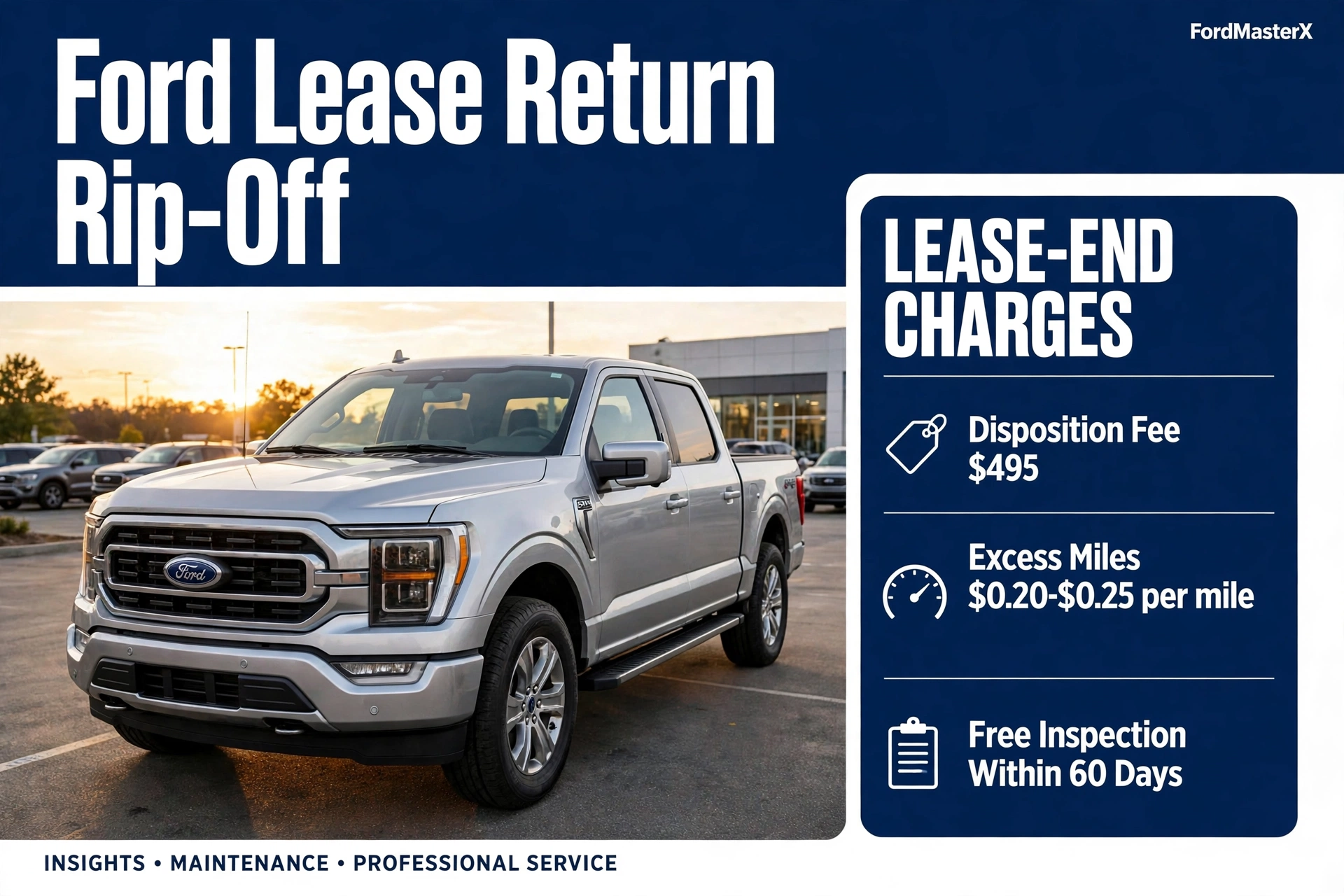
Four charges make up almost every Ford lease return bill. The table below lists them, and the infographic after it gives you the same facts to save or share.
| Charge | What it is | Typical amount |
|---|---|---|
| Disposition fee | Fee for taking the car back and preparing it for resale | $495 on current offers, waived if you lease or buy another Ford |
| Excess mileage | Charge for every mile over your allowance | $0.20 per mile, $0.25 on F-150 and Expedition |
| Excess wear and use | Repair cost for damage beyond normal wear | Varies, WearCare covers up to $5,000 if you bought it |
| Missing items and unpaid amounts | Keys, mats, manuals, charge cord, late payments | Cost of the item or the amount owed |
Ford Lease Return Charges At a Glance
The four charges, the verified figures, and the first step, as observed in November 2026.
| Charge | Verified figure | What to do |
|---|---|---|
| Disposition fee | $495 on current offers | Waived if you lease or buy another Ford |
| Excess mileage | $0.20 per mile, $0.25 on F-150 and Expedition | Your agreement sets your rate |
| Pre-inspection | Free, within 60 days of lease end | Book with your VIN and account number |
| WearCare cover | Up to $5,000 of excess wear charges | Only if you bought it at signing |
| Normal wear, body panels | Up to 3 dings per panel, up to 4 inches | No charge inside the limit |
Direct answer: Most lease return charges are contractual and disclosed in your lease agreement. The bill feels like a rip-off when the charges surprise you, so get the free inspection, fix the cheap items yourself, and dispute any line that breaks Ford Credit’s own wear limits.
Sources: Ford Credit Lease Renewal Guide; Ford Credit Excess Wear and Use guide; Westlie Ford lease return page. Figures are from current offers and vary by agreement, model, and region.
The disposition fee and the mileage charge are fixed by your agreement. The wear charge is the one you can change, because it depends on the condition of the car and on repairs you can still make.
That is why the rest of this guide spends most of its time on wear. A dent you fix for 100 dollars at a local shop can cost 300 dollars or more as a lease charge, and the free inspection tells you which dents those are.
Is It Really a Rip-Off?
A rip-off means being charged for something you never agreed to pay. A Ford lease return rarely fits that test, because the disposition fee, the mileage rate, and the wear standards are all disclosed in the lease agreement and in Ford Credit’s published guides.
What does happen is that few drivers read those documents at signing. The charges then arrive years later, with no memory of the agreement behind them, and the bill reads like a list of invented fees.
There is also a real unfair side to lease returns. Inspectors can misjudge damage, a dealer can bill for wear that Ford Credit’s own guide calls normal, and a charge can be priced far above a local repair shop’s quote for the same fix.
The fair way to read your bill is line by line. A charge that matches your agreement and Ford Credit’s wear guide is legitimate, even when it hurts. A charge that breaks those documents is one you can fight, and this guide shows you how.
Our guide to how to lease a Ford step by step covers the start of the lease. This article covers the other end: the return, the inspection, and the bill.
The Four Charges on Your Bill
Every Ford lease return bill is built from the same four charges. Learn each one and you can read your bill like an itemized receipt instead of a mystery total.
1. The Disposition Fee
The disposition fee is a flat fee for taking the vehicle back, inspecting it, and preparing it for resale. Ford Credit charges it only when your lease agreement discloses one, and the fee on current Ford Credit lease offers is $495.
You can often avoid it. Ford Credit says qualifying customers who lease or buy a new Ford or Lincoln, or a Ford Blue Advantage or Lincoln Certified Pre-Owned vehicle, may be eligible for a waiver of the fee.
Buying the vehicle you already drive also avoids it, since the fee applies to returned vehicles. The Ford Credit Lease Renewal Guide lists the waiver and the three lease-end options in full.
Do not confuse this fee with the $475 disposal fee in Ford’s Options balloon payment documents. That fee belongs to a different product, and it does not apply to a Red Carpet Lease return.
2. Excess Mileage
Your lease sets an annual mileage allowance, commonly 10,500, 12,000, 15,000, or 19,500 miles a year. Every mile over the total allowance is billed at the per-mile rate in your agreement.
Current Ford Credit lease offers charge $0.20 a mile over the allowance on most models, including the Bronco, Explorer, Maverick, Mustang, and Ranger. The F-150 and the Expedition are charged at $0.25 a mile. The Westlie Ford lease return page lists these rates from current Ford Credit offers in its region.
The math is simple and it adds up fast. Driving 5,000 miles over your allowance at $0.20 a mile costs $1,000, and the same overage on an F-150 costs $1,250.
Mileage is the hardest charge to dispute, because the odometer reading is a fact and the rate is in your agreement. Your real choice is made before the bill: compare the mileage charge with the cost of buying the vehicle or trading it in, since either path can erase the charge.
Note that the excess wear and use waiver for customers who renew does not cover extra miles. Mileage is billed even when the rest of the bill is waived.
3. Excess Wear and Use
Excess wear and use is the repair cost for damage beyond normal wear. It is also the charge with the most room for error, because it depends on one inspector’s judgment of your car’s condition.
Ford Credit publishes the exact limits in its wear and use guide, and the next section lists them in a table. A dent inside the limit is normal wear and costs you nothing, while the same dent past the limit is a charge.
If you bought WearCare when you signed the lease, Ford Credit says it waives excess wear and use charges up to $5,000 in most cases. Check your WearCare addendum for the exclusions, since some items are not covered.
Our guide to the best touch-up paint brands for Ford cars can help with small paint chips before the inspection. A careful touch-up can move a chip back inside the normal wear limit, and it costs far less than a panel repair charge.
4. Missing Items and Unpaid Amounts
Everything the vehicle came with must go back with it. Ford Credit’s checklist names all keys and key fobs, floor mats, owner’s manuals, dealer-installed accessories, and the charging cord on an electric vehicle.
Missing items are billed as excess wear and use, and a lost key fob or a missing charge cord can cost more than you expect. A spare tire and its tools must be in their storage area too.
Unpaid amounts also land on the final bill. A last payment, a late fee, or an unpaid parking ticket tied to the vehicle is still owed, and the return does not erase it.
What Ford Credit Counts as Normal Wear
Ford Credit expects the vehicle back in good condition, and it allows for normal wear and use. The table below is taken from Ford Credit’s own wear and use guide, so you can check each line of your bill against it.
| Area | No charge limit | Chargeable |
|---|---|---|
| Body panels | Up to 3 dings, dents, or scratches per panel, up to 4 inches; up to 15 paint chips per panel | More damage, or holes in the sheet metal |
| Wheels | Scratches and gouges up to 6 inches | Damage past 6 inches |
| Glass | None: all glass damage is chargeable | Repair charge for up to 2 chips or cracks per panel within a 1-inch circle; full replacement in all other cases |
| Tires | Good tread in every groove, no sidewall damage or plugs, correct size and rating | Worn, damaged, mismatched, or plugged tires |
| Interior burn holes | Up to 2 per panel, up to 1/4 inch | Larger or more numerous holes |
| Interior cuts and tears | Up to 2 per panel, up to 1/2 inch | Larger or more numerous damage |
| Interior stains | 1 permanent stain per panel, up to 1/2 inch | Larger or more stains |
| Lights and lenses | Minor scratches and scuffs | Cracked or broken lenses |
The Ford Credit Excess Wear and Use guide is the document to keep. It also lists broken or missing parts, poor-quality repairs, and mechanical or electrical faults as excess wear, so a warning light or a fault at return can be charged.
Glass deserves special attention. Every chip counts, even a small one, so a windshield chip you ignored for a year can become a repair or replacement charge at return. Ask your insurer about glass cover before the inspection, since a glass claim is often cheaper than the lease charge.
Tires are the other quiet trap. The tires must have good tread left in every groove, with no sidewall damage or plugs, and they must match the vehicle in size and rating. Our guide to the best all-season tires for the Ford Explorer helps if a replacement set is the cheaper path.
Mechanical faults are charged too, even when the car still drives. A warning light, a faulty sensor, or a worn part that should have been fixed under warranty can appear on the bill.
A slipping clutch is the same kind of mechanical fault. Our guide to how long a clutch replacement takes covers the repair time and cost, and our how to check your Ford warranty guide shows how to confirm cover by VIN before you pay for a repair yourself.
The Free Pre-Inspection: Book It Within 60 Days
Ford Credit arranges a complimentary inspection before your lease ends. An inspector from Alliance Inspection Management, known as AiM, looks the vehicle over and writes a Vehicle Condition Report that lists every item of excess wear and use.
Book the inspection within 60 days of your lease-end date. You need your VIN and your Ford Credit account number to schedule it, and the inspection takes about 30 minutes at a place you choose, such as your home or your workplace.
Call Ford Credit at 1-800-727-7000 if the scheduling tool does not work for you. The number is printed in Ford Credit’s own lease-end guide, and the same line can confirm your mileage allowance.
The report is the most valuable document in the whole return. It tells you the expected charges while there is still time to fix them, and it gives you a written record to compare with the final bill.

AI-generated illustration: a lease-end inspector with a clipboard checking the front bumper of a Ford Explorer.
Read the report line by line when it arrives. For each flagged item, get a quote from a local repair shop and compare it with the charge on the report, then fix the items where the shop is cheaper.
Keep every repair receipt. A receipt proves the work was done, and it is your evidence if the same item still appears on the final bill.
Finish any repairs your insurance covers before the inspection, not after it. Ford Credit’s checklist says the same, since an insurance repair done early can remove a charge entirely.
How to Cut the Bill Before Turn-In
The cheapest lease return is one you prepare for. The steps below work best in the last two months, while the inspection report is fresh and repair shops still have time to fit you in.
- Get the inspection first. Book the free AiM inspection within 60 days of lease end and read the Vehicle Condition Report before you spend a dollar on repairs.
- Price every flagged item twice. Get a local shop quote for each item and compare it with the charge on the report, then fix only the items where the shop is cheaper.
- Fix small paint damage yourself. Touch-up paint, paintless dent repair, and wheel refinishing are often far cheaper than the lease charge for the same damage.
- Replace worn tires with care. A used set that matches the size and rating can satisfy the guide, but mismatched tires are charged, so check the size and rating first.
- Clean the car and photograph it. Take dated photos of every side, the wheels, the interior, and the odometer on turn-in day, and keep them with the inspection report.
- Compare the buyout. Get your payoff price from Ford Credit Account Manager or your originating dealer, then compare it with the car’s market value and the total of your return charges.
- Consider a trade-in. A dealer appraisal may show the car is worth more than the payoff, and trading it in can erase the return charges entirely.
Independent repairs are almost always cheaper than the leasing company’s charge for the same fix. Paintless dent repair shops, wheel repair shops, and windshield repair companies all charge less than the figure on a lease bill, so the comparison is worth doing for every line.
A buyout deserves a real calculation, not a guess. If the car is worth more than the payoff, buying it removes the disposition fee, the mileage charge, and the wear bill in one move. Our guide to what year Ford Focus to avoid shows the same kind of value check for a used Ford buyer.
Maintenance records help too. A car with a full service history and fresh fluids reads as cared for, and a mechanical fault found at return is harder to dispute without records. Our Ford engine oil recommendation chart lists the right oil grade if a service is still due.
How to Dispute a Lease-End Bill Step by Step
You can dispute charges you believe are unfair or wrong. The process is slow, but it works when you have the documents, so start it in writing and keep a copy of everything.
- Ask for the itemized bill and the photos. Request the final bill with every charge listed separately, plus the inspection photos for each item. A single total with no detail cannot be checked.
- Compare each line with the wear guide. Measure each dent, scratch, and stain against Ford Credit’s published limits. A charge for damage inside the no-charge limit is a charge you can challenge.
- Compare each line with your own evidence. Match the bill against your dated turn-in photos, the pre-inspection report, and your repair receipts. An item you already fixed should not be billed twice.
- Get an independent repair estimate. A written quote from a local shop for the same repair shows the fair price. A charge far above the shop price is a strong point in your dispute.
- Dispute in writing with Ford Credit. Write to Ford Credit’s lease-end department with the itemized bill, the wear guide limits, your photos, and your estimates. Ask for a written reply, and keep copies of every letter.
- Escalate if the answer is no. File a complaint with the Consumer Financial Protection Bureau and with your state attorney general’s consumer protection office. Both take lease disputes, and a complaint often brings a second review.
The lease-end inspection guide from Philadelphia Car Broker explains the same process. Federal Regulation M requires lessors to disclose wear and use standards that are reasonable, so a standard that is hidden or unreasonable is itself a point in your favor.
Know the limit of one legal tool before you use it. Federal law gives lessees an independent appraisal right when what they owe depends on the vehicle’s realized value at sale, which is the open-end lease case. Most consumer Ford leases are closed-end, so the appraisal right usually does not apply, and the itemized dispute plus a regulator complaint is the practical path.
Never ignore a bill while you dispute it. Unpaid lease-end charges can be sent to collections and can damage your credit, so ask Ford Credit in writing whether the disputed amount is on hold while the review runs.
If a dealer, not Ford Credit, added a charge, ask the dealer for the same itemized detail. A dealer fee that is not in your lease agreement or in Ford Credit’s guides is not a Ford Credit charge, and it should be questioned on its own.
Return It, Buy It, or Lease a New Ford
Ford Credit gives you three ways to end a lease. The right one depends on your mileage, your car’s condition, and the payoff price, so run the numbers before you choose.
| Option | You pay | Best when |
|---|---|---|
| Return it | Disposition fee, excess miles, excess wear | Miles are within the allowance and wear is light |
| Buy it | Purchase price in your agreement, plus tax | The car is worth more than the payoff, or miles are far over |
| Lease a new Ford | New lease terms, disposition fee may be waived | You want a new Ford and qualify for the waiver |
Returning is cheapest when the car is clean and the miles are in range. The bill is the disposition fee plus any small wear items, and a clean inspection can make that bill very small.
Buying wins when the numbers favor you. Get the payoff from Ford Credit Account Manager or your originating dealer, check the market value, and buy when the value beats the payoff by more than the return charges would cost.
Leasing a new Ford can waive the disposition fee for qualifying customers. It also starts a new lease, so weigh the waiver against the new monthly payment and the new mileage allowance before you sign.
Some electric vehicles cannot be bought at lease end, so Mustang Mach-E and F-150 Lightning drivers should read the contract first. Our guide to Ford factory warranty explains the cover that may still apply to a car you buy out of a lease.
A rattle, a warning light, or a mechanical fault found at return can change the decision. Our guide to why your car sounds loud helps you name the problem, and our Ford powertrain warranty guide explains what cover a newer Ford carries.
Pre-Return Checklist
Run this checklist in the last two weeks before turn-in. It covers the items Ford Credit’s own checklist names, and it takes an evening, not a weekend.
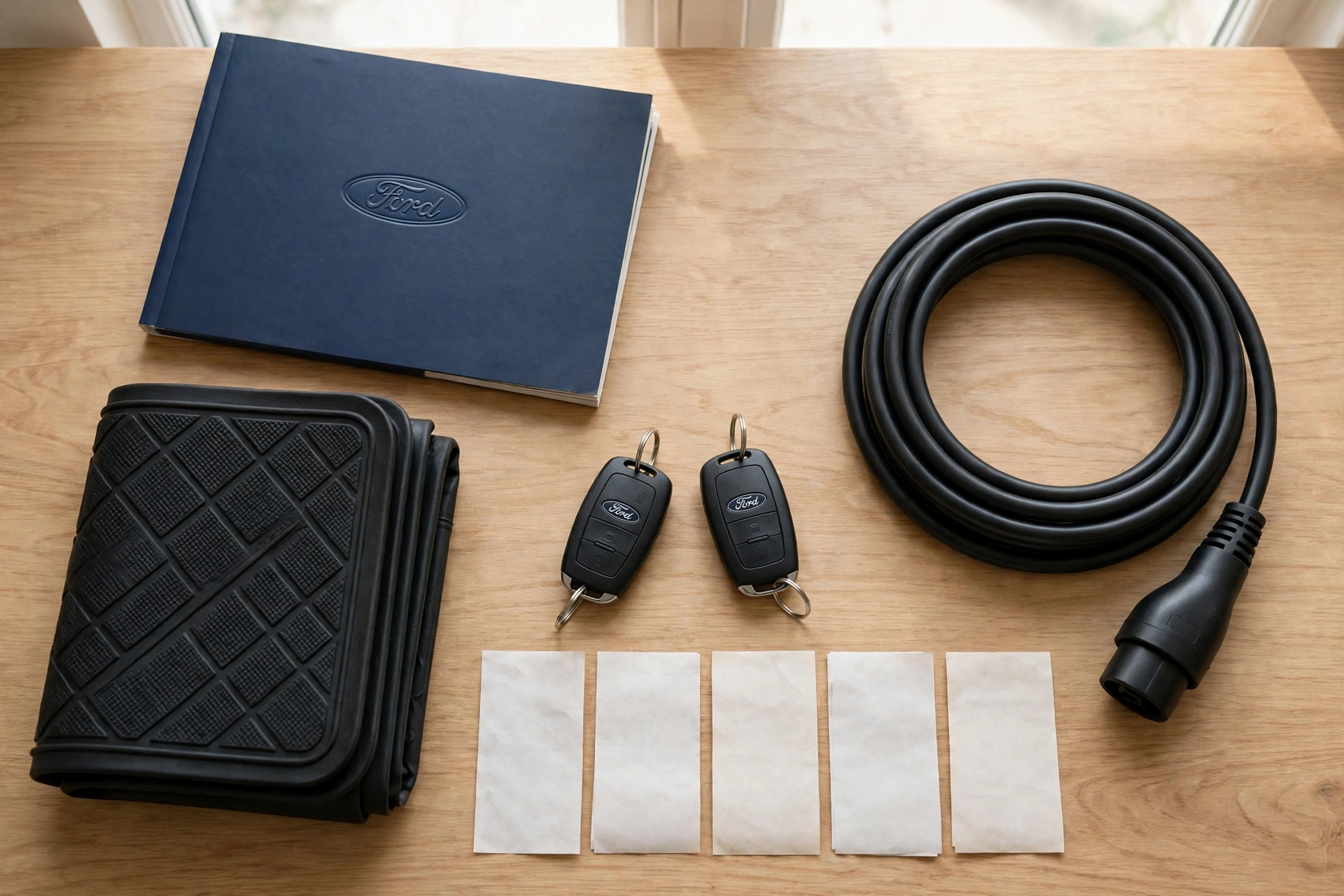
AI-generated illustration: Ford keys, owner’s manual, floor mats, charging cord, and service receipts laid out for a lease return.
- Keys and fobs. Gather every key and fob the vehicle came with, including the spare.
- Floor mats and cargo cover. Put the original mats and cargo cover back in the car.
- Owner’s manuals. Return every manual and booklet that came with the vehicle.
- Spare tire and tools. Check the spare and the jack are in their storage area.
- Charging cord. Return the charge cord on a Mustang Mach-E or an F-150 Lightning.
- Accessories. Return dealer-installed accessories and remove your personal items.
- Second key check. Count the keys against the number on your lease paperwork.
- Photos and paperwork. Keep your dated photos, the inspection report, and every repair receipt in one folder.
Cancel your automatic payments only after the return is complete. Ford Credit’s lease-end guide ends every path the same way: cancel the automatic payments once the vehicle is handed back.
Questions Ford Owners Ask About Lease Returns
Is the Disposition Fee a Rip-Off
No, it is a disclosed fee for taking the car back and preparing it for resale. It feels unfair when it arrives as a surprise, but it is in your lease agreement, and Ford Credit may waive it if you lease or buy another Ford.
How Much Is the Ford Lease Disposition Fee
Current Ford Credit lease offers list a $495 disposition fee. Your own agreement has the figure that applies to you, so check it before you argue the amount.
Can I Dispute Excess Wear and Tear Charges
Yes, ask Ford Credit for the itemized bill with photos, then compare each line with the wear and use guide and your own photos. Dispute in writing, and file a complaint with the Consumer Financial Protection Bureau if the answer is no.
What Happens If I Am Over My Mileage
You pay the per-mile rate in your agreement for every mile over the allowance. Current offers charge $0.20 a mile on most models and $0.25 a mile on the F-150 and Expedition, so compare the total with the cost of buying the vehicle.
Should I Fix Damage Before Returning My Lease
Yes, when the repair costs less than the charge. Get the free inspection first, price each flagged item at a local shop, and fix the items where the shop is cheaper.
Can I Return My Ford Lease to Any Dealer
Ford Credit’s guide says to complete the return at a dealership and to contact your originating dealer for the payoff. Call the dealer first if your lease started at another Ford store, so the return is handled correctly.
Your 5 Step Check Before You Hand Back the Keys
Is a Ford lease return a rip-off? Most charges are contractual, and the bill only becomes unfair when a charge breaks Ford Credit’s own limits.
Run the five step check before you return the car. Book the free inspection within 60 days, read the Vehicle Condition Report, fix the cheap items yourself, gather everything the car came with, and photograph the car on turn-in day.
That check costs you a few hours. It can save you hundreds of dollars, and it leaves you with the documents you need if a charge ever needs a fight.