
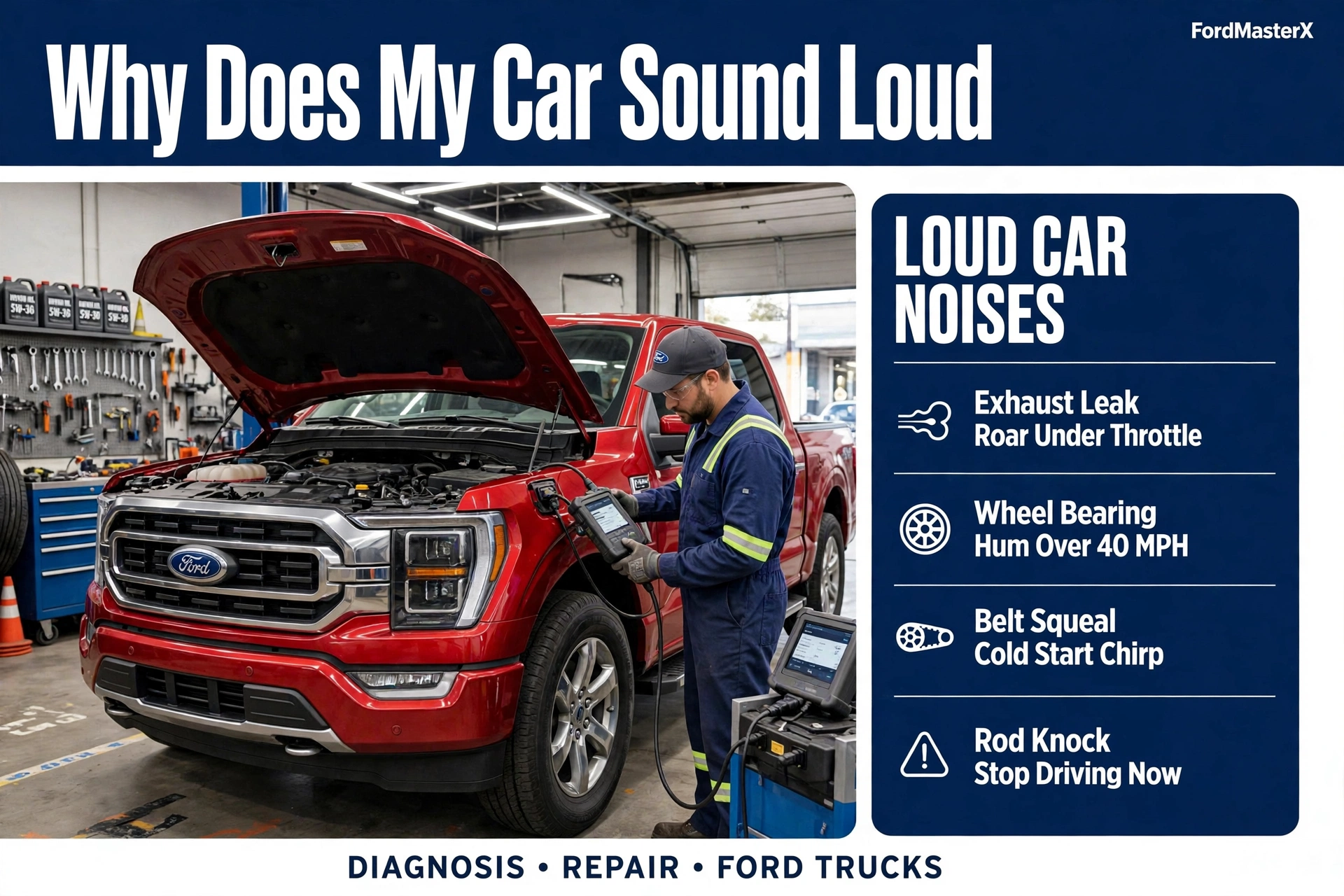
Why Does My Car Sound Loud? 7 Proven Causes for 2026

A car that sounds loud is telling you something has changed. If you are asking why does my car sound loud, one of the most common causes is an exhaust leak or a failed muffler, but wheel bearings, tires, belts, and engine parts can all make your truck louder too.
This guide works for any Ford.
The trick is to note when the noise happens. A roar that grows with speed points to a different part than a squeal that only appears on a cold start. Work through the checks below to narrow the cause.


How to Narrow Down a Loud Noise in 5 Minutes
You do not need tools for the first pass, just a quiet road and five minutes. Start the truck cold and listen for 30 seconds, then note whether the noise is there at idle, only under acceleration, only when turning, or only when braking.
Drive slowly up to 50 mph on a quiet road and note the speed where the noise starts. Speed-related noise points to wheels, tires, or bearings, while noise tied to engine speed points to the engine bay or the exhaust.
With the engine off, check the oil level, look for a loose heat shield, and check the serpentine belt for cracks.
Steer gently left and right at a steady speed and note whether the noise changes. A wheel bearing hum usually gets louder when you turn away from the bad side, because that side carries more load. A tire noise usually stays the same through a turn.
1 Exhaust Leak or Failed Muffler



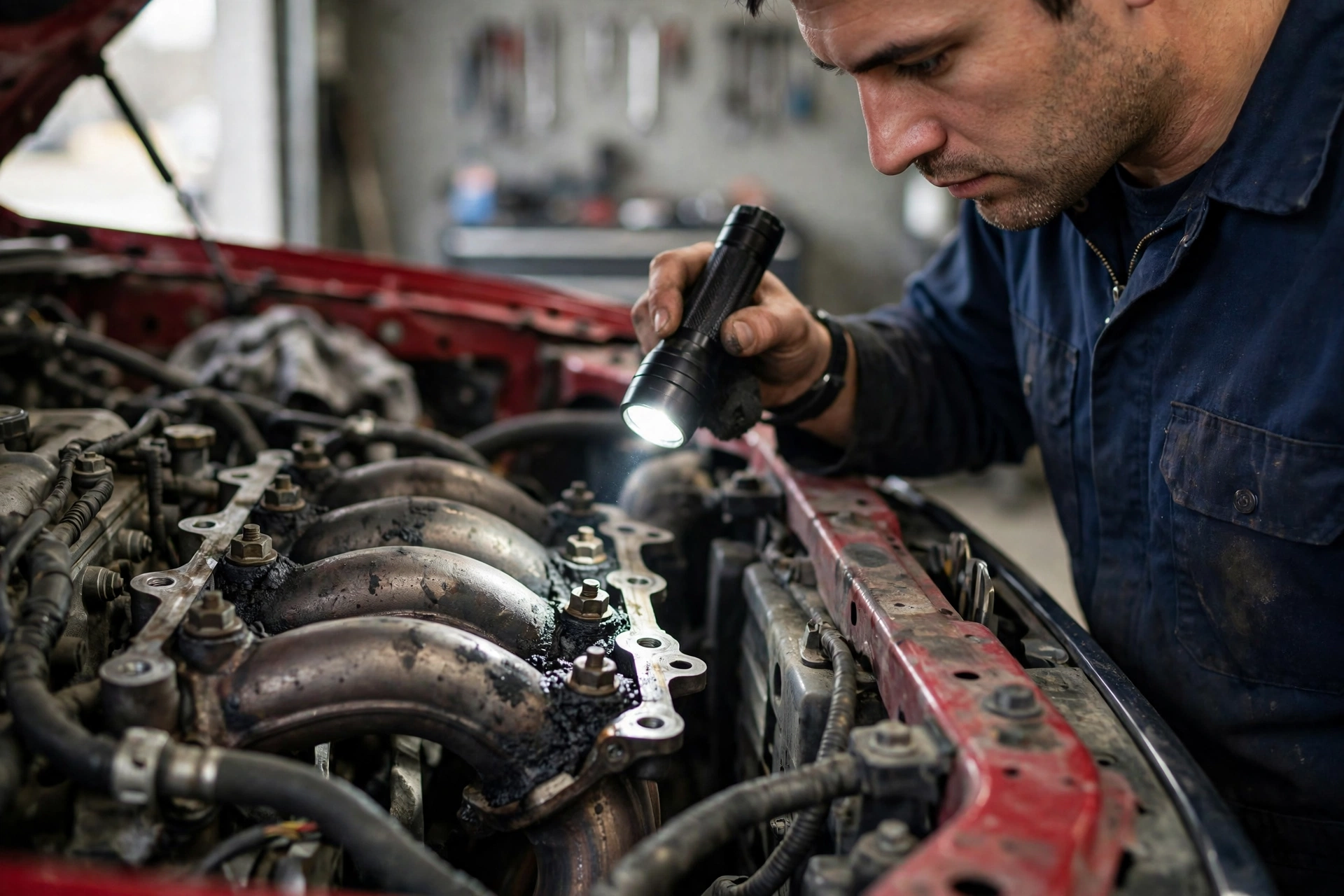
An exhaust leak is one of the most common reasons a car suddenly sounds loud. The exhaust system quiets the engine through the manifold, pipes, catalytic converter, and muffler.
A crack, rust hole, or loose joint anywhere along that path lets raw engine sound escape as a deep roar that grows when you press the throttle.
A manifold leak sounds different from a leak further back. A leak at the manifold gasket gives a sharp ticking or puffing sound that is loudest on a cold start and fades as the engine warms. A hole in a pipe or muffler gives a steady deep rumble that never fades.
Look for black soot marks around joints, flanges, and gaskets, which show where exhaust gas has been escaping. A rattle from under the truck can mean a broken piece inside the catalytic converter, and that fault can set a check engine light with code P0420.
A sudden loud bang followed by rattling underneath usually means an exhaust or driveline part has broken loose. Stop driving and arrange a tow.


An exhaust leak is also a safety problem. AAA lists louder engine noise, worse fuel economy, and fumes inside the cabin as the common signs of an exhaust leak, and it calls cabin fumes particularly dangerous because of carbon monoxide. Carbon monoxide has no color and no smell.
If you smell exhaust inside the truck, do not keep driving. Pull over safely, get everyone into fresh air, and have the truck checked or towed before driving it again.
Ford’s owner’s manual says not to drive if you smell exhaust fumes, because leaks may allow harmful and potentially lethal fumes into the passenger compartment.


If the exhaust system is due for work, check our guide to exhaust filter overload fixes on Ford trucks first.
2 Worn Wheel Bearing Hum
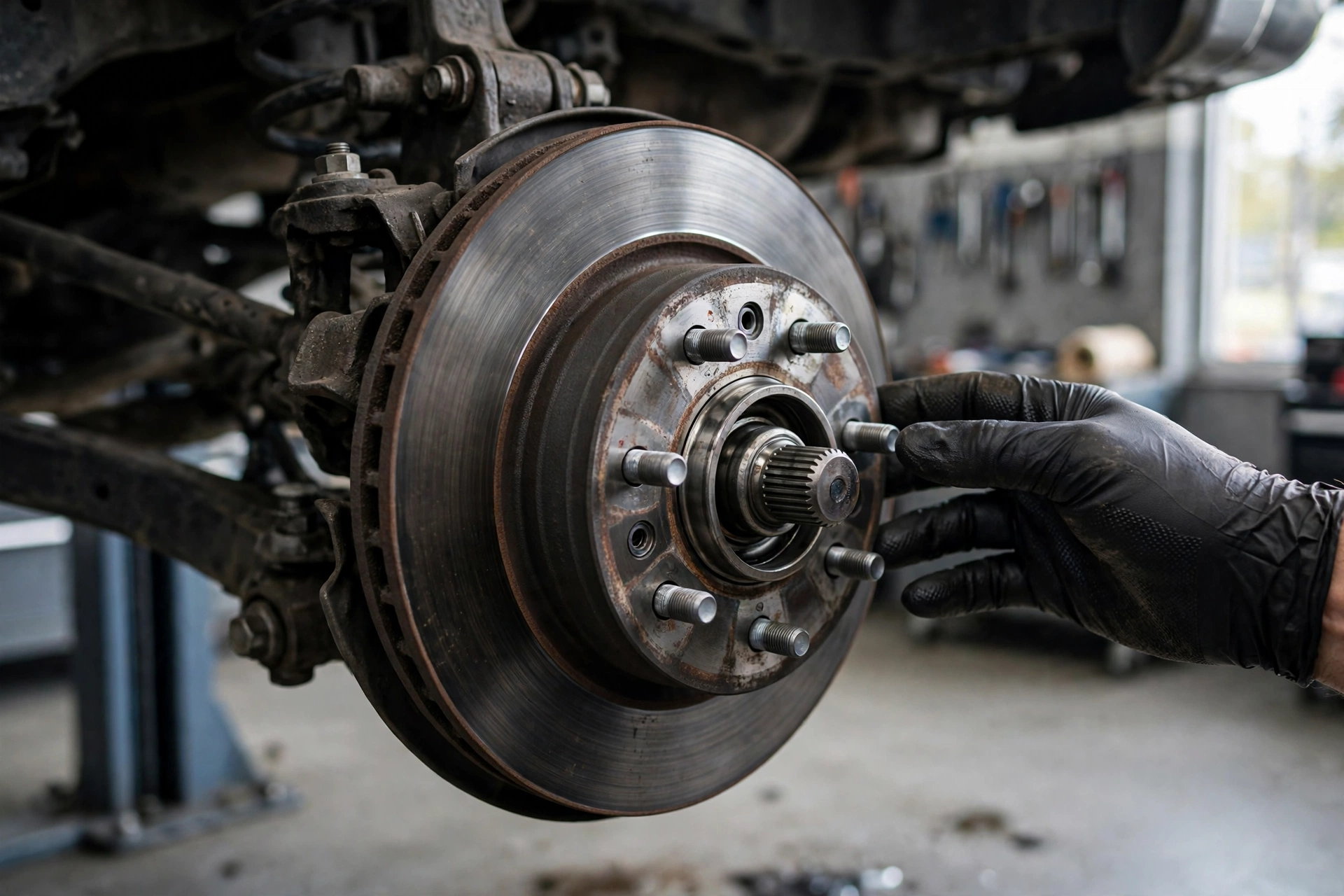
A worn wheel bearing makes a steady humming or growling sound that rises with road speed. It often starts faintly around 40 mph and grows louder on the highway, and it may change pitch when you turn.
One F-150 guide reports front hub assemblies on 2015-2020 trucks often failing around 45,000 to 50,000 miles, with the hum starting around 40 to 50 mph. That figure comes from owner reports, not a Ford specification.
The swerve test separates a bearing from a tire. Drive at the speed where the hum appears, then steer gently left and right.
If the noise gets louder in one direction, the bearing on the loaded side is the likely cause. If the noise does not change at all, suspect the tires instead.
You can also check with the truck safely raised on jack stands. Spin each wheel by hand and listen for a gritty sound, then rock the wheel at the top and bottom and feel for play. A wheel that wobbles or grinds has a bearing problem.
Four-wheel-drive F-150 trucks have one more suspect: the IWE (Integrated Wheel End) vacuum system. A leak there can cause a rhythmic hum that stops when you engage four-wheel drive.
A failing wheel bearing can seize or let the wheel wobble, so book the check soon. See our Ford F-150 humming noise guide for the full bearing and IWE diagnosis.
3 Tire Noise and Uneven Wear


Tires are another common cause of a loud cabin, and they are the easiest to rule out. As tires age, the tread blocks harden and wear unevenly, and the tire starts to sing or roar on the road. Cupped or feathered tread is the usual culprit.
Uneven wear has a cause behind it: worn shocks, bad alignment, or unbalanced wheels let the tire bounce or drag instead of rolling smoothly. Fixing the tire without fixing the alignment just wears the new tire the same way.
The bearing test above also works in reverse: if the noise stays the same through turns but changes when you move the tires to a different corner, the tires are the cause.
Keep pressures at the figure on the door jamb sticker, not the number on the tire sidewall. Underinflated tires run hotter, wear faster, and get louder. If you are sizing new rubber, our Ford F-250 tire size chart lists factory sizes.
4 Serpentine Belt Squeal and Pulley Noise
A high-pitched squeal or chirp from the front of the engine usually means the serpentine belt or one of its pulleys. The belt drives the alternator, water pump, power steering pump, and air conditioning compressor.
When it slips, it squeals loudest on a cold start or when you turn the steering wheel or switch the air conditioning on.
The usual causes are a worn or cracked belt, a weak tensioner, or a pulley bearing that has gone rough. Fluid on the belt can cause it too, so look for oil or coolant leaks above the belt path.
Belt dressing spray can quiet the noise for a day, but it is a mask, not a fix.
On a 2020 3.5L EcoBoost, a rattle lasting about 20 seconds on a cold start often points to a cam phaser problem, because the phaser drains its oil while the truck sits and rattles until oil pressure refills it.
A squeal heard at the same time can still be the belt drive, so check the belt and pulleys too. Do not replace the belt until you know which sound you are hearing.
Check the belt with the engine off. Look for cracks across the ribs, missing chunks, or a glazed shine.
Press the tensioner arm and feel whether it moves smoothly and springs back firmly. A loose or gritty tensioner needs replacement along with the belt.
A belt that snaps can leave you without the water pump and alternator, so book the check within days.
5 Engine Knock Versus Lifter Tick
The first step is to tell a tick from a knock, since they mean very different things.
Lifter Tick Signs
A lifter tick is a sharp, fast metallic click from the top of the engine, near the valve covers. It is often loudest on a cold start and fades within a few minutes as oil pressure builds. Low oil level, the wrong oil grade, or old sludged oil are the common causes.
Check the dipstick first. If the oil is low, top it up with the grade listed in your owner’s manual and listen again after a short drive.
A tick that disappears after fresh oil was an oil problem. If the tick stays on a warm engine, a lifter may be sticking or collapsed.
Direct-injection engines tick at the injectors by design, and that tick is normal.
Rod Knock Signs

A rod knock is deeper and heavier, like a dull hammer blow from low in the engine. It speeds up with engine speed, gets louder under load, and does not fade as the engine warms.
Do not keep driving a truck with a rod knock. Continued running can destroy the crankshaft and turn a bearing repair into an engine replacement. Stop driving and arrange a tow.
A third sound is often confused with both. Spark knock, also called pinging, is a light metallic rattle heard only under hard acceleration or climbing a hill.
It comes from fuel igniting at the wrong moment, often because of low-octane fuel. It usually fades with higher-octane fuel and is far less serious than a rod knock.
Ford EcoBoost owners should also know the cam phaser rattle: on 2011-2020 3.5L EcoBoost trucks, a rattle lasting 15 to 20 seconds on a cold start is a known phaser fault. Our 3.5L EcoBoost cam phaser replacement guide covers the symptoms and the repair.
This engine knock versus lifter tick comparison lays out the pitch, location, and load tests side by side. Our Ford engine oil recommendation chart lists the correct oil grade for each Ford engine, since the wrong grade is a common cause of a new tick.
6 Transmission Whine and Drivetrain Noise
A whine that rises with road speed and changes when the transmission shifts points to the transmission or the driveline. Low transmission fluid is the first suspect, because it lets the pump whine and the gears run dry.
Check the level using the method for your model year.
Our guide to checking transmission fluid on a 2016 F-150 shows the dipstick-free check step by step, since many newer F-150 trucks have no transmission dipstick. If the level is low, find the leak before you top it up.
The 10-speed automatic in 2017 and newer F-150 trucks has its own noise profile. Harsh shifts, whining in certain gears, and clunks on downshifts are widely reported, and some cases are reported to involve valve-body or software faults rather than wear. Our Ford 10-speed transmission problems guide lists the symptoms by model year.
A whine from the rear can also come from the differential: pinion bearing wear in the rear axle makes a hum that changes with throttle, while a wheel bearing follows road speed alone.
7 Brake Grinding and Suspension Clunks
Noise that appears only when you press the brake pedal belongs to the brake system. A high-pitched squeal when braking is often the wear indicator on the brake pad, and it means the pads are nearly gone. A deep grinding sound means the pad material is gone and metal is scraping the rotor.
Check the pads through the wheel spokes if you can see them. If the pad material looks very thin or nearly gone, replacement is due.
A grinding brake also damages the rotor, so waiting adds parts to the repair. Our guide to the best brake pads for the Ford F-150 4×4 lists pads by driving style.
Clunks over bumps point to the suspension: worn sway bar links, ball joints, and shock mounts all clunk, often louder in cold weather. A clunk when you turn the wheel at low speed often means a worn ball joint, and that is a safety item.
Which Loud Noises Mean Stop Driving Now
Not every loud car needs a tow truck, but some do. If your noise is in the stop-now column below, park the truck and call for help rather than driving to the shop.
Stop Now or Book Soon
Match the noise you hear to the urgency. Stop-now noises can cause injury, a breakdown, or engine failure if you keep driving.
| Noise You Hear | Likely Cause | Urgency |
|---|---|---|
| Deep knock from low in the engine, louder under load | Rod bearing failure | STOP NOW |
| Exhaust smell inside the cabin, headache or dizziness | Exhaust leak, carbon monoxide risk | STOP NOW |
| Grinding when braking, metal on metal | Brake pads worn through | STOP NOW |
| Sudden loud bang, then rattling underneath | Broken exhaust or driveline part | STOP NOW |
| Deep roar that grows with throttle | Exhaust leak or failed muffler | BOOK SOON |
| Steady hum over 40 mph, changes when turning | Worn wheel bearing | BOOK SOON |
| High squeal on cold start | Serpentine belt or pulley bearing | BOOK SOON |
| Light tick that fades as the engine warms | Lifter tick, low or old oil | BOOK SOON |
| Whine that follows road speed | Low transmission fluid or differential wear | BOOK SOON |
| Roar that stays the same through turns | Tire wear or cupping | BOOK SOON |
Sources: AAA Club Alliance exhaust leak signs; Ford owner’s manual exhaust fume warning; Ford F-150 owner reports on bearing and cam phaser noise.
If you smell exhaust inside the truck or feel headache, dizziness, or nausea while driving, pull over and get everyone into fresh air. This exhaust leak symptoms guide lists the carbon monoxide symptoms to watch for.
What to Tell Your Mechanic About a Loud Car
Write down four facts before you call the shop: when the noise happens, where it seems to come from, what it sounds like, and what makes it change.
Mention the simple checks you already ran: the oil level, whether the noise changes with steering, and whether it is worse cold or warm.
Our Ford transmission identification chart helps you confirm which transmission your truck has before you call.
Frequently Asked Questions About Loud Car Noises
Why Does My Car Sound Loud When Accelerating?


A roar that grows with the throttle usually means an exhaust leak or a failed muffler. A whine that grows with road speed instead points to a wheel bearing, tire wear, or the transmission.
Why Does My Car Sound Loud on a Cold Start?
A tick that fades as the engine warms is often a lifter tick from low oil or an exhaust manifold leak that closes as the metal expands. A rattle lasting about 20 seconds on a 3.5L EcoBoost is often the cam phaser. A squeal on a cold start is usually the serpentine belt.
Is It Safe to Drive a Loud Car?


It depends on the cause. A tire roar or a belt squeal can usually wait for a booked check within days. A rod knock, grinding brakes, or exhaust fumes inside the cabin mean stop driving now.
Why Does My Car Hum at Highway Speed?
A steady hum over 40 mph that changes when you steer is usually a worn wheel bearing. A hum that stays the same through turns is more often tire wear.
Can Low Oil Make a Car Sound Loud?
Yes. Low oil starves the lifters, which causes a tick that is loudest on a cold start. Check the dipstick first, since topping up the oil is the simplest fix on this list.
Your Next Step When Your Car Sounds Loud
If you have been asking why does my car sound loud, the answer is that something in the exhaust, wheels, belt drive, engine, or transmission has changed. Start with the five-minute checks: note when the noise happens, where it comes from, and what makes it change.
Fix the stop-now items first. A rod knock, grinding brakes, or exhaust fumes in the cabin are not noises to drive through. Park the truck and call for a tow instead of driving to the shop.
Book the rest within days. A loud truck caught early is usually a simpler repair than the same noise ignored for a month.