
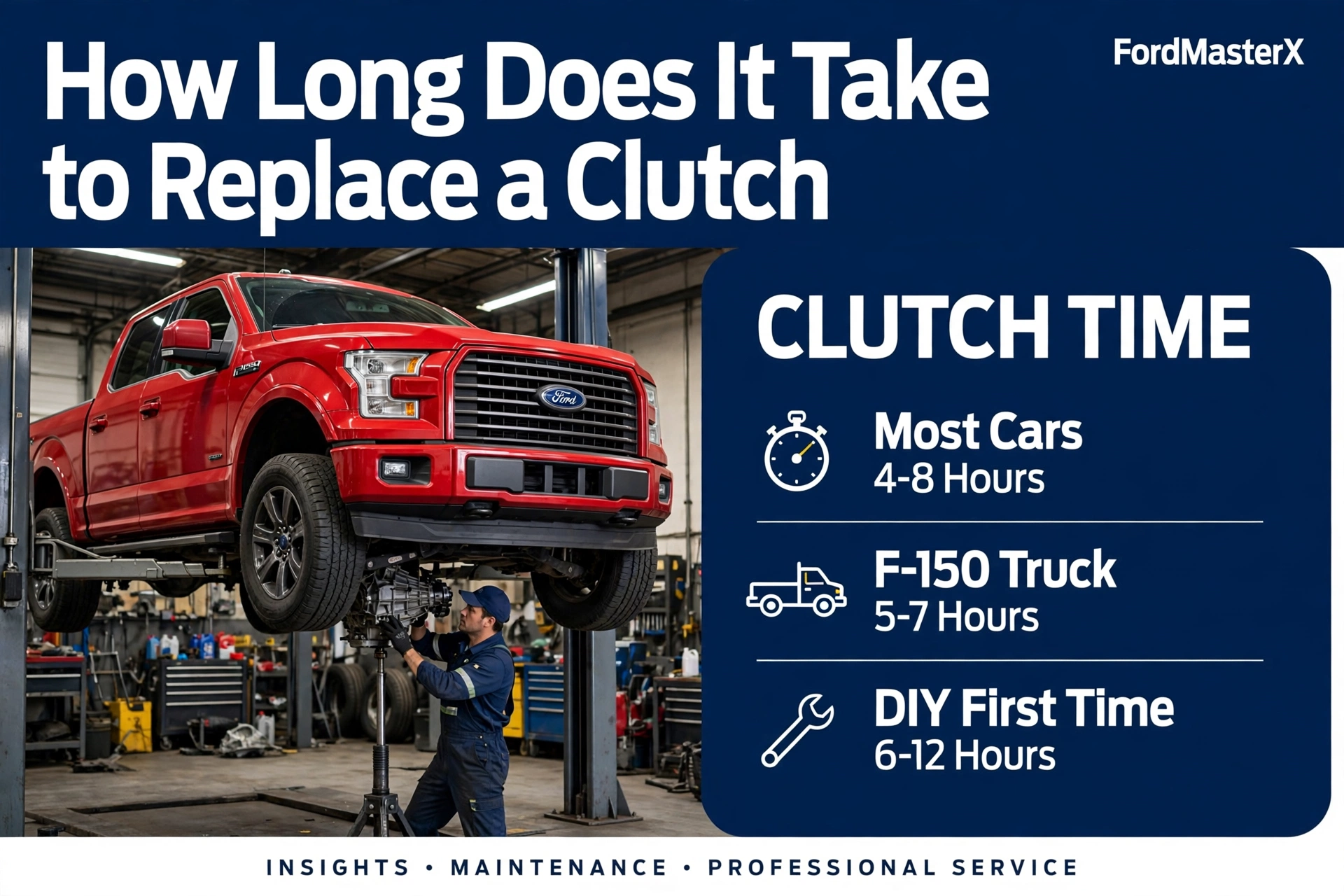
How Long Does It Take to Replace a Clutch? 2026 Complete Guide

If you are asking how long does it take to replace a clutch, the short answer is 4 to 8 hours of professional labor for most cars. A small front-wheel-drive Ford Focus sits at the fast end of that range, while a four-wheel-drive F-150 sits at the slow end.
The billed hours are only half the story. Your car is usually gone for a full working day, and sometimes two or three, because diagnosis, parts, flywheel work, and a road test sit around the wrench time. This guide gives you the time by vehicle type, the Ford-specific figures, and the questions that keep a shop quote honest.
The Short Answer in Hours
No single number fits every car, because the clutch sits between the engine and the transmission, and the transmission has to come out to reach it. How long that removal takes depends on the drivetrain layout, the size of the gearbox, and what else is in the way. Carwow puts the professional range at 3 to 6 hours, with straightforward jobs done in as little as 2 hours and complex ones running to about 10 hours.
The table below gives the working answer for each vehicle type. Use your row, not the headline number, when you judge a quote.
| Vehicle Type | Shop Labor Hours | Typical Total Cost |
|---|---|---|
| Small FWD car (Ford Focus, Fiesta) | 3–5 hours | $700–$1,300 |
| Midsize or RWD car (Mustang) | 5–8 hours | $1,000–$1,800 |
| F-150 2WD truck | 5–7 hours | $1,000–$1,600 |
| F-150 4×4 or AWD vehicle | 6–9 hours | $1,400–$2,500 |
| Performance or European manual | 6–10 hours | $1,800–$3,500 |
| DIY first-timer, any car | 6–12 hours | $300–$800 parts only |
Clutch Replacement Time at a Glance
Labor hours are what the shop bills. Turnaround is how long your car is gone. The two numbers are rarely the same.
| Vehicle Type | Shop Labor | Shop Turnaround | Typical Total Cost |
|---|---|---|---|
| Small FWD car (Ford Focus, Fiesta) | 3–5 HOURS | Same day | $700–$1,300 |
| Midsize or RWD car (Mustang) | 5–8 HOURS | 1 day | $1,000–$1,800 |
| F-150 2WD truck | 5–7 HOURS | 1 day | $1,000–$1,600 |
| F-150 4×4 or AWD vehicle | 6–9 HOURS | 1–2 days | $1,400–$2,500 |
| Performance or European manual | 6–10 HOURS | 1–2 days | $1,800–$3,500 |
| DIY first-timer, any car | 6–12 HOURS | A full weekend | $300–$800 parts only |
Verified ranges: professional labor of 4–8 hours for most cars (AutoZone); FWD 3–5 hours (Hunters Auto) and truck/AWD 6–9 hours (HowToFixCar); DIY 6–12 hours (AutoZone). Costs are installed totals at independent shops; a dual-mass flywheel can add $500–$1,000 or more. Sources: AutoZone, Carwow, HowLongFor, RepairPrice citing RepairPal.
Labor Hours Versus Shop Turnaround
Two different clocks run on a clutch job, and confusing them is how owners end up surprised. Labor hours are the billed time a technician spends working on your car, set by flat-rate guides such as Mitchell or Chilton. Turnaround is the time from drop-off to pickup, and it includes everything else.
Flat-rate time is the industry-standard expectation for a skilled technician working under ideal conditions. If the book says 6 hours, you pay for 6 hours of labor even if the technician finishes in 5, and the shop absorbs the extra time if rust turns it into 8. AutoZone’s clutch replacement guide puts transmission removal at 4 to 8 hours, and that range is the flat-rate labor, not the time your car spends in the building.
Turnaround is almost always longer than labor time. Diagnosis and a road test take 1 to 2 hours before the work starts, parts may need ordering, a flywheel may need machining at another shop, and the hydraulic system must be bled and tested after refitting. One shop guide puts total downtime at 1 to 3 days for that reason, even when the labor itself is a single day.
Ask for both numbers before you agree to the job. A shop that quotes 6 hours of labor and a 2-day turnaround is giving you an honest answer, while a shop that promises the car back in 6 hours is probably skipping the road test. Our guide to how long a diagnostic takes on a car explains the testing time that sits in front of most transmission work.
Ford F-150 Clutch Replacement Time
An F-150 with a manual transmission takes longer than a car, because the gearbox is bigger, heavier, and harder to reach. Expect 5 to 7 hours of shop labor for a two-wheel-drive F-150, and 6 to 9 hours for a 4×4. HowLongFor’s time-by-vehicle breakdown lists trucks and SUVs at 5 to 7 hours, with a typical total of $1,000 to $1,600, and all-wheel-drive or performance vehicles at 7 to 10 hours.
The 4×4 adds a whole extra removal step. The transfer case has to come off with the transmission, along with both driveshafts, before the clutch is even visible. Our guide to the signs of a bad transfer case covers the part that adds this time, and it is worth reading if your 4×4 also clunks or binds in turns.
Published flat-rate examples for older F-150 trucks show the same pattern. For a 1986 F-150 4×4 with a 302 engine, reported labor times were about 4 hours for a 3-speed, about 5.8 hours for a 4-speed, and about 5.2 hours for a 5-speed, with the transmission and transfer case removed rather than the engine. Modern trucks run longer, because the exhaust, wiring, and emissions hardware around the gearbox have all grown more complex.
Most F-150 trucks on the road today have an automatic, so a manual clutch job is now a rarer booking. That matters for timing, because the shop may need to order the clutch kit rather than pulling one off the shelf. Confirm parts availability when you book, or the labor time will not be the reason your truck stays an extra day.
Ford Focus and Fiesta Clutch Time
A manual Ford Focus or Fiesta is one of the faster clutch jobs, at 3 to 5 hours of shop labor for a straightforward swap. The transverse engine layout puts the gearbox beside the engine rather than behind it, so the technician pulls the drive axles and sometimes lowers the subframe to drop the transaxle out. That sounds slow, but a small gearbox on a lift comes out faster than a truck transmission.
Some guides give a wider range of 4 to 6 hours for front-wheel-drive cars, and that is the safer number to budget. Subframe bolts, axle nuts, and cramped engine bays add time on older cars, and a Focus that has spent winters on salted roads can add an hour of rust work alone. A shop that quotes 4 hours and finishes in 3 has still given you a fair price.
One warning applies to Focus automatics. A 2012-2018 Focus with the 2.0L automatic uses the DPS6 PowerShift dual-clutch gearbox, and its clutch work is a different job from a manual clutch replacement, with its own parts and failure modes. Our guide to the 2015 Focus transmission control module explains the shudder, slipping, and module faults that owners often mistake for a worn manual clutch.
The Fiesta has a simpler story. Its hydraulic clutch system is the usual suspect when the pedal feels wrong, and a master or slave cylinder fault can look exactly like a worn clutch. Our Fiesta clutch master cylinder guide walks through those symptoms, so check the hydraulics before you pay for a full clutch kit.
What the Hours Actually Cover
A clutch replacement is not one task but a sequence, and most of the time goes to getting the gearbox out and back in. The clutch parts themselves take only a small share of the job. Here is where the hours go on a typical shop booking.
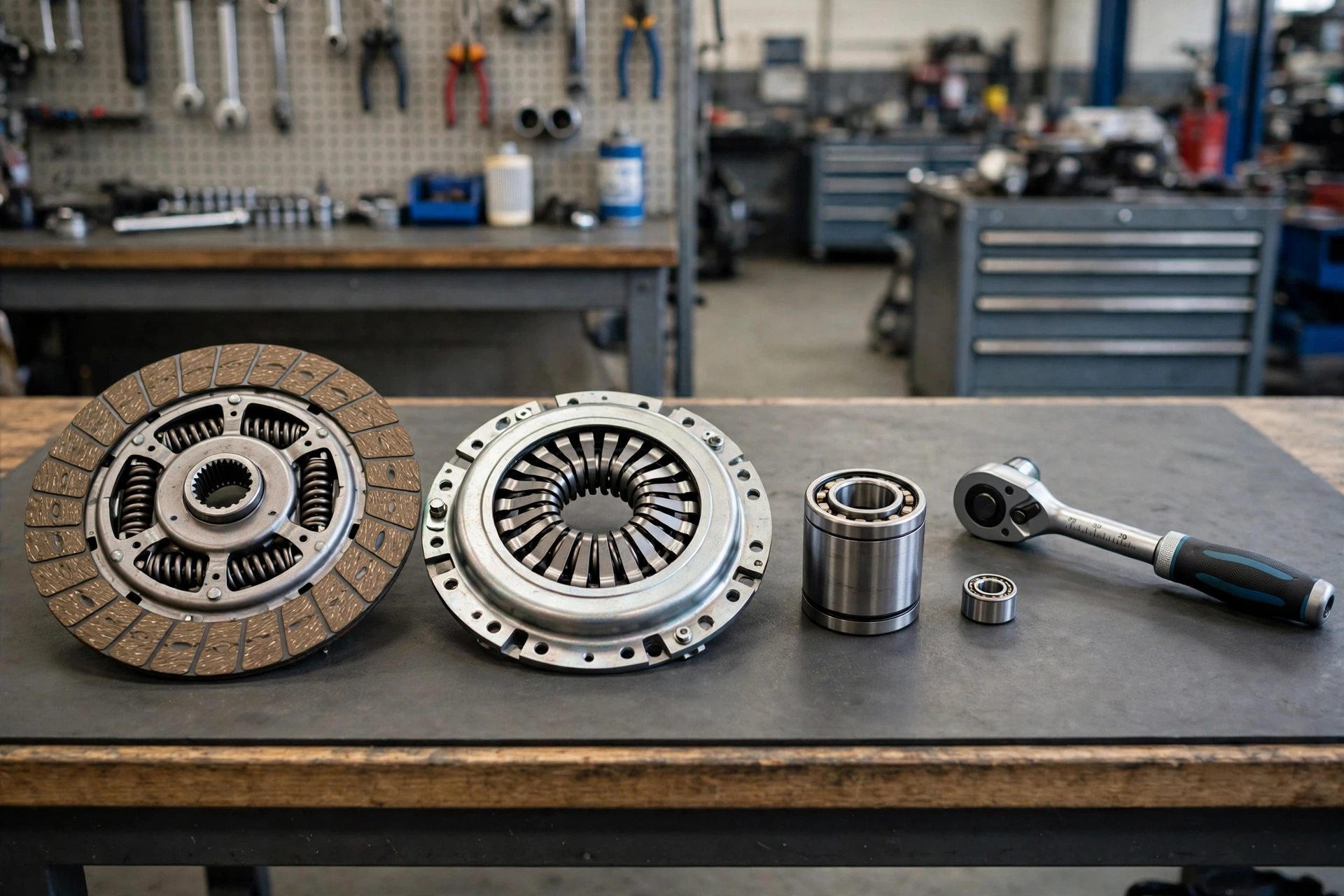
AI-generated illustration: a new clutch kit laid out on a workbench: clutch disc, pressure plate, release bearing, and pilot bearing.
- Diagnosis and road test, 1 to 2 hours (turnaround time, not billed clutch labor). The technician confirms the clutch is the fault, not the hydraulics or the transmission, and checks for leaks and noises.
- Preparation, about 1 hour. The car goes on a lift, the battery is disconnected, the exhaust and driveshaft or axles are unbolted, and the engine is supported.
- Transmission removal, 2 to 3 hours. The gearbox is unbolted from the engine and lowered on a transmission jack. This is the longest single step, and the one rust hits hardest.
- Clutch swap and flywheel check, 1 to 2 hours. The old disc, pressure plate, and release bearing come off, the flywheel is inspected and resurfaced or replaced, and the new kit is fitted with a clutch alignment tool.
- Refitting and bleeding, 1 to 2 hours. The transmission goes back in, the hydraulics are bled, and the fluid is topped up. A final road test then confirms clean engagement and no slipping, and that test is turnaround time, not billed labor.
Diagnosis before the job and the final road test sit outside the billed labor: they are turnaround time, not part of the 4-to-8-hour labor range. The four wrench-time steps above total 5 to 8 hours on a typical car, inside the professional labor range of 4 to 8 hours for most cars (AutoZone), with trucks and 4x4s running toward the top end.
That sequence explains why a “simple” clutch costs so much in labor. The parts are cheap compared with the access work, and skipping a step to save an hour usually means doing the job twice. Our clutch pedal assembly diagram guide shows the pedal, linkage, and hydraulic parts that the technician checks during the same visit.
What Else Gets Replaced With the Clutch
A clutch kit holds three wear parts: the friction disc, the pressure plate, and the release bearing, also called the throw-out bearing. A good shop replaces all three together, because the transmission is already out and the labor to reach any one of them later is the same full job again. The pilot bearing in the end of the crankshaft belongs in the same group.
The flywheel is the decision that changes the bill. A solid flywheel can usually be resurfaced, which means grinding its face smooth again, for about $50 to $400.
A dual-mass flywheel is two flywheels joined by springs, and it usually cannot be resurfaced, so a worn one must be replaced at $500 to $1,000 or more. RepairPrice’s cost guide, citing RepairPal’s US average of $1,630 to $2,047 for a clutch replacement, states the rule plainly: if the transmission is already out, do everything that is cheap now and ruinously expensive later.
The rear main seal is the cheapest part with the most expensive timing. It is a roughly $30 seal at the back of the engine, and replacing it while the transmission is out adds parts cost only.
Wait until it leaks, and you pay for a full transmission removal to reach it. Ask your shop to include it, along with the release bearing and pilot bearing, in the written quote.
| Part | Replace With the Clutch? | Typical Added Cost |
|---|---|---|
| Clutch disc, pressure plate, release bearing | Always, as a kit | Included in the kit, $150–$600 |
| Pilot bearing or bushing | Always | Small part, little added labor |
| Flywheel resurfacing (solid flywheel) | Almost always | $50–$400 |
| Dual-mass flywheel replacement | When worn or heat damaged | $500–$1,000 or more |
| Rear main seal | Yes, while the transmission is out | About $30 in parts |
| Slave cylinder (if inside the bellhousing) | Yes, if fitted there | Parts plus fluid and bleeding |
One more part deserves a check before the gearbox goes back in. On many Fords the clutch slave cylinder sits inside the bellhousing, so a leaking slave means the transmission comes out again. Replacing it during the clutch job costs the part and a little fluid, and it removes one of the most common reasons for a repeat visit.
5 Reasons the Job Takes Much Longer
Most clutch jobs land inside the ranges in this guide. When one runs long, it is almost always one of five causes, and most of them are visible only after the work starts. Knowing them helps you read a revised estimate without assuming the shop is padding the bill.
Rusted or Seized Bolts
Corroded bellhousing bolts are the most common time thief on older Fords. A bolt that shears inside an aluminum casing can add 2 hours of extraction work to any job. Subframe mounts and exhaust fasteners seize the same way, and every seized bolt has to be drilled, heated, or cut out before the gearbox can move.
Dual-Mass Flywheel Trouble
A dual-mass flywheel that is scored, heat cracked, or loose adds both time and money. It cannot be resurfaced, so the shop must order a replacement, and the car waits until it arrives. A new clutch disc fitted against a tired flywheel also wears fast, so a good shop will not skip this step to save a day.
Parts Not in Stock
Clutch kits for common Fords are usually on the shelf, but a dual-mass flywheel, a slave cylinder, or a kit for a rare manual truck may not be. One shop guide notes that a job with 4 hours of labor can still take 2 days in the shop if the parts must be ordered. Confirm the kit, flywheel, and seals are in hand before the car goes on the lift.
Hydraulic Problems Found
A slipping clutch can hide a hydraulic fault, and the two feel alike from the driver seat. Low fluid, air in the lines, or a failing master or slave cylinder can all stop the clutch from fully disengaging. Finding that fault mid-job adds diagnosis and bleeding time, but fixing it then is far cheaper than opening the gearbox again.
Transfer Case and 4WD Hardware
Four-wheel-drive hardware adds removal steps at both ends of the job. The transfer case, front driveshaft, and extra brackets must come off before the transmission, and all of them must be refilled and torqued on the way back. Heavy-duty trucks and SUVs can run 8 to 16 hours of labor for this reason, and a first-time DIY job on a 4×4 can stretch across a full weekend.
DIY Versus Shop Time
A professional shop completes most clutch replacements in 4 to 8 hours of labor, because it has a lift, a transmission jack, and a technician who has done the job many times. A first-time DIY job takes 6 to 12 hours on a car, and 8 to 15 hours on a truck, even with the right tools. Experienced home mechanics can finish faster, but a beginner should plan a full weekend.
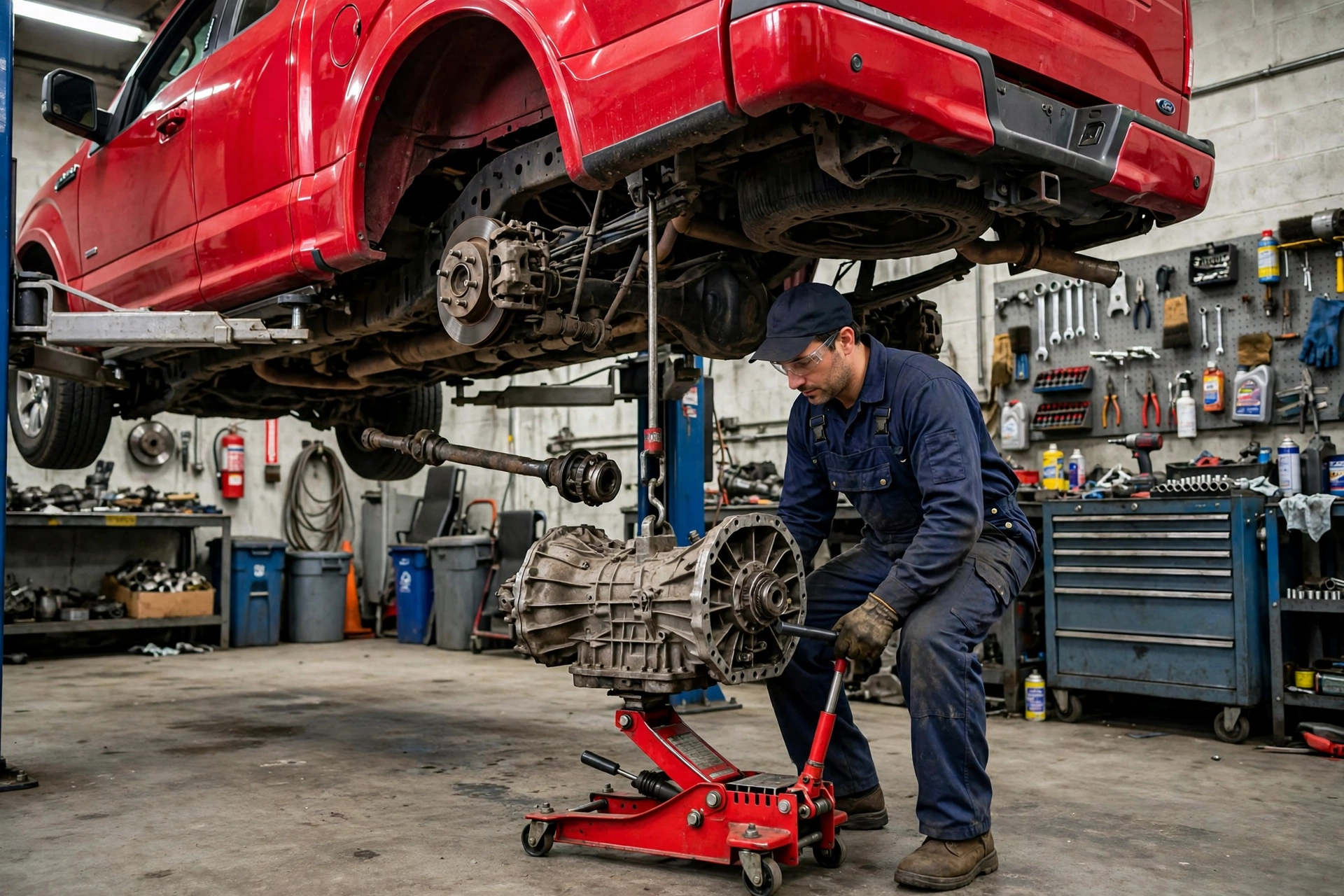
AI-generated illustration: a manual transmission being lowered from a Ford F-150 on a lift with a transmission jack.
The gap is mostly equipment. A transmission weighs far more than one person can safely hold, and a transmission jack is what lets a shop lower it in a controlled way. On jack stands in a driveway, the same step is slow, awkward, and risky, and a dropped gearbox can damage the input shaft or injure the person under it.
The tool list is also longer than most owners expect. You need jack stands, a transmission jack, a torque wrench, a clutch alignment tool, and the sockets for bellhousing, subframe, and axle bolts. A flywheel that needs resurfacing has to go to a machine shop, which adds a trip and a wait to a home job.
DIY saves real money: a kit costs $300 to $800 in parts, against $500 to $1,500 of labor at a shop. But the saving only counts if the job is done right.
A pressure plate torqued in the wrong sequence, a clutch disc fitted backward, or air left in the hydraulics will bring the car back apart. If you have never removed a transmission, treat this as an advanced job and get an experienced helper.
What a Clutch Replacement Costs in 2026
Time and cost are the same question on a clutch job, because labor is the largest part of the bill. Independent shops typically charge $90 to $150 per hour, and dealers often charge $150 to $200 per hour. At those rates, 4 to 8 hours of labor alone costs $360 to $1,200, before parts.
The national average for a car clutch repair runs $1,000 to $1,500 including parts and labor, according to AutoZone. RepairPal’s US average, updated in September 2026, is higher at $1,630 to $2,047, which reflects dealer work and dual-mass flywheels in the mix. Your quote should sit between those figures for a mainstream Ford, and above them for a 4×4 truck or a performance car.
| Vehicle Type | Labor Hours | Parts | Installed Total |
|---|---|---|---|
| Compact or economy FWD manual | 4–6 hours | $150–$350 | $700–$1,300 |
| Midsize or RWD manual | 5–8 hours | $200–$450 | $1,000–$1,800 |
| Truck or AWD manual | 6–9 hours | $300–$600 | $1,400–$2,500 |
| Performance or European manual | 6–10 hours | $400–$900 or more | $1,800–$3,500 or more |
Read the quote line by line before you approve it. The labor hours should match the range for your vehicle type in this guide, the kit should list the disc, pressure plate, and release bearing, and the flywheel line should say resurface or replace. If the quote lists only a clutch disc, ask what happens to the bearings and the flywheel before you sign.
6 Signs Your Clutch Needs Replacing
A clutch does not wear out on a calendar schedule the way oil or filters do. The common real-world range is 60,000 to 100,000 miles, with gentle highway driving stretching past that and hard city use cutting it short. Mileage alone never decides the job: the symptoms do.
- Slipping under acceleration. The engine revs climb, but the car does not speed up to match. It shows up first in a higher gear on a hill or during hard acceleration.
- Shudder or chatter on engagement. The car shakes as you let the clutch out from a stop. The friction surface may be uneven, contaminated with oil, or heat damaged.
- Hard shifting or grinding. Gears resist going in, especially first and reverse. The clutch may not be fully disengaging, though low hydraulic fluid can cause the same symptom.
- Burning smell. A sharp, acrid odor like burnt toast means the friction material is overheating from excessive slipping. It often appears after hard use or towing.
- Soft or spongy pedal. The pedal feels easier to push, or engagement happens closer to the floor. Worn friction material is one cause, and a hydraulic fault is another.
- Noise when you press the pedal. Squeaking or grumbling as the pedal moves often points to a failing release bearing. A grinding noise can mean the disc has worn to bare metal.
Two of those signs need a check before you blame the clutch. Hard shifting with a soft pedal often traces to the master or slave cylinder, and knowing how to tell if your clutch master cylinder is bad separates the two faults. Low transmission fluid can also mimic clutch trouble, so check the level using the method for your model year; our guide to checking transmission fluid on a 2016 F-150 shows the dipstick-free check step by step.
A slipping clutch will not fix itself, and it gets worse with heat. If the engine revs climb without matching acceleration in more than one gear, book the check within days. Driving on a badly slipping clutch can overheat the flywheel, which turns a standard job into a flywheel replacement as well.
How to Get an Accurate Quote
A good clutch quote answers five questions before you ask them. If a shop cannot answer one, get a second quote before you approve the work.
- How many flat-rate labor hours, and for which vehicle? The number should match your drivetrain and the ranges in this guide. Ask which labor guide the shop uses.
- Does the quote include the full kit? The disc, pressure plate, release bearing, and pilot bearing should all be listed. A kit-only price is not a complete job.
- What happens to the flywheel? The quote should say resurface or replace, and name the extra cost if a dual-mass flywheel is found worn.
- Is the rear main seal included? It costs about $30 in parts while the transmission is out. A shop that suggests it is a shop that has done this job before.
- What is the turnaround, not just the labor? Ask when the car will be ready, whether the flywheel goes to a machine shop, and what warranty covers parts and labor.
Confirm your exact transmission before you call, because labor time follows the gearbox, not the badge on the tailgate. Our Ford transmission identification chart shows how to confirm which transmission your Ford has. Bring the year, engine, drivetrain, and transmission type to every quote, and the numbers you get back will be far closer together.
Frequently Asked Questions About Clutch Replacement Time
Can I Drive With a Slipping Clutch?
You can drive a short distance to a shop, but do not keep driving on a slipping clutch. It generates extreme heat, wears the flywheel, and can fail without warning. Book the repair within days, and avoid towing or hard acceleration until then.
How Long Does a Clutch Replacement Take on an F-150?
Expect 5 to 7 hours of shop labor for a two-wheel-drive F-150, and 6 to 9 hours for a 4×4, because the transfer case must come off as well. Total turnaround is usually 1 to 2 days. Confirm parts availability first, since manual F-150 clutch kits are often ordered rather than stocked.
Does a Clutch Replacement Take One Day?
Most cars are finished within one business day of labor, but total downtime is often 1 to 3 days. Diagnosis, parts ordering, flywheel machining, bleeding, and a road test all add waiting time beyond the wrench time. Ask the shop for the pickup time, not just the labor hours.
Should the Flywheel Be Replaced With the Clutch?
Almost always, it should be resurfaced or replaced. A solid flywheel can usually be resurfaced for $50 to $400, while a dual-mass flywheel usually must be replaced at $500 to $1,000 or more. Fitting a new clutch against a scored or heat-cracked flywheel shortens the life of both parts.
Does an Automatic Transmission Have a Clutch Job Like This?
No, not in the same way. An automatic uses clutch packs inside the transmission, and its faults are usually electronic or hydraulic rather than a worn friction disc. Our Ford 10-speed transmission problems guide lists the symptoms by model year for the automatic in 2017 and newer F-150 trucks.
Your Next Step After a Clutch Quote
If you have been asking how long does it take to replace a clutch, the answer for your car is now a range you can check: 3 to 5 hours for a small front-wheel-drive Ford, 5 to 7 hours for a two-wheel-drive F-150, and 6 to 9 hours for a 4×4. Plan on the car being gone for a day, and two if a flywheel or parts order is involved.
Take the five quote questions to the shop, confirm the full kit, the flywheel, and the rear main seal are in the price, and get the turnaround in writing. A clutch job done once, with the right parts, should last 60,000 to 100,000 miles or more, and the hours you spend checking the quote are the cheapest part of the whole repair.