
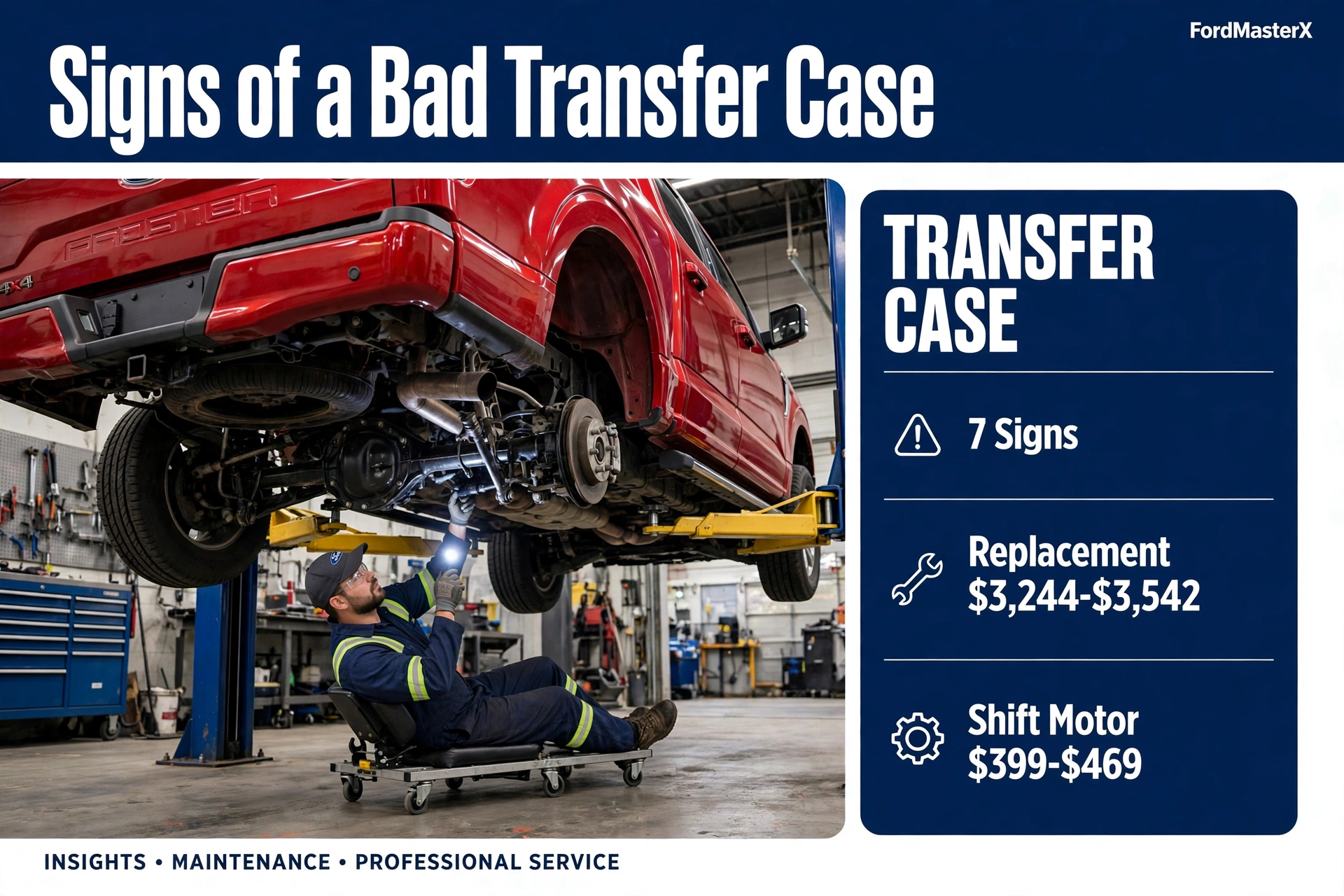
Signs of a Bad Transfer Case With 7 Proven Checks for 2026

The signs of a bad transfer case are grinding or whining under the truck, trouble shifting into or out of 4WD, a fluid leak under the middle of the truck, a 4WD warning light, vibration through the floor, binding in tight turns, and a truck stuck in 4WD or 4 Low. One sign alone does not prove the case has failed, but two or more together mean it should be checked before the next long drive.
This guide covers Ford 4×4 trucks and SUVs, with the F-150 as the main example. It shows what each sign points to, how to separate a transfer-case fault from a transmission or differential fault, and what a repair costs in 2026.


What a Transfer Case Does in Your Ford 4×4
The transfer case sits behind the transmission and splits engine power between the front and rear axles. On a part-time 4WD Ford truck it has three modes: 2H for pavement, 4H for loose surfaces, and 4L for slow, heavy work.
Most Ford F-150 and Super Duty cases use a chain drive inside a cast aluminum case, while the heavy-duty BW4407 uses a magnesium case. The chain, gears, bearings, and clutch packs run in about 1.5 to 3 quarts of fluid, depending on the model. Low fluid or a stretched chain makes the case noisy and slow to shift.
The transfer case is not the transmission and it is not a differential. The transmission changes gear ratios between the engine and the driveline, while the transfer case takes that output and decides which axles get power.
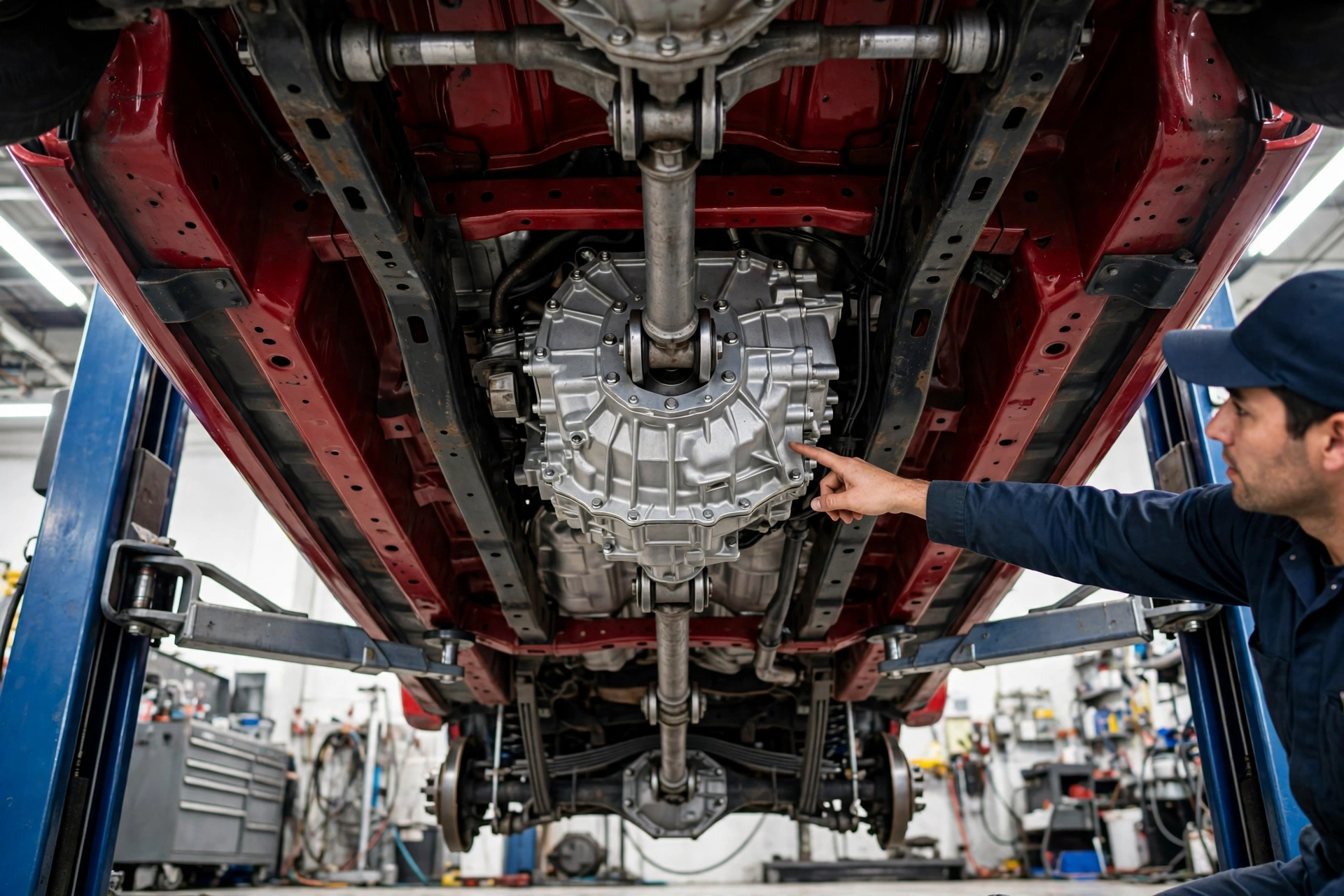
7 Signs of a Bad Transfer Case to Check First


These seven signs cover almost every transfer-case failure Ford owners report. The seven signs listed by CarTreatments match the same pattern, and each sign below ties to a specific part inside the case.
1. Grinding or Whining Under Load
A failing transfer case often makes a humming, whining, or grinding noise that grows louder with road speed. It usually gets worse when 4WD is engaged or under load.
Worn bearings, a stretched drive chain, or low fluid cause this noise.
On a 2006 to 2020 F-150 non-Raptor, one common grind is not the transfer case at all. The integrated wheel ends, or IWEs, at the front hubs can partly engage when their vacuum system leaks.
Ford TSB 20-2307 covers this noise on trucks with a Torque on Demand, or TOD, transfer case, and its fix is to remove and cap the vacuum supply line. Our F-150 4×4 actuator guide walks through the IWE vacuum test at 20 in-Hg.
2. Trouble Shifting Into 4WD


If your truck hesitates, grinds, or refuses to shift into 4WD, the transfer case is a likely cause. The same applies when it drops out of 4WD on its own on a muddy track or a snowy hill.


On electronic shift-on-the-fly trucks, the shift motor is often the failed part rather than the case itself. It bolts to the outside of the case and moves the range fork, and when it seizes the dash light blinks and never goes solid.
A truck stuck between ranges can show no drive at all. Check the fuses and the shift-motor connector first, because a cheap electrical fault looks exactly like a dead case.
3. Fluid Leaking Under the Truck
Transfer-case fluid is thin and usually red, amber, or brown, and it pools under the middle of the truck, behind the transmission and ahead of the rear axle.



Low fluid is one of the most common reasons transfer cases fail early, because it lubricates the chain, gears, bearings, and clutch packs. When it runs low those parts wear without cooling.
A slow seep from an output-shaft seal is a small job. Heavy leakage or a cracked housing needs attention the same day, so check the fluid level as soon as you spot the leak.
4. A 4WD Warning Light


Most modern Fords log a diagnostic trouble code and light a 4WD warning or show a “Service 4WD” message when the transfer case or its sensors detect a fault. If the light comes on, avoid 4WD and have the truck scanned.
A code reader will show whether the fault is the shift motor, a range sensor, the control module, or an internal problem. A warning light with normal driving is often electrical, and those parts cost far less than a case.
5. Vibration Through the Floor
A failing transfer case can send vibration through the floor or the center of the truck. It may grow with speed or under acceleration.
Worn bearings, excess internal play, or a stretched chain cause this vibration. A stretched chain runs loose on its sprockets and shows up as a shudder under load.
Vibration alone does not prove the case is bad. A worn driveshaft joint or a bad tire can feel the same, but if the vibration changes when you shift between 2WD and 4WD, the case is the prime suspect.
6. Binding in Tight Turns


If your truck resists turns, jerks, or hops during slow, tight turns, the transfer case may not be fully disengaging from 4WD. This is called driveline binding, and it happens because a part-time 4WD system locks the front and rear axles together.
Some binding on dry pavement in 4H is normal for a part-time system, because the axles must turn at the same speed while covering different distances in a turn.
Binding becomes a symptom when it continues after you shift back to 2WD. Mismatched tire sizes can cause the same fight, so check that all four tires match first. Our best tires for the Ford F-150 4×4 guide covers matched sets.
7. Stuck in 4WD or 4 Low
A truck that will not shift out of 4WD or 4 Low has a transfer-case problem until proven otherwise. In 4 Low the engine revs high at low speed, and in 4 High the driveline binds in every turn.
A failed shift motor, a damaged shift fork, a linkage fault, or internal damage can cause this. Try the manual procedure first: stop on level ground, shift to neutral, hold the brake, and select 2H.
Do not keep driving a truck stuck in 4 Low on the highway: the low range spins the engine fast at road speed and stresses the driveline, so get it checked the same day.
7 Signs at a Glance
The checks that confirm it, and what a Ford repair costs.
Stop driving if fluid loss is heavy, the driveline binds or locks, or the truck shifts modes on its own. Check the fluid first: metal flakes in the fluid mean internal wear. On a 2006-2020 F-150, check the IWE vacuum system before blaming the case: Ford TSB 20-2307 covers that grind.
Which Ford Transfer Case Is in Your Truck
Ford has used BorgWarner transfer cases in the F-150 for decades, and the model changes with the truck year. The model is stamped on a metal ID tag bolted to the case.
| Transfer Case | Ford F-150 Years | Notes |
|---|---|---|
| BW1356 | 1987-1996 | Part-time 4×4, about 3 quarts MERCON ATF |
| BW4406 | 1996-2003 | Part-time or TOD, low range 2.64 to 1 |
| BW4407 | 1996-1998 F-250/F-350 | Heavy-duty, GVWR over 8,500 lb, low range 2.69 to 1 |
| BW4417 | 2008-present | TOD, 2-speed on F-150 and Expedition |
| BW4419 | 2009-2014 | Electric shift, no TOD |
| BW4418 | 2009-2011 | Manual shift-on-the-fly |
DieselHub’s BW4406 and BW4407 spec pages list the BW4406 at 98 pounds dry with a 4-pint ATF capacity, and the BW4407 with a magnesium case and a 2-liter capacity. The BW4407 is the heavy-duty unit for trucks over 8,500 pounds GVWR.
The BW4406 was offered as a part-time case or a full-time torque-on-demand unit. The TOD version fits the Expedition and some F-150s. Separately, TSB 20-2307 covers the IWE grind on 2006-2020 F-150s with a TOD case (see Sign 1).
Transfer Case or Transmission 5 Ways to Tell


Transfer-case and transmission symptoms overlap, because both parts sit in the same driveline. These five tests separate them.
| Test | More Likely Transfer Case | More Likely Transmission |
|---|---|---|
| 4WD will not engage or disengage | Yes, the case controls the modes | No, the transmission has no 4WD modes |
| Noise changes when you shift 2WD to 4WD | Yes, the case is now under load | No, transmission noise stays the same |
| Slipping between gears in 2WD | No, the case does not change gears | Yes, slipping is a transmission clutch fault |
| Hard shifts between normal gears | Sometimes | Yes, harsh gear changes |
| Delayed drive or reverse engagement | Sometimes | Yes, delayed engagement |
Where the table says “Sometimes”, the symptom is rare for a transfer case, so check the transmission first.
A differential is the third suspect. A worn rear differential usually makes noise in 2WD and 4WD alike, while a transfer-case noise often appears only in 4WD. Our F-150 rear differential rebuild guide covers the howl and whine that point at the rear axle.
The front axle can also fool you: a failing IWE or a worn front U-joint clicks or grinds in turns. Our F-250 front axle parts diagram shows where the hubs, U-joints, and vacuum lines sit.
If the truck has a 10-speed automatic, check the transmission first for shift complaints in 2WD. Our 10-speed transmission problems guide covers the CDF drum failure and harsh shifts owners often blame on the transfer case, and our Ford transmission identification chart confirms which transmission your truck has.
How to Check Transfer Case Fluid in 5 Steps
A fluid check is the fastest driveway test for a suspect transfer case. Plan on about 20 minutes, and it tells you the level, the color, and whether metal is present.
- Park on level ground and set the parking brake. Chock the wheels, then slide under the truck and find the transfer case behind the transmission, the aluminum box with two driveshafts.
- Find the fill plug on the side of the case. Clean the dirt from around it first.
- Remove the fill plug only and look inside the hole. If fluid drips out, the level is correct. If you cannot feel fluid with a fingertip at the bottom of the hole, the level is low.
- Look at the fluid and feel it between your fingers. Healthy fluid is red, amber, or brown and clear. Dark fluid with a burnt smell means it is overdue for a change, and silver glitter or metal flakes mean internal wear.
- Top off through the fill plug until fluid reaches the bottom of the hole, then fit the plug and torque it to the manual figure. Use only the fluid the owner’s manual lists.
For a full fluid change, remove the drain plug below the fill plug and let the case empty into a clean pan before you refill it.
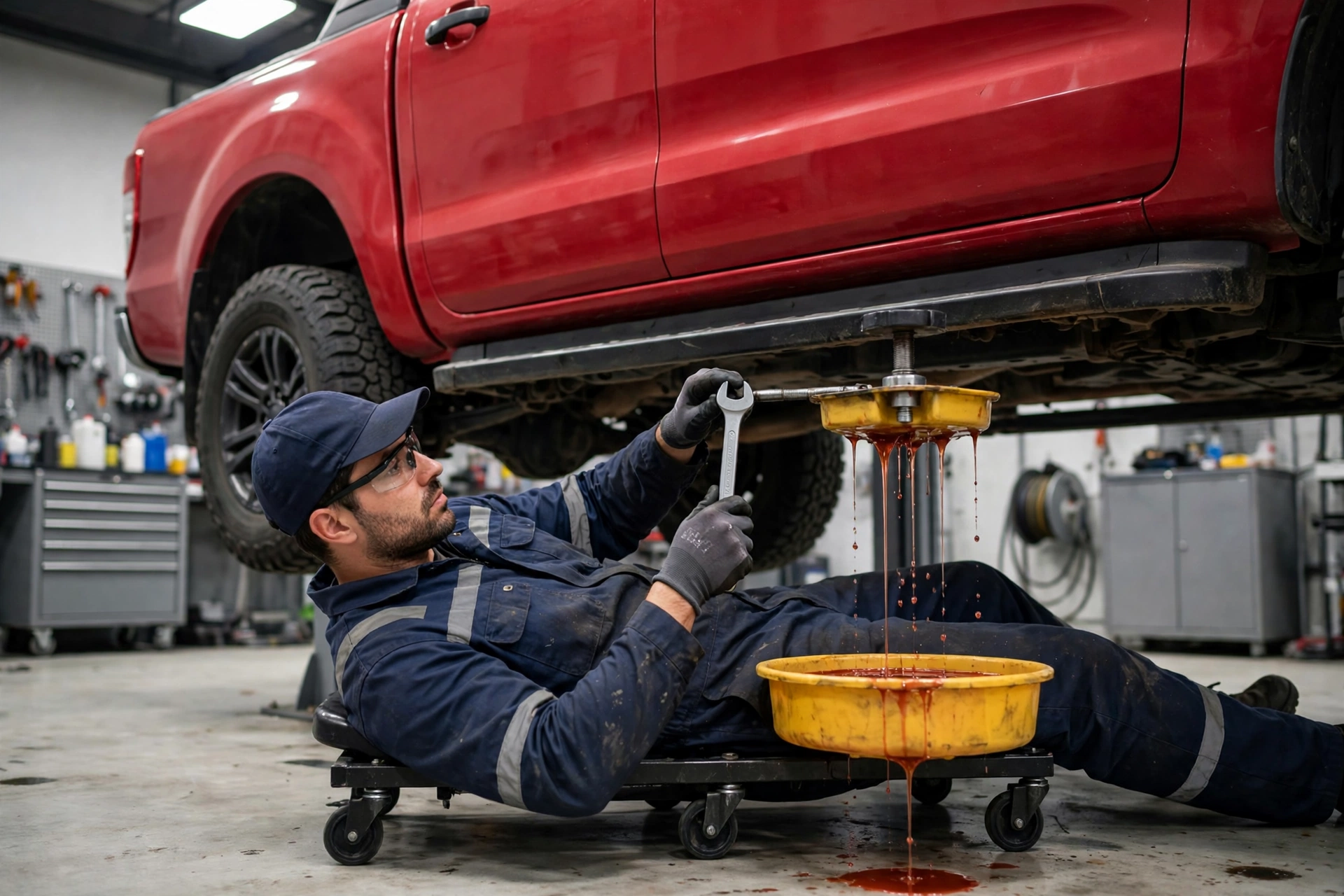
The fluid spec changes by era, so do not guess. Older BW1356 and BW4406 cases used MERCON ATF, while later TOD cases use Motorcraft Transfer Case Fluid XL-12.
Ford has discontinued XL-12, and Valvoline QU90046 is its listed direct replacement. MERCON LV and MERCON V are both marked not for use in transfer cases.
A 2004 F-150 transfer case holds 2.0 quarts, and a 1995 F-150 holds about 3 quarts. Most modern Ford cases hold 1.5 to 2 quarts.
Ford’s guidance for a 2015 F-150 is a fluid service at 150,000 miles in normal use and 60,000 miles in severe use. Our guide to checking transmission fluid on a 2016 F-150 covers the same color and smell checks.
What a Bad Transfer Case Costs to Fix in 2026
The bill depends on what actually failed. A seal or a shift motor is a small job, while a worn-out case is a large one. Get the diagnosis in writing first: a shift motor can look like a dead case.
| Repair | Typical Cost in 2026 | Notes |
|---|---|---|
| Fluid change | $90-$200 | Routine service |
| Output-shaft seal | $197-$260 | Includes parts and labor |
| Shift motor | $399-$469 on an F-150 | F-150 estimate, RepairPal September 2026 |
| Rebuild | $1,100-$2,200 | Depends on internal wear found |
| Overhaul | $1,000-$2,500 | Depends on internal wear found |
| Replacement, remanufactured | $1,800-$4,000 installed | RepairPal national estimate $3,244-$3,542 |
| Used unit installed | $900-$2,000 | Lower price, unknown prior wear |
RepairPal’s September 2026 estimate, quoted by ThePricer, puts a replacement at $3,244 to $3,542 nationwide, with about $2,608 in parts and $636 to $934 in labor.
Compare the repair against the truck’s value before you approve it. On a $12,000 truck, for example, a $3,500 replacement is about 29 percent of its value.
When to Stop Driving With Transfer Case Symptoms
Most transfer-case faults give warning before they turn critical, but a few mean you should stop and arrange a tow: heavy fluid loss that appeared suddenly, or a grinding noise that gets much worse within one short drive.
Stop driving if the driveline binds, locks up, or jerks violently, or if the truck shifts in or out of 4WD on its own while moving. A burning smell means the fluid is overheating, and a drive chain that breaks at speed can lock the driveline.
Milder symptoms allow a careful drive to a shop: a faint hum, an occasional shift hesitation, or a slow seep is not an emergency. Book the inspection within days, and stay out of 4WD until the cause is known.
Bad Transfer Case Questions Answered
Driving With a Bad Transfer Case
You can drive a short distance to a shop if the symptoms are mild, the fluid level is correct, and the truck stays in 2WD. Do not drive it in 4WD or tow with it. A bad case can damage the transmission if it locks up.
How Long a Transfer Case Lasts
There is no fixed lifespan. With regular fluid changes, many cases last well past 150,000 miles, while a 2015 F-150 needed a replacement at 44,576 miles after its dealer found metal in the fluid. Fluid condition matters more than mileage.
What a Transfer Case Repair Costs
A seal or shift motor runs $200 to $600, a rebuild runs $1,100 to $2,200, an overhaul runs $1,000 to $2,500, and a full replacement runs $1,800 to $4,000 for most trucks. RepairPal’s September 2026 national estimate is $3,244 to $3,542.
Transfer Case Fluid Change Interval
Ford’s guidance for a 2015 F-150 is 150,000 miles in normal use and 60,000 miles in severe use such as towing or off-road driving. Many shops suggest 30,000 to 60,000 miles under severe use.
Is the Noise the Transfer Case
Check whether the noise changes when you shift between 2WD and 4WD. If it appears or grows worse in 4WD, the case is the likely source. If it stays the same in both modes, look at the transmission or the differential instead.
Your Next Step With a Suspect Transfer Case
The signs of a bad transfer case are clear once you know what to look for: noise that tracks road speed, shifting trouble, a leak under the middle of the truck, a warning light, vibration, binding, or a truck stuck in one mode. Two or more signs together mean the case needs a check.
Start with the fluid check, then rule out the IWE grind and the shift motor before you accept a replacement quote. Those two Ford-specific faults are cheap fixes that look like a dead case. If the fluid shows metal, book a shop and stay out of 4WD until the diagnosis is in writing.