

How Many Idle Hours Is a Lot 2026 Complete Guide

How many idle hours is a lot? For a personal-use Ford truck, more than 500 idle hours is a lot, and an idle share above 35 percent of total engine hours is high no matter what the odometer says.
Idle hours are the hours the engine runs while the truck is not moving. The odometer never records them, so a truck can look low mileage and still carry the wear of a much older engine.
The number alone does not decide the answer. A police truck with 4,000 idle hours can be a fair buy at the right price, while a private truck with 800 idle hours and no service records can be a bad one.
This guide gives you the thresholds first, then shows you how to read the hours on your Ford dash, how to turn idle hours into equivalent miles, and what to check before you buy.
The Short Answer: The Numbers That Matter
Three numbers decide whether idle hours are a lot. The first is the raw idle-hour count, the second is the idle percentage, and the third is the equivalent mileage the idle hours add to the engine.
| Idle hours | What it usually means | What to do |
|---|---|---|
| Under 200 | Normal for any used Ford | Buy with confidence if the service history is clean |
| 200 to 500 | Moderate, common on work trucks | Check the idle percentage and the oil change records |
| 500 to 1,000 | A lot for a personal-use truck | Price it lower and inspect the engine closely |
| Over 1,000 | Heavy idle duty, usually fleet or police use | Demand full records and a pre-purchase inspection |
| Over 3,000 | Extreme, almost always a retired fleet or police unit | Walk away unless the price and records both justify it |
How Many Idle Hours Is a Lot At a Glance
The thresholds, the idle percentage bands, and the Ford wear rule, as observed in November 2026.
| Measure | Observed figure | Result |
|---|---|---|
| A lot for a personal Ford | Over 500 idle hours | Inspect closely and price it lower |
| Idle share that is high | Over 35 percent of total hours | Engine has run hard while parked |
| Idle share that is serious | Over 50 percent of total hours | Severe duty, full records required |
| Ford wear rule | 1 idle hour is about 25 miles | Multiply idle hours by 25 for equivalent miles |
| Ford severe duty oil change | Every 5,000 miles or 200 engine hours | Use engine hours, not miles alone |
Direct answer: Over 500 idle hours is a lot for a personal-use Ford, and an idle share above 35 percent is high for any truck. Multiply the idle hours by 25 to find the hidden miles, add them to the odometer, and judge the truck on that true number.
Sources: Ford 2017 Super Duty owner manual; EngineerFix idle hours guide; FleetRabbit idle wear guide; SlashGear semi-truck engine hours guide. Figures are rules of thumb and vary by engine, duty cycle, and maintenance.
The raw count matters most for a private truck, and the percentage matters most for a fleet truck. A work truck can carry 800 idle hours at a healthy 15 percent share, while a private truck with 600 idle hours at a 45 percent share has spent nearly half its life running in place.
Use both numbers together. The count tells you how much idle wear exists, and the percentage tells you how the truck lived.
What Idle Hours Actually Are
Idle hours count the time the engine runs while the vehicle speed is zero. The engine control unit logs them separately from total engine hours, so the truck keeps two counters at once.
Total engine hours cover every hour the engine has run, driving or parked. Idle hours are the parked part of that total, and driving hours are what is left when you subtract idle hours from the total.
That split is the whole point of the question. Two trucks can show the same odometer reading and the same total hours, yet one can have three times the idle hours of the other.
Our guide to average engine hours for 100,000 miles covers the total-hours side of the same question. That guide asks how many total hours a truck should show at a given mileage, while this guide asks how much of that time was spent idling.
The two guides work as a pair. Total hours tell you how long the engine has lived, and idle hours tell you how hard that life was.
How to Read Idle Hours on Your Ford
Most modern Fords show both numbers on the dash, and you need no tools to find them. The screen is called Engine Information, and it sits in the instrument cluster display menus.
On a 2020 and newer F-150, use the steering wheel arrow buttons to open the display menu, then choose Truck Info or Display Mode, then Engine Information. The screen shows engine hours and engine idle hours side by side, and holding OK resets the trip counters, not the lifetime hours.
On older Fords with a message center, press the INFO button repeatedly to cycle through trip, outside temperature, engine hours, and miles to empty. The ENG HRS reading is the total engine hours, and trucks with the idle-hour option show the idle figure on the same cycle.
If the dash does not show idle hours, an OBD scan tool can read them. Ford diagnostic software and popular tools such as FORScan read the hour counters from the engine control module, and a dealer can pull the same numbers in minutes.
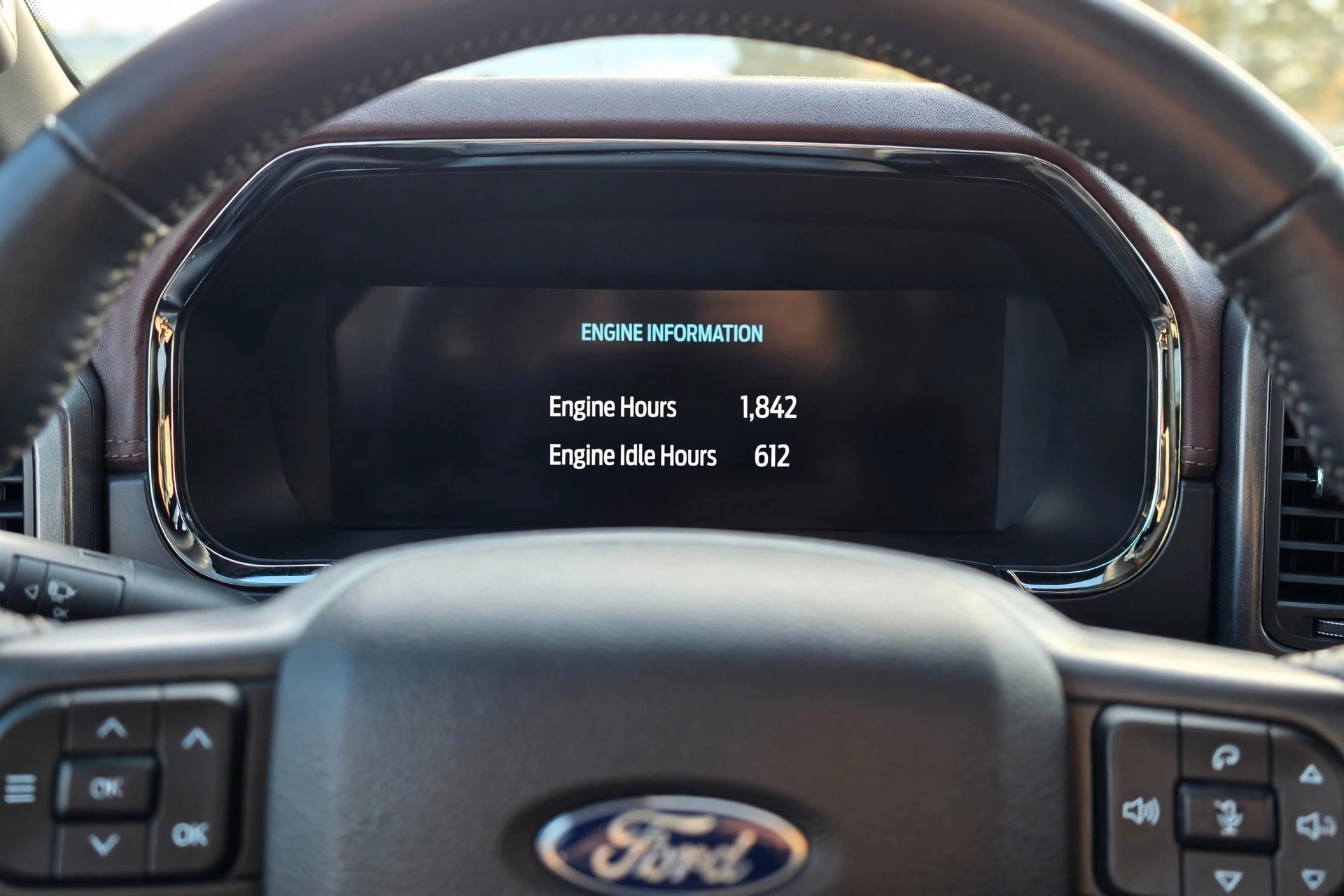
AI-generated illustration: a Ford F-150 instrument cluster showing Engine Information with 1,842 engine hours and 612 idle hours.
The AI-generated illustration above shows what to look for. This truck has 1,842 total hours and 612 idle hours, which is an idle share of about 33 percent, right at the edge of high.
Always ask the seller to show you this screen in person. A seller who will not show the hour screen is hiding the number, and that alone is a reason to walk away.
The 25 Mile Rule: One Idle Hour in Miles
Ford gives owners a simple conversion in its own manuals. The 2017 Super Duty owner manual states that for every hour the vehicle idles, it has accumulated the equivalent of approximately 25 miles of driving.
That figure comes from Ford itself, so it is the anchor for this guide. Fleet maintenance guides use a slightly wider range of 25 to 33 miles per idle hour, depending on engine type and duty cycle.
The FleetRabbit guide to idle-related engine wear puts one idle hour at roughly the same wear as 25 to 33 miles of normal highway driving. Ford’s own figure for its Police Interceptor models is 33 miles per idle hour, at the top of that range.
Not every published figure agrees. The American Trucking Associations Technology and Maintenance Council has been cited for a much lower figure of about 7 miles per idle hour, which shows that the conversion is a rule of thumb, not a laboratory standard.
Use 25 miles per idle hour as the working figure for a Ford. It is Ford’s own number, it sits at the low end of the fleet range, and it keeps your estimate honest rather than inflated.
The math is simple. Multiply the idle hours by 25, then add the result to the odometer reading to get the true wear number.
| Idle hours | Equivalent miles at 25 per hour | Added to a 60,000 mile truck |
|---|---|---|
| 100 | 2,500 miles | 62,500 miles of wear |
| 250 | 6,250 miles | 66,250 miles of wear |
| 500 | 12,500 miles | 72,500 miles of wear |
| 1,000 | 25,000 miles | 85,000 miles of wear |
| 4,000 | 100,000 miles | 160,000 miles of wear |
A truck with 500 idle hours carries about 12,500 miles of hidden wear. That is not enough to reject a good truck, but it is enough to change the price you should pay.
A truck with 4,000 idle hours carries about 100,000 miles of hidden wear. That is the police and fleet trap in one line, and it is why the odometer alone can mislead you by six figures.
The Ford 2017 Super Duty owner manual is the source for the 25 mile figure. It also explains why Ford sets its severe-duty oil intervals by engine hours as well as miles, which the oil section below covers in detail.
Idle Percentage: The Number That Decides It
The idle percentage is the share of total engine hours spent idling, and it is the single most useful number for judging a truck. Divide idle hours by total engine hours, then multiply by 100.
A truck with 3,000 total hours and 600 idle hours has an idle percentage of 20 percent. The EngineerFix guide to idle hours calls 20 percent a standard baseline for mixed driving, and it calls a ratio above 30 or 40 percent high.
Fleet benchmarks agree. An idle share below 20 percent is good, a share from 20 to 35 percent is worth watching, and a share above 35 percent is high. A share above 50 percent is serious, because more than half the engine’s life was spent running in place.
| Idle percentage | Verdict | What it means for the engine |
|---|---|---|
| Under 20 percent | Good | Mostly driving, light idle wear |
| 20 to 35 percent | Watch | Moderate idle wear, check service records |
| 35 to 50 percent | High | Heavy idle wear, price it lower |
| Over 50 percent | Serious | Severe duty life, full records and inspection required |
The percentage protects you from being fooled by a low raw count. A truck with only 300 idle hours sounds fine until you learn it has only 600 total hours, which is a 50 percent idle share.
The percentage also protects a good work truck from an unfair verdict. A truck with 1,200 idle hours sounds alarming until you learn it has 8,000 total hours, which is only a 15 percent idle share.
Run the division on every truck you consider. It takes ten seconds, and it tells you more about the engine than the odometer does.
What Counts as a Lot by Vehicle Type
A lot means something different for each kind of truck. A daily driver and a patrol car live different lives, so the same idle-hour count means a different thing in each one.
| Vehicle type | Normal idle hours | A lot starts at |
|---|---|---|
| Personal daily driver | Under 200 | Over 500 |
| Personal truck with towing | Under 300 | Over 800 |
| Work truck, construction or delivery | 500 to 800 | Over 1,500 |
| Police Interceptor or fleet unit | 2,000 to 4,000 | Over 6,000 |
| Long-haul semi-truck | Thousands per year | Over 20,000 total hours |
A personal daily driver should show only a few hundred idle hours across its life. Short warm-ups, traffic, and waiting in parking lots add up slowly, and a well-kept private truck rarely passes 500.
A work truck is different. Delivery, construction, and utility trucks idle at job sites all day, so 500 to 800 idle hours after only 40,000 miles is common, and it is not by itself a reason to reject the truck.
Police and fleet vehicles are a world apart. A patrol unit can idle 8 to 12 hours per shift, so retired units commonly show 3,000 to 12,000 idle hours, and the price should reflect that.
Semi-trucks play by their own scale. The SlashGear guide to semi-truck engine hours treats under 10,000 total hours as low, the 20,000 to 30,000 range as high, and anything past 30,000 as overhaul territory. For a semi, the idle percentage matters more than the raw count, and a share below 20 percent is the mark of a well-run truck.
Our guide to how many miles trucks last sets the mileage side of the same picture. A gas truck lasts about 200,000 to 300,000 miles and a diesel about 300,000 to 500,000 miles, but those ranges assume normal use, not a life spent idling.
Judge every truck against its own type. A number that is a red flag on a commuter truck can be normal on a work truck, and a number that is normal on a police unit would be alarming on a family SUV.
Why Idling Wears an Engine
Idling looks gentle, because the engine is barely working. In practice it is one of the harshest ways to run an engine, because the engine never reaches the conditions it was designed for.
At idle the engine runs cool and slow. Combustion stays incomplete, so unburned fuel and soot build up on the valves, the spark plugs, the turbocharger, and the diesel particulate filter.
Oil pressure is also low at idle, because the oil pump turns slowly. The upper engine parts get less oil at exactly the moment when diluted, soot-filled oil is doing the lubricating.
Fuel dilution makes the problem worse. Unburned fuel washes past the piston rings and into the oil sump, where it thins the oil and weakens the film that keeps metal parts apart.
Diesel engines suffer the most from long idling. They need high temperatures for clean combustion and for the particulate filter to regenerate, and idling never gives them those temperatures.
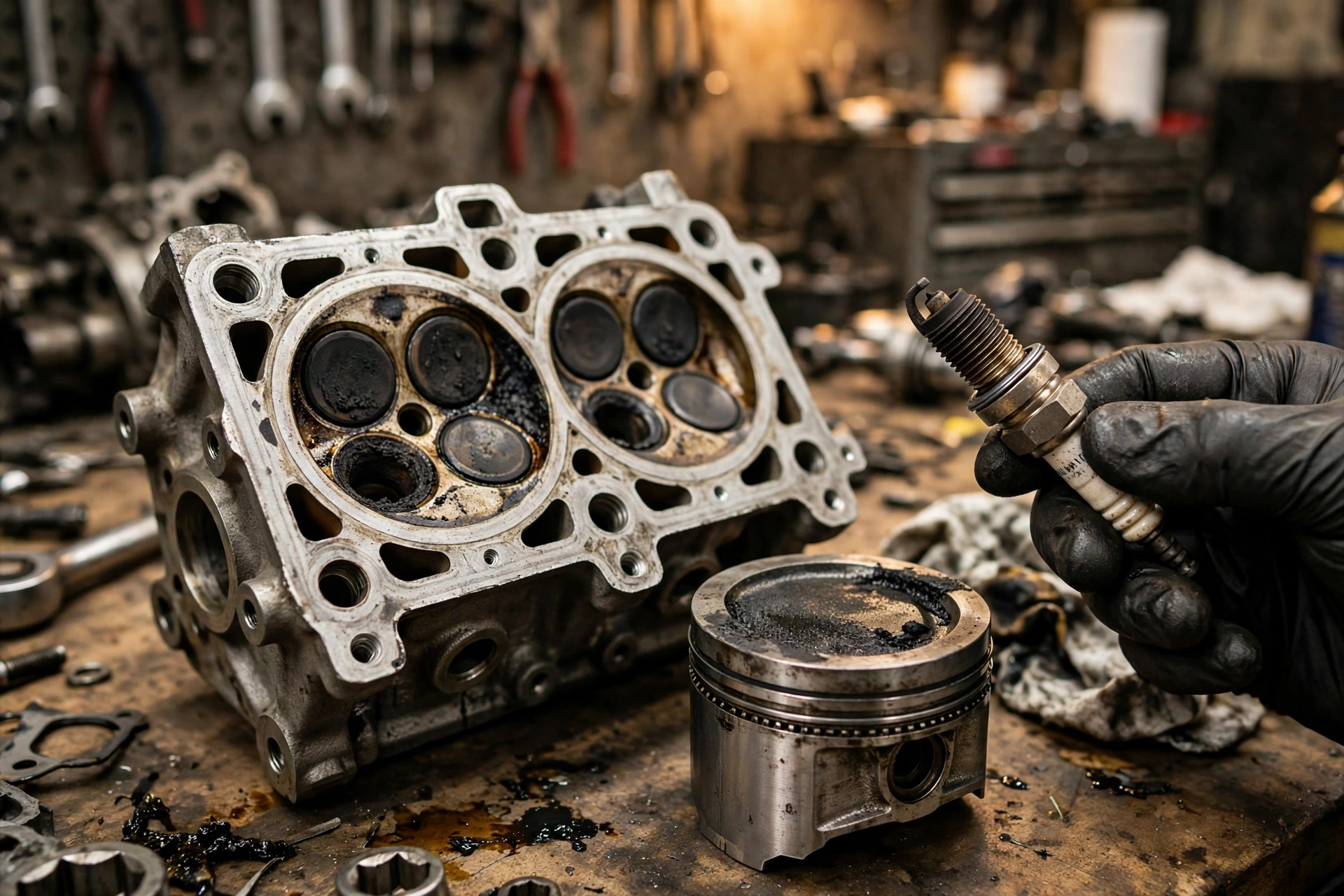
AI-generated illustration: a cylinder head and piston with heavy carbon deposits and a carbon-fouled spark plug, the kind of wear long idling leaves behind.
Carbon buildup is the visible result. The AI-generated illustration above shows what a mechanic finds inside an engine that has spent too much of its life idling, with soot caked on the valves and the piston crown.
Heavy idling also shortens oil life sharply. Fuel dilution and soot wear the oil out early, so an engine that idles heavily needs its oil changed far sooner than one that mostly drives.
Our guide to the 6.7 PowerStroke problems by year shows how these idle effects hit Ford diesels in practice. Carbon and soot problems appear across the model years, and trucks with heavy idle histories show them first.
Direct-injection gas engines have their own version of the same problem. Our guide to the 2.3L EcoBoost engine explains how carbon builds up on the intake valves when fuel never washes over them, and long idling makes that buildup worse.
None of this means an idled engine is ruined. It means the engine needs shorter service intervals and a closer inspection, which the next sections cover.
Police and Fleet Trucks: The Idle Hours Trap
Retired police trucks are the classic idle-hours trap. They look like bargains, with clean bodies, low odometer readings, and full fleet service histories, and the idle hours are the catch.
A patrol unit idles 8 to 12 hours per shift. Officers sit in the vehicle writing reports, running radar, and waiting at scenes, with the engine running to power the lights, radios, computers, and air conditioning.
A retired Ford Police Interceptor Utility with 95,000 miles and 4,000 idle hours is a common sight at auction. At Ford’s 33 mile figure for Police Interceptor models, those 4,000 idle hours add 132,000 miles of wear, so the engine has lived more like a 227,000 mile truck.
A Crown Victoria with 100,000 miles and 3,000 idle hours tells the same story. At 33 miles per idle hour, the hidden wear is about 99,000 miles, so the true wear is close to 200,000 miles.
Some retired units are far worse. Reports from auction yards describe sheriff units with 12,000 idle hours and only 80,000 miles on the odometer, which is the mechanical equivalent of roughly 300,000 miles of driving wear.
Police trucks do have heavy-duty cooling, larger alternators, and upgraded parts that help them survive the idle life. Those parts delay the damage, but they do not erase it, and the engine still needs the shorter service intervals that heavy idling demands.
The same logic applies to retired fleet trucks, delivery vans, and utility trucks. Low miles with high hours is the signature of a working vehicle, and the price should be set on the true wear number, not the odometer.
Check the hour meter before you bid or buy. On a Ford Police Interceptor, turn the key to Run without starting the engine and use the cluster controls to find the engine hours screen, which shows total and idle hours together.
How Idle Hours Change Your Oil Change Schedule
Ford writes its severe-duty schedule in engine hours as well as miles, and heavy idling is one of the conditions that puts a truck on that schedule. The manual lists extensive idling alongside towing, delivery, taxi, patrol, and livery use.
For gasoline engines under the special operating conditions schedule, Ford calls for an oil and filter change every 5,000 miles, every six months, or every 200 engine hours, whichever comes first. The 200 hour limit is the one that catches high-idle trucks.
For diesel engines, Ford’s severe-use guidance puts extended idling at 200 to 300 hours in the same band as moderate to heavy towing and mountain driving. In that band the oil change message arrives after 5,000 to 7,499 miles instead of the normal 7,500 to 10,000 miles.
Extreme diesel use, with maximum load or extreme temperatures, pulls the interval down further to 3,000 to 4,999 miles. A truck that idles for hours every day can reach the engine-hour limit long before it reaches the mileage limit.
The practical rule is simple. If your truck idles a lot, change the oil by the hour meter, not by the odometer. A truck that covers 5,000 miles in 300 engine hours has already passed the severe-duty limit.
Our Ford engine oil recommendation chart lists the right oil grade for your engine. The right grade matters more on a high-idle engine, because thin, fuel-diluted oil is the main thing standing between the bearings and metal-on-metal contact.
Shorten the other intervals too. Air filters, fuel filters, spark plugs, and fuel injectors all foul faster when the engine spends its life idling, so inspect them on the severe-duty schedule even if the mileage looks low.
Watch the oil level between changes as well. Fuel dilution can push the level up on the dipstick, while worn rings and seals can push it down, and either direction is a warning worth checking.
Buying a Used Ford: Your Idle Hours Checklist
Run this checklist on every used Ford before you agree on a price. It takes about thirty minutes, and it can save you thousands.
- Read both hour counters. Open the Engine Information screen and write down total engine hours and idle hours, then divide idle by total and multiply by 100 for the idle percentage.
- Convert the idle hours to miles. Multiply idle hours by 25 and add the result to the odometer reading, then judge the truck on that true wear number.
- Ask what the truck did. A retired police, fleet, delivery, or utility truck will carry high hours by design, while a private truck with high hours needs an explanation.
- Demand the service records. Look for oil changes by engine hours, not just by miles, and check whether the seller followed the severe-duty schedule.
- Check the oil. Pull the dipstick and look for thin, fuel-smelling oil or a level that sits above the full mark, both of which point to fuel dilution from idling.
- Look for idle wear signs. Check for carbon-fouled spark plugs, a soot-clogged air filter, rough idle, and a diesel particulate filter warning.
- Get a pre-purchase inspection. Ask the mechanic to check compression, scan for stored codes, and run an oil analysis, which shows fuel dilution and wear metals directly.
- Confirm the warranty. Our guide to how to check your Ford warranty shows how to confirm cover by VIN before you pay, and a truck still under cover is worth more than one that is not.
- Check the model year. Our guide to what year Ford Focus to avoid shows the same year-by-year thinking that applies to any used Ford, since some years carry known problems that heavy idling makes worse.
- Price the hidden miles. If the true wear number is 30,000 miles above the odometer, offer the price of a truck with that higher mileage, not the price of the one on the dash.
A truck that fails the checklist is not always a bad buy. It is a truck that needs a lower price, a full inspection, and a severe-duty service plan from day one.
A truck that passes the checklist is worth paying for. Low idle hours, a low idle percentage, and clean records by engine hours are the three signs of a Ford that was driven, not parked with the engine running.
What to Do If Your Truck Already Has High Idle Hours
High idle hours are not a death sentence. The engine is worn, not broken, and the right care can keep it running for years.
Start with the oil. Move to the severe-duty schedule at once, with changes every 5,000 miles or 200 engine hours, and use the correct grade for your engine.
Clean up the carbon. A professional intake cleaning, a fresh set of spark plugs, and a clean air filter restore the breathing that long idling took away.
Drive it properly. A regular highway run at full operating temperature burns off moisture and soot, lets the diesel particulate filter regenerate, and gives the engine the load it was built for.
Stop idling it. Switch the engine off when you are parked for more than a minute or two, and use a block heater in winter instead of a long warm-up idle.
Watch the wear parts. Clutches, mounts, and belts age by engine hours as well as miles, so budget for them sooner than the odometer suggests. Our guide to how long a clutch replacement takes covers the time and cost of one of the bigger jobs that high-hour trucks face first.
Check what cover you still have. Our guide to Ford powertrain warranty explains the cover on the engine and transmission, and our guide to Ford factory warranty explains the wider cover that may still apply. A high-idle truck with warranty cover is a different proposition from one without it.
Keep records from now on. Log engine hours at every oil change, and the next buyer will see a truck whose idle history is honest and cared for.
Questions Ford Owners Ask About Idle Hours
How Many Idle Hours Is a Lot
For a personal-use Ford, more than 500 idle hours is a lot, and an idle share above 35 percent of total engine hours is high. Fleet and police trucks run thousands of idle hours by design, so judge them on the idle percentage and the service records instead.
Is 1,000 Idle Hours a Lot
Yes, 1,000 idle hours is a lot for a personal truck, because it adds about 25,000 miles of hidden wear. For a work truck or a retired fleet unit it is moderate, and the idle percentage decides whether it is a problem.
Is 2,000 Idle Hours a Lot
For a private truck, 2,000 idle hours is a lot, because it adds about 50,000 miles of hidden wear. For a police or fleet truck it is normal, and buyers should expect it and price the truck on the true wear number.
How Do I Check Idle Hours on a Ford F-150
Use the steering wheel buttons to open the instrument cluster display, then choose Engine Information, which shows engine hours and engine idle hours together. On older trucks, press the INFO button to cycle to the engine hours screen, or use an OBD scan tool such as FORScan to read the counters.
Does Idling Damage the Engine
Yes, long idling damages the engine over time through incomplete combustion, carbon buildup, fuel dilution of the oil, and low oil pressure. The damage is slow and cumulative, and shorter oil change intervals are the main defense.
How Often Should I Change Oil on a High Idle Truck
Follow Ford’s severe-duty schedule, with an oil and filter change every 5,000 miles, every six months, or every 200 engine hours, whichever comes first. On a truck that idles heavily, the 200 engine hour limit usually arrives first.
Your 5 Step Check Before You Buy
How many idle hours is a lot? For a personal Ford, more than 500 idle hours is a lot, and an idle share above 35 percent is high.
Run the five step check before you buy. Read both hour counters on the dash, work out the idle percentage, multiply the idle hours by 25 and add the result to the odometer, check the oil change records by engine hours, and get a pre-purchase inspection with an oil analysis.
That check costs you thirty minutes. It tells you the true wear on the engine, and it leaves you with a fair price before you sign anything.