Ford F-150 Oil Capacity by Year & Engine Chart – 2026

The Ford F-150 has reigned as North America’s premier light-duty truck for decades. Throughout its evolution, the internal combustion engines powering this chassis have transitioned from heavy, cast-iron pushrod blocks to highly sophisticated, twin-turbocharged aluminum and compacted graphite iron marvels.
With this engineering evolution comes a strict reliance on precise fluid management. Modern technical resources, including official Ford maintenance guidelines, emphasize that overfilling a crankcase is just as dangerous as underfilling it. Overfilling causes the crankshaft to submerge into the oil bath, whipping the surplus fluid into an aerated froth.

Prime for Young Adults — 6 Months Free
Students and 18–24s get six months of Prime free, then half price.
Start 6 Months Free As an Amazon Associate I earn from qualifying purchases.Aerated oil contains air bubbles, making it highly compressible. This compressible fluid cannot properly pressurize critical hydraulic components, such as timing chain tensioners or Variable Cam Timing (VCT) phasers. This leads to immediate performance degradation, timing chain slap, and long-term mechanical failure.
Conversely, underfilling limits the overall thermal mass of the oil. Engine oil acts as a primary coolant for internal components, particularly the pistons and turbocharger bearings. A low oil volume increases the core temperature of the remaining fluid, accelerating oxidation, thermal breakdown, and turbocharger bearing wear.
For turbocharged owners, understanding how long turbos last in a 3.5 EcoBoost starts with strict adherence to oil capacity specifications. Adhering to the exact Ford F-150 oil capacity by year is a non-negotiable aspect of vehicle maintenance.
Ford F-150 Oil Capacity By Year
Recommended Best Deal Products


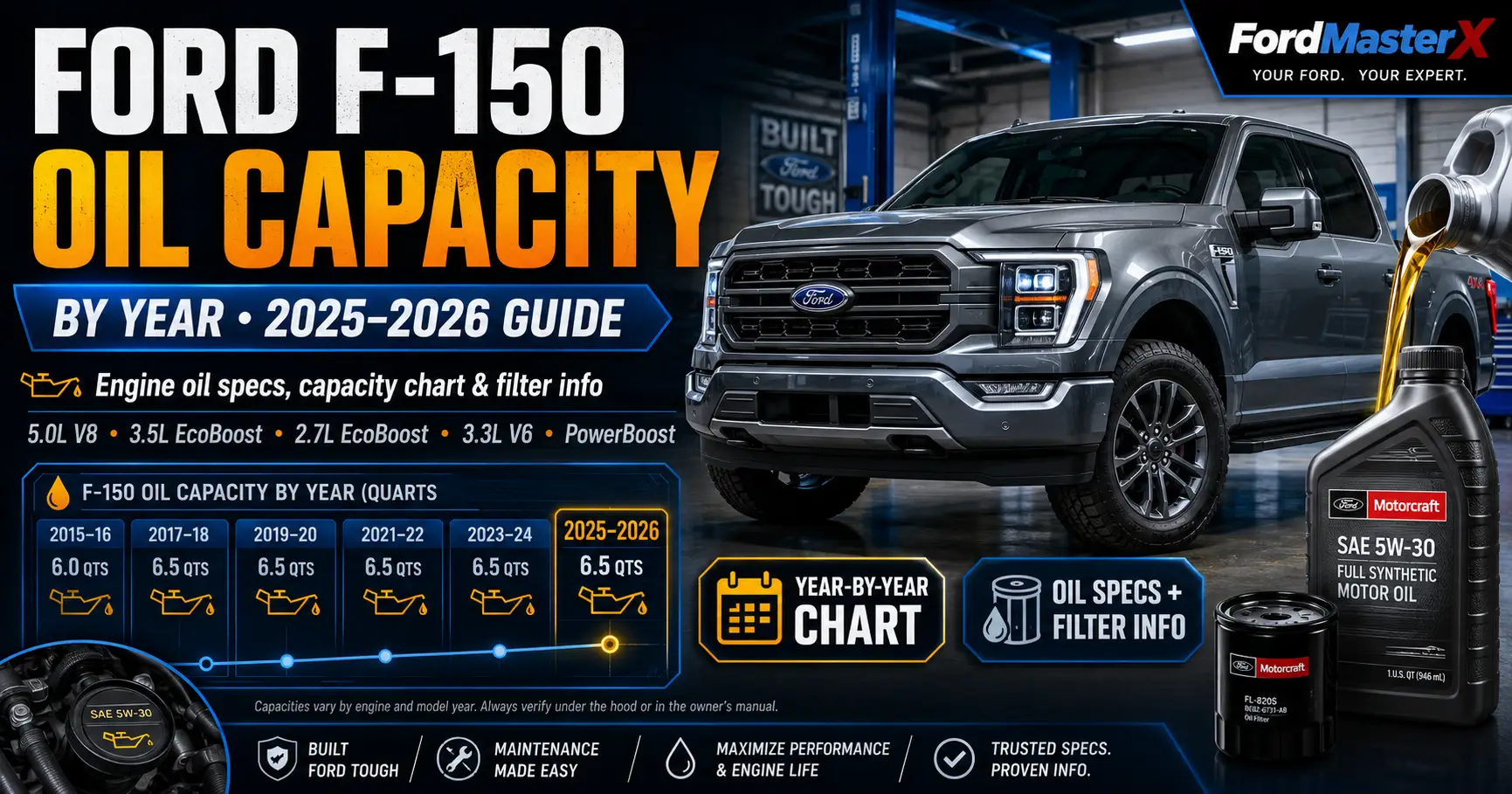
Finding the exact Ford F150 oil capacity by year is critical for the lifespan of your truck. Overfilling causes frothing and engine damage, while underfilling leads to catastrophic overheating.
Because Ford frequently updates engine architectures—like the addition of dual-injection to the 5.0L Coyote V8 or the evolution of the 3.5L EcoBoost—oil requirements change frequently. This data-driven guide provides exact capacities, oil weights, and trends from 2004 to present.
Current Generation Capacities (2021-2026)
The 14th Generation F-150 lineup streamlined oil capacities for most V6 engines, standardizing them at 6.0 quarts. However, the powerful 5.0L V8 remains the outlier, requiring significantly more lubrication due to its larger displacement and complex valve train.
Data: 14th Gen F-150 Engine Lineup. Capacities include oil filter replacement.
The 5.0L V8 Oil Anomaly
Recommended Best Deal Products


If you own a 5.0L Coyote V8, pay close attention to your model year. In 2018, Ford introduced Plasma Transfer Wire Arc (PTWA) cylinder liners and a dual-injection system.
To handle the increased heat and friction, Ford expanded the oil pan, causing the capacity to spike from 7.7 quarts to a massive 8.8 quarts for the 2018-2020 models. In 2021, engine block redesigns brought it back down to 7.75 quarts.

Audible — Listen Free for 30 Days
One free credit a month and thousands of titles included.
Listen Free for 30 Days As an Amazon Associate I earn from qualifying purchases.Recommended Oil Types
Capacity is only half the battle. Using the correct viscosity is required to protect turbo bearings in EcoBoost models and variable cam timing components in the V8s.
Generally, Ford recommends 5W-30 full synthetic or synthetic blend for all turbocharged (EcoBoost) engines to withstand high turbocharger temperatures. Naturally aspirated engines (Ti-VCT V6 and older V8s) typically utilize 5W-20.
Complete F-150 Oil Capacity Chart (2004-Present)
Recommended Best Deal Products

Use the master table below to find the exact oil capacity and recommended oil weight for your specific model year and engine combination. Always verify with your owner’s manual or dipstick after refilling.
| Model Years | Engine Size | Oil Capacity (with filter) | Recommended Oil |
|---|---|---|---|
| 2021 – 2026 | 2.7L, 3.3L, 3.5L (EcoBoost/Hybrid) | 6.0 Quarts | 5W-30 Synthetic Blend |
| 2021 – 2026 | 5.0L Coyote V8 | 7.75 Quarts | 5W-30 Synthetic Blend |
| 2018 – 2020 | 5.0L Coyote V8 | 8.8 Quarts | 5W-20 Synthetic Blend |
| 2018 – 2020 | 3.0L Power Stroke Diesel | 6.5 Quarts | 5W-30 FA-4 Diesel Oil |
| 2015 – 2020 | 2.7L & 3.5L EcoBoost V6 | 6.0 Quarts | 5W-30 Synthetic Blend |
| 2011 – 2017 | 5.0L Coyote V8 | 7.7 Quarts | 5W-20 Synthetic Blend |
| 2011 – 2014 | 3.5L EcoBoost & 3.7L V6 | 6.0 Quarts | 5W-30 / 5W-20 |
| 2010 – 2014 | 6.2L Boss V8 | 7.0 Quarts | 5W-20 Synthetic Blend |
| 2004 – 2010 | 5.4L Triton V8 | 7.0 Quarts | 5W-20 Synthetic Blend |
| 2004 – 2010 | 4.6L V8 & 4.2L V6 | 6.0 Quarts | 5W-20 Synthetic Blend |
The Evolution of 5.0L Coyote Oil Capacity
Line chart showing Ford 5.0L Coyote V8 oil capacity from 2011 to 2026, with a notable spike to 8.8 quarts in 2018 due to PTWA cylinder liners, and a return to 7.75 quarts in 2021.
Gen 2 & 3 (2011–2017)
7.7 qt 5W-20
PTWA era (2018–2020)
8.8 qt 5W-20
Gen 4 (2021–2026)
7.75 qt 5W-30
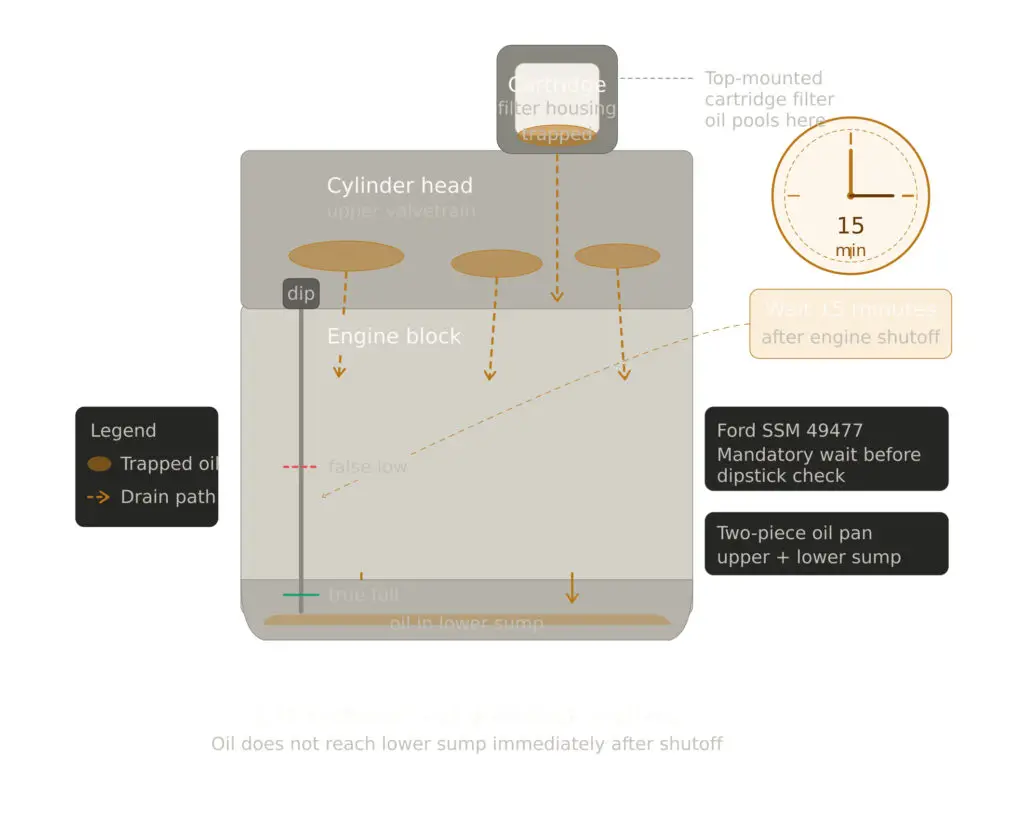
Anatomical Diagram – The 2.7L EcoBoost 15-Minute Drain-Back Rule
Comparison Matrix – Motorcraft Oil Filter Applications
Comparison matrix matching Ford F-150 engine families to their required Motorcraft oil filter: FL-820S for Triton V8s, FL-500S for Coyote and EcoBoost, FL-2062A for 2.7L EcoBoost cartridge, and FL-2081 for Power Stroke diesel.
FL-820S
Audible Premium Plus — Annual Membership
12 audiobook credits up front, plus the full Audible catalogue.
See Annual Plans As an Amazon Associate I earn from qualifying purchases.Spin-on · silicone ADV
Drain plug torque
10–17 ft·lbs
FL-500S
Spin-on · cellulose/polyester
Drain plug torque
19 ft·lbs
FL-2062A
Cartridge · top-mounted
⚠ Service note
Loosen housing first to break vacuum before removing drain plug
Wait before dipstick check
15 minutes
FL-2081
Cartridge · diesel-spec
Viscosity varies by duty
5W-30 FA-4 (highway)
5W-40 (severe/towing)
Capacity
6.5–6.6 qt
All Motorcraft filters re-engineered after January 1, 2017 to meet SAE USCAR-36 — governing media efficiency, burst pressure resistance, and anti-drain back valve durability. Using the wrong filter number risks oil starvation or unfiltered bypass.
Lubrication Specifications and Chemistry
Before dissecting the specific volumetric capacities of each engine, it is necessary to understand the chemical engineering behind Ford’s fluid recommendations. Modern Ford F-150 engines require highly specialized motor oils that meet stringent global standards.
API SP and ILSAC GF-6 Standards
The American Petroleum Institute (API) and the International Lubricant Standardization and Approval Committee (ILSAC) continuously update motor oil performance standards. Modern F-150 engines, particularly those utilizing EcoBoost technology, require oils meeting the API SP and ILSAC GF-6 classifications.
These advanced formulations are specifically engineered to mitigate Low-Speed Pre-Ignition (LSPI). LSPI is an abnormal combustion event that occurs in smaller-displacement, turbocharged, direct-injected engines operating under high loads at low engine speeds.
During an LSPI event, droplets of motor oil enter the combustion chamber and spontaneously ignite before the spark plug fires, creating massive cylinder pressures that can crack pistons and bend connecting rods. API SP oils utilize unique calcium and magnesium detergent packages to suppress this phenomenon.
Ford Internal Material Engineering Codes
Ford Motor Company pairs these global API standards with its own internal material engineering specifications to ensure compatibility with proprietary seals, gaskets, and metallurgy.
The WSS-M2C960-A1 specification is the modern standard for SAE 5W-20 synthetic blend or full synthetic motor oil. This specification is widely utilized in first and second-generation 5.0L Coyote V8s, the 3.3L naturally aspirated V6, and legacy Triton V8 engines. It ensures a baseline of fuel economy and cold-start protection for naturally aspirated platforms.
The WSS-M2C961-A1 specification dictates the requirements for SAE 5W-30 full synthetic motor oil. This is the mandated specification for all EcoBoost engines, the PowerBoost hybrid powertrain, and the 2021+ fourth-generation 5.0L Coyote V8. This heavier, robust oil film protects twin-turbocharger bearings spinning at upwards of 170,000 RPM and prevents thermal breakdown under severe towing loads. Owners using the 3.5 EcoBoost should also confirm what oil the 3.5 EcoBoost takes to verify their specific model year requirement.
The WSS-M2C963-A1 specification is reserved for 0W-30 motor oil. Ford utilizes this specification exclusively as an alternative fluid for extreme cold climates, specifically regions where ambient temperatures regularly drop below -22°F (-30°C). The zero-weight winter rating ensures rapid cold-start flow to the valvetrain, preventing dry-start wear in sub-arctic conditions.
Motorcraft OEM Oil Filters
Ford strongly advocates for the use of Original Equipment Manufacturer (OEM) Motorcraft filters. After January 1, 2017, all Motorcraft oil filters were re-engineered to align with the stringent SAE USCAR-36 specification. This standard dictates strict parameters for media filtration efficiency, burst pressure resistance, and anti-drain back valve durability.
The Motorcraft FL-820S is a spin-on filter featuring a highly durable silicone anti-drain back valve. The specific location of the pressure relief valve in this filter prevents settled debris from washing back into the engine block during cold starts. It is the mandatory filter for the 4.6L, 5.4L, and 6.2L Triton/Boss V8 families.
The Motorcraft FL-500S was developed specifically to handle the unique flow dynamics of the newer Coyote V8 and 3.5L EcoBoost engines. This spin-on filter utilizes an advanced cellulose and polyester blend media, engineered for high contaminant capacity and structural strength against extreme oil pressure spikes. For detailed EcoBoost filter guidance, see our dedicated 3.5 EcoBoost oil filter location guide.
The Motorcraft FL-2062 and FL-2062A are multi-fiber, high-density paper cartridge filters. Unlike traditional metal spin-on filters, these drop into a permanent housing located on the top of the 2.7L EcoBoost engine block. They utilize unique chemical surfactants to resist damage from moisture and high-temperature oil saturation.
By sourcing filters and lubricants directly from Ford’s authorized chemical distributors, technicians guarantee that bypass valve spring pressures perfectly match the specific flow requirements of the engine.
Fourteenth Generation Ford F-150 (2021–2026)
The fourteenth generation of the F-150 introduced a heavily revised powertrain lineup, most notably the proliferation of hybrid-electric technology and advanced cylinder deactivation. These mechanical changes directly impacted the engine oil capacities and viscosity standards across the entire platform.
For the 2021 through 2026 model years, Ford engineers standardized much of the high-performance lineup on SAE 5W-30 full synthetic or synthetic blend motor oil meeting the WSS-M2C961-A1 specification. This systemic shift away from the lighter 5W-20 was implemented to provide superior high-temperature bearing protection for forced-induction and high-load towing applications.
2.7L EcoBoost V6 (Nano)
The 2.7L EcoBoost remains a high-volume workhorse, serving as the entry-level engine for the XL, STX, and XLT trims. It requires precisely 6.0 quarts (5.7 liters) of 5W-30 motor oil and utilizes the cartridge-style Motorcraft FL-2062A oil filter.
When performing maintenance on this engine, technicians must strictly adhere to the 15-minute drain-back rule. Because of the upper-engine oil retention design and the top-mounted cartridge filter, checking the dipstick immediately after engine shutoff will yield a false low reading. Ford’s Special Service Message (SSM) 49477 explicitly dictates that the oil must be given at least 15 minutes to return to the lower pan before pulling the dipstick. When draining the oil, the upper filter cartridge housing must be loosened first to break the vacuum, allowing the trapped oil to flow downward into the sump before the lower drain plug is removed.
Before performing your drain, confirm you have the correct F-150 oil drain plug socket size on hand to avoid rounding the plug. Owners curious about overall engine durability can also review our full guide to how long the 2.7 EcoBoost lasts.
3.3L Ti-VCT V6
The naturally aspirated 3.3L V6 requires 6.0 quarts of oil. Unique among the modern F-150 lineup, the 3.3L engine retained the legacy recommendation for 5W-20 motor oil (WSS-M2C960-A1) in many basic applications. However, 5W-30 is strongly preferred and frequently utilized in hotter climates or severe duty cycles. This naturally aspirated engine pairs with the standard Motorcraft FL-500S spin-on filter.
3.5L EcoBoost V6
The 3.5L EcoBoost serves as the top F-150 engine for maximum towing capacity. This twin-turbocharged powerhouse requires 6.0 quarts of 5W-30 full synthetic motor oil and utilizes the FL-500S filter. The WSS-M2C961-A1 5W-30 specification is non-negotiable for this engine, as the heavy viscosity is required to protect the delicate journal bearings within the twin turbochargers, which endure extreme exhaust gas temperatures. For owners pushing the engine hard, reviewing common oil leaks on the 3.5 EcoBoost is a worthwhile preventative step.
3.5L PowerBoost Full Hybrid V6
The 3.5L PowerBoost Full Hybrid V6 shares the fundamental architecture of the standard EcoBoost, resulting in an identical crankcase capacity of 6.0 quarts. It also utilizes the 5W-30 WSS-M2C961-A1 oil and the FL-500S filter.
Despite sharing fluid capacities, the PowerBoost hybrid places entirely unique thermal stresses on its motor oil. Because the internal combustion engine frequently shuts off to allow for electric-only propulsion, the engine block experiences massive temperature fluctuations. It struggles to maintain a consistent high operating temperature, which is normally required to boil off crankcase moisture and unburned fuel. Therefore, utilizing a high-quality full synthetic oil with robust detergency is critical to combat fuel dilution and sludge formation in the hybrid system.
5.0L Coyote V8 (Fourth Generation)
The 2021 redesign of the 5.0L Coyote V8 brought a notable shift in fluid dynamics. After utilizing a massive 8.8-quart sump in the previous generation, Ford reduced the oil capacity back down to 7.75 quarts (7.3 liters) for the fourteenth generation.
Concurrent with this capacity reduction, Ford officially changed the recommended viscosity for the Coyote from 5W-20 to 5W-30. This update was implemented to accommodate the addition of cylinder deactivation technology. The variable displacement system relies on highly stable oil pressure to actuate the locking pins within the hydraulic lifters. The engine continues to use the FL-500S oil filter. The oil drain plug on this generation features a composite design and requires 19 ft/lbs of torque.
3.0L Power Stroke Diesel V6
Available in the early years of the fourteenth generation (2021), the 3.0L Power Stroke diesel requires 6.5 to 6.6 quarts of oil. The viscosity requirement for this diesel block is entirely dependent on climate and duty cycle. Ford recommends 5W-30 (meeting the FA-4 specification) for normal highway driving. However, Ford mandates a heavier 5W-40 oil (WSS-M2C214-B1) for severe duty towing applications or when utilizing B20 biodiesel blends. Extreme cold climates dropping below -20°F require 0W-40. The required filter is the Motorcraft FL-2081.
5.2L Supercharged V8 (Raptor R)
Introduced to combat high-horsepower off-road rivals, the F-150 Raptor R features the 5.2L Predator V8. This high-output, supercharged engine requires a massive 11.5 quarts of specialized 5W-50 full synthetic oil (WSS-M2C931-E1). This extreme viscosity is engineered to manage the immense thermal loads generated by the Eaton supercharger and sustained high-RPM desert running. It utilizes the FL-500S oil filter.
| Engine Model | Capacity (Quarts) | Viscosity Recommended | Motorcraft Oil Filter |
|---|---|---|---|
| 2.7L EcoBoost V6 | 6.0 | 5W-30 | FL-2062A |
| 3.3L Ti-VCT V6 | 6.0 | 5W-20 / 5W-30 | FL-500S |
| 3.5L EcoBoost V6 | 6.0 | 5W-30 | FL-500S |
| 3.5L PowerBoost Hybrid | 6.0 | 5W-30 | FL-500S |
| 5.0L Coyote V8 | 7.75 | 5W-30 | FL-500S |
| 3.0L Power Stroke Diesel | 6.5 – 6.6 | 5W-30 / 5W-40 | FL-2081 |
| 5.2L Supercharged V8 | 11.5 | 5W-50 | FL-500S |
Thirteenth Generation Ford F-150 (2015–2020)
The thirteenth generation marked the F-150’s revolutionary shift from stamped steel to a military-grade aluminum-alloy body structure. This massive weight reduction allowed Ford engineers to heavily promote smaller displacement, high-output turbocharged EcoBoost engines alongside traditional naturally aspirated V8s.
2.7L EcoBoost V6 (First Generation)
Debuting in 2015, the first iteration of the 2.7L EcoBoost features a compacted graphite iron (CGI) block, similar in construction to the Power Stroke diesel engines. It requires exactly 6.0 quarts of 5W-30 full synthetic motor oil.
The oil change procedure for this early 2.7L EcoBoost involves replacing the top-mounted FL-2062 cartridge filter. As noted extensively in Ford’s technical documentation, technicians must loosen the cartridge housing first to allow the trapped oil to drain into the lower pan before removing the bottom drain plug. Waiting 15 minutes before checking the dipstick remains a mandatory requirement for this early Nano engine. For owners weighing long-term ownership, our full analysis of 2.7 EcoBoost reliability provides real-world durability context.
3.3L V6 (2018–2020) and 3.5L Ti-VCT V6 (2015–2017)
The naturally aspirated base V6 engines transitioned midway through this generation. The 3.5L Cyclone V6 served from 2015 to 2017, and the slightly smaller 3.3L V6 replaced it from 2018 to 2020. Despite the displacement change, both engines require 6.0 quarts of 5W-20 motor oil. Both powerplants utilize the reliable FL-500S spin-on filter.
3.5L EcoBoost V6 (Second Generation)
The second-generation 3.5L EcoBoost was introduced in 2017, featuring both port fuel injection and direct injection to combat intake valve coking. It requires 6.0 quarts of 5W-30 full synthetic oil.
Some older owner’s manuals for the early 2015–2016 first-generation models occasionally reference a 6.3-quart capacity when the engine is completely bone dry after a rebuild, but standard service fluid change intervals strictly dictate a 6.0-quart refill. The 5W-30 viscosity is absolutely essential for lubricating the twin turbochargers under heavy load. Timing chain wear is another oil-dependent concern on this platform — see our 3.5 EcoBoost timing chain replacement guide for maintenance intervals and cost expectations.
5.0L Coyote V8 (Second and Third Generation)
The 5.0L Coyote experienced a massive structural change midway through the thirteenth generation, resulting in two distinctly different oil capacities.
From 2015 to 2017, the Coyote utilized traditional cast-iron cylinder liners. This second-generation block requires 7.7 quarts of 5W-20 motor oil.
However, for the 2018 to 2020 model years, Ford introduced Plasma Transferred Wire Arc (PTWA) spray-in cylinder liners. This technology eliminated the heavy iron sleeves, replacing them with a microscopic steel coating sprayed directly onto the aluminum bore. Concurrent with this thermal update, Ford drastically enlarged the oil pan capacity. These specific 2018–2020 models require a massive 8.8 quarts of 5W-20 motor oil. Both versions use the FL-500S filter. Under heavy payload conditions or frequent E85 flex-fuel usage, accelerated oil degradation occurs, necessitating strict adherence to change intervals determined by oil analysis.
3.0L Power Stroke Diesel
Introduced in the 2018 model year, the 3.0L Power Stroke diesel requires 6.5 quarts of oil. Viscosity relies entirely on ambient temperatures and duty cycle. Ford WSS-M2C214-B1 (5W-40) is strongly recommended for severe duty operation, while API FA-4 (5W-30) is preferred for standard unladen highway driving.
| Engine Model | Capacity (Quarts) | Viscosity Recommended | Motorcraft Oil Filter |
|---|---|---|---|
| 2.7L EcoBoost V6 | 6.0 | 5W-30 | FL-2062 |
| 3.3L / 3.5L NA V6 | 6.0 | 5W-20 | FL-500S |
| 3.5L EcoBoost V6 | 6.0 | 5W-30 | FL-500S |
| 5.0L Coyote V8 (2015–2017) | 7.7 | 5W-20 | FL-500S |
| 5.0L Coyote V8 (2018–2020) | 8.8 | 5W-20 | FL-500S |
| 3.0L Power Stroke Diesel | 6.5 | 5W-30 / 5W-40 | FL-2081 |
Twelfth Generation Ford F-150 (2009–2014)
The twelfth generation of the F-150 represents a major transitional era in automotive engineering. It began with the final iterations of the legacy modular Triton V8s and culminated in the introduction of the modern, high-tech EcoBoost and Coyote architectures.
4.6L and 5.4L Triton V8 (2009–2010)
For the first two years of this generation, Ford relied heavily on the aging modular V8 engines before phasing them out entirely.
- The 4.6L V8 requires 6.0 quarts of 5W-20 motor oil.
- The larger 5.4L 3-Valve V8 requires 7.0 quarts of 5W-20 motor oil.
Both of these modular engines utilize the Motorcraft FL-820S oil filter. The 5.4L 3-Valve engine is particularly notorious for cam phaser failure, an issue directly linked to poor oil flow and degradation. Maintaining the exact 7.0-quart volumetric capacity and utilizing a high-quality filter with a robust silicone anti-drain back valve is critical to preventing dry starts and the dreaded timing chain rattle. Owners dealing with these symptoms should review the Ford F-150 cam phaser recall coverage details.
3.7L Ti-VCT V6
Serving as the dependable base engine from 2011 to 2014, the naturally aspirated 3.7L Cyclone V6 requires 6.0 quarts of 5W-20 motor oil. It utilizes the FL-500S filter.
3.5L EcoBoost V6 (First Generation)
The engine that altered the half-ton truck landscape forever, the original 3.5L EcoBoost, debuted in 2011. It requires 6.0 quarts of 5W-30 synthetic blend or full synthetic oil.
Because early direct-injected, turbocharged engines were highly prone to intake valve carbon build-up (coking) and severe fuel dilution in the crankcase, aggressive oil change intervals of 5,000 miles were highly recommended by industry experts. While the dashboard’s Intelligent Oil-Life Monitor often allowed for much longer durations, preventative maintenance dictated shorter fluid intervals to preserve the turbo bearings. This generation’s cam phasers were also oil-pressure sensitive — problems on high-mileage units are covered in our 3.5 EcoBoost cam phaser noise guide.
5.0L Coyote V8 (First Generation)
Replacing the heavy 5.4L Triton in 2011, the first-generation 5.0L Coyote V8 demands 7.7 quarts of 5W-20 motor oil. The engine utilizes the newer FL-500S filter. The oil drain plug torque for this specific block is specified at 19 ft/lbs.
6.2L Boss V8
Reserved exclusively for the high-performance F-150 SVT Raptor and premium luxury trims like the Platinum and Harley-Davidson editions, the massive 6.2L Boss V8 requires 7.0 quarts of 5W-20 motor oil. It uses the older-style FL-820S oil filter to manage flow. The drain plug torque for this cast-iron block is a slightly lower 17 ft/lbs.
| Engine Model | Capacity (Quarts) | Viscosity Recommended | Motorcraft Oil Filter |
|---|---|---|---|
| 3.7L Ti-VCT V6 | 6.0 | 5W-20 | FL-500S |
| 4.6L Triton V8 (2009–2010) | 6.0 | 5W-20 | FL-820S |
| 5.4L Triton V8 (2009–2010) | 7.0 | 5W-20 | FL-820S |
| 3.5L EcoBoost V6 (First Gen) | 6.0 | 5W-30 | FL-500S |
| 5.0L Coyote V8 (First Gen) | 7.7 | 5W-20 | FL-500S |
| 6.2L Boss V8 | 7.0 | 5W-20 | FL-820S |
Eleventh Generation Ford F-150 (2004–2008)
The eleventh generation F-150 was characterized by a massively upgraded, heavier, fully boxed frame and the broad deployment of the technologically advanced 3-valve Triton engines.
4.2L Essex V6
The base 4.2L pushrod V6 is highly durable and mechanically simple. It requires 6.0 quarts of 5W-20 motor oil. This specific engine utilizes the slightly smaller Motorcraft FL-400S oil filter. Overfilling this block can lead to oil aeration and rapid internal seal failure.
4.6L Triton V8 (2-Valve)
The dependable 4.6L V8 utilized a traditional 2-valve head design during this era. It holds exactly 6.0 quarts of 5W-20 motor oil and uses the heavy-duty FL-820S filter. The torque specification for the standard metal drain plug is a modest 10 ft/lbs.
5.4L Triton V8 (3-Valve)
The 5.4L 3-Valve V8 represents the core powerplant of this entire truck generation. It features a larger oil pan than its 2-valve predecessor, requiring exactly 7.0 quarts of 5W-20 motor oil. For complete specifications on this engine’s oil capacity across all model years, see how much oil the 5.4 Triton takes.
The introduction of Variable Cam Timing (VCT) on this engine made oil viscosity, pressure, and cleanliness absolutely paramount. The VCT solenoids actuate based entirely on fine oil pressure manipulation. Using heavier viscosity oils (like 10W-30 or 10W-40) out of outdated habit can physically restrict flow through the microscopic mesh screens of the VCT solenoids. This restriction induces rough idling, stalling, and the infamous “Triton death rattle.” Maintaining a clean 7.0 quarts of pure 5W-20 is essential for the mechanical survival of this block. Owners should also be aware of the 5.4 Triton timing chain replacement interval to prevent a related failure. The drain plug requires 10 ft/lbs of torque.
| Engine Model | Capacity (Quarts) | Viscosity Recommended | Motorcraft Oil Filter |
|---|---|---|---|
| 4.2L Essex V6 | 6.0 | 5W-20 | FL-400S |
| 4.6L Triton V8 (2-Valve) | 6.0 | 5W-20 | FL-820S |
| 5.4L Triton V8 (3-Valve) | 7.0 | 5W-20 | FL-820S |
Tenth Generation Ford F-150 (1997–2003)
The radical 1997 redesign brought aerodynamically rounded styling and marked the permanent replacement of the legendary Windsor pushrod V8s with the modern, overhead-cam Modular V8 family.
4.2L Essex V6
Replacing the venerable 4.9L inline-six as the base engine, the 4.2L V6 requires 6.0 quarts of oil. Ford engineers originally specified 5W-30 for these early models during production, but later amended this requirement to 5W-20 via official technical service bulletins to improve efficiency.
4.6L Triton V8
The 4.6L Modular V8 takes 6.0 quarts of motor oil. While owner’s manuals printed in the late 1990s specified 5W-30, Ford officially updated the requirement to 5W-20 via TSB 02-1-9. The engine utilizes the large-capacity Motorcraft FL-820S filter.
5.4L Triton V8 (2-Valve)
Unlike the later 3-valve variations that require 7.0 quarts, the 1997–2003 5.4L 2-valve V8 has a smaller oil pan depth and requires only 6.0 quarts of 5W-20 motor oil. For a complete longevity assessment of this platform, see our guide on Ford 5.4 engine life expectancy.
5.4L Supercharged V8 (SVT Lightning)
The high-performance SVT Lightning, produced from 1999 to 2004, utilized a specially forged and supercharged variant of the 5.4L 2-valve engine. Despite the added thermal load of the Eaton M112 supercharger and a high-performance oil cooler, the crankcase capacity remains 6.0 quarts of 5W-20 full synthetic motor oil.
Enthusiasts frequently debate oil weights for this aging platform, but Ford’s official documentation and aftermarket Lightning performance kits clearly outline 5W-20 paired with an FL-820S filter. The oil drain plug on the SVT Lightning is torqued to a very light 8–12 lb-ft, while the filter itself should only be hand-tightened to 10–12 lb-ft.
| Engine Model | Capacity (Quarts) | Viscosity Recommended | Motorcraft Oil Filter |
|---|---|---|---|
| 4.2L Essex V6 | 6.0 | 5W-20 | FL-400S |
| 4.6L Triton V8 | 6.0 | 5W-20 | FL-820S |
| 5.4L Triton V8 (2-Valve) | 6.0 | 5W-20 | FL-820S |
| 5.4L Supercharged V8 (Lightning) | 6.0 | 5W-20 | FL-820S |
Eighth and Ninth Generation Ford F-150 (1980s–1996)
The F-150 trucks of the 1980s and 1990s are defined by their heavy, cast-iron, pushrod architectures known for immense low-end torque and incredible mechanical simplicity.
4.9L (300 cubic inch) Inline-Six
Widely considered by automotive historians and mechanics to be one of the most durable engines ever produced, the 4.9L straight-six requires exactly 6.0 quarts of motor oil, including the filter. The factory drain plug torque for this iron sump is 15–25 ft/lbs.
5.0L (302) and 5.8L (351) Windsor V8s
The classic pushrod V8 engines — both the 5.0L and the larger 5.8L variant — require exactly 6.0 quarts of motor oil. Both of these engines historically utilized the massive Motorcraft FL-1A oil filter, which provided exceptional filtration surface area for older conventional oils.
During the active production run of these vehicles, 5W-30 or 10W-30 were the universally accepted viscosities recommended by the manufacturer. However, to improve Corporate Average Fuel Economy (CAFE) numbers across the national fleet, Ford issued a retrospective mandate altering the viscosity requirements for these engines long after they left the showroom floor.
| Engine Model | Capacity (Quarts) | Viscosity Recommended | Motorcraft Oil Filter |
|---|---|---|---|
| 4.9L Inline 6 | 6.0 | 5W-20 / 5W-30 | FL-1A |
| 5.0L Windsor V8 | 6.0 | 5W-20 / 5W-30 | FL-1A |
| 5.8L Windsor V8 | 6.0 | 5W-20 / 5W-30 | FL-1A |
Technical Service Bulletin (TSB) 02-1-9 Explained
A frequent point of friction and confusion for owners of pre-2002 Ford F-150s is the stark conflict between the oil viscosity physically printed on their original oil filler caps (almost always 5W-30) and the data presented in modern digital databases and lube shop manuals. This historical discrepancy is entirely due to Ford Technical Service Bulletin (TSB) 02-1-9.
Released in the early 2000s, TSB 02-1-9 stated that Ford Motor Company was retroactively updating the recommended motor oil viscosity for the vast majority of its existing engine lineup from 5W-30 to the thinner SAE 5W-20. This sweeping bulletin affected the 4.9L Inline 6, 5.0L Windsor, 5.8L Windsor, 4.6L Modular, and 5.4L Modular engines.
The primary catalyst for this massive shift was environmental and regulatory. Thinner 5W-20 oil reduces internal fluid friction — often referred to as parasitic drag — against the crankshaft journals and piston skirts. This reduction in drag slightly improves fuel economy across millions of vehicles, helping Ford meet stringent CAFE standards.
While the official engineering bulletin assures that 5W-20 provides adequate film strength for protection, real-world application often differs. Many high-mileage owners operating older pushrod engines with over 200,000 miles prefer to remain with 5W-30 or even 5W-40. They argue that the slightly thicker oil helps maintain critical oil pressure against expanding, worn bearing clearances, preventing lifter tick and oil consumption.
Beyond Engine Oil: A Holistic Look at F-150 Fluid Capacities
While engine oil is the most frequently serviced fluid, comprehensive F-150 maintenance requires a holistic understanding of the entire powertrain. Transmission, differential, and cooling systems all rely on exact volumetric capacities for survival.
Transmission Fluid Capacities
The F-150 utilizes several different automatic transmissions, each with vastly different fluid requirements. The older 4-speed 4R70W transmission requires a total fill of 13.9 quarts of Mercon V fluid. The heavier-duty 6-speed 6R80, widely used with early EcoBoosts and Coyotes, demands a total system fill of 13.1 quarts of specialized fluid.
Modern F-150s equipped with the advanced 10-speed 10R80 transmission require approximately 13.1 quarts of highly specialized ULV (Ultra-Low Viscosity) transmission fluid. Using older Mercon V in a 10R80 transmission will result in immediate catastrophic clutch failure due to incorrect friction modifiers. Owners can verify their transmission type using our guide on what transmission is in my F-150, and learn what year the F-150 got the 10-speed transmission. Fluid checking procedures vary by generation — see our walkthroughs for checking transmission fluid on a 2016 F-150 and checking transmission fluid on a 2011 F-150.
Engine Coolant and Axle Fluid
Cooling system capacities vary wildly based on engine block size and whether the truck is equipped with an auxiliary towing package. The 5.0L Coyote generally holds 13.9 to 14.3 quarts of Motorcraft Orange or Yellow prediluted coolant. The massive 6.2L Boss V8 requires an astonishing 21.3 quarts of coolant to manage its thermal output.
Axle fluids are equally critical for towing applications. The Ford 8.8-inch and 9.75-inch rear differentials require 4.2 to 5.7 pints of Motorcraft SAE 75W-85 Premium Synthetic Hypoid Gear Lubricant. Overfilling differentials can cause the fluid to foam and vent out of the axle breather tube, leading to gear starvation. For a step-by-step maintenance walkthrough, see how to check rear differential fluid on the F-150, and for torque specs after a cover reseal, consult the F-150 rear differential cover torque specs guide.
For 4WD owners, transfer case lubrication is equally time-sensitive. Our dedicated article on F-150 transfer case fluid type covers the correct Mercon LV specification and service intervals.
Best Practices for the DIY Mechanic
When performing an oil change on a Ford F-150, adhering to factory specifications is only the first step. Modern mechanical best practices dictate several additional procedures to ensure the longevity of the powertrain.
First, the vehicle must be properly leveled. Lifting only the front of the truck on steep ramps can trap up to a quart of dirty oil in the rear of the sump, contaminating the fresh 5W-30 immediately upon refill.
Second, the skid plates on modern FX4 and Tremor packages must be carefully removed or bypassed. Dropping the oil filter on a 3.5L EcoBoost without utilizing the factory drain chute will result in oil pooling on top of the electronic steering rack, degrading the rubber boots.
Finally, technicians must pre-lubricate the O-rings on spin-on filters like the FL-500S and properly seat the plastic drain plugs on newer composite oil pans. The 14th generation plastic quarter-turn drain plugs are highly susceptible to cracking if over-torqued. Hand-tightening until the locking tab clicks is the only approved method. Following a complete refill, running the engine to operating temperature and waiting the requisite drain-back period before a final dipstick verification is the hallmark of professional maintenance.
FAQs Ford F150 Oil Capacity by Year
Why did Ford reduce the 5.0L Coyote V8 oil capacity in 2021?
The oil capacity for the 5.0L Coyote V8 dropped from 8.8 quarts back to 7.75 quarts for the 2021 model year. This reduction was coupled with an official viscosity shift from 5W-20 to 5W-30. This engineering decision was driven primarily by the introduction of cylinder deactivation technology and a redesigned oil pan.
Cylinder deactivation requires highly stable, slightly thicker oil pressure to actuate the hydraulic lifters that disable combustion in specific cylinders during highway cruising. The smaller oil pan allows the engine oil to reach operating temperature more rapidly, improving cold-start emissions and efficiency. The shift to 5W-30 ensures that the oil film strength remains robust under the thermal loads of a modern, high-compression V8. Owners tracking 2021 F-150 5.0 oil consumption should note this capacity change as the baseline for their monitoring.
Why must a technician wait 15 minutes before checking the oil on a 2.7L EcoBoost?
Due to the engine’s auto-start-stop system, two-piece oil pan, and upper-engine oil retention design, oil requires an extended drain-back period. Checking the dipstick too soon after engine shutoff results in a false low reading.
Ford issued Special Service Message (SSM) 49477 explicitly addressing this issue across multiple vehicles equipped with the 2.7L Nano EcoBoost engine. If an owner or lube technician rushes the check, they may mistakenly assume the engine is low on oil and add unnecessary quarts. This catastrophic overfilling can cause the crankshaft to whip the surplus oil into an aerated froth, destroying hydraulic tensioners and seals. Technicians must wait a full 15 minutes to allow oil to drain from the upper cylinder heads and cartridge filter housing back down into the primary sump.
How does Ford Technical Service Bulletin (TSB) 02-1-9 affect 1990s F-150 models?
This pivotal bulletin retroactively changed the viscosity recommendation for modular and pushrod engines manufactured before 2002. Engines including the 4.9L inline-six, 5.0L Windsor, 5.8L Windsor, 4.6L Triton, and 5.4L Triton were originally spec’d for 5W-30 motor oil. TSB 02-1-9 officially updated this recommendation to 5W-20.
The motivation behind this retroactive change was largely tied to Corporate Average Fuel Economy (CAFE) standards. Lighter 5W-20 oil reduces parasitic drag on internal engine components, thereby improving fleet-wide fuel efficiency. While the bulletin authorized 5W-20, many owners of high-mileage pushrod engines continue to utilize 5W-30 to maintain oil pressure against expanding bearing clearances. This is especially relevant for owners researching 4.6L Triton longevity or assessing which 5.4L Triton years to avoid.
Does the 3.5L PowerBoost Hybrid V6 require a specific motor oil?
Yes, the PowerBoost hybrid powertrain operates under unique thermal cycles due to frequent engine shutdowns. Because the internal combustion engine frequently powers down during low-speed driving, deceleration, and battery-only operation, the engine oil struggles to maintain consistent high operating temperatures.
This environment promotes moisture condensation and fuel dilution within the crankcase. To combat this, Ford mandates the use of an advanced WSS-M2C961-A1 specification 5W-30 full synthetic oil. This specific formulation includes robust detergent packages and anti-wear additives designed to prevent Low-Speed Pre-Ignition (LSPI) and manage the unique thermal stresses of a hybrid system.
What differentiates the Motorcraft FL-500S from the older FL-820S oil filter?
The FL-500S is a modern spin-on filter designed specifically for the higher flow rates and tighter tolerances of the EcoBoost and Coyote engine families. It features an updated pressure-relief valve location designed to prevent settled debris from washing back into the engine during cold starts or instances where the filter media becomes clogged.
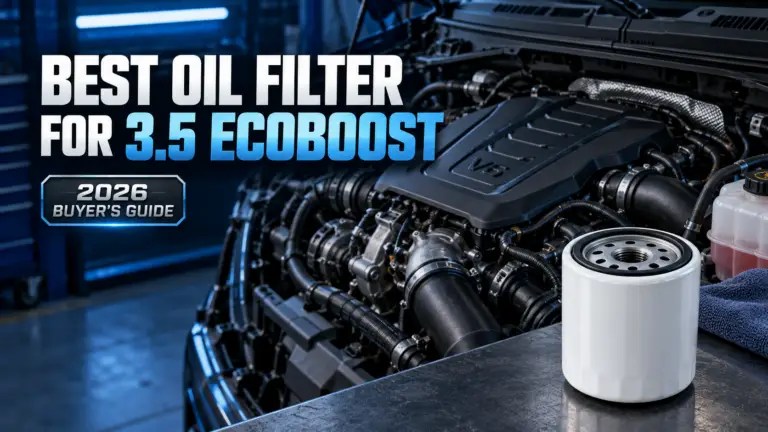
The older FL-820S was the standard for the Modular Triton V8s (4.6L, 5.4L, 6.8L). While both feature heavy-duty steel cases and silicone anti-drain back valves, the internal micron ratings and bypass spring pressures are calibrated differently. Using the incorrect filter can result in oil starvation or unfiltered oil bypassing the media entirely. For EcoBoost owners comparing filter options, our guide to the best oil filter for the 3.5 EcoBoost covers top-rated alternatives in detail.
Synthesizing the Data
The exact oil capacity of a Ford F-150 is heavily dependent not just on the nominal engine displacement, but on the specific production year and the internal engineering updates applied by Ford throughout that generation’s lifecycle.
The historical data indicates three major paradigm shifts in F-150 fluid management over the last forty years.
The first shift was the sweeping move to synthetic blends and 5W-20 initiated by TSB 02-1-9, moving millions of legacy pushrod engines to a thinner viscosity for fuel economy compliance.
The second shift was the EcoBoost Era (2011–Present), which normalized the 6.0-quart capacity for high-output turbocharged V6 engines, paired strictly with 5W-30 full synthetic to protect high-RPM turbine bearings.
The third shift involves the Coyote Fluctuations (2011–2026), tracking the 5.0L V8’s journey from 7.7 quarts, up to 8.8 quarts to accommodate PTWA cylinder liners, and back down to 7.75 quarts with a viscosity shift to 5W-30 to support advanced cylinder deactivation.
For optimal longevity and peak performance, owners and technicians must consult the exact specifications for their specific model year. They must adhere strictly to the 15-minute drain-back rule for the 2.7L EcoBoost and utilize modern API SP-rated oils paired with Motorcraft USCAR-36 compliant filters. Routine fluid maintenance, executed with exact volumetric precision, remains the single most effective method for preserving the mechanical integrity of the Ford F-150.
Oil Capacity By Year
Full oil capacity guide: Ford Engine Oil Recommendation Chart (All Models)
Oil viscosity and Ford spec by engine: Ford F-150 Oil Type Chart: 5W-20 vs 5W-30 By Engine