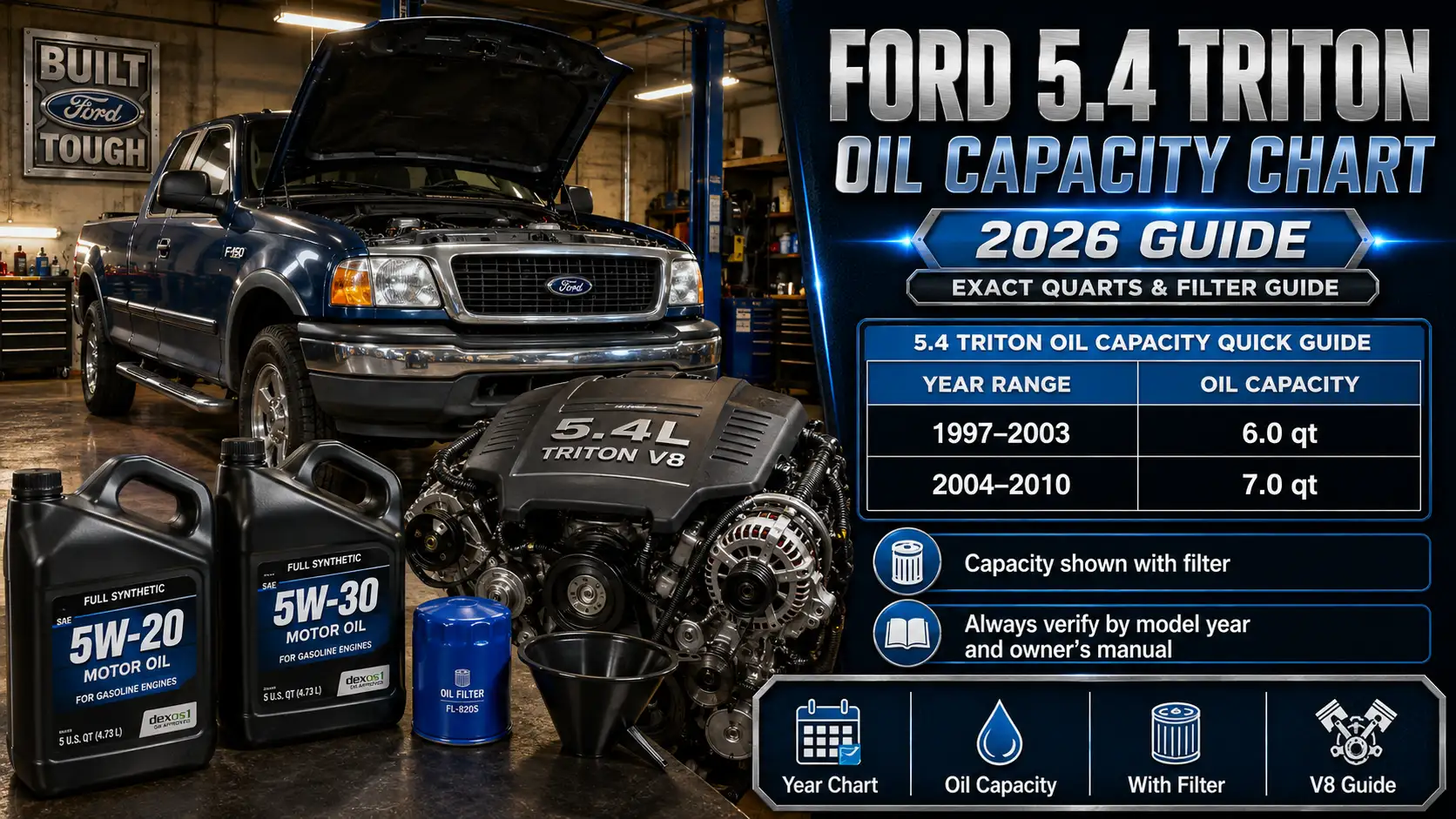
Ford 5.4 Triton Oil Capacity Chart – 2026 Exact Quarts & Filter Guide

The Ford 5.4L Triton V8 is one of the most consequential powerplants in modern automotive engineering. Introduced in 1997, it served as the mechanical foundation for millions of trucks, commercial vans, and luxury SUVs. As part of the revered Ford Modular engine family, its overhead camshaft architecture demanded a highly advanced lubrication system.
Unlike the older Windsor pushrod engines it replaced, the 5.4L Triton relies heavily on strict fluid dynamics to survive. Oil in this engine does more than simply lubricate bearings; it acts as a critical hydraulic fluid for timing chain tensioners and variable camshaft phasers. Maintaining the exact oil capacity is the absolute baseline for preventing catastrophic mechanical failures.

Prime for Young Adults — 6 Months Free
Students and 18–24s get six months of Prime free, then half price.
Start 6 Months Free As an Amazon Associate I earn from qualifying purchases.Over its multi-decade production run, the 5.4L engine evolved through three distinct cylinder head generations. Each of these iterations—the 2-valve, 3-valve, and 4-valve—introduced specific changes to the engine’s internal oil volume requirements. This report exhaustively details these fluid capacities, viscosity standards, and filtration protocols.
The Ultimate Ford 5.4 Triton Oil Capacity Chart
Recommended Best Deal Products


Finding the exact oil capacity for your Ford 5.4L Triton V8 shouldn’t be a guessing game. Over its extensive lifespan spanning from 1997 to 2014, Ford made critical updates to this modular engine architecture.
These rolling updates directly changed the oil pan size and total capacity requirements across different vehicle platforms. Using the incorrect amount of oil can lead to timing chain issues or catastrophic engine failure.
Our comprehensive, data-driven guide breaks down the exact quarts needed for your specific F-150, Super Duty, or Expedition. We rely on official Ford service manuals and validated enthusiast data to keep your Triton running strong.
Standard Volume
6.0 – 7.0 Quarts
Capacity varies strictly by model year and valve configuration (2V vs 3V/4V).
Recommended Viscosity
5W-20
Official Ford specification for all 5.4L engines, back-spec’d via TSB for pre-1999 models.
Required Filter
FL-820S

Audible — Listen Free for 30 Days
One free credit a month and thousands of titles included.
Listen Free for 30 Days As an Amazon Associate I earn from qualifying purchases.The Motorcraft filter with a critical silicone anti-drainback valve to prevent dry starts.
Oil Capacity by Generation & Model
The 5.4L Triton engine experienced a major capacity shift between the 2-valve and 3-valve generations. Early generation F-150s and Expeditions utilize a smaller oil pan requiring exactly 6.0 quarts with a filter change.
Starting in 2004 for the F-150 (and 2005 for Super Duty lines), Ford upgraded to the 3-valve configuration. This redesign included a larger oil pan capacity of 7.0 quarts to improve cooling and lubrication.
| Vehicle Model | Years Active | Engine Type | Capacity (w/ Filter) |
|---|---|---|---|
| Ford F-150 | 1997 – 2003 | 2-Valve V8 | 6.0 Quarts (5.7L) |
| Ford F-150 | 2004 – 2010 | 3-Valve V8 | 7.0 Quarts (6.6L) |
| F-250 / F-350 Super Duty | 1999 – 2004 | 2-Valve V8 | 6.0 Quarts (5.7L) |
| F-250 / F-350 Super Duty | 2005 – 2010 | 3-Valve V8 | 7.0 Quarts (6.6L) |
| Ford Expedition | 1997 – 2004 | 2-Valve V8 | 6.0 Quarts (5.7L) |
| Ford Expedition | 2005 – 2014 | 3-Valve V8 | 7.0 Quarts (6.6L) |
The 5W-20 vs 5W-30 Debate
Recommended Best Deal Products


When the 5.4L Triton originally launched in 1997, the factory oil cap specified 5W-30 motor oil. However, Ford later issued a comprehensive Technical Service Bulletin (TSB 02-1-9).
This bulletin explicitly back-specified 5W-20 for nearly all older Triton engines. The thinner 5W-20 oil reaches the top end of the engine faster during cold starts, reducing critical wear.
Furthermore, 5W-20 is essential for proper operation of the Variable Cam Timing (VCT) solenoids found in the 2004+ 3-valve engines, preventing the notorious “cam phaser tick”.
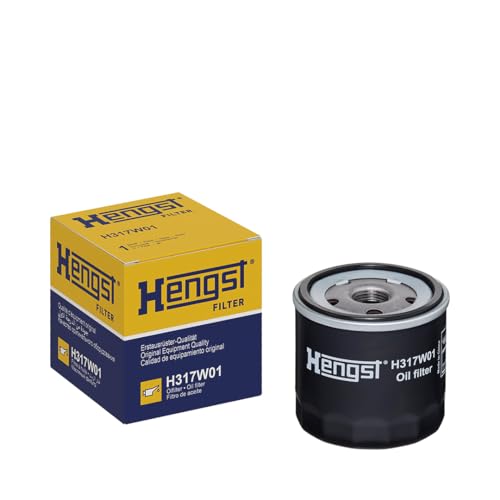
Filter Selection: Motorcraft FL-820S
The importance of the correct oil filter on a 5.4L Triton cannot be overstated. Enthusiasts and mechanics universally recommend sticking exclusively to the OEM Motorcraft FL-820S.
Why? The FL-820S features a highly reliable silicone anti-drainback valve located at the thread end. This prevents oil from draining out of the upper engine when shut off.
Aftermarket filters often use cheap nitrile valves that harden and fail. A failed valve leads to a “dry start,” causing timing chain rattle and accelerated wear on critical top-end components.
The Evolution of Triton Engine Architecture
Recommended Best Deal Products


The 2-Valve (2V) Generation (1997–2003)
The original 5.4L 2-valve Triton engine made its market debut in the redesigned 1997 Ford F-150 platform. This engine utilized a single overhead camshaft (SOHC) per cylinder bank, actuating two valves per cylinder to produce 235 horsepower. The lubrication system in this early architecture was relatively straightforward, relying on standard hydraulic lash adjusters.
Audible Premium Plus — Annual Membership
12 audiobook credits up front, plus the full Audible catalogue.
See Annual Plans As an Amazon Associate I earn from qualifying purchases.For the vast majority of 2V applications, Ford engineers designed the oil pan to accommodate exactly 6.0 quarts (5.7 liters) of engine oil. This capacity measurement inherently includes the volume required to fill the specified Motorcraft oil filter. Operating within this 6.0-quart parameter provided a sufficient hydrodynamic barrier for the main and rod bearings.
These early 2V Modular engines are widely regarded by technicians as highly reliable powerplants. With strict adherence to the 6.0-quart capacity and regular 5,000-mile service intervals, these engines routinely surpass 250,000 miles of service life. The only notable flaw was spark plug thread blowout, which was unrelated to the lubrication system.
The 3-Valve (3V) Generation (2004–2010)
For the 2004 model year, Ford introduced a completely redesigned 5.4L 3-valve engine to accompany the new F-150 body style. This iteration introduced Variable Cam Timing (VCT), a system that dynamically advanced or retarded camshaft positioning. The VCT system relied entirely on pressurized engine oil to actuate the internal vanes of the cam phasers.
To support these massive new hydraulic demands, the lubrication requirements of the engine changed drastically. Ford increased the standard crankcase capacity for the 3V 5.4L engine to 7.0 quarts (6.6 liters), including the filter. This 16% increase in fluid volume was designed to improve thermal stability and reduce peak oil operating temperatures.
Despite the increased capacity, the 3V engine became infamous for timing chain rattle, VCT solenoid failure, and cam phaser degradation. Strict adherence to the 7.0-quart capacity is completely non-negotiable for 3V owners. Running even slightly low on oil in a 3V engine rapidly destroys the sensitive aluminum camshaft journals, leading to complete engine failure.
The 4-Valve (4V) InTech and Supercharged Variants
The highly complex 4-valve versions of the 5.4L engine were reserved for luxury applications and high-performance SVT models. Marketed under the “InTech” moniker for vehicles like the Lincoln Navigator, this naturally aspirated engine featured dual overhead camshafts (DOHC). The standard oil capacity for the InTech V8 was typically 6.0 quarts, though some early 4WD models specified 6.9 quarts due to differential clearance.
Ford’s Special Vehicle Team (SVT) also utilized supercharged 4-valve variants for their halo performance vehicles. The Shelby GT500 requires 6.4 to 6.5 quarts of specialized 5W-50 synthetic oil to manage immense supercharger heat loads. These engines require frequent level checks, as forced induction naturally increases oil consumption.
The most extreme iteration of the 5.4L 4V engine was utilized in the 2005-2006 Ford GT supercar. To achieve a low center of gravity, engineers equipped the GT with a racing-derived four-stage external dry-sump lubrication system. This complex system eliminated the traditional oil pan entirely, requiring between 12.0 and 15.3 quarts of oil for total system capacity.
Comprehensive Oil Capacity Charts by Vehicle Platform
Ford F-150 and SVT Lightning Capacities
The Ford F-150 is the most ubiquitous platform to feature the 5.4L Triton engine. Throughout its extensive production run, the required engine oil capacity shifted in direct correlation with the cylinder head generation bolted to the block. Technicians must carefully verify the model year to prevent catastrophic overfilling or underfilling.
For the 1997 through 2003 model years, the F-150 utilized the 2-valve engine architecture. The official technical specification requires exactly 6.0 quarts (5.7 liters) of oil, which includes the volume required to fill a fresh oil filter. This volume provides optimal lubrication without causing the crankshaft to aerate the oil pool.
With the introduction of the 3-valve engine in 2004, the F-150 required more fluid to operate its sensitive cam phasers. All standard F-150 models equipped with the 5.4L engine from 2004 to 2010 require exactly 7.0 quarts (6.6 liters) of engine oil. The SVT Lightning (1999-2004), despite being supercharged, utilized the 2V architecture and maintained a 6.0-quart capacity.
| Model Year Range | Vehicle Platform | Engine Architecture | Total Oil Capacity (w/ Filter) | Recommended Viscosity |
| 1997–2003 | Ford F-150 | 5.4L 2-Valve (2V) V8 | 6.0 Quarts (5.7 L) | 5W-20 (Originally 5W-30) |
| 2004–2010 | Ford F-150 | 5.4L 3-Valve (3V) V8 | 7.0 Quarts (6.6 L) | 5W-20 |
| 1999–2004 | Ford SVT Lightning | 5.4L 2-Valve Supercharged | 6.0 Quarts (5.7 L) | 5W-20 |
| 2010 | Ford F-150 SVT Raptor | 5.4L 3-Valve (3V) V8 | 7.0 Quarts (6.6 L) | 5W-20 |
When refilling the F-150 crankcase, automotive professionals advise pouring the oil gradually to allow it to settle. The engine dipstick must always serve as the final point of verification to prevent the severe consequences of aerated oil. Maintaining the level precisely at the crosshatched “MAX” marker is crucial for VCT health.
Ford F-250 and F-350 Super Duty Capacities
The Ford Super Duty truck line was engineered for severe-duty applications, including extreme payload hauling and continuous trailer towing. The 5.4L V8 served as the highly capable base gasoline engine for these robust trucks for over a decade. Because of the intense mechanical loads, Super Duty oil maintenance is highly critical.
Similar to the light-duty F-150, the Super Duty line transitioned from the 2V to the 3V architecture. For the 1999 through 2004 F-250 and F-350 models, the 5.4L 2V engine required 6.0 quarts of oil during a standard service. Owners must monitor oil levels frequently when towing, as high heat can accelerate oil consumption.
From the 2005 model year through 2010, the Super Duty trucks received the upgraded 5.4L 3V engine. Consequently, the required oil capacity increased to 7.0 quarts to support the VCT system and aid in essential oil cooling. Driveline configurations, whether 2WD or 4WD, do not typically alter this 7.0-quart specification.
| Model Year Range | Vehicle Platform | Engine Architecture | Total Oil Capacity (w/ Filter) | Recommended Viscosity |
| 1999–2004 | F-250 / F-350 Super Duty | 5.4L 2-Valve (2V) V8 | 6.0 Quarts (5.7 L) | 5W-20 |
| 2005–2010 | F-250 / F-350 Super Duty | 5.4L 3-Valve (3V) V8 | 7.0 Quarts (6.6 L) | 5W-20 |
Operating a Super Duty truck with low oil levels is exceptionally dangerous due to the high load factors placed on the rotating assembly. Heavy towing dramatically increases crankcase temperatures, which can thin the oil and accelerate the rate of burn-off. Technicians highly recommend checking the dipstick at every fuel stop during long hauls.
Ford Expedition Oil Capacities
The full-size Ford Expedition SUV shared its powertrain lineage directly with the F-150 pickup. As a result, it mirrored the truck’s engine generations and subsequent fluid capacity changes. Designed for large families and heavy cargo, the Expedition subjects its engine to significant daily stress.
For the first-generation Expedition, spanning the 1997 to 2004 model years, the 5.4L 2V engine requires 6.0 quarts of oil. This capacity provides adequate lubrication for the heavy SUV under standard passenger-hauling conditions. Overfilling these models can cause internal seal damage and decreased fuel economy.
When the Expedition transitioned to the 3V architecture for the 2005 model year, the oil capacity was subsequently increased. From 2005 through 2014, the 5.4L Expedition requires 7.0 quarts of oil, ensuring the VCT phasers operate correctly under load. This larger sump also helps dissipate heat generated by the SUV’s hefty curb weight.
| Model Year Range | Vehicle Platform | Engine Architecture | Total Oil Capacity (w/ Filter) | Recommended Viscosity |
| 1997–2004 | Ford Expedition | 5.4L 2-Valve (2V) V8 | 6.0 Quarts (5.7 L) | 5W-20 |
| 2005–2014 | Ford Expedition | 5.4L 3-Valve (3V) V8 | 7.0 Quarts (6.6 L) | 5W-20 |
It is highly recommended to check the oil level in an Expedition only after running the engine briefly and letting it settle. This standard procedure primes the oil filter and provides the most accurate reading on the dipstick. Failing to account for the filter volume often leads to accidental overfilling.
Lincoln Navigator and Blackwood Capacities
The Lincoln Navigator, Ford’s premier luxury SUV, frequently utilized higher-output variations of the 5.4L engine. While very early models featured the standard 2V engine, the Navigator quickly adopted the 4-valve DOHC “InTech” engine for superior horsepower. This high-revving engine required pristine oil maintenance to protect its four camshafts.
For the 1998 through 2004 Navigator models, the standard oil capacity is generally listed as 6.0 quarts. However, strict engineering data for certain 1999 4WD models suggests a capacity of 6.9 quarts due to differential clearance altering the pan design. Always consult the specific owner’s manual for 4WD variations.
The short-lived Lincoln Blackwood luxury pickup truck, produced primarily in 2002, utilized the same 5.4L 4V InTech engine. Technical specifications from synthetic oil manufacturers denote a standard 6.0-quart oil capacity for the Blackwood.
When the Navigator adopted the 3-valve 5.4L engine configuration in 2005, its fluid dynamics aligned with the Expedition. From 2005 to 2014, the Navigator requires 7.0 quarts (sometimes noted as 6.6 quarts in specific early 3V technical documentation) for optimal operation. Consistent oil changes are vital to protect the Navigator’s heavy valve train.
| Model Year Range | Vehicle Platform | Engine Architecture | Total Oil Capacity (w/ Filter) | Recommended Viscosity |
| 1998–2004 | Lincoln Navigator | 5.4L 4-Valve (4V) InTech | 6.0 Quarts (up to 6.9 in 4WD) | 5W-20 |
| 2002 | Lincoln Blackwood | 5.4L 4-Valve (4V) InTech | 6.0 Quarts (5.7 L) | 5W-20 |
| 2005–2014 | Lincoln Navigator | 5.4L 3-Valve (3V) V8 | 7.0 Quarts (6.6 L) | 5W-20 |
Ford E-Series Commercial Vans (E-150, E-250, E-350)
The Ford Econoline, later rebranded as the E-Series, is a commercial workhorse that frequently featured the 5.4L Triton V8. These vans are subjected to grueling stop-and-go delivery routes, heavy cargo transportation, and excessive idling. This severe duty cycle rapidly degrades engine oil additives.
Unlike the trucks and SUVs, the E-Series vans maintained a remarkably consistent oil capacity across their production span. From 2003 to 2013, all 5.4L E-Series vans require 6.0 quarts of oil. Fleet managers must strictly enforce capacity checks to prevent costly commercial vehicle downtime.
This consistency is largely due to the unique engine bay packaging of the E-Series van chassis. The spatial constraints forced specific oil pan geometries that did not always align with the capacity increases seen in the F-150 platform. Fleet operators should also note that some E-Series vans were modified for Compressed Natural Gas (CNG), though oil capacity remained 6.0 quarts.
| Model Year Range | Vehicle Platform | Engine Architecture | Total Oil Capacity (w/ Filter) | Recommended Viscosity |
| 1997–2013 | E-150 / E-250 / E-350 | 5.4L 2-Valve (2V) V8 | 6.0 Quarts (5.7 L) | 5W-20 |
High-Performance SVT Platforms (Ford GT & Shelby GT500)
Ford’s Special Vehicle Team (SVT) utilized heavily modified, supercharged 4-valve versions of the 5.4L block for ultimate halo vehicles. These hand-built engines require specialized lubrication to survive extreme track conditions and massive horsepower outputs. Maintaining perfect oil levels in these vehicles is paramount to preventing catastrophic bearing failure.
The Shelby GT500, produced from 2007 through 2012, utilizes a wet-sump supercharged 5.4L V8. The required capacity for the GT500 is 6.4 to 6.5 quarts of fully synthetic 5W-50 engine oil. The heavier 5W-50 viscosity is strictly required to combat the extreme thermal shearing caused by the supercharger.
The exotic 2005–2006 Ford GT supercar features an aluminum 5.4L 4V engine mated to a four-stage external dry-sump pump. This racing-derived system eliminates the oil pan entirely, moving fluid storage to an external tank. A complete fluid service for the Ford GT requires between 12.0 and 15.3 quarts of specialized oil.
The Viscosity Debate: 5W-20 vs. 5W-30
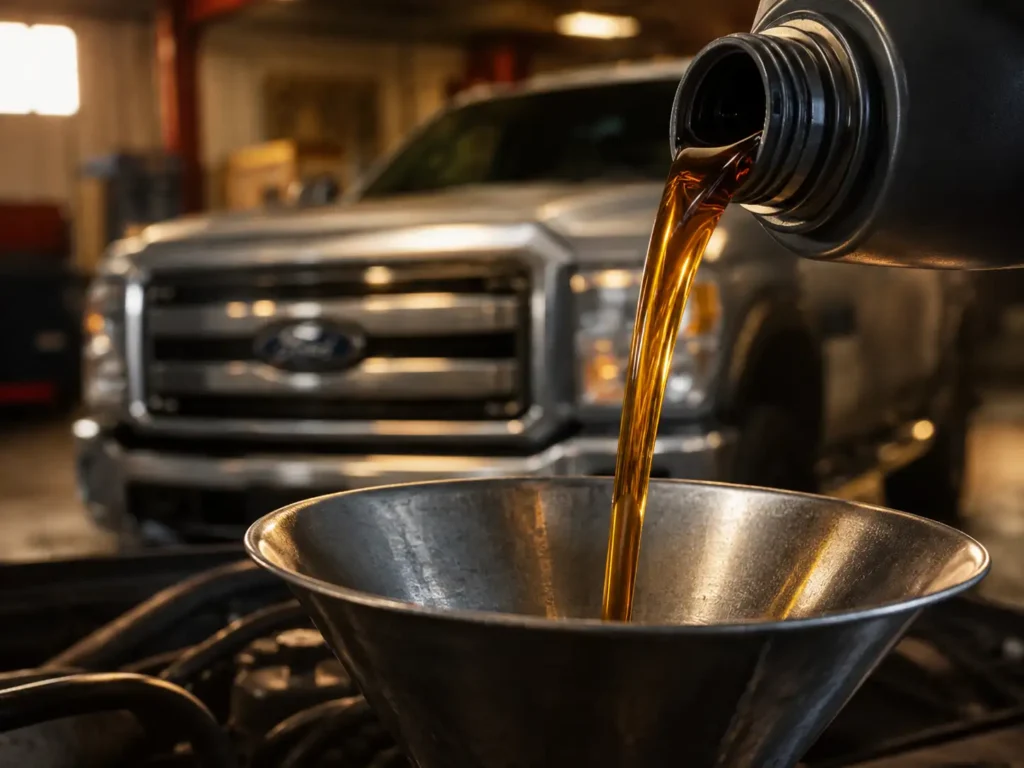
Corporate Average Fuel Economy (CAFE) Influence
The manufacturer’s recommended oil viscosity for the vast majority of 5.4L Triton engines is 5W-20. However, this recommendation has become a point of intense mechanical debate among automotive engineers and master technicians. The argument centers on whether 5W-20 prioritizes fuel economy over long-term engine survival.
When the Modular engines were originally designed in the 1990s, they were engineered around 5W-30 viscosity. As environmental regulations tightened in the early 2000s, Ford retroactively issued a technical service bulletin changing the recommendation to 5W-20 for nearly all previous models. This was a highly controversial move within the automotive community.
This shift to a thinner viscosity was driven primarily by a desire to meet strict Corporate Average Fuel Economy (CAFE) standards. Thinner oil provides less fluid friction within the engine, yielding marginal improvements in overall fleet fuel mileage. However, many automotive experts argue this fraction of an MPG comes at the cost of bearing life.
Thermal Breakdown and High-Load Implications
While 5W-20 performs adequately under light loads and cold starts, it has distinct disadvantages under high thermal stress. When the engine is pushed hard—such as during towing or sustained highway driving—the oil heats up significantly and thins out further. This thinning reduces the hydrodynamic wedge protecting the crankshaft journals.
At extreme operating temperatures, 5W-20 exhibits a lower resistance to “coking,” a destructive process where overheated oil bakes into a hard, sludge-like solid. This sludge can easily block delicate oil feed lines, starving critical engine components of vital lubrication. Once oil lines are restricted, engine failure is imminent.
Full synthetic 5W-30 offers far superior thermal stability and resists this high-temperature coking much better than its thinner counterpart. Using a thicker oil ensures the boundary layer remains intact when the engine is subjected to heavy mechanical loads. For trucks used as tow rigs, 5W-30 is increasingly viewed as the superior choice.
Protecting the 3-Valve Cam Phasers from the “Triton Tick”
The viscosity debate becomes hyper-critical when discussing the 5.4L 3-valve engine. The 3V architecture relies entirely on robust oil pressure to keep the Variable Cam Timing (VCT) phasers locked and operating smoothly. If oil pressure drops, the entire timing system destabilizes.
As 5W-20 thins out at high temperatures, the resulting drop in oil pressure often causes the cam phasers to rattle or “knock” at hot idle. This phenomenon, colloquially known as the “Triton Tick,” is a direct symptom of insufficient hydraulic pressure reaching the upper valvetrain. It is the precursor to complete timing chain failure.
Extensive empirical evidence from engine rebuilders suggests that switching to a high-quality 5W-30 full synthetic oil dramatically reduces timing chain noise. The thicker 5W-30 maintains higher pressure at hot idle, keeping the VCT solenoids properly actuated. This simple viscosity switch can significantly extend the life of the aluminum cam journals.
Filtration Science: The Motorcraft FL-820S
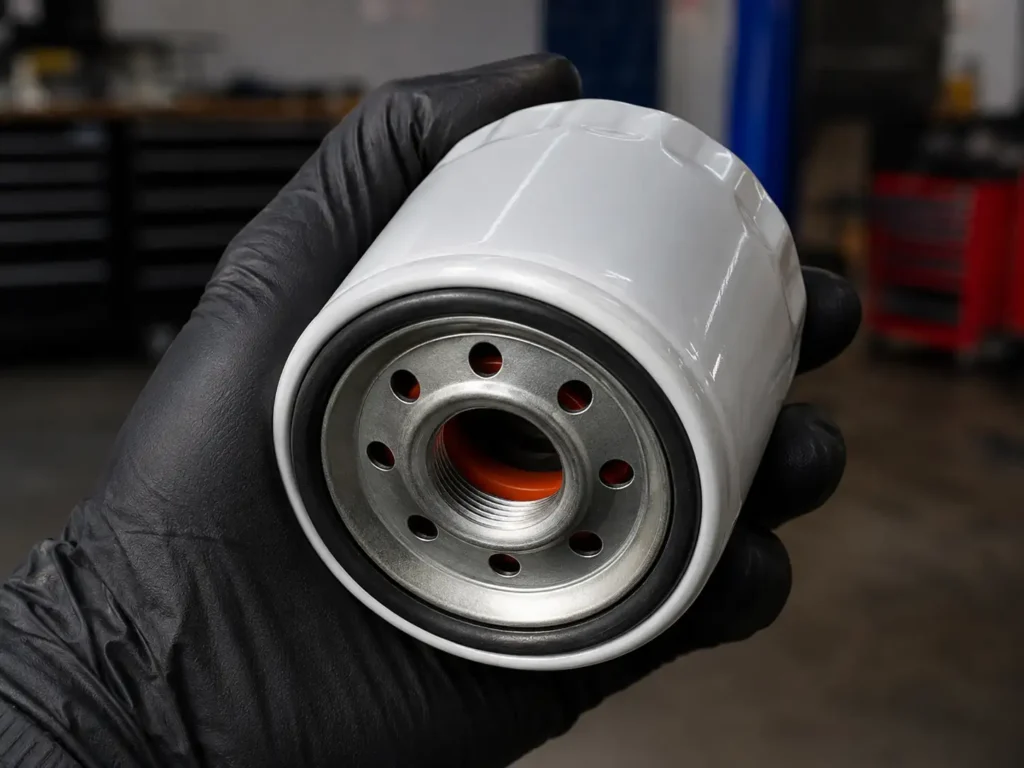
OEM Filtration vs. Aftermarket Alternatives
The total oil capacity of the 5.4L Triton engine explicitly includes the volume of the oil filter, making the selection of the filter a critical component of the fluid system. The factory-specified filter for nearly all 5.4L applications is the Motorcraft FL-820S. Choosing the correct filter is just as important as choosing the right oil.
While the aftermarket offers dozens of interchangeable filters, automotive engineers strongly advise adhering exclusively to the OEM Motorcraft filter. The FL-820S is engineered to precise tolerances mandated by Ford to protect the Modular engine’s specific flow requirements. Deviating from this design can alter internal engine pressure.
Using substandard filters can severely disrupt the engine’s internal fluid dynamics. Decreased flow rates from cheap filter media can starve the engine of oil during cold starts, leading to accelerated bearing and valvetrain wear. The 3V cam phasers are particularly sensitive to poor filtration.
Silicone Anti-Drainback Valve Dynamics
One of the most critical mechanical features of the FL-820S is its high-temperature silicone anti-drainback valve. Because the 5.4L engine utilizes long timing chains to reach the overhead camshafts, preventing oil from draining out of the upper engine when shut off is paramount. Gravity will naturally pull oil back to the pan without this valve.
The silicone valve within the FL-820S remains completely pliable in extreme cold (down to -75°F) and extreme heat (up to 450°F). This ensures that oil is trapped in the engine’s upper galleries, providing instant lubrication the moment the ignition key is turned. This prevents the destructive phenomenon known as a “dry start.”
Many cheaper aftermarket filters use inferior nitrile rubber for their anti-drainback valves. These rubber valves quickly harden, crack, and fail under high heat, allowing oil to drain back into the pan. Upon startup, the engine runs without upper lubrication for several seconds, rapidly destroying the timing chain guides.
Thread-End Bypass Valve Architecture
The FL-820S incorporates a pressure relief (bypass) valve designed specifically at the threaded inlet end of the filter. This design is an intentional, highly protective engineering choice by Ford. It dictates how oil flows when the filter is overloaded.
If the filter media becomes clogged, or during cold starts when thick oil cannot flow rapidly, the bypass valve opens to ensure the engine is not starved of oil. By locating this valve at the threaded base, the bypassing oil does not wash over the dirty filter media. The dirty oil enters the engine, but it does not pick up additional concentrated debris.
In contrast, many aftermarket filters locate the bypass valve at the dome end. When a dome-end valve opens, the flow of oil sweeps accumulated dirt and metal debris off the filter element and injects it directly into the engine’s critical bearings. This design flaw causes massive, accelerated bearing scoring.
Filter Component Comparison Matrix
| Feature | Motorcraft FL-820S | Standard Aftermarket Filter |
| Anti-Drainback Material | High-Temp Silicone | Standard Nitrile Rubber |
| Bypass Valve Location | Thread-End (Protective) | Dome-End (Risk of Debris Wash) |
| Filtration Efficiency | 80% at 20 microns | Highly Variable by Brand |
| Center Tube Design | Corrugated Steel | Flimsy Plastic or Thin Metal |
This matrix highlights the invisible internal engineering choices that make OEM filtration mandatory for the preservation of Modular engine timing chains.
The Oil Change Procedure & Fastener Specifications
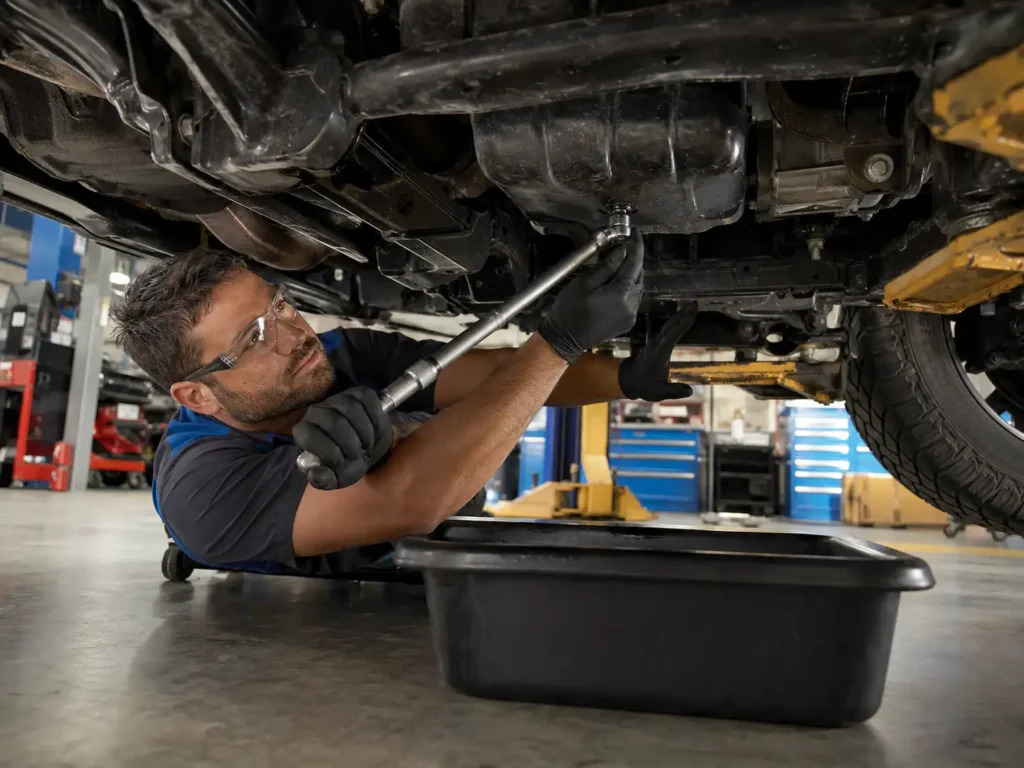
Professional Step-by-Step Methodology
Performing an oil change on the 5.4L Triton requires adherence to a strict methodology to ensure capacity accuracy and prevent leaks. The vehicle must first be parked on level ground to ensure the drain pan empties completely. Technicians suggest running the engine for five minutes prior to draining to suspend contaminants in the hot oil.
Begin by removing the oil filler cap and extracting the dipstick; this provides adequate crankcase venting and allows the old oil to flow rapidly out of the drain hole. Utilize a 16mm or 17mm socket to remove the oil drain plug, allowing the fluid to drain completely into a catch pan. Inspect the old oil for heavy metallic sheen, which indicates bearing wear.
Once drained, remove the oil filter using an appropriately sized filter wrench. Clean the filter mating surface on the engine block meticulously with a shop rag. Install the new FL-820S filter, reinstall the drain plug to spec, and fill with the required 6.0 or 7.0 quarts of oil. Run the engine briefly, shut it off, and verify the final level on the dipstick.
Drain Plug Torque Specifications
Accurate torquing of the drain plug fastener is vital; over-tightening leads to stripped oil pans, while under-tightening risks catastrophic fluid loss. For the vast majority of F-150 and Super Duty models equipped with the standard stamped steel oil pan, the factory drain plug torque specification is 10 ft/lbs.
It is highly recommended to replace the drain plug gasket or the entire plug assembly if the rubber seal shows signs of flattening or tearing. Certain 5.4L platforms, particularly those adapted for Flex Fuel (E85/M85) or specific Lincoln Navigators, cite a higher torque spec of 17 ft/lbs.
Technicians must verify the specific pan material before applying heavy torque. Applying 17 ft/lbs to a standard steel pan can deform the crush washer, while under-torquing an aluminum pan can lead to vibrations backing the plug out.
Oil Filter Tightening Dynamics
The installation of the Motorcraft FL-820S oil filter also follows strict engineering guidelines to prevent gasket blowout. Technicians must apply a light film of fresh oil to the new filter’s rubber gasket before installation. Thread the filter onto the adapter stud until the gasket makes initial contact with the engine block.
Once contact is made, the factory specification dictates tightening the filter exactly 3/4 of a turn, or roughly 60 degrees of rotation. Under no circumstances should a mechanical filter wrench be used to tighten the filter onto the block.
Over-tightening the oil filter crushes the silicone gasket, leading to high-pressure oil leaks while the engine is running. Conversely, hand-tightening insufficient amounts can cause the filter to spin loose under the intense vibrations of the V8 engine.
Supplementary Fluid Capacities for the 5.4L Platform
Automatic Transmission Fluid Volumes
While managing engine oil capacity is paramount, maintaining the associated driveline fluids is equally critical for the longevity of the 5.4L platform. Many 5.4L vehicles are utilized for towing, which places immense thermal stress on the automatic transmission. The primary transmissions paired with the 5.4L are the 4R100, 4R70W, and later 6R80 TorqShift models.
For early F-150s equipped with the 4R70W or 4R75E, the total system fill requires 13.9 quarts of transmission fluid, with an initial pan drop requiring roughly 5.0 quarts. Heavier applications utilizing the robust 4R100 transmission require 17.0 quarts for RWD models and 17.6 quarts for 4WD variations.
The introduction of the 6-speed 6R80 transmission in later models like the Navigator changed the total fill requirement to 13.1 quarts. Ford mandates the use of Mercon LV for modern applications, strictly warning against mixing incorrect fluid types which can destroy clutch packs.
| Transmission Model | Vehicle Application | Total System Capacity | Initial Pan Drop Fill |
| 4R70W / 4R75E | F-150 / Expedition | 13.9 Quarts | 5.0 Quarts |
| 4R100 (RWD) | Super Duty / Lightning | 17.0 Quarts | 6.4 Quarts |
| 4R100 (4WD) | Super Duty / Navigator | 17.6 Quarts | 6.4 Quarts |
| 6R80 (6-Speed) | Late Model Navigator | 13.1 Quarts | 3.5 Quarts |
Engine Coolant and Air Conditioning Refrigerant
Thermal management in the 5.4L Triton relies on massive volumes of engine coolant to prevent aluminum cylinder heads from warping. A standard F-150 or E-Series van requires approximately 27.2 to 28.7 quarts of Engine Coolant. Models equipped with auxiliary rear heat, such as passenger vans or Expeditions, require an expanded 30.7 quarts (29.1 liters) of coolant.
Air conditioning systems on these large vehicles also require precise fluid measurements to maintain compressor health. The A/C system on a standard 5.4L platform requires 1.9 lbs (0.85 kg) of refrigerant.
The A/C compressor itself relies on 8.0 fluid ounces of specific compressor oil. Vehicles equipped with the heavy-duty prep package require a doubled capacity of 16.0 fluid ounces of compressor oil to prevent seizure under high duty cycles.
People Also Ask
What happens if the 5.4L Triton is overfilled with oil?
Overfilling the crankcase introduces excessive fluid directly into the path of the rapidly spinning crankshaft counterweights. As the crankshaft violently strikes the high oil pool, it whips the fluid into a frothy, aerated foam.
Aerated oil contains tiny air bubbles that compress under load, effectively destroying the uncompressible hydrodynamic wedge inside the engine bearings. Furthermore, overfilling increases crankcase pressure, which will force oil past the rear main seal and valve cover gaskets, resulting in severe external leaks. Accurate dipstick measurement prevents this costly error.
Why does the 3-valve 5.4L sound like a diesel engine at hot idle?
The signature “diesel ticking” of a hot 5.4L 3V engine is primarily caused by a failure of the Variable Cam Timing (VCT) phasers. When 5W-20 oil thins out at high operating temperatures, the stock oil pump struggles to maintain adequate pressure to the top of the engine.
Without sufficient hydraulic pressure, the phasers cannot hold the camshaft steady, causing them to slap violently back and forth against their stops. This is why transitioning to a highly stable 5W-30 full synthetic oil often quiets the engine and preserves the valvetrain. Installing a high-volume Melling M360 oil pump is also a highly recommended mechanical upgrade to permanently solve this pressure drop.
Is there an oil capacity difference between 2WD and 4WD models?
For the vast majority of F-150 and Super Duty applications, the driveline configuration (2WD vs. 4WD) does not alter the required 6.0 or 7.0-quart engine oil capacity. The oil pan geometry remains consistent enough to mandate the exact same fluid volume.
However, in very specific historical literature for the 1999 Lincoln Navigator, Ford noted a slight variance, citing 6.6 quarts for RWD and 6.9 quarts for 4WD models. This was due to differential clearance constraints modifying the sump depth. Today, modern service protocols generally standardize these to the closest full quart based on the generation, verified strictly by the dipstick.
What are the dangers of ignoring the 5,000-mile service interval?
The 5.4L Modular engine, particularly the 3-valve variant, is highly intolerant of dirty, degraded, or sludged oil. Ford recommends a maximum 5,000-mile interval for conventional oils in standard driving conditions.
Pushing the oil beyond its useful life allows carbon soot and metal particulates to accumulate in the incredibly fine mesh screens of the VCT solenoids. Once these screens clog, oil flow to the cam phasers ceases completely. This leads to immediate timing chain failure, broken chain guides, and necessitates a multi-thousand-dollar engine rebuild.
Can synthetic and conventional oils be mixed in this engine?
While it is technically permissible to mix conventional and synthetic oils in an emergency, doing so severely dilutes the superior thermal properties of the synthetic base stock. To achieve maximum protection against sludge and coking, a 100% full synthetic oil is highly advised.
For engines operating in extreme cold (-40°C) or engaging in heavy summer towing, full synthetic 5W-30 ensures rapid cold-start flow while refusing to break down under high heat. If a top-off is required between changes, it is best practice to match the exact brand and viscosity already present in the crankcase.
Does the use of E85 Flex Fuel change oil requirements?
Yes, operating a 5.4L Triton engine on E85 or M85 alternative fuels impacts the lubrication environment inside the crankcase. Ethanol-based fuels tend to introduce more moisture and fuel dilution into the engine oil than standard gasoline.
Because of this dilution, oil change intervals must be strictly monitored and often shortened. Furthermore, high-quality full synthetic oils are demanded to resist the chemical breakdown caused by ethanol blow-by Oil analysis is highly recommended for fleet vehicles constantly running E85 to determine the true degradation rate.
Why is 5W-30 better for the 3V engine than the factory 5W-20?
Ford specified 5W-20 largely to satisfy strict federal fuel economy regulations, not necessarily to maximize engine longevity. The 3V engine’s cam phasers are highly prone to failure when hot oil pressure drops too low.
5W-30 maintains a thicker hydrodynamic film at 212°F (100°C) compared to 5W-20, preventing this critical pressure drop. Thicker oil restricts flow through the engine marginally but provides vastly superior cushion for the aluminum cam journals. The slight reduction in fuel economy is a worthy trade-off to prevent premature valvetrain death.
Strategic Maintenance Directives for Triton Longevity
The Ford 5.4L Triton V8 is a powerplant defined by its highly complex relationship with fluid dynamics and internal oil pressure. From the robust simplicity of the early 1997 2-valve models to the highly sensitive hydraulic demands of the 2010 3-valve systems, exact oil capacity remains the absolute cornerstone of engine survival.
The compiled engineering data confirms a distinct, uncompromising dividing line across generations. Early 2V engines require exactly 6.0 quarts of oil, while the later 3V iterations demand exactly 7.0 quarts to satiate the needs of their Variable Cam Timing systems. Deviating from these specific volumes invites rapid, irreversible mechanical degradation ranging from bearing starvation to massive oil seal blowouts caused by aeration.
Furthermore, empirical field data strongly supports moving beyond bare-minimum factory viscosity recommendations for heavy-duty applications. Utilizing a high-quality 5W-30 full synthetic oil, paired exclusively with a Ford Motorcraft FL-820S filter, offers the highest statistical probability of avoiding the Triton’s notorious cam phaser and timing chain failures.
By understanding the mechanical realities behind these stringent fluid requirements, technicians and operators can ensure the 5.4L Triton operates reliably well past the quarter-million-mile mark. Consistent maintenance, precise fluid measurements, and superior filtration are the definitive keys to unlocking the true potential of the Ford Modular V8.
Oil Capacity By Year
Full oil capacity guide: Ford Engine Oil Recommendation Chart (All Models)