Ford 6.0 Powerstroke EGR Valve Location: Full Guide + Diagram 2026

If your 6.0L Powerstroke is throwing an EGR-related code or you just want to inspect the valve before it fails, the good news is that it’s not buried deep in the engine. Here’s exactly where to find it, how to tell it apart from the EGR cooler, and what to check once you get there.
FordMasterX · 6.0 Powerstroke

Prime for Young Adults — 6 Months Free
Students and 18–24s get six months of Prime free, then half price.
Start 6 Months Free As an Amazon Associate I earn from qualifying purchases.EGR Valve Location & Diagnosis
Driver’s side, upper intake manifold · 2003–2007 model years
Where It Sits on the Engine
Valve vs. Cooler: Know Which Part You’re Looking At
EGR Valve
Compact solenoid actuator. Bolts to the intake manifold. Fails from carbon buildup or a sticking pintle. Look for rough idle or flow/position codes.
EGR Cooler
Long, finned, coolant-jacketed tube upstream of the valve. Fails from cracking. Look for coolant loss, a sweet smell, or white smoke.
Most Common EGR Trouble Codes

Audible — Listen Free for 30 Days
One free credit a month and thousands of titles included.
Listen Free for 30 Days As an Amazon Associate I earn from qualifying purchases.P0401
Insufficient EGR flow. Usually a carbon-clogged valve.
P0403
EGR control circuit fault. Can false-set briefly on a fresh valve.
P0405
Position sensor signal low. Causes rough idle and hesitation.
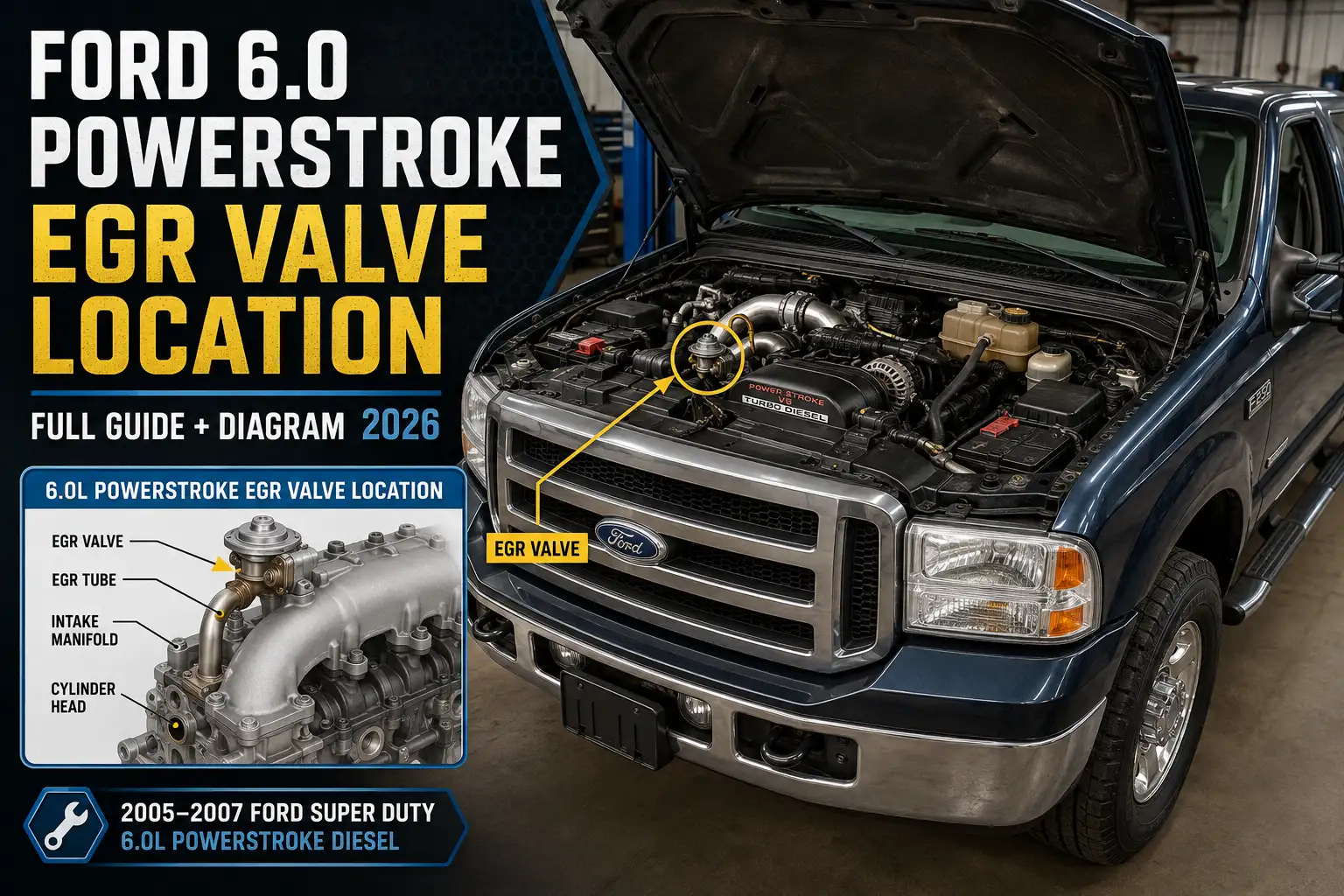
6.0 Powerstroke EGR Valve Location: Driver’s Side, Under the Upper Intake Manifold
On the 6.0L Powerstroke, the EGR valve is mounted on the driver’s side of the engine, bolted directly to the rear of the upper intake manifold horn where the EGR system feeds cooled exhaust gas back into the intake tract. The valve sits at the outlet end of the EGR cooler, so if you trace the finned coolant tube running along the driver’s side valve cover back toward the intake, the valve is the compact actuator unit at the end of that run.
The EGR valve itself is a small solenoid-actuated unit with an electrical connector on top and a two-bolt flange mount underneath, sealed to the intake manifold with a gasket. This applies across the full 2003–2007 model years of the 6.0L Powerstroke, covering the F-250, F-350, F-450, F-550, Excursion, and E-Series vans.
EGR Valve vs. EGR Cooler: Don’t Confuse These Two Parts
This is the single most common mix-up we see in owner forums, and it matters because the two parts fail differently and get diagnosed differently.
The EGR valve is the actuator: a compact solenoid unit that opens and closes to control exhaust flow into the intake. The EGR cooler is a completely different part: a long, finned, coolant-jacketed tube that sits upstream of the valve and cools the exhaust gas before it reaches it.
Audible Premium Plus — Annual Membership
12 audiobook credits up front, plus the full Audible catalogue.
See Annual Plans As an Amazon Associate I earn from qualifying purchases.If you’re seeing coolant loss, a sweet smell from the engine bay, or white smoke, that points to a cracked EGR cooler, not the valve. If you’re seeing rough idle, carbon buildup, or a stuck-open/stuck-closed code, that points to the valve itself. Knowing which part you’re actually looking at before you start pulling bolts saves a lot of wasted diagnostic time.
For a full breakdown of how the cooler ties into the rest of the 6.0 Powerstroke intake manifold system, our intake manifold diagram guide covers the surrounding hardware in more detail.
Signs You’re Looking at a Failing EGR Valve (P0401, P0403, P0405)
A handful of trouble codes point directly at this part:
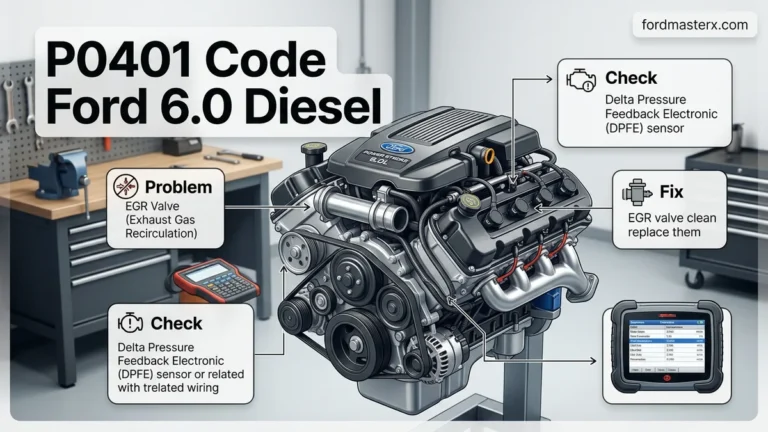
P0401 (Insufficient EGR Flow) is the most common code tied to the EGR valve on the 6.0. It sets when the PCM doesn’t see the exhaust flow it expects, usually from a carbon-clogged valve or blocked passage.
P0403 (EGR Control Circuit) points to an electrical fault in the valve’s control circuit. Worth noting: an NHTSA technical service bulletin documents that P0403 can false-set on lower-mileage vehicles right after a new EGR valve is installed, because the internal motor brushes haven’t fully seated yet. If you just replaced the valve and get this code shortly after, it may resolve itself as the part breaks in rather than indicating a bad new part.
P0405/P0406 (EGR Position Sensor Signal Low/High) point to the position sensor inside the valve reporting a voltage outside the expected range, which can cause rough idle, hesitation on acceleration, and reduced fuel economy as the PCM compensates.
Physically, expect rough idle, a hesitation or stumble under light acceleration, and a drop in fuel economy as the earliest symptoms before a code even sets. A scan tool built for the 6.0 Powerstroke will pull these codes and, on more capable units, live EGR position data so you can confirm the valve is actually moving when commanded rather than guessing from symptoms alone.
How to Access and Test the EGR Valve
- Locate the two mounting bolts on the valve’s flange where it meets the intake manifold, on the driver’s side rear of the engine.
- Disconnect the electrical connector on top of the valve before removing anything.
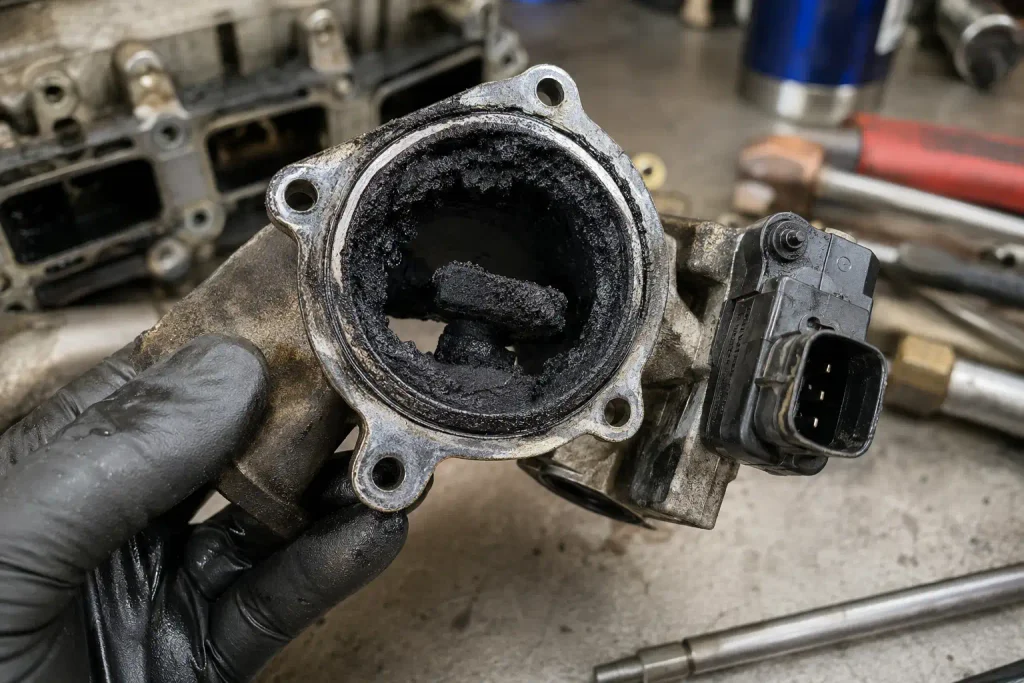
- Remove the two bolts and pull the valve straight out. Owners commonly report it’s heavily carbon-caked after years of service, sometimes stuck enough that a small prying tool or gear puller arm is needed to break it free.
- Inspect the valve for carbon buildup around the pintle and manually work the shaft (with the connector disconnected) to confirm it moves freely rather than binding.
- Note the gasket/O-ring underneath. The OEM Ford gasket for this application is part number 3C3Z-9P455-AB (superseding the earlier 3C3Z-9P455-AA), confirmed across multiple Ford OEM parts listings. Reusing an old, hardened gasket after cleaning is a common cause of a comeback vacuum leak or code.
- Torque the mounting bolts to spec on reinstall. [UNVERIFIED — a specific ft-lb torque value for the EGR valve mounting bolts was not located in the sources checked; verify against a Ford/Motorcraft workshop manual or motorcraftservice.com before publishing a number.]
Before reinstalling a cleaned or new valve, it’s worth confirming the EGR cooler next to it isn’t also failing. Persistent coolant loss around this area often traces back to the 6.0 Powerstroke oil cooler, since a clogged oil cooler reduces coolant flow to the EGR cooler, causing it to overheat and eventually crack. Chasing the EGR valve alone without checking this upstream cause is a common reason owners end up back under the hood a second time.
When to Replace vs. Delete the EGR Valve on a 6.0 Powerstroke
If your truck is still subject to emissions testing, a straightforward valve failure with no other EGR system damage usually just needs cleaning or a direct replacement.
If you’re dealing with recurring EGR cooler failures, a truck that sees off-road or non-emissions-tested use only, or you’ve already replaced the valve once and are seeing the same symptoms return, many owners move to a full EGR delete instead of repeated repairs. Our 6.0 Powerstroke EGR delete kit guide walks through what that involves and what to consider before going that route, including the legal and emissions-compliance factors that apply depending on where the truck is registered.
FAQ: 6.0 Powerstroke EGR Valve Location Questions
Does every 6.0 Powerstroke model year (2003–2007) have an EGR valve?
Yes. The 6.0L Powerstroke was introduced in 2003 specifically as Ford’s emissions-compliant diesel, built around EGR technology from the start, and it carried an EGR valve and cooler across its full 2003–2007 production run. Owner forum confusion about “later trucks not having one” isn’t accurate: aftermarket EGR delete kits are sold specifically for the full 2003–2007 range because the hardware was present the whole time.
Can I drive with a bad EGR valve?
Short term, yes, in most cases, though you’ll likely notice rough idle, hesitation, and reduced fuel economy, and the check engine light will stay on. If the failure is tied to a cracked EGR cooler leaking coolant rather than just the valve itself, that’s a more urgent issue and shouldn’t be driven on for long without inspection.
How do I know if my EGR valve or EGR cooler is leaking?
Coolant loss, a sweet smell, or white smoke from the exhaust point to the EGR cooler. A stuck valve, rough idle without coolant symptoms, or an EGR flow/position code points to the valve itself.
What does an EGR delete change on a 6.0 Powerstroke?
It removes the EGR valve and cooler from the exhaust recirculation path entirely, which eliminates that failure point but also takes the truck out of factory emissions compliance, so it’s generally intended for off-road or non-emissions-tested use depending on local law.