
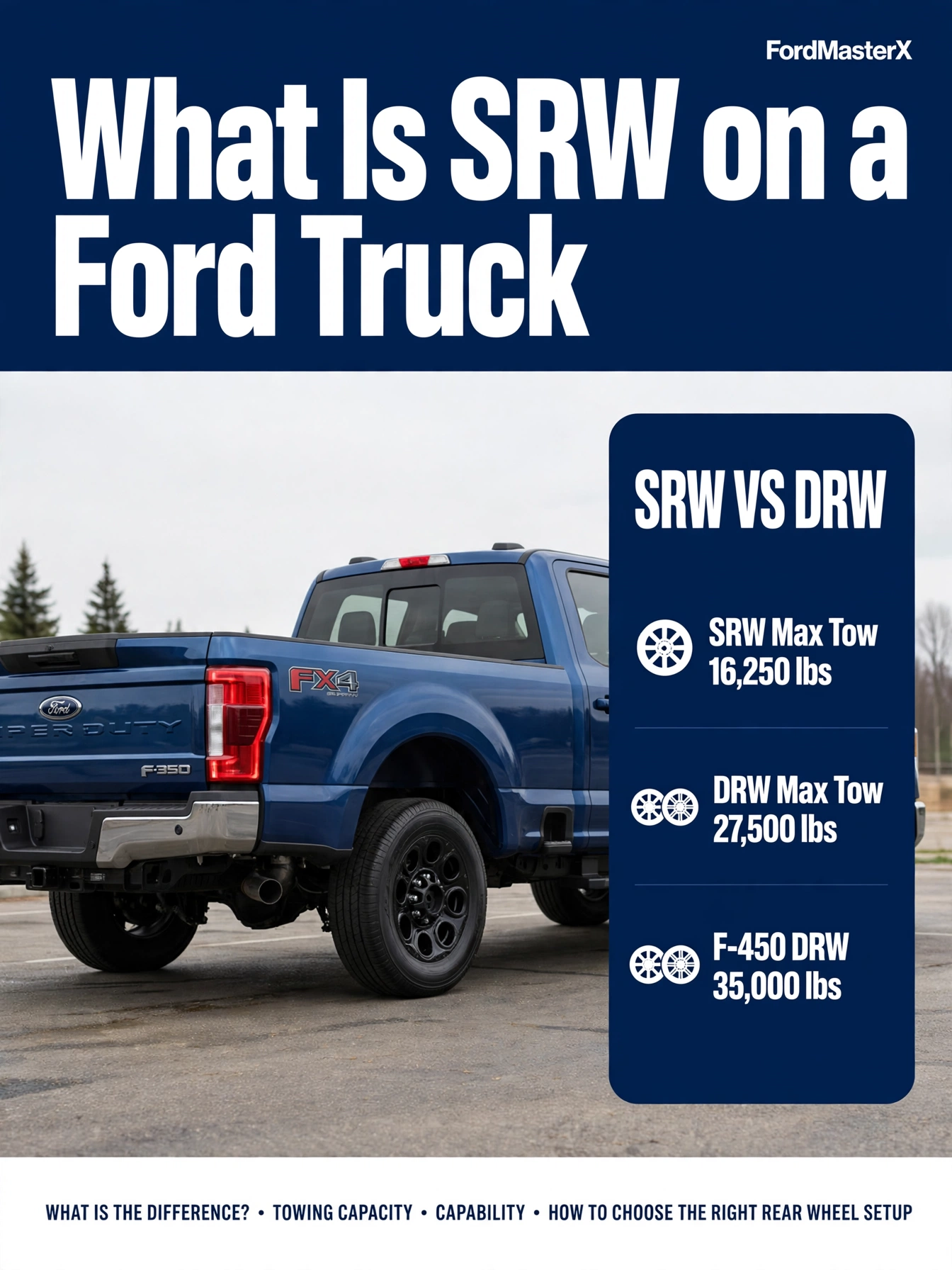
What Is SRW on a Ford Truck 2026? Complete Buying Guide

What is SRW on a Ford truck? SRW stands for single rear wheel, which means the truck has one wheel on each side of the rear axle, for four wheels in total.
You will see those three letters on window stickers, in towing charts, and in Super Duty brochures. They describe the rear axle layout, not an engine, a trim level, or a package.
The letters matter because the rear axle layout sets how much the truck can tow and carry. A dually, or DRW truck, spreads the same load over four rear tires instead of two, and that changes the ratings by thousands of pounds.
This guide explains what SRW means, how it differs from DRW, which Ford trucks offer each layout, and how to pick the right one for your trailer and your daily drive.
The Short Answer in 4 Facts
Four facts answer the question for most shoppers. The table below holds them, and the infographic after it gives you the same facts to save or share.
| Fact | What it means for your Ford |
|---|---|
| SRW means single rear wheel | One wheel on each side of the rear axle, four wheels in total |
| DRW means dual rear wheel | Two wheels on each side of the rear axle, six wheels in total, also called a dually |
| SRW tows less than DRW | Ford SRW trucks average about 16,250 lbs of max towing, while DRW trucks average about 27,500 lbs |
| DRW is Super Duty only | Ford offers DRW only on the F-250, F-350, and F-450, and the F-450 comes as DRW only |
SRW vs DRW At a Glance
The direct answer, the towing gap, and where each layout is sold, as observed in November 2026.
| Measure | SRW | DRW |
|---|---|---|
| Rear wheels | 2, one on each side | 4, two on each side |
| Total wheels | 4 | 6 |
| Average max towing, Ford | About 16,250 lbs | About 27,500 lbs |
| F-450 max towing | Not offered | Up to 35,000 lbs |
| Typical max payload | 3,000 to 4,000 lbs | 5,000 to 7,500 lbs |
| Width, F-350 | 80 inches | 96 inches |
| Sold on | F-150, F-250, F-350 | F-250, F-350, F-450 only |
Direct answer: SRW means single rear wheel. One wheel sits on each side of the rear axle, and the truck has four wheels in total. DRW adds a second wheel on each side, which raises towing and payload ratings.
Sources: SlashGear citing Ford, Westlie Ford, CJ Pony Parts, and Dorian Ford.
One fact on its own can mislead. Knowing that SRW means single rear wheel is not enough, because the same F-350 can tow far more as a dually than as an SRW truck.
The rest of this guide fills in the detail. You will see which Ford trucks offer each layout, what the towing numbers really mean, and how to spot the difference in a parking lot.
What SRW Means on a Ford Truck
SRW is short for single rear wheel. It describes a rear axle with one wheel mounted on each side, which is the layout on nearly every car, SUV, and light truck on the road.
On a Ford truck, SRW is the standard layout. Every F-150 is an SRW truck, and most F-250 and F-350 trucks on dealer lots are SRW too.
The letters show up in places where the rear axle matters. You will find SRW and DRW in towing guides, on build sheets, in parts catalogs, and on the door jamb label that lists axle and tire ratings.
How a Single Rear Wheel Axle Works
A single rear wheel axle carries the rear of the truck on two tires. Each axle shaft drives one wheel, and the weight of the bed, the payload, and the trailer tongue presses down through those two contact patches.
That simple layout keeps the truck lighter and narrower than a dually. It also keeps the parts count low, with two rear tires, two rear wheels, and one set of rear brakes to maintain.
What DRW Means by Comparison
DRW is short for dual rear wheel, and it means two wheels sit on each side of the rear axle. The truck has four rear wheels and six wheels in total, which is why most owners just call it a dually.
The extra wheels need a wider and stronger rear axle, plus flared fenders to cover the outer tires. That wider track is the whole point, because it spreads the load and steadies the truck under a heavy trailer.
A DRW truck is easy to spot once you know the look. The rear fenders bulge outward, the rear track looks much wider than the front, and the truck fills its lane in a way an SRW truck never does.
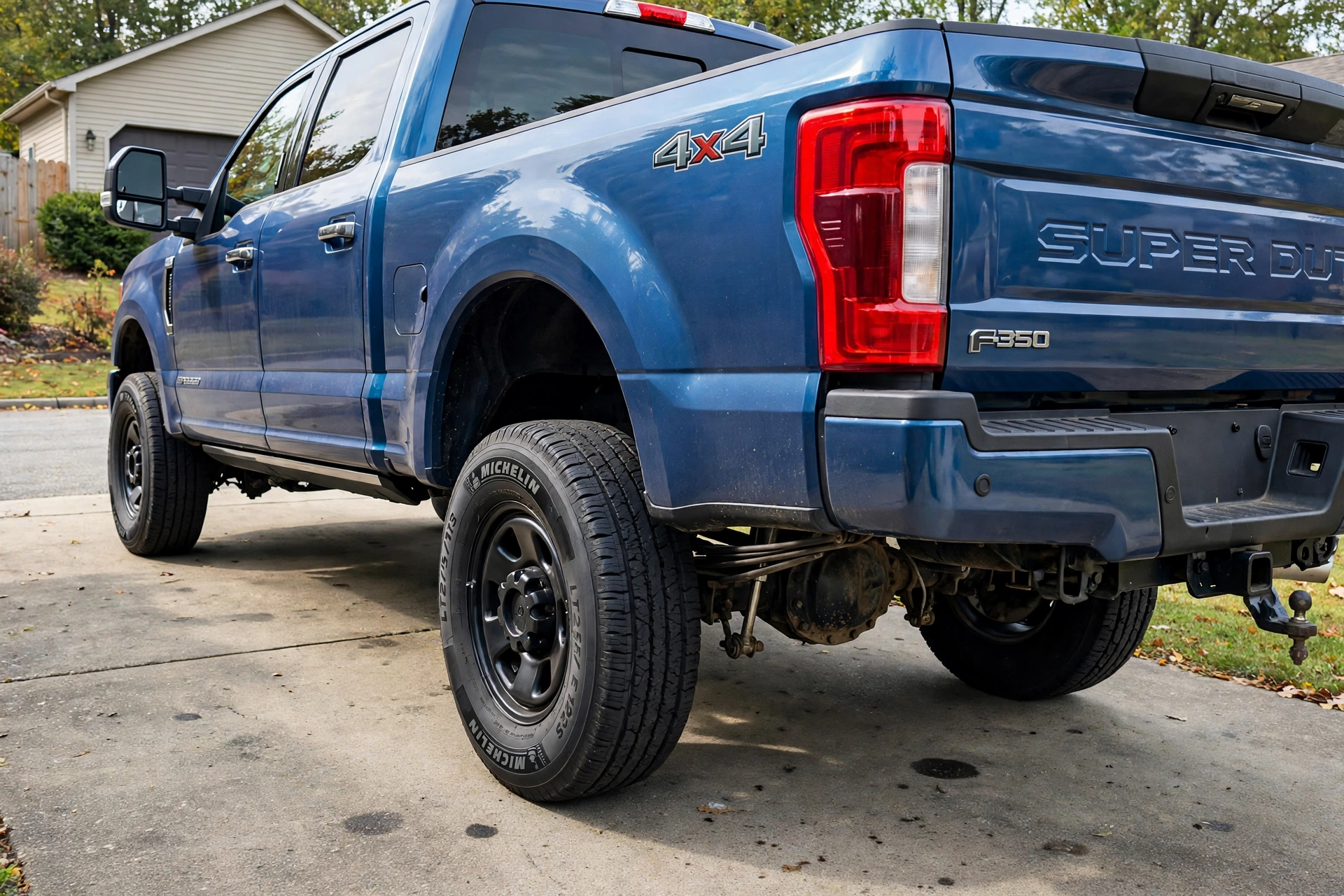
AI-generated illustration: a blue Ford F-350 Super Duty single rear wheel truck parked in a driveway showing one rear wheel on each side of the rear axle.
SRW vs DRW Side by Side
The two layouts look alike from the front, and the difference only shows at the rear axle. The table below lines them up so you can compare what changes and what stays the same.
| Feature | SRW | DRW |
|---|---|---|
| Rear wheels | 2 | 4 |
| Total wheels | 4 | 6 |
| Width, F-350 | 80 inches | 96 inches |
| Average max towing, Ford | About 16,250 lbs | About 27,500 lbs |
| Typical max payload | 3,000 to 4,000 lbs | 5,000 to 7,500 lbs |
| Ride quality when empty | Smoother on paved roads | Stiffer and firmer |
| Parking and tight turns | Fits standard spaces | Needs wider turns and wider spaces |
| Rear tires to replace | 2 | 4 |
| Best for | Daily driving and moderate towing | Heavy fifth wheel and gooseneck towing |
Width is the easiest difference to see. An F-350 SRW measures about 80 inches wide, while the DRW version measures about 96 inches, and our guide to how wide a dually truck is shows what that extra width means in real parking spaces.
Ride quality splits the same way. Westlie Ford notes that SRW trucks ride better on smooth roads, while DRW trucks feel stiffer when unloaded, because their springs and tires are built for loads the truck is not carrying yet.
The fuel and tire bill splits too. An SRW truck carries less weight and less rolling resistance, so it uses a little less fuel, and it needs two fewer tires at every replacement.
Which Ford Trucks Offer SRW and DRW
Ford does not offer DRW on every truck. The dual rear wheel option lives only in the Super Duty range, and one model in that range does not offer SRW at all.
| Ford truck | SRW available | DRW available | What to know |
|---|---|---|---|
| F-150 | Yes | No | SRW only, with max towing of about 13,500 lbs |
| F-250 | Yes | Yes | DRW versions tow over 18,000 lbs |
| F-350 | Yes | Yes | DRW versions tow up to 35,000 lbs with the right diesel |
| F-450 | No | Yes | DRW only, built for the heaviest fifth wheel and gooseneck loads |
The F-150 is the simplest case. It comes only with single rear wheels, so every F-150 you see is an SRW truck, and our Ford F-150 towing capacity chart lists what each engine and cab can pull.
The F-250 and F-350 are where the choice appears. Both trucks offer SRW and DRW, and the right pick depends on your trailer, so compare the F-350 trim levels and the Super Duty package comparison before you order.
The F-450 sits at the top and skips the choice entirely. It comes only as a dually, and our F-450 Super Duty Platinum guide shows what that flagship dually carries.
CJ Pony Parts lays out the same split in its SRW vs DRW guide. Its table shows the F-150 as SRW only, the F-250 and F-350 as both, and the F-450 as DRW only, with the F-450 rated to tow 35,000 lbs.
Towing and Payload: The Numbers That Matter
Towing is where SRW and DRW part ways. The two extra rear tires spread the load, raise the rear axle weight rating, and let Ford certify far higher trailer weights.
SlashGear, citing Ford, reports that Ford SRW trucks average about 16,250 lbs of maximum towing, while DRW trucks average about 27,500 lbs. That is a gap of about 11,250 lbs, and the DRW version of the F-450 can tow up to 35,000 lbs. Read the full figures in the SlashGear SRW and DRW explainer.
Westlie Ford gives the same picture as ranges. Its SRW vs DRW guide lists SRW towing at 15,000 to 17,500 lbs and DRW towing at 20,000 to 35,000 lbs, with payload at 3,000 to 4,000 lbs for SRW and 5,000 to 7,500 lbs for DRW.
Payload grows with the same step. SlashGear reports that the average maximum payload of a DRW truck runs about 56 percent higher than an SRW truck, which matters when the load sits in the bed rather than behind the bumper.
The 2026 F-350 shows how the gap looks on one model. Dorian Ford reports that an F-350 SRW with the high output diesel can tow up to 27,400 lbs conventionally.
The DRW version reaches 35,000 lbs, and maximum payload runs up to about 4,400 lbs for SRW against 8,000 lbs for DRW. See the full 2026 figures in the Dorian Ford 2026 F-350 SRW and DRW overview.
The reason sits in the rear axle rating. The same source lists F-350 SRW rear axle weight ratings at 6,780 to 7,230 lbs, while DRW rear ratings jump to 9,900 to 10,300 lbs, so the dually can legally carry far more weight over its rear tires.
Treat every number here as a maximum for a properly equipped truck, not a promise for the truck on the lot. Cab size, bed length, axle ratio, engine, and packages all move the rating, so check the door jamb label and the towing guide for your exact truck before you hitch up.
If you tow heavy with a dually, the trailer setup matters as much as the truck. Our F-350 dually towing and hauling guide walks through the limits by configuration, and the right hitch is part of that setup.
How to Tell SRW from DRW at a Glance
You can tell the two layouts apart in seconds once you know where to look. Walk to the rear of the truck and count the wheels, then check the fenders and the roof.
Count the Rear Wheels
The fastest check is the wheel count. An SRW truck shows one rear wheel on each side, while a dually shows two wheels bolted together on each side, with the outer wheel easy to spot.
Look from behind the truck at a slight angle. The inner and outer dually wheels sit close together, and you can see the seam between them, plus the wider stance of the pair.
Look at the Fenders and the Width
A dually wears wide rear fenders that flare out over the outer tires. An SRW truck has flat rear fenders that sit close to the body, with no flare at all.
The width follows the fenders. An F-350 SRW is about 80 inches wide without mirrors, while the DRW version is about 96 inches, so a dually fills a lane and a parking space in a way an SRW truck never does.
Check the Roof Marker Lamps
Most dually trucks carry a row of small amber clearance lamps on the roof. Federal rules require them on wide vehicles, so the lamps are a strong hint that the truck is a DRW model.
An SRW truck can have roof lamps too, so do not use them alone. Pair the lamps with the wheel count and the fender shape, and the answer is certain.
Read the Door Jamb Label
The sure check is the label on the driver door jamb. It lists the rear gross axle weight rating, the tire size, and the tire load rating, and the DRW numbers run far higher than the SRW numbers.
The label also settles the tire question. A dually lists four rear tires with a lower load rating each, while an SRW truck lists two rear tires that each carry more of the load.
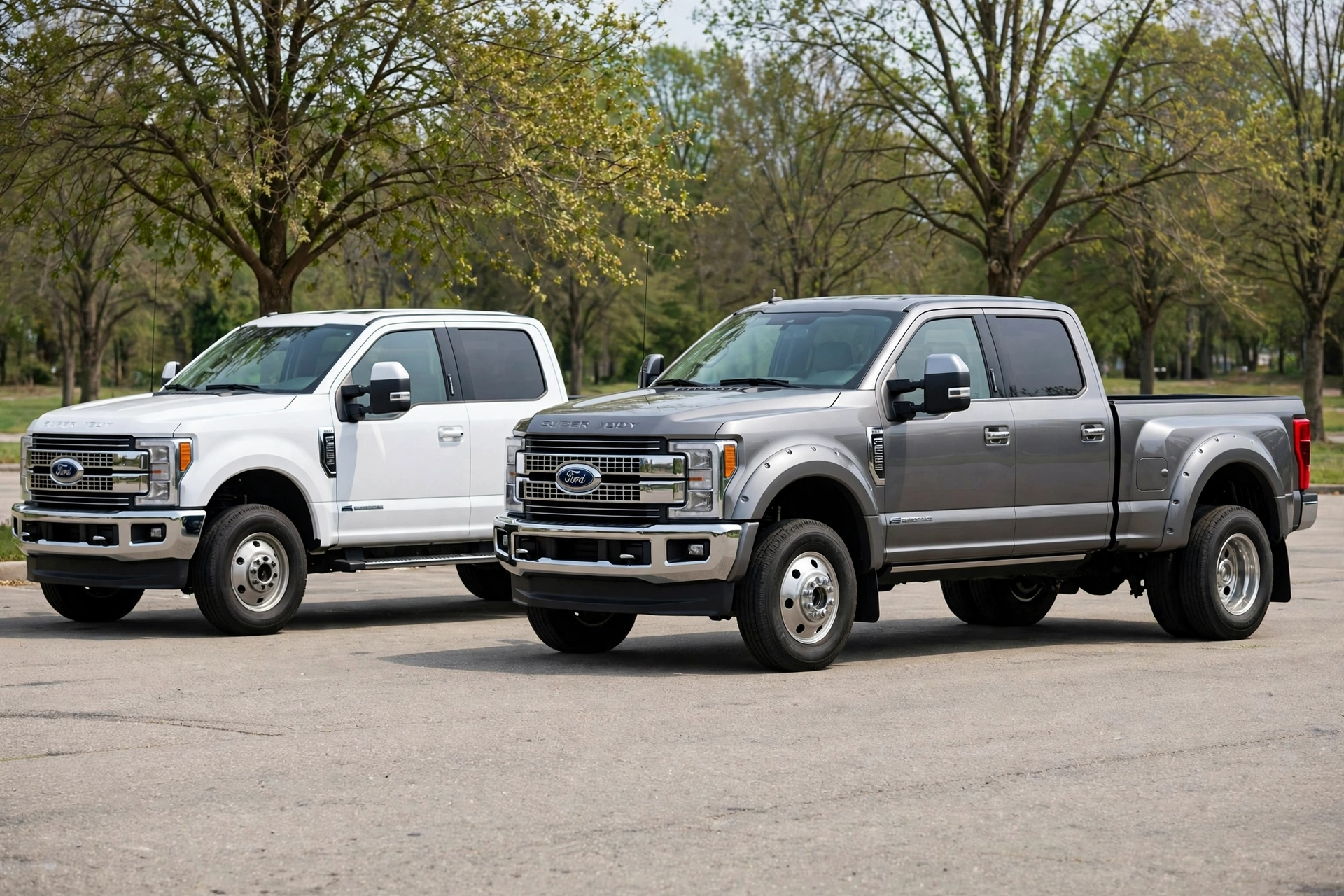
AI-generated illustration: a white Ford F-350 single rear wheel truck parked beside a gray Ford F-350 dually with wide fender flares showing the width difference.
Daily Driving: Where SRW Wins
Most Super Duty trucks spend most of their life unloaded, and that is where SRW earns its keep. The narrower body, the lighter rear axle, and the softer ride add up every day.
Parking is the first win. An SRW truck fits standard parking spaces, drive-through lanes, and home garages that a 96 inch wide dually cannot enter without a fight.
The ride is the second win. With fewer rear tires and springs tuned for a lighter rear axle, an SRW truck rides smoother on paved roads when the bed is empty.
Running costs are the third win. Two rear tires cost less to replace than four, and the lighter axle and narrower body help fuel economy a little, so CJ Pony Parts notes that SRW owners save on both gas and tires.
Tire choice matters on either layout, and the wrong tire hurts both ride and towing. Our guide to tires for the F-250 Super Duty 4×4 covers sizes and load ratings for heavy duty trucks.
Where a Dually Earns Its Keep
A dually earns its keep the moment the trailer gets heavy. Four rear tires give the truck a wider base, more grip, and more stability when a big trailer starts to sway.
Fifth wheel and gooseneck trailers are the classic case. The hitch sits over the rear axle, the pin weight presses straight down on it, and the dual wheels share that weight across four tires instead of two.
Wind is the second case. A tall travel trailer or enclosed hauler catches crosswinds like a sail, and the wide rear track of a dually keeps the combination steadier than an SRW truck.
Heavy bed loads are the third case. A truck camper, a loaded service body, or a bed full of stone pushes the rear axle rating, and the dually rear axle rating runs thousands of pounds higher.
The hitch is part of the system, and the wrong hitch wastes the dually advantage. Our guide to the best fifth wheel hitch for the Ford puck system ranks the hitches that fit Super Duty beds.
What SRW vs DRW Costs to Own
A dually costs more to buy and more to keep. The gap starts at the dealer and continues every time you buy tires.
Westlie Ford lists new F-250 SRW trucks at about 40,000 to 60,000 dollars, with DRW versions at about 45,000 to 65,000 dollars. The dual rear axle, wider fenders, and heavier rear axle all add cost, and the gap grows with trim level.
Tires are the running cost that never goes away. A dually needs four rear tires instead of two, so every replacement set costs roughly half again as much at the rear, and rotations take longer.
Fuel is a smaller gap, but it is real. The wider body and heavier axle add drag and weight, so a dually usually drinks a little more fuel than the same truck as an SRW.
Resale cuts the other way for the right buyer. SRW trucks are easier to find and appeal to more buyers, while a dually holds its value best with buyers who tow heavy and need the ratings only a dually offers.
Should You Buy SRW or DRW?
The right answer starts with your trailer, not with the truck. Work out the heaviest load you will tow or carry, then pick the layout whose ratings cover it with room to spare.
- Weigh your heaviest trailer. Find the loaded weight of the biggest trailer you will tow, then add the gear, water, and fuel you carry in it.
- Check the payload you need. Add passengers, bed cargo, and the trailer tongue or pin weight, then compare the total with the payload rating on the door jamb label.
- Measure your parking. Check your garage, your driveway, and the tightest lot you use every week, and make sure a 96 inch wide truck fits.
- Count your towing days. If you tow heavy most weekends, the dually pays for itself, but if you tow twice a year, the SRW truck is the better daily driver.
- Test drive both layouts. Drive an SRW and a DRW truck over the same roads, park both, and pick the one that fits your life when the trailer is unhitched.
The rule of thumb is simple. If your trailer stays under about 16,000 lbs and your payload stays modest, an SRW truck does the job with less hassle, but if you tow a large fifth wheel or carry a truck camper, buy the dually.
SRW Maintenance and Tire Care
An SRW truck is simpler to maintain than a dually, but the basics still matter. The rear tires carry the load, so their pressure, tread, and torque settings deserve regular checks.
Rotation is the first job. An SRW truck rotates in the standard front to rear pattern, while a dually needs a six tire pattern, so our guide to rotating tires on a dually shows how the extra pair changes the job.
Tire pressure is the second job. Check the door jamb label for the loaded pressure, run the rears higher when you tow, and drop them back when the bed is empty so the ride stays smooth.
Lug nut torque is the third job, and it matters most after any wheel work. Our F-350 lug nut torque guide by year lists the torque values for single and dual rear wheel trucks, so check your year before you tighten.
Watch the rear axle seals and the differential for leaks. A small leak left alone can starve the bearings, and a dually hides the inner wheel so well that a leak can go unnoticed longer.
Questions Ford Owners Ask About SRW
What Does SRW Mean on a Ford Truck?
SRW means single rear wheel. The truck has one wheel on each side of the rear axle, for four wheels in total, and it is the standard layout on the F-150 and on most F-250 and F-350 trucks.
Is SRW Better Than DRW?
Neither layout is better in every case. SRW is better for daily driving, parking, ride comfort, and tire costs, while DRW is better for heavy towing, payload, and stability with a big trailer.
Can an SRW Truck Tow a Fifth Wheel?
Yes, an SRW truck can tow a fifth wheel, as long as the trailer weight and pin weight sit inside the truck ratings. Check the loaded trailer weight against the towing chart, and check the pin weight against the payload rating on the door jamb label.
Why Is the F-450 Only DRW?
The F-450 is built for the heaviest fifth wheel and gooseneck loads Ford rates, and those loads need the rear axle rating only a dually provides. Ford sells it as DRW only, so there is no SRW version to order.
Does SRW Affect Fuel Economy?
Yes, a little. An SRW truck is lighter and narrower than the same truck as a dually, so it uses a little less fuel, but the engine and axle ratio matter far more than the wheel layout.
How Wide Is an SRW F-350?
An F-350 SRW is about 80 inches wide without mirrors. The DRW version is about 96 inches wide, which is why a dually needs wider parking spaces and wider turns.
Can You Convert an SRW Truck to DRW?
Aftermarket kits exist, but a conversion is not a factory DRW truck. The axle, fenders, brakes, and ratings all differ, so a converted truck will not carry the factory dually ratings or the factory warranty coverage for that layout.
Your 5 Step Check Before You Choose SRW or DRW
What is SRW on a Ford truck? It means single rear wheel, one wheel on each side of the rear axle, and it is the layout that fits most Ford truck owners most of the time.
Run the five step check before you choose. Weigh your heaviest trailer, add up your payload, measure your parking, count your towing days, and test drive both layouts on the same roads.
That check costs you an afternoon. It keeps you from buying a dually you will curse in every parking lot, and it keeps you from buying an SRW truck that cannot legally tow the trailer you already own.