2004 Ford F-250 Fuse Box Diagram: Every Fuse and Amp Rating

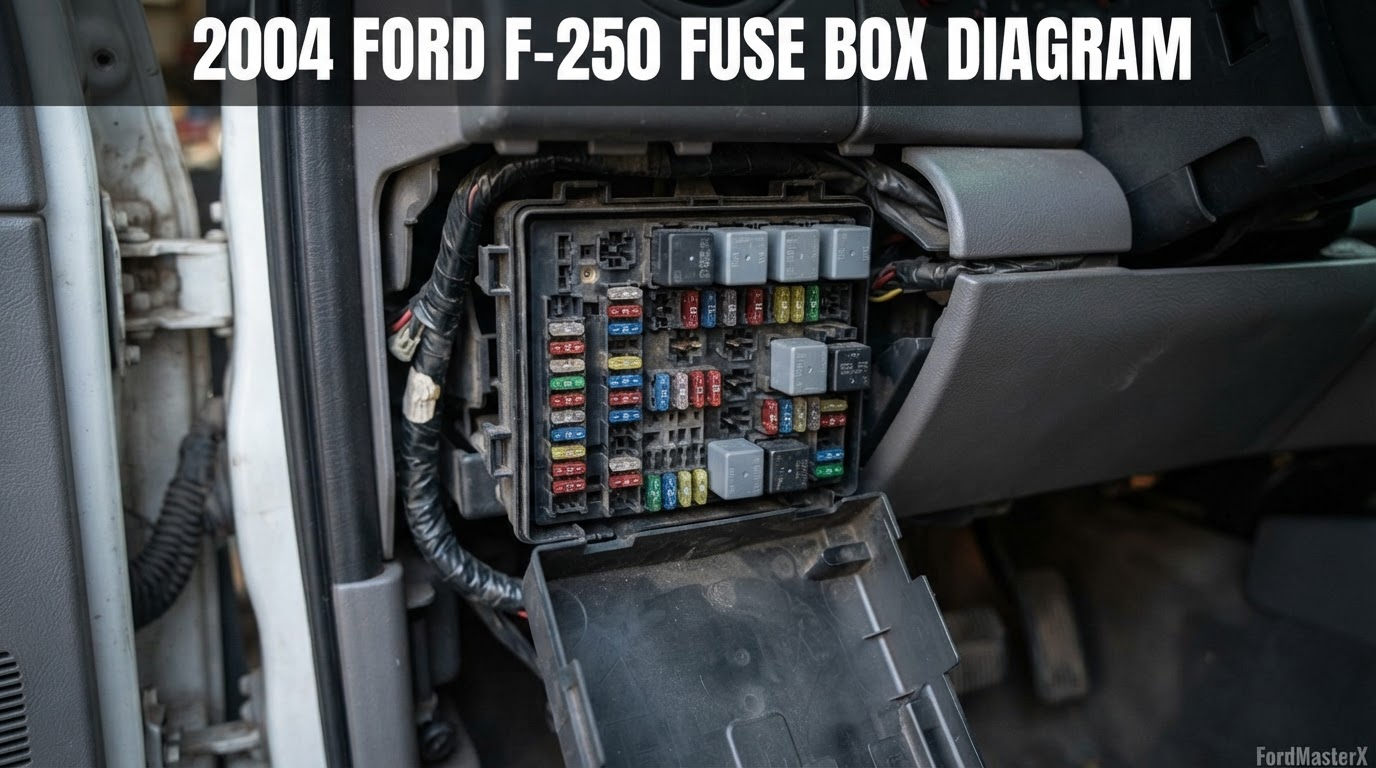
Your 2004 Ford F-250 has two fuse boxes. The main panel is inside the cab, below and to the left of the steering wheel, by the brake pedal. A power distribution box sits in the engine bay, driver side rear corner, near the battery.
The cigar lighter and 12-volt outlet run through fuse 12, rated 20A, the same position it has held since 2002.

Prime for Young Adults — 6 Months Free
Students and 18–24s get six months of Prime free, then half price.
Start 6 Months Free As an Amazon Associate I earn from qualifying purchases.Most combined “2002 to 2007” fuse charts show you one blended table. Your truck is not the same as a 2002 or a 2006 at five separate fuse positions. The 6.0L Power Stroke diesel that arrived this model year changed what some of those positions actually do.
Skip to what changed since 2002 if that is why you are here.
Where are the fuse boxes on a 2004 F-250?
Recommended Best Deal Products


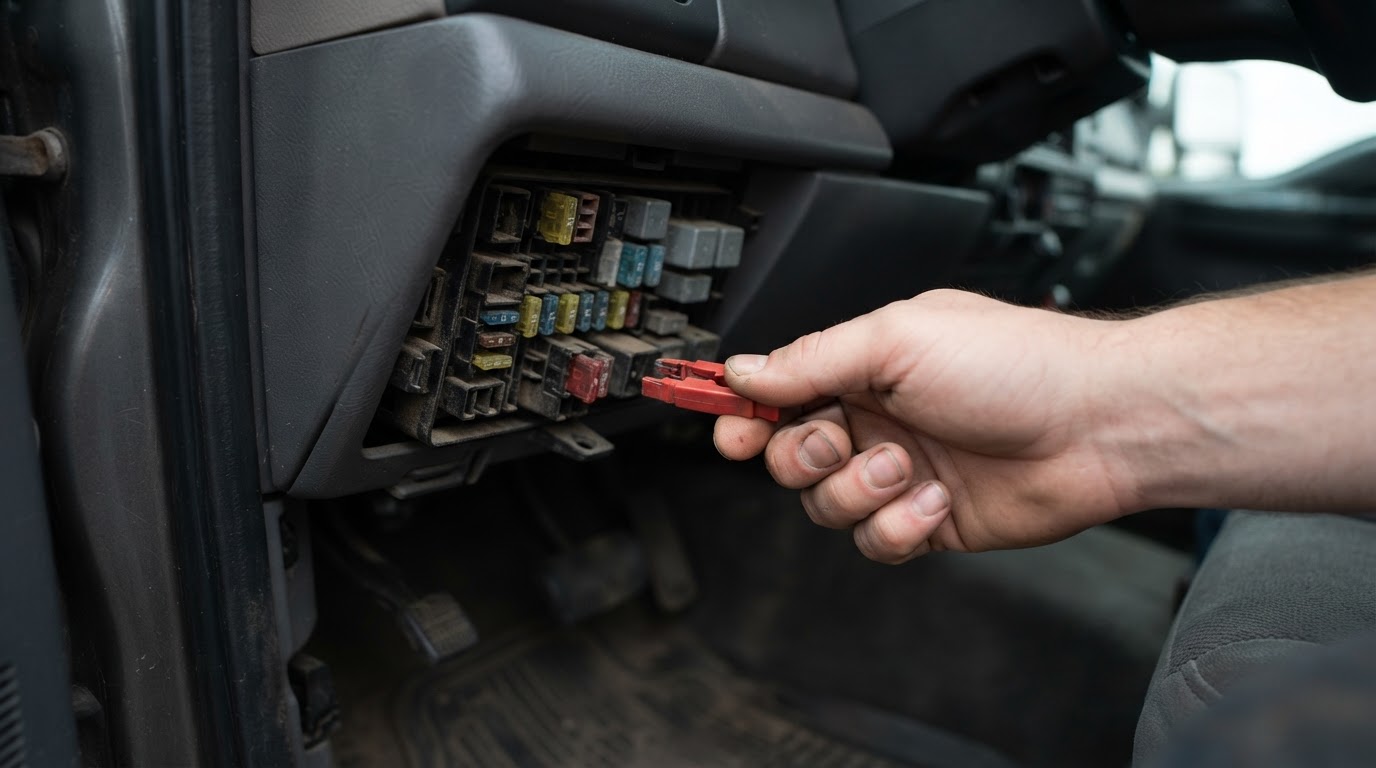
Passenger compartment fuse panel. Driver side, below and left of the steering wheel, by the brake pedal. A plastic cover pulls off by hand.
Everything numbered 1 through 48, plus relays 210, 212 and 301 through 307, lives in this one box.
Power distribution box. Engine compartment, driver side rear corner, near the battery and the brake master cylinder. This holds the high-current fuses 101 through 116, the 601 circuit breaker and the 602 maxi fuse.
Your truck also carries four smaller auxiliary relay clusters in the engine bay. They hold no fuses of their own, and are covered further down. A generic chart that only shows two boxes misses them entirely.
Worth knowing: the box cover on your specific truck has a label printed on the underside. Trim level, engine and production date all move things around in ways a website cannot see. That label is the final authority.
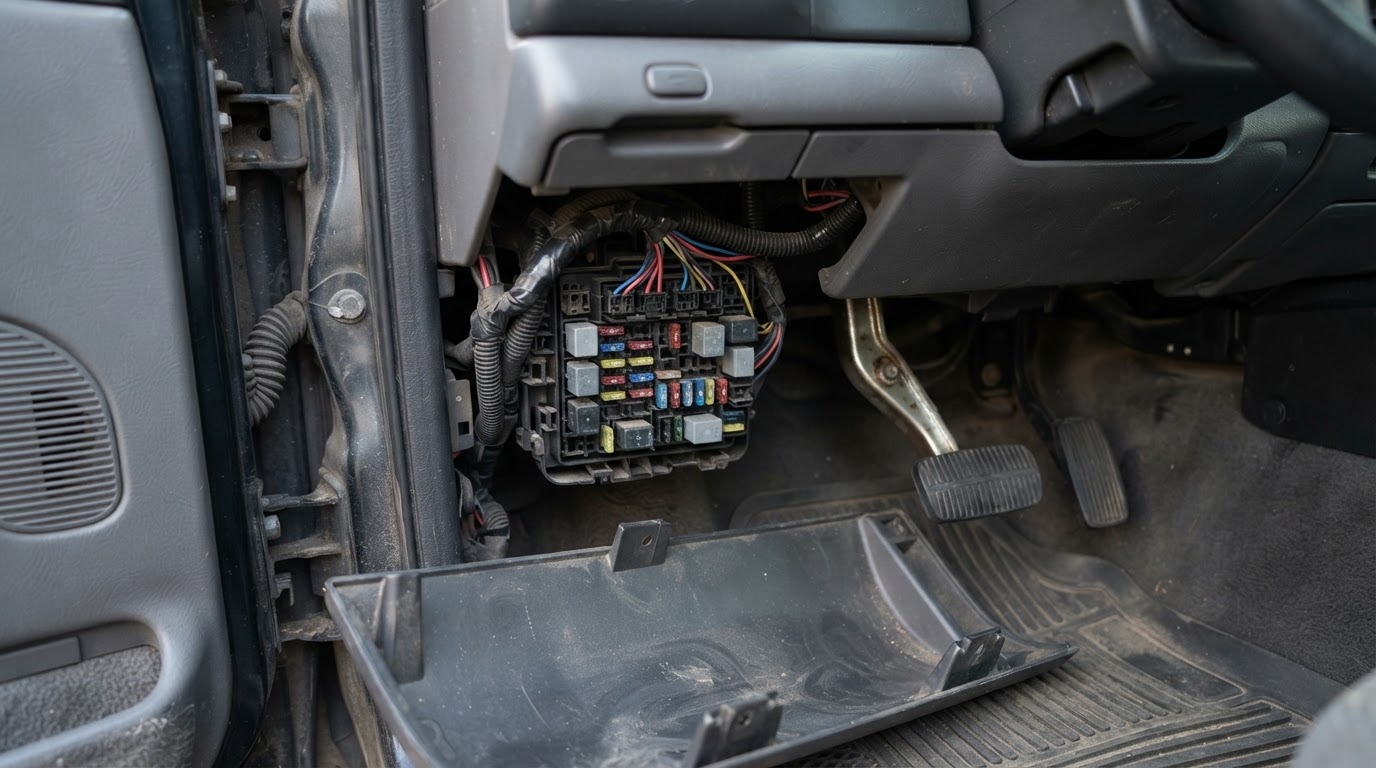
Passenger compartment fuse chart: fuses 1 to 48
The chart below comes from the 2004 Ford F-250 Owner’s Manual, cross-checked against two independent year-specific sources. All three agree on every value listed.
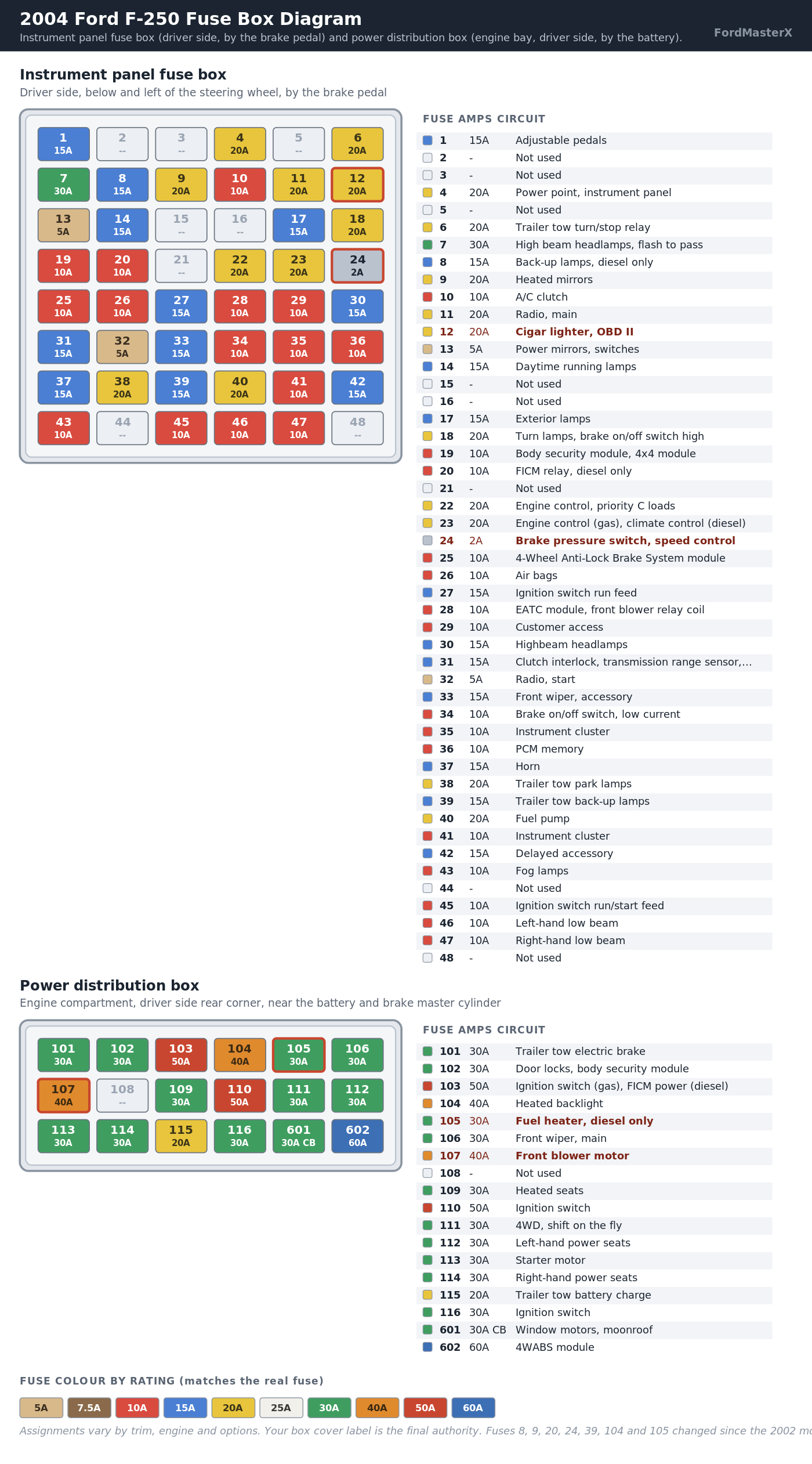
| Fuse | Amps | Circuit protected |
|---|---|---|
| 1 | 15A | Adjustable pedals |
| 2 | – | Not used |
| 3 | – | Not used |
| 4 | 20A | Power point, instrument panel |
| 5 | – | Not used |
| 6 | 20A | Trailer tow turn/stop relay |
| 7 | 30A | High beam headlamps, flash to pass |
| 8 | 15A | Back-up lamps, diesel engine only |
| 9 | 20A | Heated mirrors |
| 10 | 10A | A/C clutch |
| 11 | 20A | Radio, main |
| 12 | 20A | Cigar lighter, OBD II |
| 13 | 5A | Power mirrors, switches |
| 14 | 15A | Daytime running lamps |
| 15 | – | Not used |
| 16 | – | Not used |
| 17 | 15A | Exterior lamps |
| 18 | 20A | Turn lamps (flasher), brake on-off switch, high current side |
| 19 | 10A | Body security module, 4×4 module |
| 20 | 10A | FICM relay, diesel engine only |
| 21 | – | Not used |
| 22 | 20A | Engine control, priority C loads |
| 23 | 20A | Engine control, gasoline, or climate control, diesel |
| 24 | 2A | Brake pressure switch, speed control |
| 25 | 10A | 4-Wheel Anti-Lock Brake System module |
| 26 | 10A | Air bags |
| 27 | 15A | Ignition switch, run feed |
| 28 | 10A | EATC module, front blower relay coil |
| 29 | 10A | Customer access |
| 30 | 15A | High beam headlamps |
| 31 | 15A | Clutch interlock (manual) or transmission range sensor (automatic), starter relay, 4×4 |
| 32 | 5A | Radio, start |
| 33 | 15A | Front wiper, accessory |
| 34 | 10A | Brake on-off switch, low current side |
| 35 | 10A | Instrument cluster |
| 36 | 10A | PCM memory |
| 37 | 15A | Horn |
| 38 | 20A | Trailer tow park lamps |
| 39 | 15A | Trailer tow back-up lamps |
| 40 | 20A | Fuel pump |
| 41 | 10A | Instrument cluster |
| 42 | 15A | Delayed accessory |
| 43 | 10A | Fog lamps |
| 44 | – | Not used |
| 45 | 10A | Ignition switch, run/start feed |
| 46 | 10A | Left-hand low beam headlamp |
| 47 | 10A | Right-hand low beam headlamp |
| 48 | – | Not used |
Fuse assignments vary by trim, cab style and engine: 5.4L, 6.8L V10, or 6.0L Power Stroke diesel. Your truck may not use every position listed.
Power distribution box chart: fuses 101 to 602
Recommended Best Deal Products


The engine bay box carries the high-current circuits. Same three sources agree on every value here too.

Audible — Listen Free for 30 Days
One free credit a month and thousands of titles included.
Listen Free for 30 Days As an Amazon Associate I earn from qualifying purchases.| Fuse | Amps | Circuit protected |
|---|---|---|
| 101 | 30A | Trailer tow electric brake |
| 102 | 30A | Door locks, body security module |
| 103 | 50A | Ignition switch, gasoline, or FICM power, diesel |
| 104 | 40A | Heated backlight |
| 105 | 30A | Fuel heater, diesel engine only |
| 106 | 30A | Front wiper, main |
| 107 | 40A | Front blower motor |
| 108 | – | Not used |
| 109 | 30A | Heated seats |
| 110 | 50A | Ignition switch |
| 111 | 30A | 4WD, shift on the fly |
| 112 | 30A | Left-hand power seat |
| 113 | 30A | Starter motor |
| 114 | 30A | Right-hand power seat |
| 115 | 20A | Trailer tow battery charge |
| 116 | 30A | Ignition switch |
| 601 | 30A circuit breaker | Window motors, moonroof |
| 602 | 60A | 4-Wheel Anti-Lock Brake System module |
Position 601 is a resettable breaker, not a fuse. If your windows die and come back a minute later, the breaker tripped and reset itself. Look for a binding window regulator or a motor pulling too much current.
What changed since 2002, and why five “not used” positions are not actually empty on your truck
Ford sold the 2004 F-250 with the 6.0L Power Stroke diesel. It began phasing that engine in during the 2003 model year, while finishing out the last 7.3L Power Stroke trucks.
That swap changed what two fuse positions actually do. A combined “2002 to 2007” chart tends to flatten it out.
Five positions that most 2002-specific charts mark “not used” are assigned on your 2004 truck. Fuse 8 covers diesel back-up lamps, fuse 9 covers heated mirrors, and fuse 20 covers the FICM relay.
Fuse 39 covers trailer tow back-up lamps, and fuse 104 covers the heated backlight. None of these are wiring errors or a bad chart. They are genuine additions tied to feature and engine changes between the two model years.
Fuse 105 is the one worth slowing down on. On a 2002 truck with the 7.3L Power Stroke, this 30A position feeds the Injector Driver Module. That module is the control unit for that engine’s injectors.
Your 2004 truck’s 6.0L Power Stroke uses a Fuel Injection Control Module instead. It draws power through fuse 103, alongside the ignition switch circuit. That change freed fuse 105 for a different job.
Fuse 105 now feeds the fuel heater, which keeps diesel from gelling in cold weather. Same position, same amperage, a different circuit. The engine underneath it is what changed.
| Fuse | 2002 F-250 (7.3L diesel era) | 2004 F-250 (6.0L diesel) |
|---|---|---|
| 24 | Disputed: not used, or 15A rear air suspension | 2A, brake pressure switch and speed control |
| 105 | 30A, Injector Driver Module, diesel only | 30A, fuel heater, diesel only |
| 8, 9, 20, 39, 104 | Not used | Assigned: diesel back-up lamps, heated mirrors, FICM relay, trailer back-up lamps, heated backlight |
Fuse 24 is the clearest example of why a year-specific source matters here. Sources that only ever covered 2002 disagreed with each other. Some called it unused, others tied it to an optional rear air suspension.
Three sources reading the 2004 Owner’s Manual directly agree on 2A for the brake pressure switch and speed control circuit. None disagree. If your combined chart still shows that old dispute, it has not actually looked at your model year.
Audible Premium Plus — Annual Membership
12 audiobook credits up front, plus the full Audible catalogue.
See Annual Plans As an Amazon Associate I earn from qualifying purchases.2004 F-250 symptom to fuse guide
Recommended Best Deal Products

Readers usually arrive with a symptom, not a fuse number. This maps the common ones.
| What is not working | Check this fuse |
|---|---|
| Cigar lighter or 12V outlet dead | 12, 20A |
| Radio completely dead, no display | 11, 20A |
| Radio silent but display works | 32, 5A |
| No air movement at any blower speed | 107, 40A, or relay 301 |
| Climate control panel dead | 28, 10A |
| Heated seats not working | 109, 30A |
| Heated mirrors not working | 9, 20A |
| Trailer running or park lamps dead | 38, 20A |
| Trailer back-up lamps dead | 39, 15A |
| Trailer electric brakes not working | 101, 30A |
| Trailer battery will not charge while towing | 115, 20A |
| 4×4 will not shift on the fly | 111, 30A |
| Power windows or moonroof dead | 601, 30A breaker |
| ABS warning light on | 25, 10A, or 602, 60A |
| No crank, no start | 113, 30A, or 45, 10A |
| Diesel hard start or no start, FICM related | 20, 10A, or 103, 50A |
| Cruise control will not engage | 24, 2A |
| Horn will not sound | 37, 15A |
| Fuel gelling in cold weather, heater not working | 105, 30A |
| Rear window defroster dead | 104, 40A |
| Front wiper dead | 33, 15A, or 106, 30A |
How do you tell if a fuse is actually blown?
Pull it and look through the plastic window at the metal strip inside. An intact fuse has an unbroken strip. A blown one shows a visible gap, or the window is smoked dark.
A hairline break is easy to miss. Hold the fuse up to a light, or test continuity with a multimeter set to ohms. Near zero resistance means the fuse is good.
Never guess the replacement rating. Match the number printed on the old fuse and cross-check your box cover label.
A higher rated fuse lets the wiring become the fuse. That costs far more to fix than a blown fuse ever does.
A cheap fuse assortment kit covers both mini and maxi sizes on this truck. It costs less than one dealer fuse. Any brand meeting the ATO/ATC standard fits.
Why does the same fuse keep blowing?
A fuse that blows once is usually a one-off surge. One that blows again within days is telling you something is wrong upstream.
Unplug whatever you most recently added. Trailer wiring, a brake controller, an aftermarket radio, a phone charger left in the 12V socket at fuse 12. Aftermarket accessories cause most repeat blows on these trucks.
Look for chafed insulation where the harness moves. Door jambs, tailgate wiring and anything routed near the steering column flex thousands of times over a truck’s life.
Check for water intrusion. A wet connector shorts intermittently, which is why the fuse survives a dry week and fails in the rain.
If a fuse blows the instant you push it in, that circuit has a hard short. Stop replacing fuses and trace the wiring with a proper diagnostic tool instead of guessing.
A parasitic draw that drains the battery overnight is a different problem from a blown fuse. It needs a different test. If your truck is dying between drives, start with a battery health check before chasing the wiring.
What is in the auxiliary relay clusters?
Your truck carries four small relay clusters in the engine bay that hold no fuses of their own. A chart that only shows the two main boxes misses these entirely.
- Behind the center of the dash: auxiliary A/C relay, indicator flasher relay.
- Left rear corner, cluster one: daytime running lamp relays and a park brake relay.
- Left rear corner, cluster two: transfer case low-to-high and high-to-low shift relays.
- Left rear corner, cluster three: A/C clutch relay and the trailer tow left and right turn relays. On diesel trucks this cluster adds a 15A FICM logic fuse and the FICM power relay. A gasoline truck does not carry either one.
If your transfer case will not shift between 2WD and 4WD electronically, check fuse 111 first. If that fuse tests fine, the shift relays in cluster two are next.
2004 F-250 fuse quick reference
The fuses owners look up most, in one place.
| What you want | Fuse | Amps |
|---|---|---|
| Cigar lighter, 12V outlet | 12 | 20A |
| Instrument panel power point | 4 | 20A |
| Radio, main | 11 | 20A |
| Blower motor | 107 | 40A |
| A/C clutch | 10 | 10A |
| Fuel pump | 40 | 20A |
| Horn | 37 | 15A |
| Starter motor | 113 | 30A |
| Heated seats | 109 | 30A |
| Power windows, moonroof | 601 | 30A breaker |
| Trailer electric brakes | 101 | 30A |
| 4WD, shift on the fly | 111 | 30A |
| Speed control, brake pressure switch | 24 | 2A |
| Fuel heater, diesel | 105 | 30A |
Not sure your truck matches this exactly? Compare it against the 2002 Ford F-250 fuse box diagram for the generation before the diesel change. Or check the 2008 Ford F-250 fuse box diagram for the panel that replaced this one.
The 1999 Ford F-250 and 2003 Ford F-250 pages cover the years in between. If swapping a fuse twice has not fixed a repeat failure, the problem is upstream. Our F-250 fuse box diagnosis guide walks through tracing the circuit itself.