
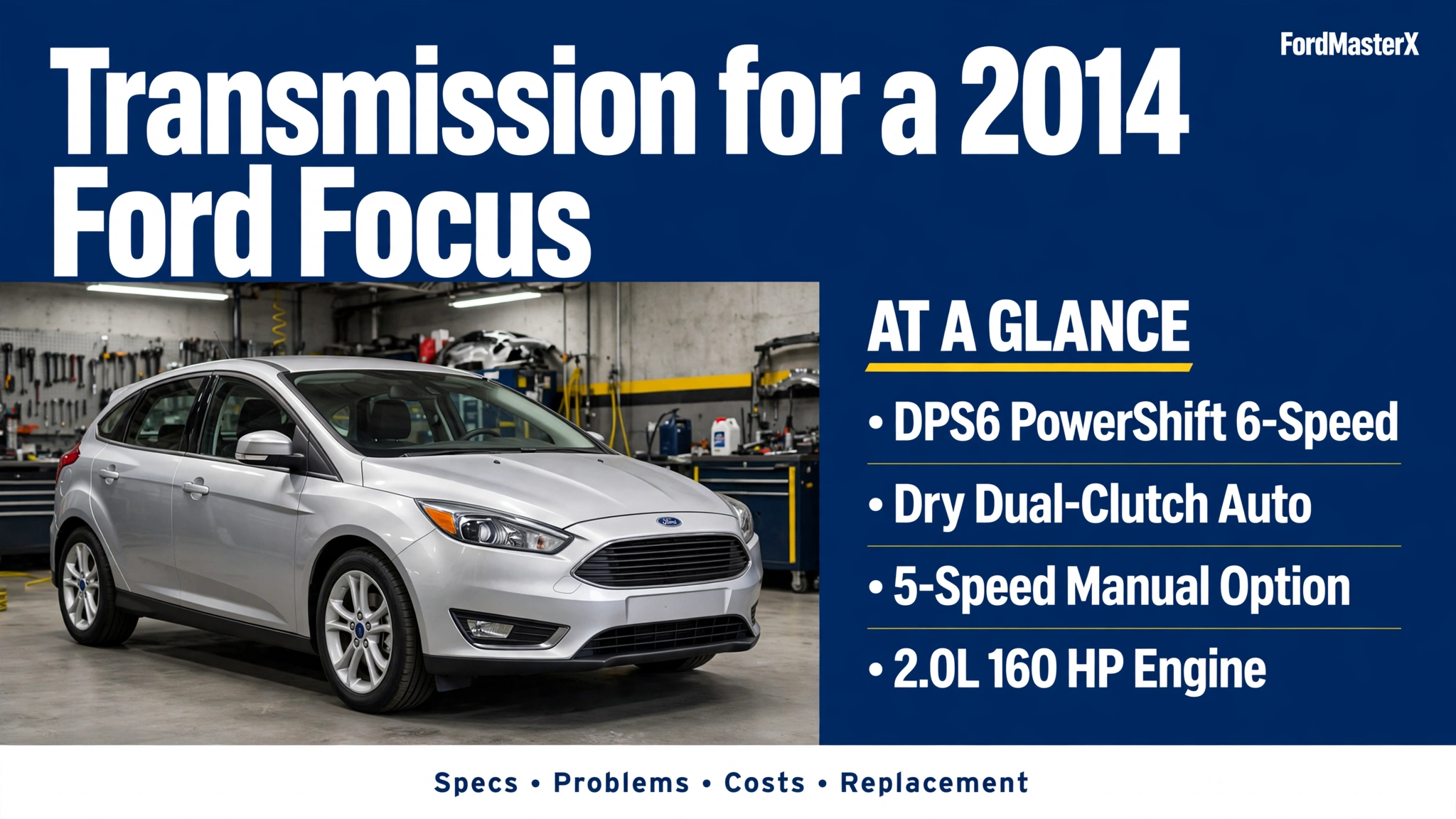
Transmission for a 2014 Ford Focus 2026 Essential Guide

The transmission for a 2014 Ford Focus is either the DPS6 PowerShift 6-speed dual-clutch automatic or a 5-speed manual. Most 2014 Focus cars on the road have the DPS6 automatic, while the manual is standard on the S and SE trims.
That one fact shapes almost every buying and repair decision for this car. The DPS6 is efficient and quick shifting when it works, but it has a well documented history of shudder, clutch wear, and control module failure.


This guide gives you the full picture. You will learn which transmission your car has, the exact specs, how to tell the two apart, the common problems, the warranty cover that applied, and what a repair or a replacement should cost.
Use it before you buy a used 2014 Focus, before you approve a repair, or before you decide whether your car is worth a new transmission.
The Short Answer in 5 Facts


Five facts answer most questions about the transmission for a 2014 Ford Focus. The table below holds them, and the infographic after it gives you the same facts to save or share.
| Fact | What it means for you |
|---|---|
| Automatic | DPS6 PowerShift 6-speed dual-clutch automatic with dry clutches |
| Manual | 5-speed manual, standard on S and SE, optional on Titanium |
| Engine | 2.0L Ti-VCT four cylinder, 160 hp and 146 lb-ft of torque |
| Known weak point | Clutch shudder and TCM failure on the DPS6 automatic |
| Replacement range | About 3,000 to 7,000 dollars installed, depending on the unit and the shop |
2014 Ford Focus Transmission At a Glance
The type, the specs, and the cost range, as observed in November 2026.
| Measure | Observed figure | Result |
|---|---|---|
| Automatic transmission | DPS6 PowerShift, 6-speed dual-clutch, dry clutches | Most 2014 Focus cars have this unit |
| Manual transmission | 5-speed manual, standard on S and SE | The simpler and more durable choice |
| Engine | 2.0L Ti-VCT, 160 hp, 146 lb-ft | Same engine with either transmission |
| Fuel economy, automatic | 27 mpg city, 37 mpg highway | EPA estimate for the DPS6 car |
| Clutch cover, 14M01 | 7 years or 100,000 miles | Expired for most 2014 cars by time |
| TCM cover, 14M02 | 10 years or 150,000 miles | Expired for most 2014 cars by time |
| Replacement, installed | About 3,000 to 7,000 dollars | Used is cheapest, new is dearest |
Direct answer: A 2014 Ford Focus has the DPS6 PowerShift 6-speed dual-clutch automatic or a 5-speed manual. Check the VIN before you buy or repair, because the two transmissions have very different problems and costs.
Sources: Edmunds 2014 Ford Focus review; Ford PowerShift transmission overview; Ford Customer Satisfaction Programs 14M01 and 14M02. Costs are US averages and vary by region, shop, and unit type.
The DPS6 is not a conventional automatic. It has no torque converter, and it shifts more like two manual gearboxes working together than like a normal automatic.
That design is the reason for both its fuel economy and its problems. Dry clutches save fuel and weight, but they are less forgiving in stop and go traffic than a fluid filled torque converter.
Which Transmission Does a 2014 Ford Focus Have
Most regular 2014 Ford Focus sedans and hatchbacks came with one of two transmissions. The answer depends on the trim and on what the first buyer ordered, so never guess from the year alone.
The automatic is the DPS6 PowerShift. It is a 6-speed dual-clutch automatic built by Getrag Ford Transmissions, and Ford also calls it the 6DCT250. It was the only automatic offered on the regular 2.0L Focus in 2014.
The manual is a 5-speed. It was standard on the S and SE trims, and it was still available as a no-cost option on the Titanium. The Edmunds 2014 Ford Focus review confirms that split: the S and SE get the five-speed manual standard, while the six-speed automatic is standard on the Titanium.
Two special versions break the pattern. The Focus ST uses a 2.0L EcoBoost engine with a 6-speed manual, and the Focus Electric uses a single-speed drive with no multi-gear transmission at all. If you are shopping for a regular Focus, those two are easy to rule out by the badge and the engine.


| 2014 Focus version | Engine | Transmission | Notes |
|---|---|---|---|
| S sedan and hatchback | 2.0L Ti-VCT, 160 hp | 5-speed manual standard, DPS6 automatic optional | Base trim, simplest spec |
| SE sedan and hatchback | 2.0L Ti-VCT, 160 hp | 5-speed manual standard, DPS6 automatic optional | Most common trim on the used market |
| Titanium sedan and hatchback | 2.0L Ti-VCT, 160 hp | DPS6 automatic standard, 5-speed manual optional | Top trim, most have the DPS6 |
| ST hatchback | 2.0L EcoBoost, 252 hp | 6-speed manual only | Performance model, different gearbox |
| Electric hatchback | Electric motor, 143 hp | Single-speed drive | No DPS6 and no manual |
Our guide to whether the Ford Focus is a good car puts this transmission question in a wider buying context. A 2014 Focus can be a good cheap car, but only if you price the transmission risk into the deal.
Our guide to what year Ford Focus to avoid covers the same risk by model year. The 2014 car sits inside the DPS6 years, so its history matters more than its price tag.
2014 Ford Focus Transmission Specs at a Glance
The specs below cover the regular 2.0L car, which is the car most readers own or are shopping for. The ST and the Electric are different cars with different drivetrains, and their figures do not apply here.
The engine is a 2.0L Ti-VCT four cylinder with direct injection. It makes 160 hp at 6,500 rpm and 146 lb-ft of torque at 4,450 rpm. That output is the same with the manual and with the DPS6 automatic.
Fuel economy favors the automatic slightly. The EPA estimate for the DPS6 car is 27 mpg in the city and 37 mpg on the highway, with 31 mpg combined. The manual is rated at 26 mpg city and 36 mpg highway.
The DPS6 is rated for 250 Nm of torque capacity, which is about 184 lb-ft. That figure comes from the Getrag 6DCT250 name, where 250 is the torque rating in Newton metres. The 2.0L engine sits well inside that limit, so the unit is not overstressed by power alone.
| Spec | DPS6 automatic | 5-speed manual |
|---|---|---|
| Full name | DPS6 PowerShift, also 6DCT250 | MTX-75 5-speed manual |
| Forward gears | 6 | 5 |
| Clutch type | Two dry clutches | Single dry clutch, driver operated |
| Torque converter | None | None |
| Drive | Front wheel drive | Front wheel drive |
| Engine pairing | 2.0L Ti-VCT, 160 hp | 2.0L Ti-VCT, 160 hp |
| EPA city and highway | 27 and 37 mpg | 26 and 36 mpg |
| Fluid | Motorcraft dual clutch fluid, about 1.7 to 1.9 quarts | Manual transmission fluid, check the manual |
| Dipstick | None, sealed unit | None, fill plug check |
The DPS6 has no dipstick and no torque converter. That surprises owners who expect a normal automatic, and it is the first thing to understand before you check the fluid or judge a leak.
The fluid figure above is the small fill reported for the DPS6 in a published DPS6 research paper, about 1.7 to 1.9 quarts. The gears are splash lubricated, so the unit holds far less fluid than a conventional automatic. Do not top it up like a normal automatic, and do not use automatic transmission fluid in it.
Our Ford transmission identification chart helps you match a Ford transmission code to the right unit. Use it with the door sticker and the VIN when the seller is unsure what the car has.
How to Identify Your Transmission in 5 Minutes
You can identify the transmission in a 2014 Ford Focus in five minutes with no tools. The shifter tells you the most, and the VIN confirms it when the shifter leaves any doubt.
Start with the shifter and the pedals. Three pedals and a stick mean a manual. Two pedals and a lever marked P, R, N, D, and S mean the DPS6 automatic, and the S position gives manual style gear selection.
Next, read the door sticker on the driver side jamb. The transmission code sits on that label with the axle and paint codes. Match that code against the Ford transmission chart, or ask a Ford parts desk to decode it from the VIN.
Then decode the VIN through a Ford dealer or a VIN decoder. The VIN is the most reliable check, because a shifter and a badge can be changed, but the factory build record cannot. A free VIN check will name the factory transmission for that exact car.
- Count the pedals. Three pedals mean a manual, and two pedals mean the DPS6 automatic. Look at the shifter at the same time.
- Read the shifter. P, R, N, D, and S marks mean the DPS6 automatic. A gated stick with numbered gears means a manual.
- Check the door sticker. Find the transmission code on the driver door jamb label, and match it to the Ford chart.
- Decode the VIN. Run the VIN through a Ford dealer or a decoder, and confirm the factory transmission in writing.
- Test drive in traffic. Drive slowly in stop and go traffic, and note any shudder, slip, or harsh shift before you buy.
The test drive is the step buyers skip most often. A DPS6 can feel fine on a highway run and shudder badly in slow traffic, so a short highway loop will not expose the fault.
If you are buying used, ask for the service history as well. A DPS6 with a documented clutch replacement and a software update is a different risk from one with no history at all, and the paperwork should name the parts.
How the DPS6 PowerShift Actually Works
The DPS6 is a dual-clutch transmission, which means it works like two manual gearboxes in one case. One clutch handles reverse, first, third, and fifth gears, and the other clutch handles second, fourth, and sixth gears.
While one gear is driving the car, the other side has already selected the next gear. The transmission then swaps clutches to change gear, which is why a healthy DPS6 can shift quickly and smoothly at speed.
The clutches are dry, which means they run without an oil bath. The Ford PowerShift transmission overview states that the lower torque versions, including the 6DCT250 DPS6 used in the Focus, used dry clutches with electric motor and solenoid actuation. Dry clutches are lighter and more efficient, but they have less tolerance for slipping than wet clutches.
That trade is the heart of the DPS6 story. At highway speed the clutches are fully engaged and the car feels normal. In slow traffic the clutches slip and engage again and again, and that repeated slipping builds heat and wear.
The transmission control module, known as the TCM, runs the whole process. It decides when to engage each clutch, how much slip to allow, and when to change gear. When the TCM fails, the car can lose drive, refuse to start, or drop into neutral without warning.
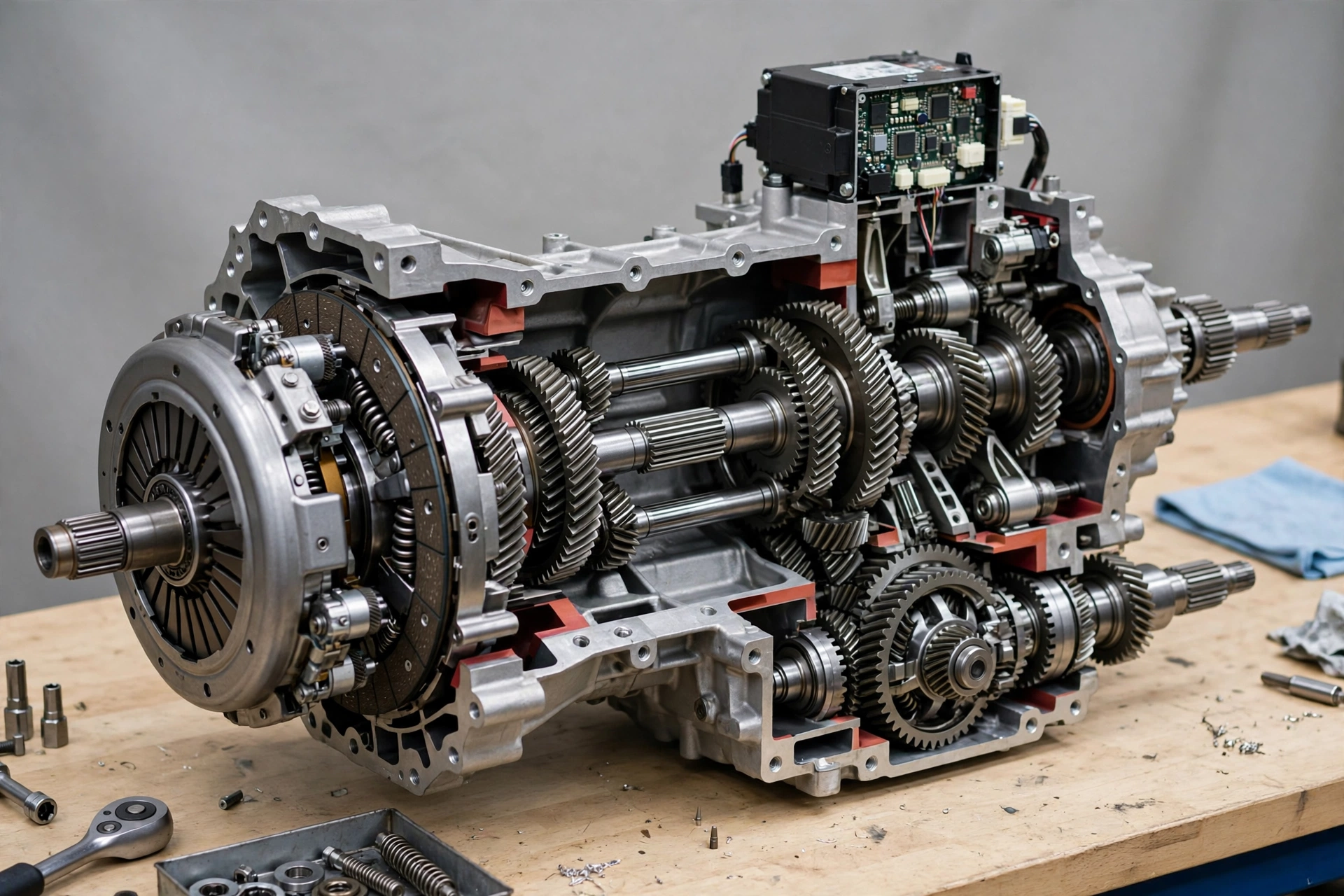
AI-generated illustration: a cutaway view of a Ford DPS6 PowerShift dual-clutch transmission showing the clutch packs, gear sets, and control module.
There is no torque converter to smooth out a bad shift. A conventional automatic uses fluid to absorb the shock of a gear change, but the DPS6 relies on precise clutch control instead. When that control is off, you feel every mistake as a shudder or a jerk.
The DPS6 also has no fluid pump, no valve body, and no hydraulic shift circuits like a normal automatic. The gears are splash lubricated, and the shift motors do the work that hydraulics do in a conventional box. That simplicity is part of the design, and it is also why a DPS6 fault feels different from a normal automatic fault.
Common 2014 Ford Focus Transmission Problems
The 2014 Focus has one of the most reported transmission problem lists of any Ford car of its age. The faults below are the ones owners and repair sources report most often, and they cluster around the DPS6 automatic.
The manual is far less troubled. It can wear a clutch, grind with a worn synchro, or develop a noisy bearing at high mileage, but it does not share the DPS6 clutch shudder or TCM failure pattern. That contrast is a real buying factor.
Read the symptoms first, then match them to the likely cause. A shudder on light acceleration points at the clutch, while a sudden loss of drive points at the TCM, and the two faults need different fixes.
Clutch Shudder on Light Acceleration


Shudder is the classic DPS6 complaint. The car shakes or judders as it pulls away gently from a stop, often in first or second gear, and the shake fades once the car is moving faster.
Ford traced many shudder cases to fluid contamination of the clutch. Leaking input shaft seals let fluid reach the dry clutch, and a contaminated clutch cannot grip smoothly. That is the fault behind Customer Satisfaction Program 14M01, covered in the warranty section below.
Shudder can also come from worn clutch material itself. A clutch that has slipped too often in traffic wears unevenly, and the wear shows up as a shake that gets worse over time rather than better.
A software update can mask mild shudder for a while, but it cannot fix a contaminated or worn clutch. If the shudder returns after an update, the clutch pack is the likely cause, and a shop needs to test it.
TCM Failure and Loss of Drive
TCM failure is the most serious DPS6 fault. The car can lose drive while moving, refuse to engage a gear, refuse to start, or show a transmission fault message with no warning.
The TCM is an electronic module mounted on the transmission. It controls the shift motors and the clutch actuators, so a failed module can leave the car stuck in neutral or stuck in one gear. The fault codes U0100, U0101, and U1013 often appear with this failure.
Our guide to the 2015 Ford Focus transmission control module explains how the module works and what its failure looks like. The 2014 car uses the same DPS6 system, so the symptoms and the diagnosis carry over directly.
A failed TCM is not a fluid job and not a clutch job. The module must be replaced and programmed to the car, and the work needs a scan tool that can talk to the DPS6. A shop that guesses at a TCM without reading the codes can waste your money.
Input Shaft Seal Leaks
Input shaft seal leaks are the quiet fault behind many shudder cases. The seals sit between the transmission and the clutch, and when they leak, fluid reaches the dry clutch pack.
The leak may not leave a puddle on the ground. Fluid can stay inside the clutch housing, so the only sign is the shudder itself, or a faint fluid smell near the transmission. A shop has to inspect the housing to confirm it.
Ford improved the input shaft seals for cars built from June 6, 2013 onward. A 2014 Focus built after that date has the improved seals, but it can still develop a leak at higher mileage. Build date is on the door sticker, so check it before you assume your car is clear.
Overheating and Neutral Dropout
Overheating is a DPS6 fault in heavy stop and go traffic. The dry clutches build heat when they slip again and again, and the TCM can disengage the clutches to protect them. The car then feels as if it has dropped into neutral.
Journalistic reports on the PowerShift note that pre-production test cars pulled over after the transmission shifted into neutral, and that clutch pack overheating was a cause. A car that loses drive in traffic and recovers after it cools down fits that pattern.
Do not keep driving a car that drops into neutral. Pull over safely, let the transmission cool, and get the car scanned. Repeated overheating wears the clutch faster, and it can turn a clutch job into a full replacement.
Harsh Shifts and Delayed Engagement
Harsh shifts and delayed engagement are the milder DPS6 symptoms. The car may bang into gear, hesitate for a second when you select Drive, or jerk when it changes down at low speed.
These symptoms can come from the clutch, the TCM, or the software calibration. A scan is the only way to separate them, because the same harsh shift can have three different causes. A shop should read the codes before it quotes a repair.
Our guide to automatic transmission high RPM before shifting covers a related symptom. High RPM before a shift can point at a slipping clutch, and a DPS6 that slips under load needs a clutch test, not just a fluid change.
Manual Transmission Problems
The 5-speed manual is the low risk choice in a 2014 Focus. Its common faults are the normal wear items of any manual: a worn clutch, a tired release bearing, or a synchro that grinds on a fast shift.
Clutch wear shows up as slipping under load, a high biting point, or a burning smell on a hill. A slipping manual clutch is a straightforward repair, and it costs far less than a DPS6 clutch pack.
Grinding into a gear, usually second or third, points at a worn synchro. The fix is inside the gearbox, so get a quote before you buy a car that grinds. A noisy bearing in neutral that goes quiet when you press the clutch points at the release bearing.
| Symptom | Likely cause | Transmission | Urgency |
|---|---|---|---|
| Shudder on light acceleration | Contaminated or worn clutch pack | DPS6 automatic | Book a diagnosis soon |
| Loss of drive or no start | Failed TCM | DPS6 automatic | Do not drive, tow it |
| Fluid near the clutch housing | Leaking input shaft seal | DPS6 automatic | Book a diagnosis soon |
| Drops into neutral in traffic | Clutch overheating | DPS6 automatic | Stop and let it cool |
| Harsh shift or delayed Drive | Clutch, TCM, or software | DPS6 automatic | Scan the codes first |
| Slipping under load | Worn clutch | 5-speed manual | Book a repair soon |
| Grinding into gear | Worn synchro | 5-speed manual | Get a quote first |
Warranty Coverage You Should Still Check
Ford extended warranty cover for the DPS6 twice, under two programs with different parts and different limits. Both programs matter for a 2014 Focus, and both have now expired for most cars by time, but you should still check by VIN before you pay.
Program 14M01 covers the clutch shudder fault. It extends cover for the DPS6 input shaft seals, the clutch, and the transmission software calibration to 7 years of service or 100,000 miles from the warranty start date, whichever comes first. It covers 2012 to 2014 Focus cars built at Michigan from August 1, 2010 through July 8, 2013.
Program 14M02 covers the TCM. It extends cover for the DPS6 transmission control module to 10 years of service or 150,000 miles from the warranty start date, whichever comes first. It covers 2012 to 2016 Focus cars, and it addresses loss of transmission engagement while driving, no-start, and lack of power.
The Ford 14M01 program text states the 7 year and 100,000 mile limit and the build date range. The same text says the cover transfers to later owners, and that dealers should repair an affected car that shows excessive shudder whether or not the owner got a letter.
The Ford 14M02 program text states the 10 year and 150,000 mile limit for the TCM. A later supplement offered a one-time TCM replacement through June 30, 2025 for cars that had already passed the time or mileage limit. That one-time offer has now closed.
Do the math for a 2014 car in 2026. A car that started service in 2014 passed the 7 year clutch limit in 2021, and it passed the 10 year TCM limit in 2024. Mileage can extend nothing past the time limit, so most 2014 cars have no DPS6 cover left.
Check anyway, because the warranty start date is the date the first owner took the car, not the model year. A late registered 2014 car could still sit inside a limit, and a dealer check by VIN takes minutes. Our guide to how to check your Ford warranty shows how to run that check before you book any work.
Class action settlement cover is a separate path. The US PowerShift settlement was tentatively approved in 2017, and it gave owners a route to claim for repeated DPS6 repairs. Settlement deadlines have passed for most claims, so treat it as history unless a lawyer tells you otherwise for your exact case.
Repair or Replace Your 2014 Focus Transmission
The repair or replace decision for a 2014 Focus starts with the diagnosis, not with the price. A TCM fault and a worn clutch pack are different repairs with different costs, and a full replacement is only the right answer when the unit itself is worn out.
Start with a scan that reads the TCM, not just the engine. The engine codes alone can miss a DPS6 fault, because the fault lives in the transmission module. A shop needs a scan tool that talks to the DPS6 and can read clutch slip data.
Next, ask the shop to name the failed part and the test that proved it. A clutch shudder needs a clutch slip test or a housing inspection.
A TCM fault needs the codes and a module test. A quote that names no test is a guess, and a guess on a DPS6 is expensive.
| Situation | Best move | Why |
|---|---|---|
| TCM codes, loss of drive | Replace the TCM | The module is the failed part, the gearbox may be fine |
| Shudder, clutch test fails | Replace the clutch pack and seals | The clutch is worn or contaminated |
| Shudder plus seal leak | Replace clutch pack, seals, and update software | The leak caused the clutch fault |
| Multiple internal faults, high mileage | Replace the whole unit | Repairing one part leaves the next fault waiting |
| Manual clutch slips | Replace the manual clutch kit | A simple repair, far cheaper than a DPS6 job |
| Car value below repair cost | Do not repair, sell or scrap | The repair costs more than the car is worth |
Compare the repair cost with the value of the car before you agree to anything. A running 2014 Focus with a good body is often worth 3,000 to 6,000 dollars on the used market, so a 5,000 dollar replacement can be more than the car is worth.
Our guide to Ford powertrain warranty cover explains what a new Ford powertrain warranty covers. A 2014 car is long past that cover, so the DPS6 programs above are the only Ford cover that ever applied.
Get every quote in writing, with parts and labor split out. Ask whether the quote includes the TCM, the clutch pack, the seals, the software update, and the fluid. A DPS6 quote that leaves out the seals or the software is incomplete.
Replacement Options and What Each Costs
Replacement costs for a 2014 Ford Focus transmission vary widely, because the part can be used, remanufactured, rebuilt, or new, and the labor rate varies by shop and region. Treat every figure below as a US average range, not a quote for your car.
A used DPS6 from a salvage yard is the cheapest part, often 800 to 2,000 dollars for the unit alone. The risk is the history: a used DPS6 may carry the same clutch wear and seal leak that killed your old one. A short warranty of 30 to 90 days is common, and it rarely covers labor if the unit fails.
A remanufactured DPS6 is the middle choice. The unit is rebuilt to factory spec with new seals and clutches, and it often carries a 1 to 3 year warranty. Parts alone often run 1,800 to 4,000 dollars, and the installed total often lands between 3,000 and 5,000 dollars.
A new OEM DPS6 is the dearest option, and it is rarely available for a 2014 car now. Parts alone can run 4,000 to 6,000 dollars, and the installed total can pass 7,000 dollars at a dealer. For most owners, a new unit is not worth the price on a car of this age.
Labor alone often runs 800 to 1,500 dollars, depending on the shop rate and the region. The DPS6 needs TCM programming after fitting, so the labor quote should include the programming and the software update, not just the physical swap.
| Replacement option | Part cost | Installed total | Warranty | Best for |
|---|---|---|---|---|
| Used DPS6 | 800 to 2,000 dollars | About 2,000 to 3,500 dollars | 30 to 90 days | A cheap car you will sell soon |
| Remanufactured DPS6 | 1,800 to 4,000 dollars | About 3,000 to 5,000 dollars | 1 to 3 years | A daily driver you plan to keep |
| Rebuilt DPS6, local shop | 1,500 to 3,000 dollars | About 2,500 to 4,500 dollars | Varies by shop | A trusted local specialist |
| New OEM DPS6 | 4,000 to 6,000 dollars | About 6,000 to 8,000 dollars | About 1 year | Rarely worth it on a 2014 car |
| Used 5-speed manual | 500 to 1,200 dollars | About 1,200 to 2,500 dollars | 30 to 90 days | A manual car with a failed gearbox |
| Clutch pack only, DPS6 | 800 to 1,500 dollars | About 2,500 to 4,500 dollars | Varies by shop | Shudder with a sound gearbox |
The remanufactured unit is the best balance for most owners who plan to keep the car. It costs more than a used unit, but it comes with updated parts and a warranty that a used unit cannot match.
The used unit is only a good deal when you know its history. Ask for the donor car mileage, the reason it was scrapped, and whether the clutch and TCM were tested. A used DPS6 with no history is a gamble, and the labor to fit it twice wipes out the saving.
Ask the shop three questions before you choose. Does the price include TCM programming and a software update.
Does the warranty cover parts and labor, and for how long. Will the shop fit a unit you supply, and does that change the warranty.
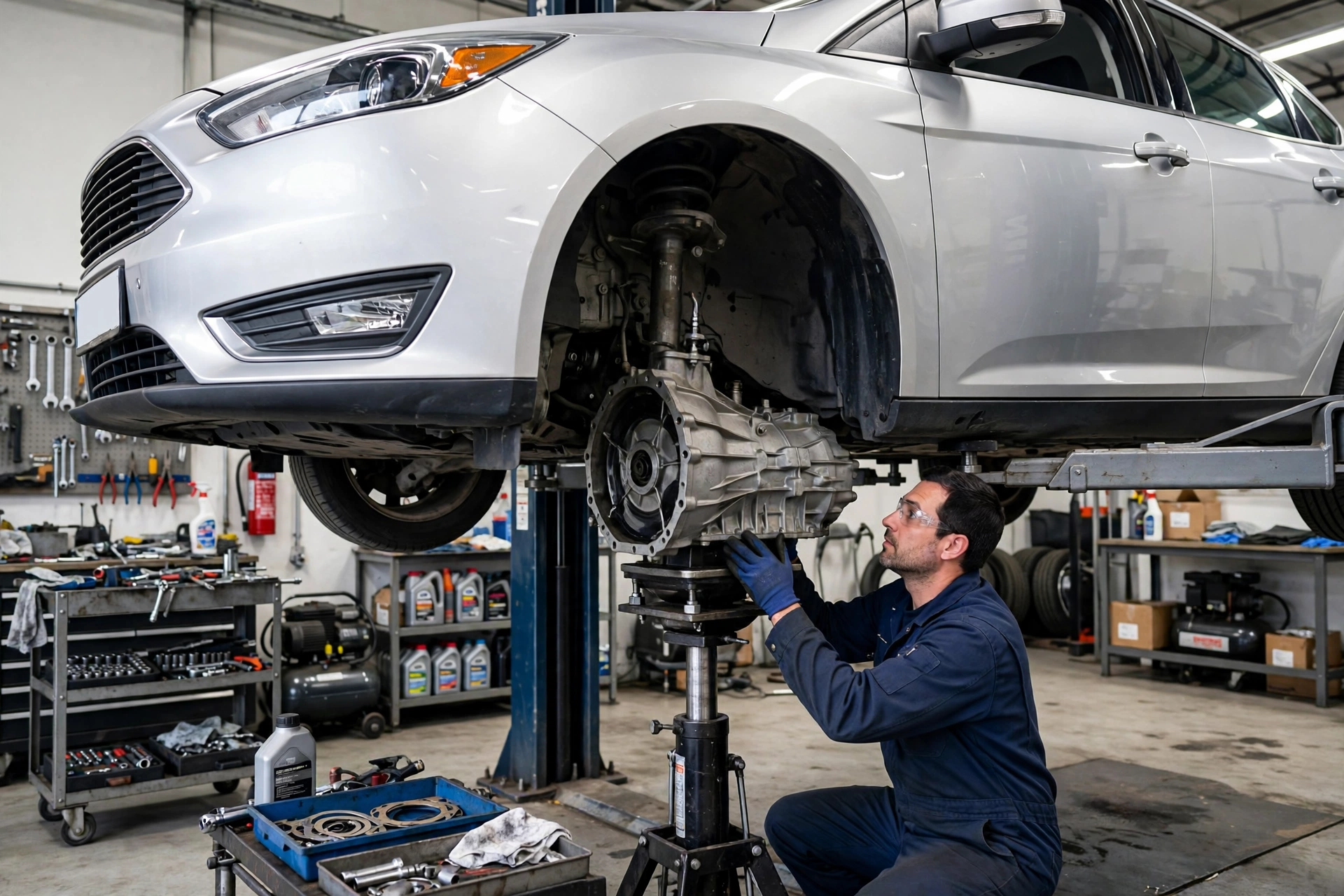
AI-generated illustration: a mechanic installing a replacement transmission into a silver 2014 Ford Focus on a lift in a repair shop.
Do not buy a DPS6 by price alone. A cheap unit with the old clutch design and old seals will shudder again, and the second labor bill will cost more than the saving on the first unit.
Buying a Used 2014 Ford Focus With Confidence
A used 2014 Ford Focus can be a good buy, but only if you check the transmission before you pay. The checks below take less than an hour, and they can save you thousands of dollars.
Start with the history. Ask for service records, clutch work, TCM work, and software updates. A car with a documented clutch replacement after 2014 is a better buy than one with no transmission history at all.
Next, run the VIN through a Ford dealer. Ask about open recalls, open field service actions, and any DPS6 program cover that still applies. The dealer check is free in most cases, and it can reveal work the seller did not mention.
Then test drive the car in the conditions that expose a DPS6 fault. Drive slowly in traffic, pull away gently from stops, and crawl up a hill. Note any shudder, slip, harsh shift, or warning light, and walk away if the car drops into neutral.
- Check the shudder. Pull away gently from five stops in a row, and note any shake in first or second gear.
- Check the engagement. Shift from Park to Drive and to Reverse, and note any delay longer than a second.
- Check the warning lights. Look for a transmission fault message or a check engine light, and scan the codes.
- Check the fluid leak. Look under the car and near the clutch housing for fresh fluid or a damp seal area.
- Check the paperwork. Ask for clutch, TCM, and software records, and match them to the VIN and the mileage.
- Check the price. Price a remanufactured DPS6 into the deal, and walk away if the seller will not allow a scan.
A pre-purchase inspection at an independent shop is worth the fee. Ask the shop to scan the TCM, read the clutch slip data, and inspect the clutch housing for leaks. That inspection costs far less than a replacement.
Prefer a manual car if you want the lowest risk. A 5-speed 2014 Focus avoids the DPS6 entirely, and its clutch is a normal wear item with a normal repair cost. The manual is also cheaper to buy in many markets.
Our guide to the 2014 Ford Focus tire size for the SE is a useful check when you inspect a used car. Wrong tire size can mask a handling fault, and it is one more sign that the car was not maintained to spec.
How to Maintain a 2014 Focus Transmission
Maintenance will not fix a worn DPS6 clutch, but it can slow the wear and catch a fault early. The steps below are simple, and they apply to both transmissions in the 2014 Focus.
For the DPS6, the key habit is gentle driving in traffic. Avoid creeping forward on the clutch in a jam, and avoid holding the car on a hill with the throttle. Both habits slip the dry clutches and build heat, and heat is what wears them.
Let the car engage fully before you press the throttle hard. A DPS6 that is still slipping when you accelerate will wear faster than one that is fully engaged. Smooth, steady throttle in slow traffic is kinder to the clutches than sharp bursts.
For the manual, the key habit is full clutch use. Press the pedal fully before you shift, do not rest your foot on the pedal while you drive, and do not hold the car on a hill with the clutch. Those habits wear the clutch and the release bearing.
Fluid checks are limited on both units, because neither has a dipstick. The DPS6 is a sealed unit, and the fluid level is checked from underneath with the car level and at the right temperature. That check belongs to a shop with a lift.
Our guide to the 2014 Ford Focus transmission fluid dipstick location explains why there is no dipstick to check. The guide shows what to check instead, and when a shop check is the right move.
Keep the software current. Ford released DPS6 software updates that change how the clutches engage, and an old calibration can make a healthy clutch feel worse than it is. A dealer or a specialist can check the calibration version by VIN.
Fix leaks early. A small input shaft seal leak can contaminate the clutch over time, and a contaminated clutch needs replacement. A leak caught early is a seal job, while a leak ignored is a clutch job.
Questions Ford Focus Owners Ask Most
What Transmission Does a 2014 Ford Focus Have
A regular 2014 Ford Focus has the DPS6 PowerShift 6-speed dual-clutch automatic or a 5-speed manual. The manual is standard on S and SE trims, the DPS6 is standard on Titanium, and the ST has a 6-speed manual with the EcoBoost engine.
Is the 2014 Ford Focus Transmission Reliable
The 5-speed manual is reliable with normal clutch wear, but the DPS6 automatic has a poor record. It is known for clutch shudder, TCM failure, and seal leaks, and many owners needed clutch or TCM work well before 100,000 miles.
How Much Does a 2014 Focus Transmission Cost
A replacement often costs about 3,000 to 7,000 dollars installed, depending on the unit and the shop. A used DPS6 is cheapest at about 2,000 to 3,500 dollars installed, while a remanufactured unit often costs 3,000 to 5,000 dollars installed.
Can You Drive With a Shuddering DPS6
You can drive a short distance to a shop if the shudder is mild and the car still engages gear. Do not keep driving it for weeks, because a slipping clutch wears faster and can damage the gearbox. Book a diagnosis as soon as you can.
Does the DPS6 Have a Dipstick
No, the DPS6 has no dipstick. It is a sealed unit with a small fluid fill, and the level is checked from underneath at a shop. Do not add automatic transmission fluid to it, because it uses a special dual clutch fluid.
What Is the DPS6 Transmission Control Module
The TCM is the electronic module that controls the DPS6 clutches and gear changes. When it fails, the car can lose drive, refuse to start, or drop into neutral. Ford extended TCM cover to 10 years or 150,000 miles under program 14M02, but that cover has expired for most 2014 cars.
Should I Buy a Used 2014 Ford Focus
Buy one only after a TCM scan, a slow traffic test drive, and a check of the clutch and TCM history. A manual car is the lower risk choice, while a DPS6 car needs a documented clutch replacement or a price that covers a remanufactured unit.
Is a Manual Swap a Good Fix for a Bad DPS6
A manual swap is possible in theory, but it is rarely worth the cost. It needs the gearbox, pedals, clutch hydraulics, wiring, and programming, and the labor often costs more than a remanufactured DPS6. Sell the car or fit a remanufactured DPS6 instead.
Your 5 Step Check Before You Decide
The transmission for a 2014 Ford Focus is either the DPS6 PowerShift automatic or a 5-speed manual, and the two choices lead to very different costs. The DPS6 is the common one, and it is also the one with the shudder and TCM history.
Run the five step check before you buy or repair. Identify the transmission by VIN, test drive it in slow traffic, scan the TCM and read the codes, check 14M01 and 14M02 cover by VIN, and compare the repair quote with the value of the car.
That check takes less than an hour, and it can save you from buying a car that needs a 4,000 dollar transmission. If the car passes the check, it can still be a good cheap runabout, and if it fails, you will know before you pay.