Powertrain Warranty What Does It Cover in 2026 Ultimate Guide

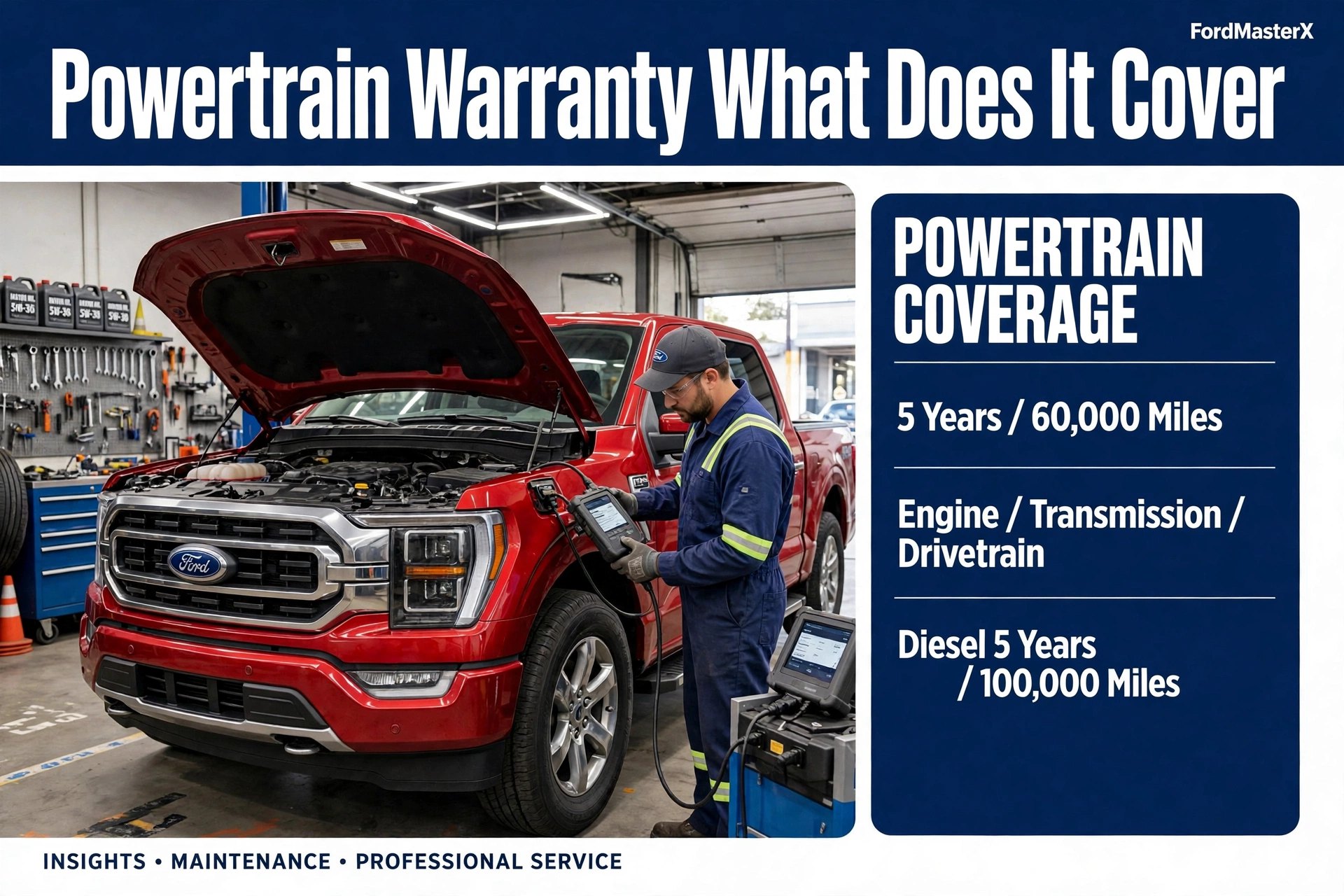
Powertrain warranty what does it cover? For Ford owners, the short answer is the parts that make your truck move: the engine, the transmission, and the drivetrain. On most new Fords it runs for 5 years or 60,000 miles, whichever comes first, and it pays for defects in factory materials or workmanship on the components Ford lists in its warranty guide. It does not cover routine maintenance, wear items like brakes and tires, or damage from accidents, neglect, or aftermarket parts. If your truck is still inside 5 years and 60,000 miles and the failed part is on Ford’s list, the repair should cost you nothing. This guide gives you that list, the exclusions, and a four-question check to run before you call the dealer.
5 Ford Warranty Layers You Must Know First
A new Ford does not carry one warranty. It carries a stack of them, and each layer covers different parts for a different length of time.


| Warranty layer | Term | What it covers in plain words |
|---|---|---|
| New Vehicle Limited Warranty, bumper to bumper | 3 years or 36,000 miles | Almost every part of the truck |
| Powertrain Warranty | 5 years or 60,000 miles | Engine, transmission, and drivetrain parts Ford lists |
| Power Stroke Diesel Warranty | 5 years or 100,000 miles | Diesel engine and related powertrain parts |
| Safety Restraint System | 5 years or 60,000 miles | Seat belts and airbag components |
| Corrosion Warranty, perforation only | 5 years, unlimited miles | Rust through a body panel |
| Hybrid and Electric Unique Components | 8 years or 100,000 miles | Battery and electric drive parts |
Every term above is “whichever comes first.” A 2022 F-150 with 62,000 miles is out of powertrain coverage even though it is only four years old. Coverage starts on the Warranty Start Date, the day you take delivery or the truck first goes into service as a demonstrator. Ford publishes these periods on its official warranty page. For the full picture of the base layer, read our Ford factory warranty overview.
The point for your wallet is the gap between year three and year five. After 3 years or 36,000 miles, the bumper-to-bumper layer ends. The engine, transmission, and drivetrain keep coverage for two more years or 24,000 more miles, so the most expensive parts stay protected longer than the rest.
What Ford Covers Under the Engine


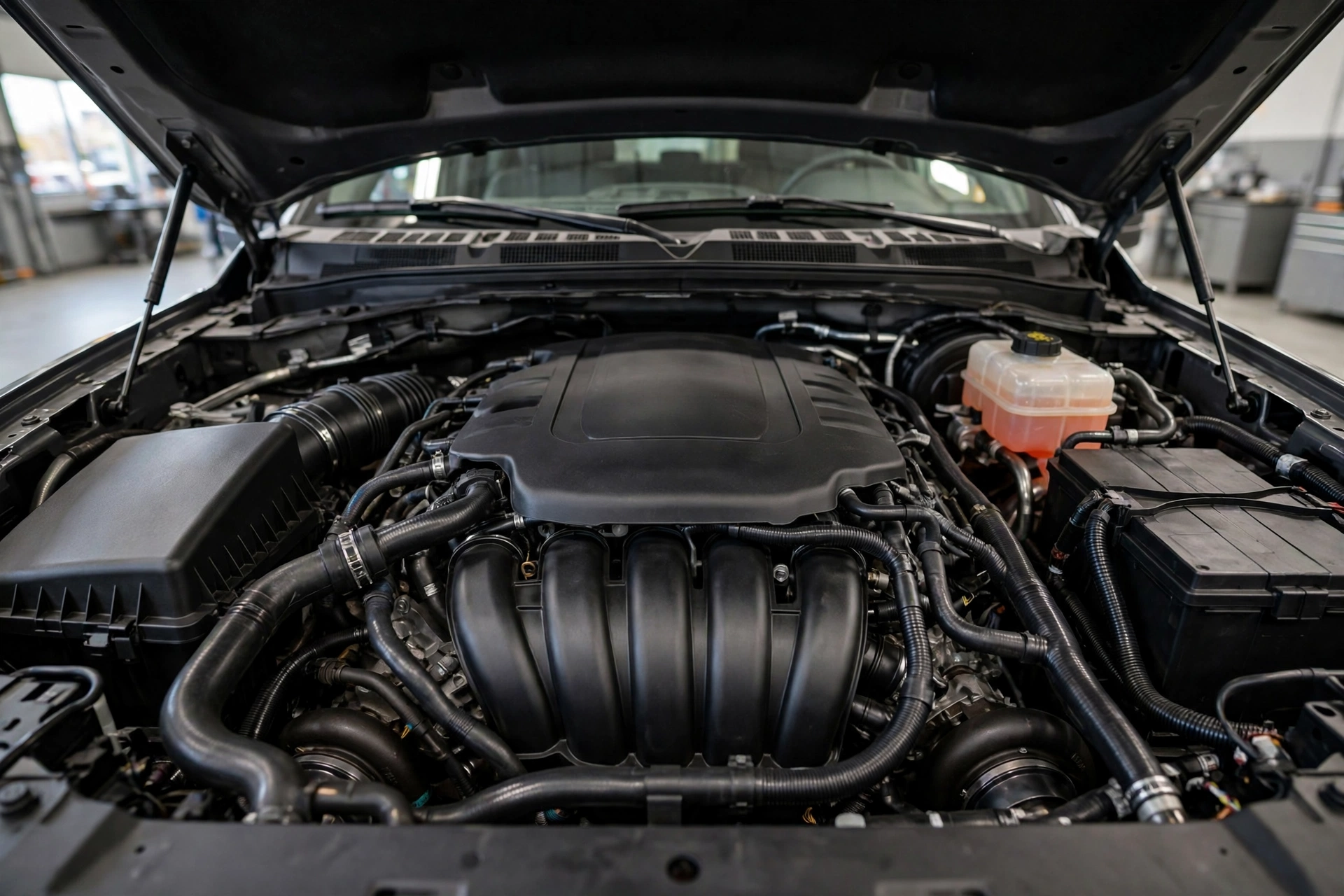
The engine list is generous in one specific way: it covers all internal lubricated parts. That means the pistons, crankshaft, connecting rods, camshafts, and bearings inside the block are covered without Ford having to name each one.
Around that core, the warranty guide names the rest of the engine part by part: the cylinder block and heads, the oil pump and pan, the water pump, the intake and exhaust manifolds, the flywheel, the valve covers, the engine mounts, the seals and gaskets, the thermostat and housing, the timing chain cover, the timing chain with its gears or belt, the fuel pump, the injection pump (diesel models), the powertrain control module, and the turbocharger or supercharger unit. That last item matters for EcoBoost owners: the twin turbos on a 3.5L EcoBoost are covered parts, not wear items. Our 3.5L EcoBoost cam phaser replacement guide explains one of the most common EcoBoost engine repairs owners ask about.
Two details deserve attention. Seals and gaskets are covered, so a leaking front cover gasket inside the term is a warranty job. The powertrain control module is also covered as an engine part, and a failed PCM can cost more than a thousand dollars on its own.
The engine list is a named-parts list, not a blank promise. Belts and hoses outside the timing system, the alternator, the starter, and the air conditioning compressor are not powertrain parts. The stakes are high: a full F-150 engine replacement typically costs between $5,000 and $12,000, which is exactly why the powertrain term exists.
Transmission and Drivetrain Parts Ford Covers


Ford covers the transmission case and all internal parts, the torque converter on automatics, the clutch cover on manuals, the transfer case including all internal parts on four-wheel-drive trucks, the transmission mounts, and the seals and gaskets. The 10-speed automatic in a modern F-150 has hundreds of internal parts, and they are all covered by that one line, including the labor to remove and rebuild it.


The drivetrain list changes with the layout of your truck. For rear-wheel-drive trucks, Ford covers the axle shafts, the rear bearings, the center support bearing, the drive axle housing including all internal parts, the driveshaft, the retainers and supports, the seals and gaskets, and the universal and constant velocity joints. Four-wheel-drive trucks add the front axle housing, the front bearings, the locking hubs, and the transfer case. Front-wheel-drive vehicles get the axle shafts, the front bearings, the support bracket, and the joints.


That detail matters if you own a 4×4. The transfer case, the front differential, and the locking hubs are all covered parts, and transfer case repairs can run into four figures. The electronic locking rear differential sits inside the drive axle housing assembly, so a locking mechanism failure from a defect is generally a powertrain claim. Our guide on how to check transmission fluid on a 2016 F-150 shows the check that catches low fluid before it becomes a failure.
One limit applies across the whole list. Ford covers defects in factory-supplied materials or workmanship, not a part that failed because the truck was run low on fluid, overloaded past its rating, or fitted with a tuner that raised boost past factory limits.
7 Repairs Your Powertrain Warranty Will Not Pay For
Every item here is a repair someone has tried to claim and been refused.
- Routine maintenance. Oil changes, oil filters, engine air filters, cabin filters, spark plugs, and tire rotations are never covered, and skipping service can void coverage on the parts that service protects. Our guide on how often a car needs an oil change gives the Ford intervals, and the Ford engine oil recommendation chart lists the exact oil spec.
- Wear items. Brake pads, worn rotors, tires, wiper blades, and clutch discs wear out by design. A clutch disc worn smooth after 50,000 miles of towing is not a defect.
- Collision and impact damage. A cracked transmission case from a rock strike or a bent driveshaft from an off-road hit belongs to your insurance, not to the warranty.
- Neglect and abuse. Running the engine without oil, driving with the temperature gauge in the red, or overloading past the rated payload can void the claim.
- Aftermarket performance parts. A tuner, a larger turbo, or any non-factory performance part that damages the engine, transmission, or final drive takes the repair outside coverage.
- Damage from lost fluids. Repairs caused by loss of oil, coolant, or transmission fluid, or by continued driving after that loss, are excluded. If the oil light comes on and you keep driving, the damage that follows is yours.
- Improper or unauthorized service. A repair done wrong by an unqualified shop is not a factory defect. Keep receipts from qualified service, because Ford may ask for proof of maintenance when a failure could have come from missed service.
The pattern is simple: the warranty covers parts that failed because Ford built them wrong, not parts that were used up, damaged, or starved of service. A general guide to powertrain coverage from ConsumerAffairs draws the same line, noting that steering, brakes, suspension, climate control, and infotainment are not powertrain parts. ConsumerAffairs powertrain warranty guide


Is Your Repair Covered 4 Questions That Decide
Use this check in order. A “no” at any step means the repair is probably not covered.
Question 1: Is the failed part on Ford’s powertrain list? Check the lists above. If the part is named, or it is an internal lubricated engine part or an internal transmission part, move on. A radio, air conditioning compressor, suspension part, or brake part is not a powertrain part.
Question 2: Are you inside 5 years and 60,000 miles from your Warranty Start Date? Time and mileage both count, and whichever limit you hit first ends coverage. Diesel Power Stroke owners use 5 years and 100,000 miles instead, and certified pre-owned Gold trucks use 7 years and 100,000 miles from the original start date.
Question 3: Did the part fail from a defect, not from damage or neglect? A turbo that failed because a bearing was machined wrong is a defect; one that failed because the truck ran without oil for a week is not. The dealer will inspect the part and the service history.
Question 4: Is the truck free of disqualifying modifications and missed service? A tuner, a larger turbo, or a deleted emissions system on the affected parts can void the claim, and so can missing oil changes when the failure is tied to lubrication. Bring your service receipts.
If you answer yes to all four questions, book the repair and say the words “powertrain warranty claim” at the desk. If any answer is no, get a written quote before you approve work, and ask the service advisor to confirm the decision in writing. A second opinion from another Ford dealer sometimes reverses a wrong denial, but ask first whether a diagnostic fee applies if the repair is not covered.
Ford Powertrain Warranty at a Glance
What Ford pays for, for how long, and the four questions that decide your claim.
Covered
- Engine: internal parts, block, heads, turbo
- Transmission: case, internals, torque converter
- Drivetrain: axles, driveshaft, differential
- Transfer case on 4WD trucks
- Seals and gaskets in a covered repair
Not Covered
- Oil changes, filters, spark plugs
- Brakes, tires, wiper blades, clutch discs
- Accident, collision, or impact damage
- Neglect, abuse, or missed service
- Aftermarket performance parts
Is Your Repair Covered? Ask These 4 Questions
- Is the failed part on Ford’s powertrain list?
- Are you inside the time and mileage limit?
- Did it fail from a defect, not damage or neglect?
- Is the truck free of disqualifying mods and missed service?
3 Special Cases That Change Your Coverage
Power Stroke diesel trucks get more miles. The Power Stroke diesel warranty runs 5 years or 100,000 miles, which is 40,000 miles more than the gas term. The covered parts follow the same lists, with diesel-specific parts such as the high-pressure fuel pump and injectors included. A comparison of Ford warranty terms confirms the diesel term. CarBuzz Ford warranty comparison
Hybrids and electric Fords get a separate battery term. The F-150 PowerBoost hybrid and the all-electric F-150 Lightning carry 8-year or 100,000-mile coverage on their hybrid and electric unique components, including the high-voltage battery. If you own a PowerBoost, check both terms: the gas engine and transmission sit under the 5-year term, while the battery and electric drive parts sit under the 8-year term.
Certified pre-owned Gold trucks get 7 years and 100,000 miles. A Ford Blue Advantage Gold Certified truck adds a 12-month or 12,000-mile comprehensive warranty on top of any remaining factory coverage, plus a 7-year or 100,000-mile powertrain warranty from the original warranty start date. Ford’s certified warranty page lists the Gold powertrain term and the components it covers, and it is worth reading before you buy a used Ford. Ford Blue Advantage certified warranties
One more special case deserves a warning. Some dealers sell their own “lifetime powertrain warranty” with a new truck. That is a dealer program, not a Ford factory warranty. It usually applies to the original owner only and is not transferable if you sell the truck.
How to Check Your Ford Warranty in 3 Steps
Step 1: Find your Warranty Start Date. It is the day you took delivery, or the day the truck first went into service as a demonstrator, whichever came first. It is printed in your warranty guide and in your purchase paperwork.
Step 2: Check your truck by VIN. Sign in to your Ford account at owner.ford.com or open the Ford app, select your truck, and read the coverage details against your start date. Our step-by-step guide walks through the same check. How to check your Ford warranty by VIN Emissions parts follow their own rules and can outlast the powertrain term, so read how long the Ford emissions warranty lasts before you pay for an emissions repair.
Step 3: Confirm the part list before you book. Match the failed part against the lists in this article. If it matches and you are inside the term, call the dealer, describe the symptom, and say you are bringing the truck in for a powertrain warranty claim. Bring your service receipts. If the dealer denies the claim, ask for the denial in writing, then check with a second dealer.

What Happens After 5 Years or 60000 Miles
When the factory powertrain term ends, you have two main options. The first is to pay as you go: if your truck has been reliable and you service it on schedule, set aside money for the repairs that do come.
The second option is a Ford Protect extended service plan, offered in four tiers from PowertrainCARE, which covers 29 core powertrain components, up to PremiumCARE, which covers the most systems. Plans can extend coverage up to 10 years or 175,000 miles, and they include rental car reimbursement, depending on the plan, for covered repairs that keep the truck overnight. Buy while you are still inside the 3-year/36,000-mile bumper-to-bumper term, because prices rise and eligibility narrows after coverage lapses.
5 Questions Ford Owners Ask About Powertrain Coverage
Does a Ford powertrain warranty cover the transmission? Yes. Ford covers the transmission case and all internal parts, the torque converter, the transfer case, and the mounts for 5 years or 60,000 miles on gas trucks and 5 years or 100,000 miles on Power Stroke diesel trucks.
Does a Ford powertrain warranty cover oil changes? No. Oil changes, filters, spark plugs, and tire rotations are routine maintenance, and no Ford warranty layer pays for them.
Does a Ford powertrain warranty cover the turbo on an EcoBoost? Yes. The turbocharger unit is named in Ford’s engine coverage list, so a turbo failure from a factory defect inside the term is a covered repair. Damage from a tuner or from running without oil is not covered.
Is a powertrain warranty transferable when I sell my Ford? Yes, the factory powertrain warranty stays with the truck and passes to the next owner for the rest of the term. Dealer-added lifetime warranties usually do not transfer, so check the paperwork.
What voids a Ford powertrain warranty? Abuse, neglect, collision damage, and aftermarket performance parts that damage covered components can void a claim on the affected parts. Missing scheduled maintenance can also void coverage when the failure is tied to it, so keep your receipts.
Your Next Step Before Your Next Repair
The question “powertrain warranty what does it cover” has a simple answer once you see the list. Ford covers the engine, transmission, and drivetrain for 5 years or 60,000 miles, 5 years or 100,000 miles on a Power Stroke diesel, and 7 years or 100,000 miles on a Gold certified used truck. It covers defects in the parts Ford names, not maintenance, wear, damage, or neglect. Before your next repair, check your Warranty Start Date, run the four-question check, and confirm your coverage by VIN. That ten-minute check is the difference between a free repair and a bill for thousands.