
Ford Code P0420 Bank 1 Location: Pinpointed by Configuration

On Ford vehicles, Bank 1 refers to the side of the engine containing the number one cylinder. For a P0420 code, this specifically identifies the catalytic converter efficiency issue on the exhaust manifold or pipe assembly located on that same side. This guide details how to locate your bank-specific sensor and catalyst components based on your engine’s firing order and cylinder orientation to ensure an accurate, VIN-verified repair.
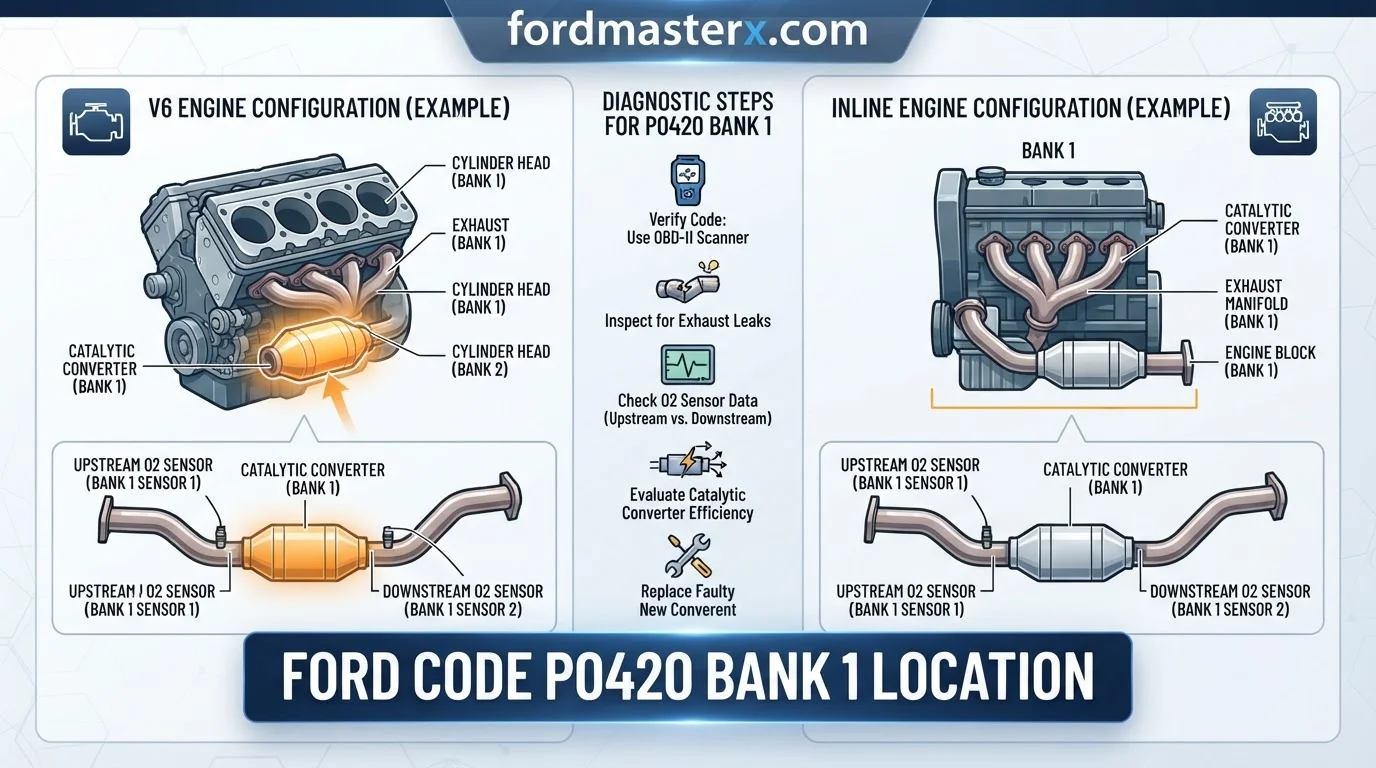
Ford Code P0420 Bank 1 Location Main Reference Chart
How to Read This Chart
This chart identifies the physical placement of Bank 1 to help you locate the specific catalytic converter associated with code P0420. Bank 1 is defined as the side of the engine containing cylinder #1.


For V-configured engines, the “Bank 1 Identification” column specifies the side of the engine bay where the corresponding exhaust manifold and catalytic converter are located. On most Ford V6 and V8 engines, Bank 1 is on the passenger side, positioned toward the rear of the engine bay.

In Inline engine configurations, such as an I4, there is only one bank. Therefore, the entire engine is considered Bank 1. When diagnosing a P0420 code, always pair this location with the downstream oxygen sensor (Sensor 2) on that specific bank to confirm you are testing the correct exhaust flow path.
Code P0420 is a generic OBD-II fault indicating that the Powertrain Control Module (PCM) has detected catalyst efficiency below the required threshold for Bank 1. Always verify your specific engine layout via your owner’s manual or under-hood emissions label, as some specific Ford engine orientations may vary.
Engine Configuration and Ford Code P0420 Bank 1 Location Variables
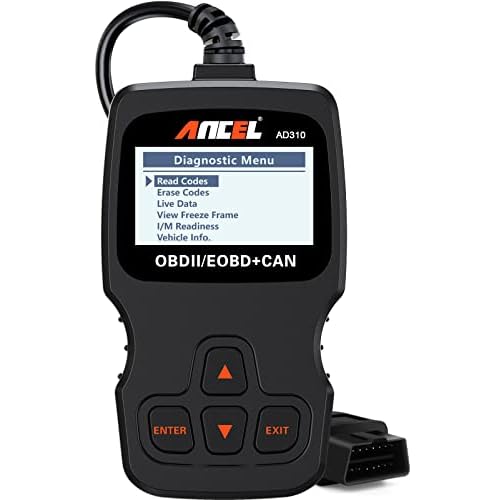


The P0420 code specifically identifies catalyst system efficiency below threshold for a designated engine bank. Because V-type engines split exhaust flow into two distinct paths, identifying the correct bank is the most common pitfall during Ford diagnostics. Failing to distinguish Bank 1 from Bank 2 often leads to replacing the wrong catalytic converter.
Identifying Cylinder 1 on Ford V-Engines


On Ford V6 and V8 engines, Bank 1 is the side that contains the number 1 cylinder. Generally, Ford follows the industry standard where Bank 1 is the passenger side of the engine. However, this is not a universal constant across every vehicle platform or engine architecture, particularly with transverse-mounted engines.
To determine the correct side, you must locate the cylinder numbering sequence. In many Ford V6 engines, such as the 3.5L or 3.7L Duratec, the cylinders are numbered with 1-2-3 on the rear bank and 4-5-6 on the front bank. Because of this, Bank 1 is physically located closest to the firewall.
Conversely, on many Ford V8 engines like the Modular series, cylinder 1 is the front-most cylinder on the passenger side. Always consult your specific vehicle’s owner’s manual or the under-hood emissions label to verify the firing order and cylinder numbering scheme for your particular engine block.


Never assume the passenger side is Bank 1 by default. On some transverse Ford V6 engines, the rear bank (closest to the firewall) is defined as Bank 1, while the front bank (closest to the radiator) is Bank 2.
Inline Engine P0420 Considerations
Inline engines, such as the Ford 2.0L or 2.3L EcoBoost four-cylinder models, simplify the P0420 location process. Because these engines feature a single cylinder head and a single exhaust manifold, they only possess one bank. In diagnostic scan tools, this is universally referred to as Bank 1.


On these inline configurations, the P0420 code points directly to the primary catalytic converter downstream of the exhaust manifold or integrated into the turbocharger assembly. Since there is no second bank, there is no ambiguity regarding which converter requires inspection or replacement.
When working on these units, focus entirely on the singular oxygen sensor upstream and downstream pair. If you see “Bank 2” data in a scan tool for an inline-four engine, it is likely an error in the diagnostic software or a misinterpretation of the data stream, as no second exhaust bank exists.
Understanding the Catalyst System Efficiency Monitor


The P0420 code is a diagnostic trouble code generated by the Engine Control Module (ECM) when it determines the catalytic converter is performing below a specific efficiency threshold. It is crucial to understand that this code identifies a performance deficiency rather than a specific failed component.


While a faulty catalytic converter is a common cause, the code can also be triggered by exhaust leaks, damaged wiring to oxygen sensors, or engine misfires. The system uses a logic-based monitor to evaluate whether the chemical conversion process is meeting federal emissions standards.
The Role of Oxygen Sensors in P0420 Detection


The ECM monitors catalyst efficiency by comparing data from two specific sensors: the upstream O2 sensor (located before the converter) and the downstream O2 sensor (located after the converter). These sensors measure the oxygen content in the exhaust stream to verify the air-fuel mixture.
The upstream sensor constantly adjusts the air-fuel ratio to keep the engine running at stoichiometry—the ideal theoretical ratio of 14.7 parts air to 1 part fuel. Because of these constant adjustments, the upstream sensor signal fluctuates rapidly between lean and rich readings.
A healthy catalytic converter acts as a buffer. It uses its internal precious metals to store oxygen and neutralize pollutants, which effectively “smooths out” the exhaust gas pulses. Consequently, the downstream sensor should produce a relatively flat, stable voltage line compared to the active upstream signal.
If the catalytic converter substrate is degraded, it loses its ability to store oxygen. When this happens, the downstream sensor begins to mirror the upstream sensor’s rapid fluctuations. When the ECM detects that the downstream signal matches the upstream signal too closely, it triggers the P0420 code.
Defining Catalyst Substrate Health
The core of the catalytic converter contains a ceramic or metallic honeycomb structure, known as the substrate, which is coated with a washcoat of platinum, palladium, and rhodium. These metals facilitate chemical reactions that convert harmful CO, HC, and NOx into safer gases.
The ECM calculates efficiency by monitoring the “Oxygen Storage Capacity” of this substrate. Over time, high heat, oil consumption, or excessive fuel can contaminate or physically melt the substrate. Once the active surface area is significantly reduced, the converter can no longer hold enough oxygen to buffer the exhaust flow.
The ECM establishes a specific efficiency threshold—typically expressed as a ratio or a time-delayed correlation between the two sensors—to determine when the catalyst is no longer effective. If the calculated capacity falls below this limit during a standardized drive cycle, the ECM sets the P0420 code.
Drivers should recognize that this system is sensitive. Even a small exhaust leak near the converter can introduce fresh oxygen into the pipe, tricking the downstream sensor and causing a “false” P0420 code. Always verify the physical integrity of the exhaust system before assuming the converter itself has failed.
Diagnostic Procedures for P0420: Avoiding Common Pitfalls
Before condemning a catalytic converter, you must verify the integrity of the exhaust system and the accuracy of sensor data. Replacing a converter based solely on a P0420 code is a common mistake that often fails to resolve the underlying engine management issue.
Diagnostics should focus on ruling out external factors that skew the catalyst efficiency monitor. If you ignore the root cause, you risk damaging a brand-new converter or allowing engine performance to degrade further over time.
Testing for Exhaust Leaks Near Bank 1


Exhaust leaks occurring before or near the Bank 1 catalytic converter frequently trigger false P0420 codes. When air is pulled into the exhaust stream through a crack or faulty gasket, it alters the oxygen concentration, misleading the downstream oxygen sensor.
Perform a thorough physical inspection of the exhaust manifold and the flange connections leading to the catalyst. Listen carefully for a sharp, rhythmic ‘ticking’ sound while the engine is running cold, as this is a primary indicator of a leaking exhaust manifold gasket.
Check for visible signs of soot buildup around connections, which suggests escaping exhaust gases. Even a pinhole-sized leak can introduce enough ambient oxygen to fool the Powertrain Control Module (PCM) into thinking the catalyst has lost its ability to store oxygen.
Verifying O2 Sensor Signal Patterns
The catalytic converter’s health is determined by comparing the upstream sensor signal to the downstream sensor signal. A functional converter should produce a steady, dampened voltage signal from the downstream sensor, typically ranging between 0.45V and 0.7V.
Use a scan tool to monitor the live data for both the upstream and downstream sensors on Bank 1. If the downstream sensor voltage mimics the rapid switching of the upstream sensor—fluctuating wildly between 0.1V and 0.9V—it suggests that the catalyst is not effectively treating the exhaust gases.
However, if the downstream sensor exhibits a flat line or shows erratic spikes unrelated to engine load, the sensor itself may be failing. Verify the sensor’s response time and voltage range before concluding that the catalytic converter is the component at fault.
Checking for Underlying Misfires
Misfires are a leading cause of P0420 codes that are unrelated to converter failure. When a cylinder misfires, unburned fuel and excessive oxygen are dumped directly into the exhaust system, causing the catalyst to overheat and become chemically overwhelmed.
Because the P0420 code is often a secondary symptom, a misfire will frequently manifest as a flashing Check Engine Light or specific codes such as P0300 through P0308. Address any ignition or fuel delivery issues—such as worn spark plugs or faulty ignition coils—immediately.
Failure to resolve a misfire will cause the catalyst to melt or become fouled, leading to permanent damage to the substrate. Always scan for all stored diagnostic trouble codes; if a misfire code is present, it must take priority in your repair sequence.
How to Find Your VIN-Specific Exhaust Configuration
The P0420 code is a generic OBD-II diagnostic trouble code that signifies your catalyst system efficiency is below the required threshold. Because this is a universal standard, it appears across many manufacturers, not just Ford. To identify your specific exhaust layout, you must bypass generic diagrams and focus on your vehicle’s unique build data.
Using Your VIN for Part Accuracy
Your Vehicle Identification Number (VIN) is the most accurate tool for determining your exact engine and exhaust configuration. Ford assigns a specific build date and powertrain code to every vehicle, which dictates the placement of the Bank 1 catalytic converter and associated sensors.
Use a trusted Ford VIN decoder or the official Ford ETIS portal to retrieve your vehicle’s “As-Built” data. This will provide the precise engineering number for your exhaust components, ensuring that any replacement parts or diagnostic tests you perform align with the factory-specified exhaust geometry for your specific trim level.
Locating Under-Hood Emissions Labels
Before crawling under the vehicle, consult the Vehicle Emission Control Information (VECI) label. This sticker is typically located on the underside of the hood, the radiator support, or the valve cover. It contains a vacuum and component diagram essential for identifying Bank 1.
Look specifically for a layout labeled “Catalyst” or “Exhaust System.” This diagram provides a visual representation of how your exhaust manifold connects to the catalytic converters. It will clearly distinguish between Bank 1 and Bank 2 positions, which is critical since P0420 specifically flags an efficiency issue on the side containing the number one cylinder.
📋
Lookup Procedure
Enter your 17-digit VIN into the Ford Service portal to pull the engine build date and specific exhaust emission calibration codes.
Open the hood and locate the emissions decal. Match the visual diagram of the catalyst system to your specific engine orientation.
Access the Ford Professional Technician Society or official service manual to cross-reference your VIN with the specific Bank 1 sensor pinout.
Professional Tips for Safe and Efficient Repairs
Repairing a P0420 code often involves expensive hardware, making diagnostic precision essential. Following a systematic process prevents unnecessary spending and ensures your vehicle remains road-legal and compliant with environmental regulations.
Before You Replace the Catalytic Converter
Replacing the catalytic converter without first verifying oxygen sensor health is a common pitfall. A sluggish or failing downstream O2 sensor often reports false data, tricking the powertrain control module (PCM) into flagging a perfectly functional converter as faulty.
Always use a diagnostic scan tool to view live data for the oxygen sensors. A healthy downstream sensor (Sensor 2) should show a relatively flat, stable voltage line compared to the rapidly fluctuating voltage of the upstream sensor (Sensor 1).
If the downstream sensor voltage mirrors the upstream sensor, it is a primary indicator of a genuine catalyst failure. However, if the sensor waveform is erratic or pegged at a specific voltage, the sensor itself is likely the culprit and should be tested or replaced first.
Furthermore, avoid driving for extended periods with a truly clogged converter. Excessive backpressure caused by a restricted internal honeycomb structure creates extreme heat at the exhaust manifold, which can cause severe damage to the engine valves or even trigger an engine fire.
Check for exhaust leaks near the flange before committing to a converter replacement. A small leak allows fresh air to enter the exhaust stream, skewing oxygen readings and causing the PCM to miscalculate the catalyst efficiency, leading to a false-positive P0420 code.
Passing OBD-II Emissions Inspections
A P0420 code will prevent your vehicle from passing an OBD-II emissions inspection. During a state-mandated test, inspectors look for ‘Ready’ flags on the vehicle’s emission monitors. A pending or active code automatically forces the catalyst monitor to a ‘Not Ready’ status.
Clearing the code with a scan tool is not enough to pass. Simply resetting the code wipes the memory of the PCM, which resets all readiness monitors to ‘Not Ready.’ You must perform a specific drive cycle to allow the vehicle to recalibrate and complete its self-tests.
Most Ford drive cycles require a combination of city and highway driving. Start with a cold soak, letting the engine sit for at least eight hours. Follow this by driving at a steady cruise of 55 mph for approximately 15 minutes, followed by a series of decelerations without touching the brake pedal.
Be aware that some newer Ford models have very specific monitor criteria. These often require a fuel level between 25% and 75% and consistent ambient temperatures. If the catalyst monitor fails to set to ‘Ready’ after three days of mixed driving, you may have a secondary sensor issue or a marginal fault that has not yet reached the threshold to turn on the Check Engine Light.
Always verify the monitor status using your scan tool before heading to an inspection station. If the catalyst monitor remains ‘Not Ready’ despite completion of the drive cycle, double-check your exhaust system for any lingering air leaks that could be delaying the completion of the diagnostic routine.
Key Takeaways
-
✓
Bank 1 is almost always the passenger side on Ford V6 and V8 engines. -
✓
P0420 indicates the Bank 1 catalyst efficiency is below the required threshold. -
✓
Upstream and downstream sensor readings must be compared to verify converter failure. -
✓
Exhaust leaks before the converter are common false-positive triggers for this code. -
✓
Using OEM-grade catalytic converters provides significant advantages in longevity and emissions compliance.
❓ Frequently Asked Questions
1
What is Ford code P0420?
P0420 is a diagnostic trouble code indicating that the engine control module has detected the Bank 1 catalytic converter is operating below efficiency standards. This means the converter is failing to sufficiently reduce harmful exhaust emissions, triggering a check engine light to alert the driver for necessary maintenance.
2
How does the Catalyst System Efficiency Monitor work?
The system compares the waveform patterns of the upstream and downstream oxygen sensors. A functioning converter should show steady downstream voltage, while a failing converter produces a pattern mirroring the upstream sensor. The monitor analyzes these pros and cons of oscillation to determine if the catalyst is spent.
3
Why is identifying Bank 1 important?
Correct identification is vital because V-engine configurations have two separate banks and two primary catalytic converters. Replacing the wrong side is a costly disadvantage. By targeting the Bank 1 location accurately, you ensure your repair addresses the specific exhaust stream where the efficiency monitor flagged the discrepancy.
4
What are the benefits of fixing a P0420 code?
Fixing the P0420 code restores optimal fuel economy and engine performance. Beyond legal emission requirements, repairing the system prevents damage to upstream sensors and reduces harmful tailpipe pollutants. Investing in a proper repair ensures your vehicle passes inspection while avoiding the long-term disadvantages of a sluggish, inefficient engine.
5
How can I get started with diagnosing P0420?
Start by plugging an OBD-II scanner into your vehicle’s port to confirm the code. Inspect the exhaust system for physical damage or heat shield rattles. Next, compare the O2 sensor data on your scanner during a cold start versus operating temperature to see if the converter responds to heat.
6
Is it safe to drive with a P0420 code?
Explain that while you can technically drive, a damaged converter could restrict exhaust flow or lead to engine heat buildup, and you will fail emissions testing.