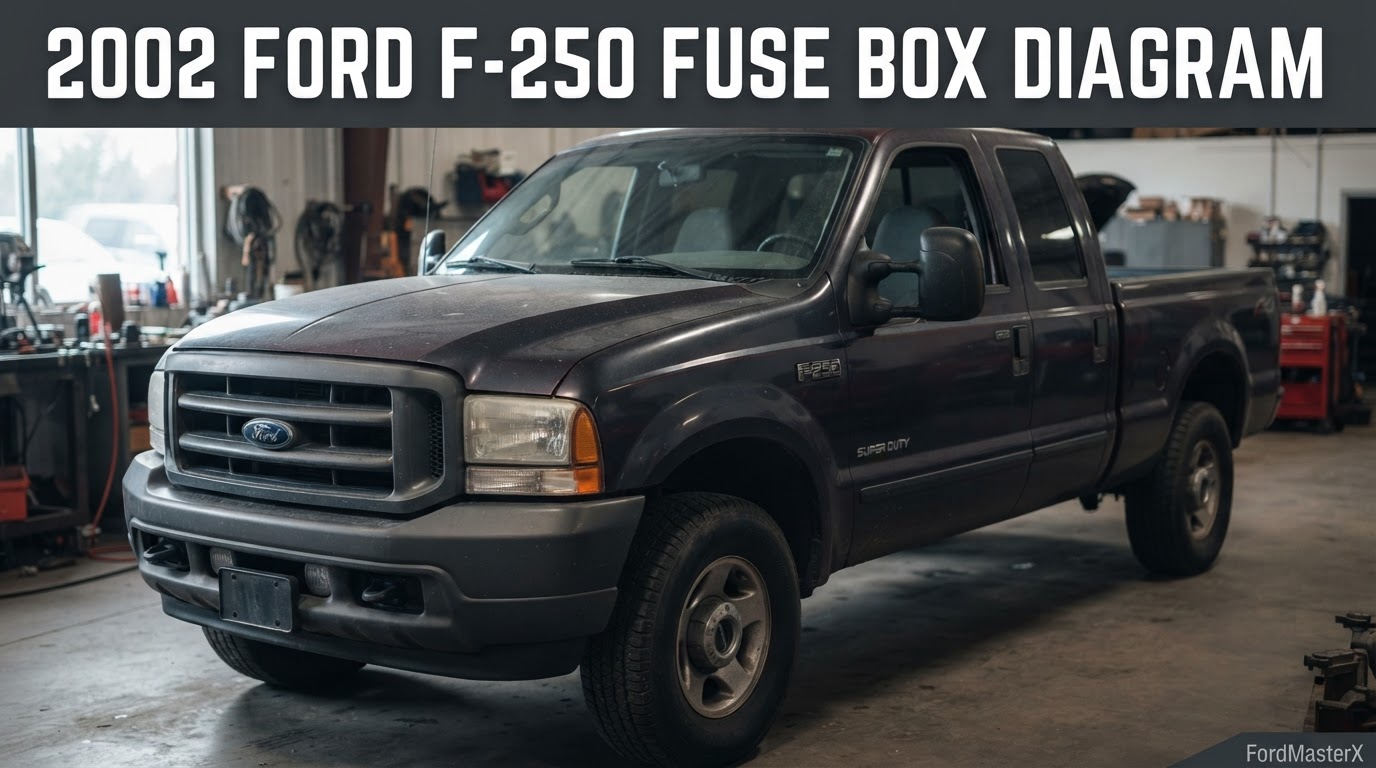
2002 Ford F-250 Fuse Box Diagram: Cabin and Under-Hood Charts

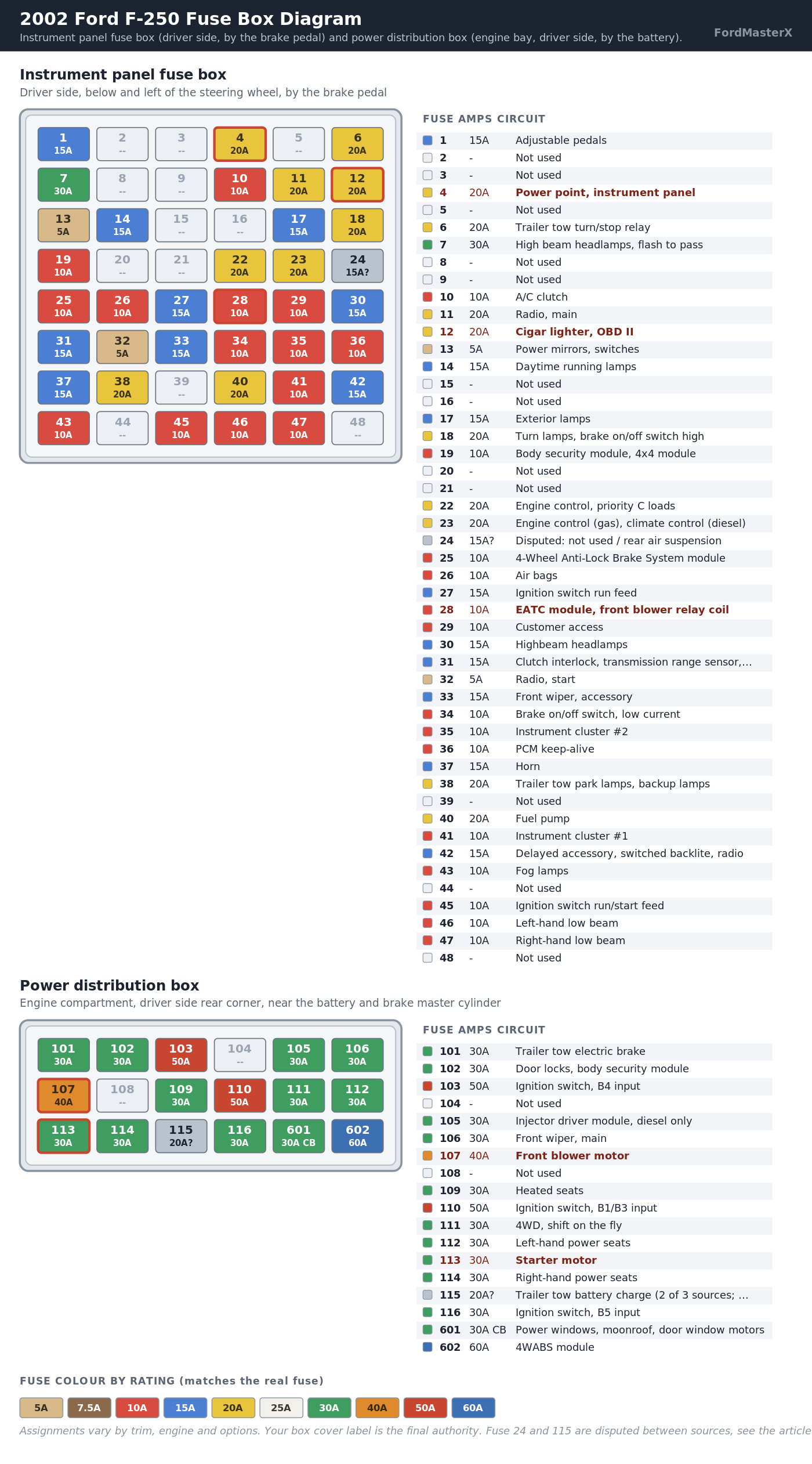
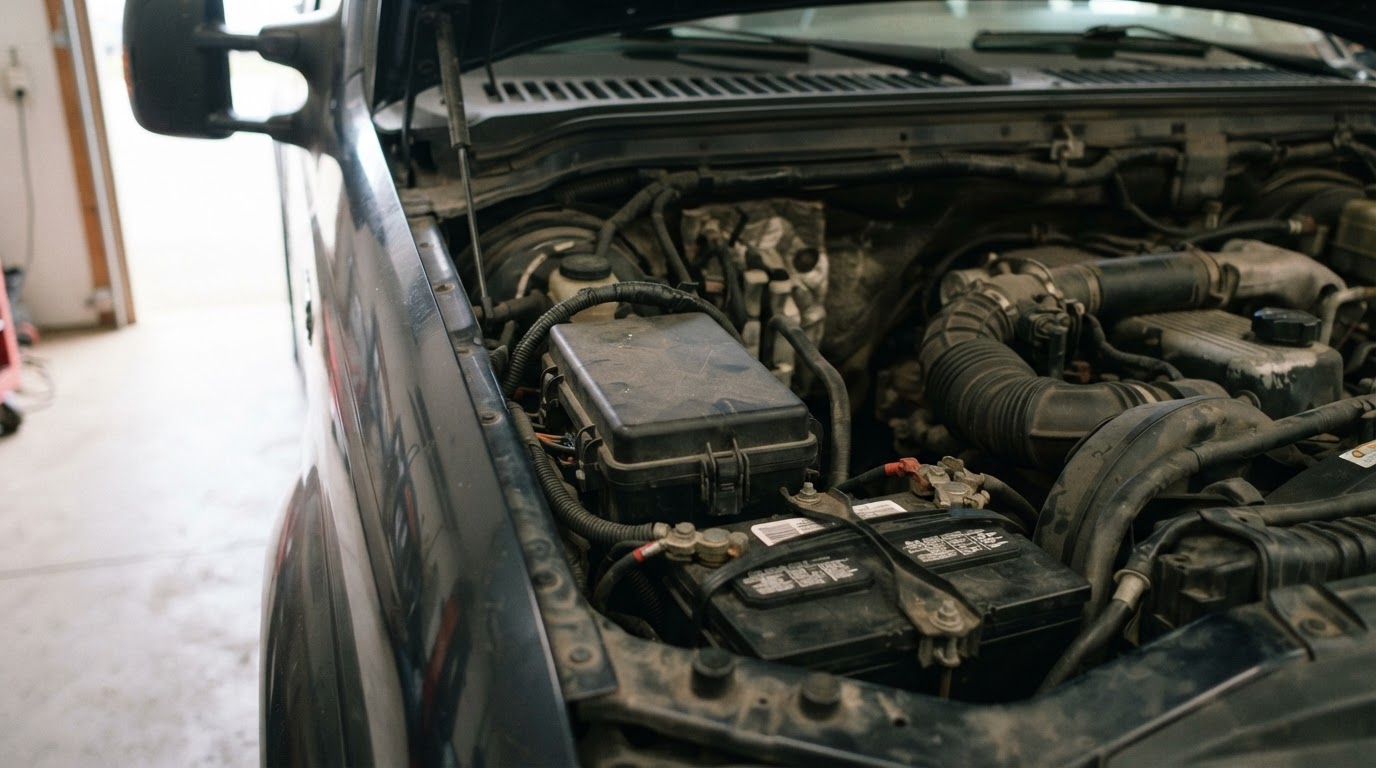
Your 2002 Ford F-250 Super Duty has two fuse boxes. The instrument panel fuse box sits below and left of the steering wheel, by the brake pedal. The power distribution box is in the engine bay, driver side, near the battery. The cigar lighter is fuse 12, rated 20A, in the instrument panel box.
Where are the fuse boxes on a 2002 F-250?


Both boxes carry real fuses on this truck.
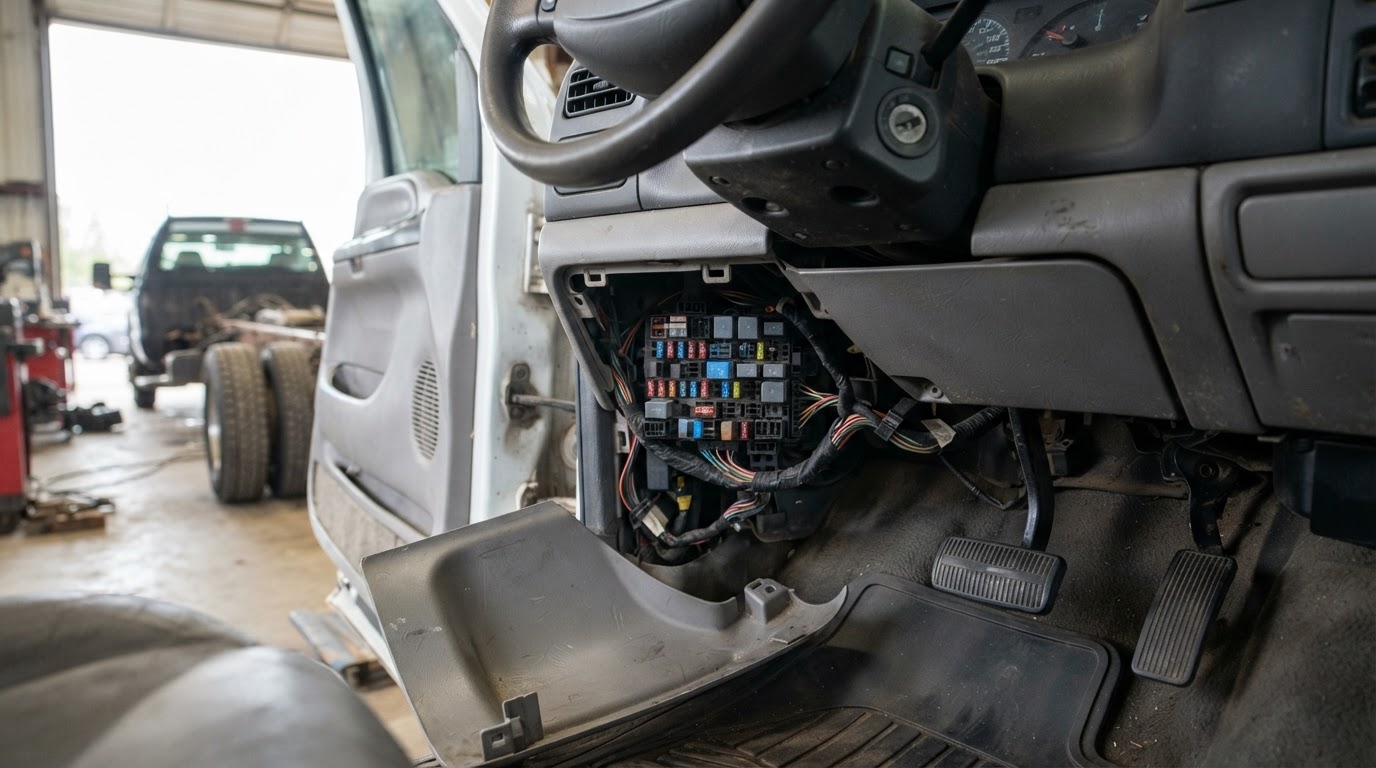
Instrument panel fuse box. Driver side, below and left of the steering wheel, by the brake pedal, behind a removable kick panel cover. This holds mini fuses 1 to 48.
Power distribution box. Engine compartment, driver side rear corner, near the battery and the brake master cylinder. It carries cartridge fuses 101 to 116, plus a circuit breaker at 601 and a maxi fuse at 602. Relays fill positions 210 to 307.
If you own a different model year, do not carry this chart across the line. A 1999 to 2001 Super Duty uses a completely different numbering scheme. That older panel runs fuses 1 to 31 in the cab, with five relay slots. Your 2002 truck uses the 1 to 48 plus 101 to 602 layout instead. Our 1999 Ford F-250 fuse box diagram covers that earlier panel.
What changes at 2002 and again at 2005 (most sites miss this)


Ford’s Super Duty fuse panel is not one chart for 1999 through 2007. It is at least three.
1999 to 2001 uses the older-style panel. Fuses 1 to 31 sit in the cab, with a separate 1 to 41 power distribution box. The cigar lighter is fuse 3, rated 25A.
2002 to 2004, your truck’s era, is a full renumbering. The cab panel jumps to 48 positions. The engine bay box switches to the 101 to 602 cartridge numbering. The cigar lighter moves to fuse 12 at 20A, and the ignition switch feed fuses, 103 and 110, carry 50A.
2005 to 2007 renumbers again inside the same body style. Ignition switch fuses 103 and 110 drop from 50A to 30A. The front blower motor moves off fuse 107 entirely, into a separate engine compartment fuse box your 2002 truck does not have.
A 2006 or 2007 Super Duty also gained an auxiliary relay box for the shift-on-the-fly system. Our 2008 Ford F-250 fuse box diagram covers that later numbering in full.
I checked this against two sources. Fuse-box.info publishes 2000 to 2003 as one article, each year broken out separately. Auto Genius publishes 2002 to 2007 as one article, but tags every position that changes at 2005. Both confirm the same boundary.
A generic chart labelled simply “2002-2007 F-250 fuse box” will not separate those two periods. It can hand you the wrong ignition fuse rating. It can also send you looking for the blower in a box your truck does not have.
Here is the number a generic site will not give you. Your truck’s ignition switch fuses, 103 and 110, are rated 50A. A 2005 or later Super Duty carries 30A at those same two positions. It wears the identical “F-250 Super Duty” name on the fender.
2002 F-250 instrument panel fuse chart


Driver side, by the brake pedal. All mini fuses.
| Fuse | Amps | Circuit protected |
|---|---|---|
| 1 | 15A | Adjustable pedals |
| 2 | – | Not used |
| 3 | – | Not used |
| 4 | 20A | Power point, instrument panel |
| 5 | – | Not used |
| 6 | 20A | Trailer tow turn/stop relay |
| 7 | 30A | High beam headlamps, flash to pass |
| 8 | – | Not used |
| 9 | – | Not used |
| 10 | 10A | A/C clutch |
| 11 | 20A | Radio, main |
| 12 | 20A | Cigar lighter, OBD II |
| 13 | 5A | Power mirrors, switches |
| 14 | 15A | Daytime running lamps |
| 15 | – | Not used |
| 16 | – | Not used |
| 17 | 15A | Exterior lamps |
| 18 | 20A | Turn lamps, brake on/off switch high |
| 19 | 10A | Body security module, 4×4 module |
| 20 | – | Not used |
| 21 | – | Not used |
| 22 | 20A | Engine control, priority C loads |
| 23 | 20A | Engine control, gasoline. Climate control, diesel |
| 24 | 15A, disputed | Sources disagree, see note below |
| 25 | 10A | 4-Wheel Anti-Lock Brake System module |
| 26 | 10A | Air bags |
| 27 | 15A | Ignition switch run feed |
| 28 | 10A | EATC module, front blower relay coil |
| 29 | 10A | Customer access |
| 30 | 15A | Highbeam headlamps |
| 31 | 15A | Clutch interlock switch, transmission range sensor, starter relay coil |
| 32 | 5A | Radio, start |
| 33 | 15A | Front wiper, accessory |
| 34 | 10A | Brake on/off switch, low current |
| 35 | 10A | Instrument cluster #2 |
| 36 | 10A | PCM keep-alive |
| 37 | 15A | Horn |
| 38 | 20A | Trailer tow park lamps, backup lamps |
| 39 | – | Not used |
| 40 | 20A | Fuel pump |
| 41 | 10A | Instrument cluster #1 |
| 42 | 15A | Delayed accessory, switched backlite, radio |
| 43 | 10A | Fog lamps |
| 44 | – | Not used |
| 45 | 10A | Ignition switch run/start feed |
| 46 | 10A | Left-hand low beam |
| 47 | 10A | Right-hand low beam |
| 48 | – | Not used |
Assignments vary with trim, engine and options. Your truck may not use every position listed.
2002 F-250 power distribution box chart
Engine bay, driver side rear corner, near the battery. Cartridge and maxi fuses.
| Fuse | Amps | Circuit protected |
|---|---|---|
| 101 | 30A | Trailer tow electric brake |
| 102 | 30A | Door locks, body security module |
| 103 | 50A | Ignition switch, B4 input |
| 104 | – | Not used |
| 105 | 30A | Injector driver module, diesel only |
| 106 | 30A | Front wiper, main |
| 107 | 40A | Front blower motor |
| 108 | – | Not used |
| 109 | 30A | Heated seats |
| 110 | 50A | Ignition switch, B1/B3 input |
| 111 | 30A | 4WD, shift on the fly |
| 112 | 30A | Left-hand power seats |
| 113 | 30A | Starter motor |
| 114 | 30A | Right-hand power seats |
| 115 | 20A, disputed | Trailer tow battery charge. One of three sources lists 40A, see note below |
| 116 | 30A | Ignition switch, B5 input |
| 601 | 30A, circuit breaker | Power windows, moonroof, door window motors |
| 602 | 60A | 4WABS module |
Relays in this box: 301 front blower motor, 302 powertrain control module, 303 injector driver module on diesel trucks. Also 305 trailer tow battery charge, 306 delayed accessory, 307 starter. Positions 210 and 212 are trailer tow turn and stop relays. Assignments vary with trim and options.
Where sources disagree, and which to trust
Two positions did not match cleanly across fuse-box.info, StartMyCar and Auto Genius.
Fuse 24, instrument panel box. Fuse-box.info marks it not used, a spare slot. StartMyCar lists it as a 15A rear air suspension circuit. Auto Genius does not assign it on a 2002 gasoline truck either.
Super Duty trucks offered an optional rear air suspension package in this era. A used slot on one build and an active one on another, by option, is plausible. Two of three sources say not used.
Fuse 115, power distribution box. Fuse-box.info and Auto Genius both list 20A for trailer tow battery charge. StartMyCar lists the same circuit at 40A. Two of three sources agree on 20A, so that is what the chart above shows.
In both cases, the fuse box cover label on your own truck is the final authority. Options and running production changes move individual positions in ways no third party chart catches every time.
Which fuse is the cigar lighter and 12V power point?
On a 2002 F-250 the cigar lighter is fuse 12, rated 20A, in the instrument panel box. It shares that circuit with the OBD II scan tool connector. A blown fuse 12 can also stop a scan tool from connecting.
The dash-mounted 12V power point in front of the shifter is a separate circuit. That is fuse 4, 20A, also in the instrument panel box.
Both ratings hold for 2002 through 2004. Confirm the fuse is good first. Our Ford F-250 fuse box diagnosis guide covers tracing a dead power point from there.
Which fuse controls the radio?
Two fuses feed the audio system on this truck.
- Fuse 11, 20A, radio main. Instrument panel box. Blow this and the radio is dead.
- Fuse 32, 5A, radio start. Instrument panel box. Feeds the radio only while the key is in the start position.
Fuse 42 also touches the radio through the delayed accessory circuit, shared with the power switched backlite. If the radio only loses power a few seconds after you shut the truck off, check fuse 42 before 11.
Which fuse controls the A/C, blower and heated seats?
Comfort circuits split across both boxes, so the symptom tells you which one to open.
| Symptom | Check this | Box |
|---|---|---|
| Fan blows but never gets cold | Fuse 10, 10A, A/C clutch | Cab panel |
| No air at any fan speed | Fuse 107, 40A, front blower motor | Engine bay |
| Climate controls unresponsive, blower relay dead | Fuse 28, 10A, EATC module and blower relay coil | Cab panel |
| Heated seats do not warm | Fuse 109, 30A, heated seats | Engine bay |
| Power seat will not move | Fuse 112 driver, 114 passenger, 30A each | Engine bay |
The blower motor is the one people get wrong most. It is a 40A cartridge fuse in the engine bay box, not a mini fuse behind the dash. If the fan runs on high but nothing else works, the fuse is fine. Look at the blower motor resistor or relay next.
If nothing on the climate system responds at all, check fuse 28 in the cab panel first. Do that before you assume a bigger fault.
Which fuse stops the truck from starting?
Three positions can leave you turning the key with nothing happening.
- Fuse 113, 30A, engine bay. Starter motor. No crank at all points here first.
- Fuse 103, 110 and 116, engine bay. Ignition switch feeds, B4, B1/B3 and B5 inputs, 50A and 30A. Any one of these open can kill the whole truck’s electrical system.
- Fuse 40, 20A, cab panel. Fuel pump. Engine cranks normally but will not fire.
Cranks but will not start points at fuel, so check 40. No crank at all points at 113 or the ignition switch fuses.
How do you tell if a fuse is actually blown?
Pull it and look through the plastic window at the metal strip. An intact fuse has an unbroken element. A blown one shows a visible gap, or the window is smoked brown or black.
Three things catch people out on this truck:
- A hairline break looks intact. Hold the fuse to a light. If you are not certain, test continuity with a multimeter set to ohms. Near zero means good.
- Never guess the replacement rating. Match the number printed on the fuse and cross-check the box cover label. Fitting 30A where 10A belongs lets the wiring become the fuse.
- The power distribution box fuses need a puller. Positions 101 to 116 are the flat cartridge type. Pliers crack the housing. A mixed ATO/ATC fuse assortment kit costs less than one dealer fuse and usually includes the puller.
Why does the same fuse keep blowing?
A fuse that blows once is usually a surge. One that blows again within days means the fault is upstream. Replacing it repeatedly just treats the alarm, not the fire.
Work through it in this order:
- Unplug whatever you added most recently. Trailer wiring, a dash cam, an aftermarket stereo, a charger left in the power point. Aftermarket accessories cause most repeat blows on these trucks.
- Check where the harness moves. Door jambs, the tailgate run, and anywhere near the steering column flex thousands of times and chafe.
- Look for water. A wet connector shorts intermittently, which is why the fuse survives a dry week and fails in the rain.
Fuse 101 and 115 feed the trailer tow system on this truck. If either keeps blowing and you tow regularly, check the trailer connector and harness before you fault the truck’s wiring.
If a fuse blows the instant you seat it, there is a hard short. Stop replacing fuses and trace the circuit instead. A Ford-capable scan tool reads live data rather than guessing.
The cigar lighter fuse also feeds the OBD II connector on this truck. Confirm fuse 12 is good before you blame the scan tool itself.
2002 F-250 fuse quick reference
The positions owners look up most, in one place. C means the cab panel, E means the engine bay box.
| What you want | Fuse | Amps | Box |
|---|---|---|---|
| Cigar lighter, OBD II connector | 12 | 20A | C |
| Power point, instrument panel | 4 | 20A | C |
| Radio, main | 11 | 20A | C |
| A/C clutch | 10 | 10A | C |
| Front blower motor | 107 | 40A | E |
| Blower relay, climate controls | 28 | 10A | C |
| Fuel pump | 40 | 20A | C |
| Starter motor | 113 | 30A | E |
| Ignition switch, B4 input | 103 | 50A | E |
| Ignition switch, B1/B3 input | 110 | 50A | E |
| Power windows, moonroof | 601 | Breaker | E |
| 4-Wheel ABS module | 602 | 60A | E |
| Heated seats | 109 | 30A | E |
| Trailer tow electric brake | 101 | 30A | E |
| High beam headlamps | 7 | 30A | C |
| Low beam, left / right | 46 / 47 | 10A | C |
| Fog lamps | 43 | 10A | C |
| Horn | 37 | 15A | C |
| Air bags | 26 | 10A | C |