
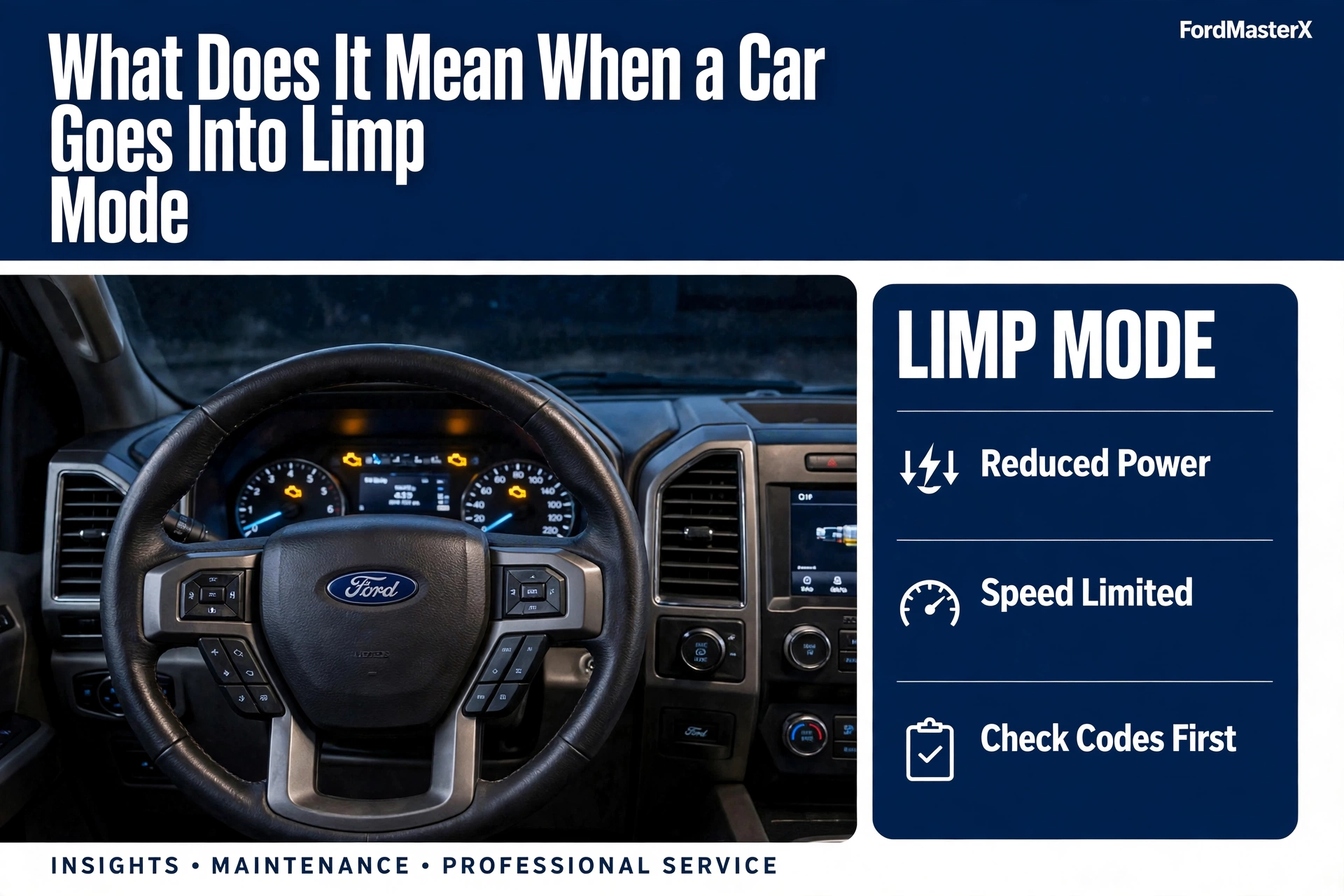
What Does It Mean When a Car Goes Into Limp Mode 2026 Guide

What does it mean when a car goes into limp mode? It means the car’s computer detected a fault that could damage the engine or the transmission, so it cut power on purpose to protect those parts.
Limp mode is not a breakdown in itself. It is a safety response, and the car can usually still move slowly to a safe place or to a shop.
The name says it plainly. The car limps instead of running at full strength, because running at full strength with that fault could cause serious damage.
This guide explains what limp mode means, what the computer actually does, why it triggers, what to do in the first minutes, and when to stop driving and call for a tow.
The Short Answer in 5 Signs
Five signs explain most limp mode events. The table below holds them, and the infographic after it gives you the same facts to save or share.
| Sign | What you notice | What it means |
|---|---|---|
| Sudden power loss | Pressing the pedal does almost nothing | The computer is limiting throttle |
| Low RPM ceiling | Engine will not rev past a low point | The computer capped engine speed |
| Stuck in one gear | Automatic stays in second or third | The transmission is in failsafe |
| Warning light | Check engine light or wrench light on | A fault code was stored |
| Slow top speed | Car will not go faster than a low limit | Speed is capped for protection |
Limp Mode At a Glance
The signs, the typical limits, and the first step, as observed in November 2026.
| Measure | Observed figure | Result |
|---|---|---|
| Direct meaning | Computer limits power to protect the engine and transmission | You can usually still move slowly |
| Typical RPM limit | About 2,500 to 3,000 RPM | Engine will not rev normally |
| Typical speed limit | About 35 to 45 mph | Too slow for fast traffic |
| Common gear limit | Often second or third gear | Slow starts and harsh shifts |
| First step | Pull over safely, then read the codes | A restart is a test, not a repair |
Direct answer: Limp mode means your car detected a fault and cut power to protect itself. Drive slowly only to a safe place or a shop, read the fault codes, and do not treat a restart as a repair.
Sources: AutoZone limp mode guide; MechanicBase limp mode guide; Jalopnik limp mode explainer; Rohnert Park Transmission limp mode guide. Limits are typical ranges and vary by make, model, engine, and transmission.
One sign alone does not prove limp mode. A warning light with normal power is a different problem, and low power with no light can be a fuel or air fault.
When several signs arrive together, the picture is clear. The computer has stepped in, and the fault code will name the system it was protecting.
What the Computer Actually Does
Modern cars are run by computers that watch dozens of sensors every second. They check engine speed, throttle position, transmission pressure, coolant temperature, air flow, and exhaust readings against the values they expect.
When a reading falls outside the safe range, or when two readings contradict each other, the computer switches to a reduced power strategy. That strategy is what drivers call limp mode, and some makers call it failsafe mode or reduced power mode.
The computer can limit power in several ways at once. It can cut the throttle opening, change the ignition timing, cap engine speed, and hold the transmission in one gear.
The exact limits vary by make, model, engine, and transmission. The AutoZone limp mode guide lists the same pattern: reduced power, limited RPM, a single gear, warning lights, and altered shifting.
Typical limits reported by repair sources are an engine that will not rev past about 2,500 to 3,000 RPM and a speed capped at about 35 to 45 mph. Those are typical ranges, not a specification for your car, and your car may limit itself more or less than that.
The Rohnert Park Transmission limp mode guide describes the same fingerprint: a car that will not accelerate past about 35 to 45 mph, an engine that will not rev past about 3,000 RPM, and a transmission that feels stuck in one gear. That guide also warns that a restart is only a temporary test, not a repair.
The computer may also limit nonessential systems in some cars. Climate control may be reduced or limited rather than stopped, the cruise control will not work, and the engine may run rough or shake if a misfire is part of the fault.
None of this means the computer is broken. The computer is doing its job, and the fault it found is the problem to fix.
Why the Car Does Not Just Stop
A car that stopped dead on a highway would be more dangerous than a car that crawls. The makers chose a middle path: enough power to reach safety, and little enough power to limit the damage.
That middle path is why limp mode exists. It protects the engine and the transmission while it still lets you move out of traffic.
The trade is real, though. A car capped at a low speed is a hazard in fast traffic, so the first job is always to get out of the fast lane and off the road.
Engine Failsafe Mode vs Transmission Limp Mode
Drivers use one name for two different protections. The engine computer and the transmission computer can each limit the car, and they do it for different reasons.
Engine failsafe mode is about the engine. The engine computer limits throttle, engine speed, or fuel when it sees a misfire, an overheating engine, a throttle fault, or a sensor reading it cannot trust.
Transmission limp mode is about the gearbox. The transmission computer holds one gear, usually second or third, when it sees a sensor fault, a solenoid fault, low fluid, overheating, or an internal pressure problem.
Both protections can appear at the same time. A transmission fault can limit engine power, and an engine fault can change how the transmission shifts, so the two systems are linked.
| Type | What limits the car | Typical signs | Common triggers |
|---|---|---|---|
| Engine failsafe mode | Engine computer limits throttle and RPM | Weak pedal, low RPM ceiling, wrench or check engine light | Throttle body, misfire, overheating, bad sensor |
| Transmission limp mode | Transmission computer holds one gear | Stuck in second or third, harsh shifts, slow starts | Low fluid, solenoid fault, sensor fault, overheating |
The difference matters when you diagnose the car. An engine only scan can miss a transmission fault, because the code lives in the transmission module, not the engine module.
That is why a good scan reads both modules. A code reader that only talks to the engine may report nothing while the transmission module holds the answer.
Our guide to how to reset engine failsafe mode on a Ford F-150 is the procedure companion to this article. That guide walks through the reset steps for one model, while this article explains what the mode means and why it triggers.
Our guide to automatic transmission high RPM before shifting covers a related symptom. High RPM before a shift can point at the transmission, and a transmission that will not shift at all points at limp mode.
Why It Happens: The Common Triggers
Limp mode has no single cause. It is a response, and the trigger can sit in the engine, the transmission, the throttle system, the sensors, or the wiring between them.
The list below covers the triggers repair sources report most often. A fault code points at one of these systems, and the code is the starting point, not the final answer.
Transmission Faults
Transmission problems are a leading trigger. Low fluid, burnt fluid, a faulty solenoid, a bad speed sensor, or overheating can all push the transmission computer into failsafe.
Low fluid is the first thing to check when the car has a dipstick. Fluid that is very low, dark brown, or smells burnt is a strong clue, and the wrong fluid type can cause damage on its own.
Many modern transmissions have no dipstick. On those cars the fluid level is checked from underneath, so the check belongs to a shop with a lift.
Our guide to the 2015 Ford Focus transmission control module shows how one Ford transmission fault works. The control module is the brain of the gearbox, and when it fails, the gearbox protects itself by limiting gears.
Throttle Body and Throttle Sensors
The electronic throttle body controls how much air enters the engine. When its motor fails, its plate sticks, or its position sensor sends a bad signal, the computer cannot trust the throttle, so it limits power.
A dirty throttle body can cause the same problem. Carbon buildup makes the plate stick, and the computer sees a throttle angle that does not match the pedal.
The accelerator pedal sensor is part of the same chain. If the pedal signal and the throttle signal disagree, the computer limits power rather than risking a runaway throttle.
Our Ford F-150 air intake diagram shows where the throttle body sits in the air path. The diagram helps you see the parts the code may be pointing at before you replace anything.
Sensor Failures
Modern cars rely on sensors for almost every decision. Speed sensors are a leading cause of limp mode, because the transmission needs a true road speed to choose a gear.
Mass air flow sensors, throttle position sensors, oxygen sensors, and crankshaft position sensors can each trigger limp mode when they fail. A sensor that sends no signal is easy to spot, but a sensor that sends a wrong signal is harder, because the computer must decide which reading to trust.
Wiring is often the real fault behind a sensor code. A damaged wire, a corroded connector, or a poor ground can make a good sensor look bad, so the circuit should be tested before the sensor is replaced.
Turbo, DPF, and Exhaust Faults
Turbocharged engines can enter limp mode when boost pressure goes wrong. A boost leak, a stuck actuator, or a faulty boost sensor can push pressure too high or too low, and the computer cuts power to protect the engine.
Diesel cars add the diesel particulate filter, known as the DPF. When the filter clogs with soot and regeneration fails, exhaust backpressure rises, and the car can enter limp mode with smoke from the exhaust.
The exhaust gas recirculation valve, known as the EGR valve, can clog with carbon in the same way. A stuck EGR valve upsets the air and fuel mix, and the computer responds by limiting power.
Our guide to Ford 6.7 Powerstroke problems by year covers diesel faults on Ford trucks, including turbo and emissions parts. Diesel limp mode often starts with one of those systems.
Overheating and Low Fluids
Overheating is a direct trigger. When coolant temperature climbs past the safe range, the computer may cut fuel to some cylinders so fresh air can cool the engine, and the car will still move slowly.
Low engine oil can trigger the same protection on some cars. Oil pressure that drops too low means the engine is not protected, so the computer limits load until the problem is fixed.
Coolant leaks, a faulty thermostat, and a failed radiator fan are common causes of overheating. Any of them can put the car into limp mode on a hot day or under a heavy load.
Misfire and Fuel Delivery
A bad misfire can damage the catalytic converter and the engine itself. When the computer sees a misfire that is severe enough, it limits power to stop the damage.
You will feel a misfire as a rough idle, shaking, or uneven acceleration. The check engine light may flash, and a flashing light means the misfire is active right now.
Fuel delivery faults cause the same response. A failing fuel pump, a clogged filter, or a bad injector can starve the engine, and the computer limits power rather than letting it run lean.
Electrical Glitches and Low Voltage
Low system voltage can confuse the computers. A weak battery, a failing alternator, or a corroded ground can create fault codes in several modules at once, and the car can enter limp mode with no single part at fault.
That is why voltage codes matter. If the scan shows voltage or communication codes, the battery, the charging system, and the grounds should be tested before any part is replaced.
A low or flat battery can even trip the check engine light on its own. A booster pack may restart the car, but the underlying voltage problem still needs a test.
Ford Drivers: The Wrench Light and Throttle Body
Ford drivers see limp mode through the wrench light. On many Fords the wrench light means the powertrain has limited throttle authority and entered a reduced power state.
Ford describes the Powertrain Malfunction or Reduced Power message as the detection of a fault in the powertrain, the all-wheel-drive system, or the four-wheel-drive system. The owner guide tells the driver to have the system inspected.
The check engine light can mean many things, but the wrench light narrows the field. It shifts the odds toward throttle control, pedal input, or another powertrain input that the computer no longer trusts.
The electronic throttle body is the most common Ford trigger. Ford and Lincoln cars with the 3.5L EcoBoost engine, including the 2013 to 2019 Explorer, the 2010 to 2019 Taurus and Flex, and the Lincoln MKT and MKS, had a known throttle body problem.
When the throttle body fails on one of these cars, the computer can no longer control the throttle accurately. It forces the engine into a reduced power state, and the car can enter limp home mode or stall without warning.
Customer Satisfaction Program 13N03 is a different program for a different set of cars. It covers 2009 to 2013 Fusion, Milan, Escape and Mariner cars with 2.5L or 3.0L engines only, and it is not a formal recall.
The program extended throttle body cover to 10 years or 150,000 miles from the original warranty start date. It has since expired for most of those cars based on time, but it is still worth checking with a Ford dealer whether any cover remains for your exact car.
Cleaning the throttle body can help when carbon is the problem. If the motor contacts are worn, cleaning will not fix it, and the throttle body needs replacement.
Our guide to what year Ford Focus to avoid covers the same kind of year by year check for a used Ford buyer. A Focus with a transmission fault history deserves the same careful look as a car that has entered limp mode.
Our guide to how to check your Ford warranty shows how to confirm cover by VIN before you pay. A throttle body or a transmission fault may still be covered, and the check takes minutes.
What to Do Right Now
What you do in the first minutes matters. The steps below are safe, simple, and in the right order, and they do not need tools.
- Get out of fast traffic. Signal, ease to the right, and take the first safe exit or shoulder. Turn on the hazard lights if you are slowing sharply.
- Stop in a safe place. Choose a parking lot or a wide shoulder, put the car in Park, and apply the parking brake before you do anything else.
- Read the gauges. Check the temperature gauge, the oil pressure warning, and any message on the cluster. Note which lights are on.
- Try the restart test. Switch the engine fully off, wait one to two minutes so the computer can power down, then restart and see if normal power returns.
- Read the codes. Plug in an OBD-II scanner and record every code before you clear anything. Note the conditions when the fault appeared.
- Drive only to safety or a shop. If the restart worked, drive gently to the nearest shop. If the fault returns, stop and call for a tow.
The restart test is the step most drivers ask about. The Jalopnik limp mode explainer gives the same advice: pull over, stop the car, and restart it, because a minor glitch can trip the mode, but if the restart fails, the car needs an inspection at a service center.
A restart that works does not mean the car is fixed. The fault that triggered limp mode is still there, and the car will usually enter limp mode again within a few miles if the fault is active.
Clearing codes without reading them first is a mistake. The codes are the only record of what the computer saw, and clearing them erases the evidence the mechanic needs.
Disconnecting the battery is a stronger reset, and it can erase radio presets, clock settings, and learned idle settings. It also erases useful diagnostic information, so record the codes first.

AI-generated illustration: a Ford F-150 dashboard with two amber check engine warning lights lit at dusk.
What Not to Do
Do not keep clearing the codes and driving. Each reset hides the fault for a while, and driving on a slipping or overheating transmission can turn an affordable repair into a full rebuild.
Do not try to bypass limp mode. The limit is a safety system, and defeating it lets the car run at full power with a fault that could destroy the engine or the transmission.
Do not ignore a flashing check engine light. A flashing light means a misfire is active now, and driving with it can damage the catalytic converter within minutes.
Is It Safe to Drive in Limp Mode
There is no safe mileage limit that applies to every car. Some cars still move well enough to reach a nearby safe place, and others have too little power or a transmission fault that makes driving unsafe.
The safe answer depends on three things: the gauges, the traffic, and the symptoms. If any one of them is bad, stop driving and arrange help.
- Keep driving slowly if: the temperature gauge is normal, no oil pressure warning is on, the car holds a steady low speed, and the shop is close on slow roads.
- Stop and tow if: the engine is overheating, the oil pressure warning is on, the car makes a serious mechanical noise, or it cannot keep up safely with traffic.
- Stop and tow if: the check engine light is flashing, the transmission slips or bangs into gear, or the car stalls at idle.
- Stop and tow if: you are on a highway with no safe shoulder, the car cannot hold a safe speed, or you feel unsafe merging or turning.
On city streets a car in limp mode is slow but manageable. It will not accelerate quickly from a red light, and it will struggle on hills, so keep the speed low and the distance to other cars long.
On a highway the same car is a hazard. Take the first exit, and if you cannot reach one safely, pull onto the shoulder, switch on the hazard lights, and call for help.
Turn off nonessential electrical systems if the car lets you. The air conditioning, the stereo, and the interior fan all draw power, and switching them off can give the car a little more to work with.
Watch the temperature gauge the whole way. If the needle climbs or a temperature warning appears, switch the engine off as soon as you can stop safely and call for a tow.
Our guide to why your car sounds loud helps you tell a limp mode noise apart from other engine noise. A rattle or a knock that arrives with limp mode points at the fault, not at the exhaust.
Our guide to why your engine is making a rattling noise covers the sounds that mean stop driving at once. A loud, fast rattle with a warning light is a tow, not a slow drive to the shop.
How a Mechanic Diagnoses It
Diagnosis starts with the scan, not with a part. A mechanic reads the codes, saves the freeze frame data, and then tests the system the codes point at.
Freeze frame data records the conditions when the fault appeared. Engine speed, load, temperature, and throttle position at that moment can show whether the fault is hot, cold, under load, or at idle.
The MechanicBase limp mode guide sets out the same order: scan all relevant modules, look at related codes together, check the conditions when the fault occurred, inspect the system the evidence points at, compare readings with the specifications for the exact car, then repair and verify.
That order matters because one fault can trigger other codes. Replacing the part named in the first code can miss the real fault, and the car will enter limp mode again.
A basic code reader can still give useful information. A more capable scan tool is needed to read transmission faults, maker specific codes, and live data, so a cheap reader that shows no code does not mean the car is clear.
After the scan, the mechanic inspects the parts the codes point at. Connectors, wiring, hoses, fluid level and condition, and the throttle body are checked before any part is ordered.
Live data is compared with the specifications for the exact car. Sensor readings and normal ranges are not universal, so the service information for your year, make, model, engine, and transmission is the standard.
After the repair, the codes are cleared and the car is test driven under the same conditions that triggered the fault. The repair is only done when the fault does not return.
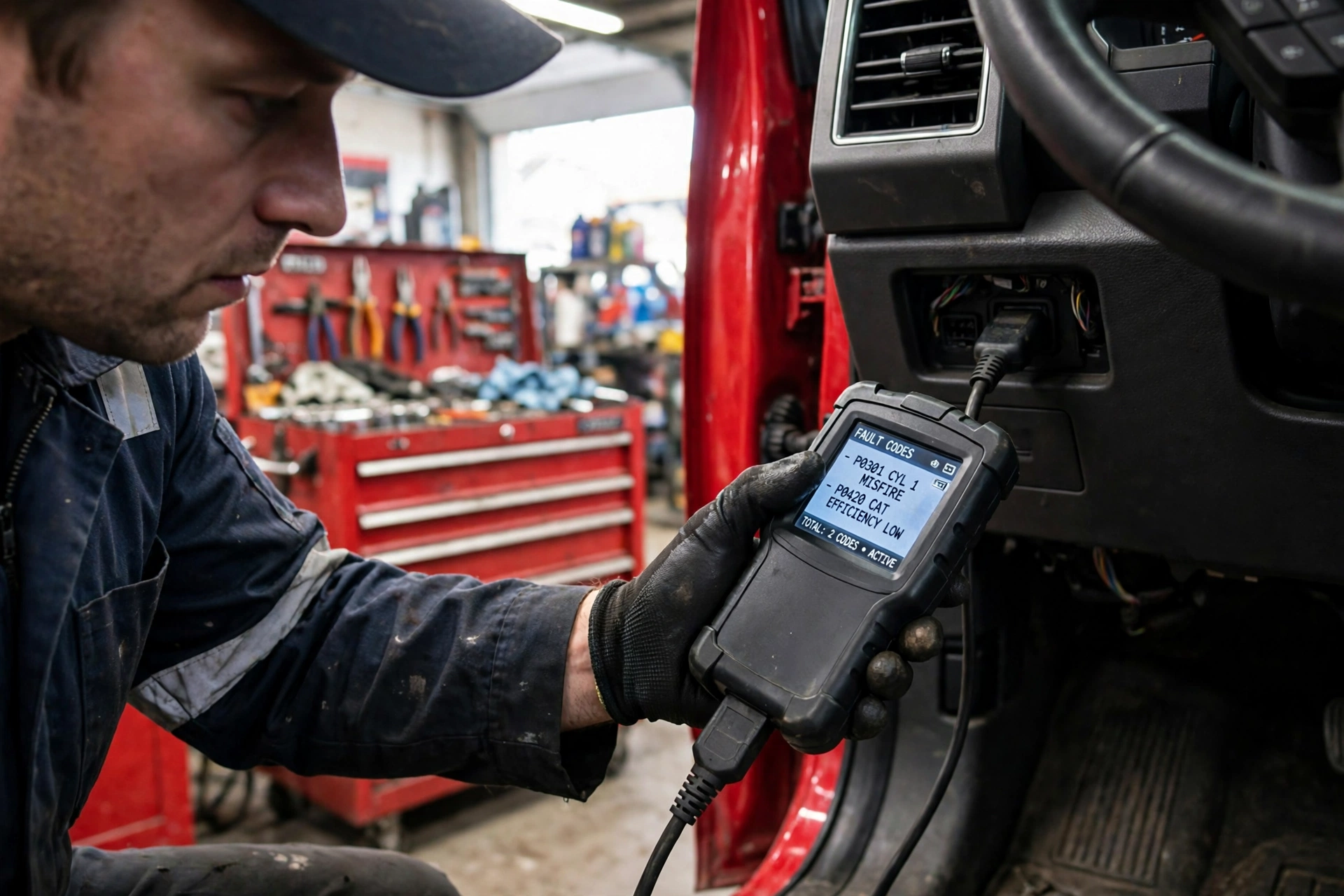
AI-generated illustration: a mechanic reading fault codes on a handheld OBD-II scanner plugged into a Ford F-150.
What the Fix Costs
There is no single repair cost for limp mode, because limp mode describes how the car is operating, not one specific failure. The cost depends on the cause, and the cause can be minor or major.
A loose connector, a low fluid top up, or a repairable leak can be a minor bill. A failed transmission, a failed throttle body, or a clogged diesel filter can be a major bill.
The table below gives typical ranges for common causes. Costs are US national averages and vary by model, region, and dealer, so treat them as a guide, not a quote.
| Cause | Typical fix | Typical cost range | How urgent |
|---|---|---|---|
| Loose connection or corroded connector | Clean and repair the connection | Low, often under 200 dollars | Soon |
| Faulty sensor | Test the circuit, then replace the sensor | 150 to 400 dollars | Soon |
| Throttle body fault | Clean or replace the throttle body | 300 to 800 dollars | Within days |
| Transmission fluid low or burnt | Change fluid and filter, find the leak | 200 to 500 dollars | Soon |
| Transmission solenoid or sensor | Replace the faulty part | 400 to 1,000 dollars | Within days |
| Turbo or DPF fault | Repair boost leak or clean or replace the filter | 500 to 2,500 dollars | Soon |
| Major transmission failure | Rebuild or replace the transmission | 2,500 dollars and up | Do not drive |
The cheapest outcome is also the most hopeful one. Many limp mode events trace back to a sensor, a connector, or a fluid level, and those fixes are far cheaper than a rebuild.
The most expensive outcome is a transmission rebuild. That is why the restart test is not a repair, and why driving for weeks in limp mode is the most expensive choice of all.
Get a written estimate before you agree to any work. Ask the shop to name the code, the test that proved the cause, and the part that will be replaced, so you are paying for a diagnosis, not a guess.
Our guide to Ford powertrain warranty cover explains what cover a new Ford carries. A transmission or throttle fault inside the warranty period may be a warranty claim, not a bill you have to pay.
Questions Ford Owners Ask About Limp Mode
What Does It Mean When a Car Goes Into Limp Mode
It means the car’s computer detected a fault and limited power to protect the engine or the transmission. The car can usually still move slowly, but the fault needs diagnosis and repair.
Can You Drive in Limp Mode
You can usually drive slowly to a nearby safe place or shop if the temperature is normal, no oil pressure warning is on, and the car holds a steady low speed. Stop and call for a tow if the car overheats, the oil warning is on, the check engine light flashes, or the car cannot keep up safely with traffic.
How Do You Get a Car Out of Limp Mode
Find and repair the fault that caused it. A restart or a code clear may change how the car behaves for a while, but neither fixes the fault, and the car will usually enter limp mode again if the fault is still active.
Will Limp Mode Go Away on Its Own
It can clear after a restart if the trigger was a temporary glitch, such as a brief voltage dip or a one time sensor error. If the fault returns, the computer is telling you the problem is active and needs a real diagnosis.
Does Limp Mode Always Store a Code
A control module will often store a code when it detects a fault, but a basic scanner may not read the module that stored it. Scan the engine and transmission modules with a tool that supports your car, and do not assume the car is clear because one reader shows nothing.
Can a Bad Battery Cause Limp Mode
Yes, low system voltage or a poor electrical connection can cause control module faults on some cars. If the scan shows voltage or communication codes, test the battery, the charging system, the connections, and the grounds before replacing any other part.
Is Limp Mode the Same as Engine Failsafe Mode
The names overlap, but they are not identical. Engine failsafe mode is the engine computer limiting throttle and engine speed, while transmission limp mode is the transmission computer holding one gear. Some makers use one name for both, so the fault code tells you which system stepped in.
How Much Does It Cost to Fix Limp Mode
There is no single price, because limp mode is a response, not a part. A sensor or connector fix can cost a few hundred dollars, while a transmission rebuild can cost 2,500 dollars or more. Confirm the cause with a scan before you rely on any parts estimate.
Your 5 Step Check Before You Drive
What does it mean when a car goes into limp mode? It means the computer cut power to protect the engine and the transmission, and the car needs a diagnosis, not just a restart.
Run the five step check before you drive. Pull over safely and read the gauges, try the restart test once, read and record the fault codes, drive slowly only to a shop if the car is safe, and book the repair instead of clearing the codes and hoping the fault stays away.
That check costs you a few minutes. It can save you from driving a car that should not move, and it leaves you with the code that names the system before the shop quotes the fix.