
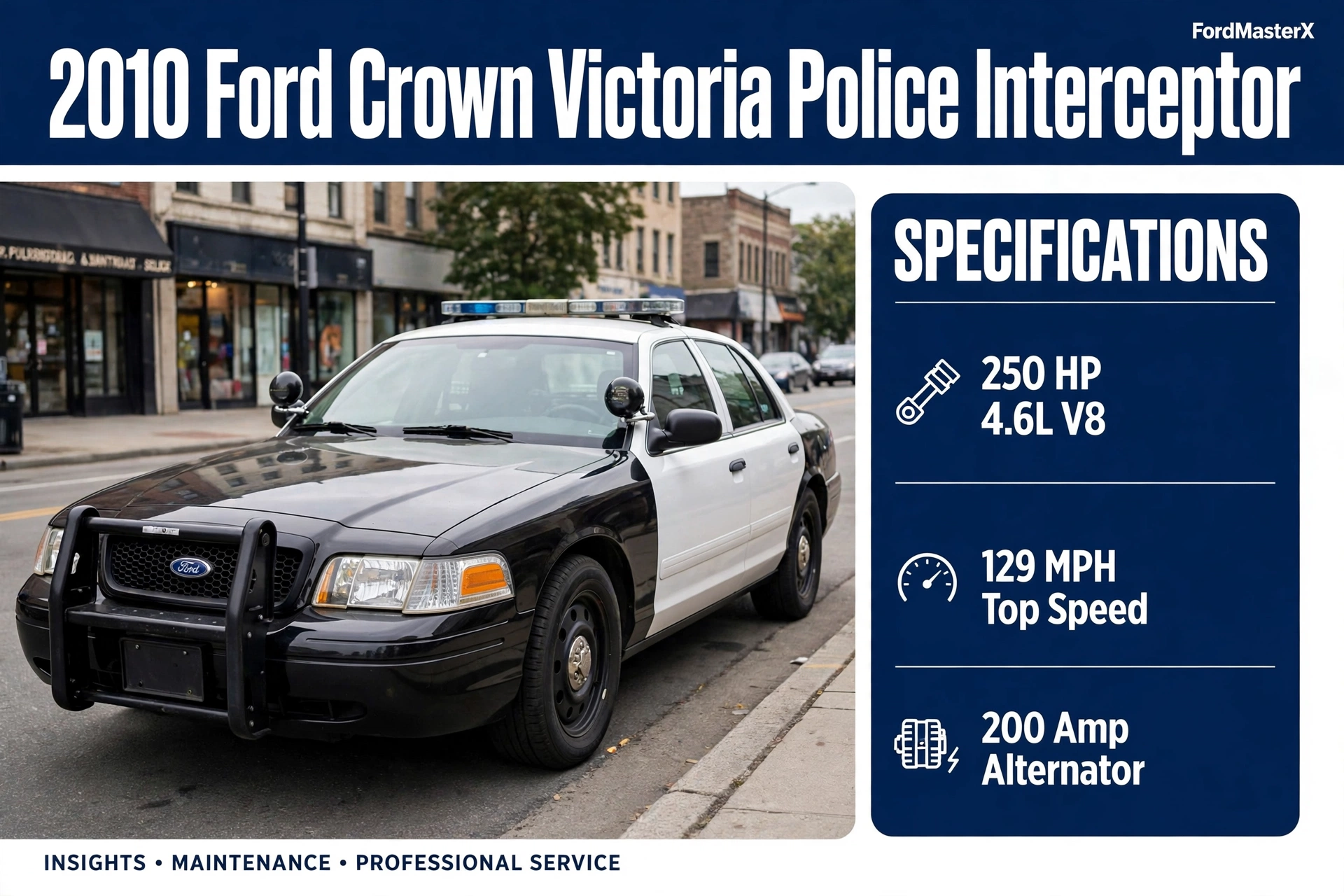
2010 Ford Crown Victoria Police Interceptor 2026 Guide

Is a 2010 Ford Crown Victoria Police Interceptor worth buying? Yes, if you buy the right car and check the idle hours first, because this is a tough, simple, body-on-frame V8 sedan that sells for very little money.
The catch is the odometer. A retired patrol car can show 90,000 miles and still carry the wear of a car with twice that number, because police cars spend hours idling at traffic stops, in parking lots, and on radar duty.
That idle time does not show on the odometer. It shows in the engine hours, and this guide shows you how to read them, what the 2010 car really is, and what to check before you pay.
The Short Answer
The 2010 Crown Victoria Police Interceptor is a fleet-only patrol sedan built on the Panther platform, powered by a 4.6 liter V8 rated at 250 horsepower and 297 lb-ft of torque, with a four-speed automatic and rear-wheel drive.
Ford sold it only to police fleets, never to the public new. Every 2010 car on the used market is a retired working car, and its condition depends far more on which agency ran it and how many hours it idled than on its model year.
| Spec | 2010 Police Interceptor |
|---|---|
| Engine | 4.6L 2V SOHC V8, 250 hp, 297 lb-ft |
| Transmission | 4-speed automatic, 4R75E |
| Drivetrain | Rear-wheel drive, body-on-frame |
| Rear axle | 3.27 open standard, 3.55 Trac-Lok optional |
| Top speed | 129 mph with 3.27 axle, 119 mph with 3.55 axle |
| Alternator | 200 amp heavy-duty |
| Fuel economy | 16 city, 24 highway, 19 combined (EPA) |
| VIN code | P7B in 2010 and 2011, P71 before that |
2010 Crown Victoria Police Interceptor At a Glance
The verified specs, the top speed, and the idle-hour rule, as observed in November 2026.
| Measure | Observed figure | Result |
|---|---|---|
| Engine | 4.6L 2V V8 | 250 hp, 297 lb-ft of torque |
| Transmission | 4-speed automatic | 4R75E, rear-wheel drive |
| Top speed | 129 mph, 3.27 axle | 119 mph with the 3.55 axle |
| Alternator | 200 amp | Built for lights, radios, and idle time |
| Fuel economy | 16 city, 24 highway, 19 combined (EPA) | Thirsty, even by V8 standards |
| Idle-hour rule | 1 idle hour equals 30 to 33 miles | Read the hours, not just the odometer |
Direct answer: The 2010 Police Interceptor is a strong, cheap, simple used buy, but only if the idle hours, the intake manifold, and the transmission check out. A low odometer means little on a retired patrol car, so verify the hours before you pay.
Sources: MotorGrail Crown Victoria Police Interceptor history and specs; RiotMind Studios P71 build differences guide; HubPages used Police Interceptor buyer guide. Fuel economy is the EPA rating for the 2010 Crown Victoria. Figures vary by car, region, and seller.
The rest of this guide works through the car in order. It starts with what the 2010 car is, then the engine, then the police parts, then the checks that decide whether a given car is a bargain or a money pit.
What the 2010 P71 Actually Is
The 2010 Crown Victoria Police Interceptor is a purpose-built patrol car, not a trim level of the civilian Crown Victoria. Ford built it on the same Panther platform as the civilian car and the Lincoln Town Car, but the police car got its own chassis code, its own heavy-duty parts, and its own calibration.
That chassis code is the first thing to understand. From 1992 through 2009 the police car carried the code P71 in the fifth through seventh characters of the VIN, and in 2010 Ford changed the code to P7B with no mechanical changes at all.
The change was nomenclature only. A 2010 car with P7B in the VIN is the same machine as a 2009 car with P71 in the VIN, and the same parts, the same engine, and the same service procedures apply to both.
Check the VIN before you believe any badge or light bar. The only definitive way to confirm a true Police Interceptor is the VIN code, since anyone can bolt a push bar and a spotlight onto a civilian Crown Victoria.
The 2010 model year also sits near the end of the line. Ford unveiled the Taurus-based Police Interceptor Sedan in March 2010, stopped taking Crown Victoria orders in April 2011, and the last Police Interceptor left the line in August 2011.
The final Crown Victoria of all was built on 15 September 2011 for export, and the St Thomas Assembly Plant closed with it. A short 2012 model year was built only for export markets, so 2011 was the last model year sold in North America.
That late position in the run is good news for a buyer. The 2010 car carries every running change Ford made to the Panther platform: the reworked 2003 frame, rack and pinion steering, the 200 amp alternator, the 4R75E transmission, and flex fuel capability that became standard across the line in 2008.
Our Crown Vic P71 performance forums roundup points you to the owner communities where these cars are discussed every day. This article is different: it is a model-year spec and buyer guide, not a list of forums, and it gives you the verified 2010 figures and the checks in one place.
For a sense of how far the nameplate goes back, our 1988 Ford LTD Crown Victoria technical review covers a much earlier car from a different generation. The 2010 car shares the name and the full-size rear-drive idea, but almost nothing else.
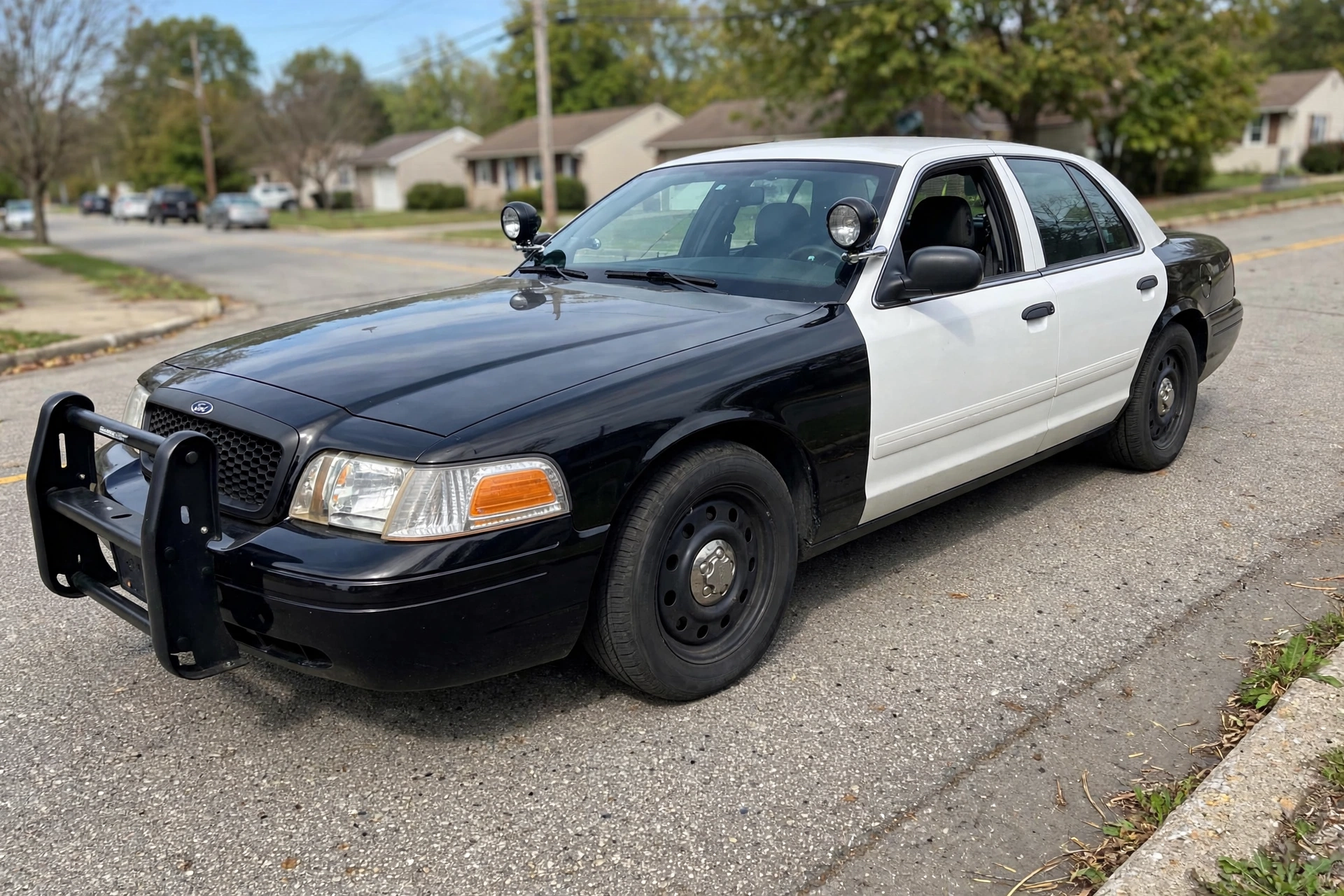
AI-generated illustration: a retired black-and-white 2010 Ford Crown Victoria Police Interceptor with a push bar, spotlights, and black steel wheels.
Engine and Performance
The 2010 Police Interceptor runs the 4.6 liter two-valve SOHC V8 from Ford’s modular engine family, the same basic engine as the civilian Crown Victoria but with a hotter calibration. Output is rated at 250 horsepower and 297 lb-ft of torque, with peak torque arriving at 4,000 rpm.
That rating has been the same since 2004, when Ford fitted the Marauder air intake with its 80 mm mass airflow sensor. The 2004 to 2011 cars all carry the same 250 horsepower figure, so a 2010 car is not down on power against any other late Police Interceptor.
The civilian Crown Victoria of the same year made 239 horsepower and 287 lb-ft. The police car gains 11 horsepower and 10 lb-ft, and the difference comes from the intake and the calibration, not from a different engine block.
The transmission is the 4R75E four-speed automatic, which arrived in 2006 with better launch performance than the earlier 4R70E. It shifts more aggressively than the civilian calibration, holds gears longer, and is built to take the constant stop and go of patrol work.
The MotorGrail history and specs page for the Crown Victoria Police Interceptor confirms the engine history, the 250 horsepower rating for 2004 to 2011, and the year-by-year changes. It is the best single source for the production story behind the 2010 car.
Acceleration is brisk for a large sedan of its era but not quick by modern standards. No official 0 to 60 figure was published for the police car, so treat any number you see online as an estimate, and judge the car on how it pulls from a stop in your own test drive.
Top speed is limited electronically, and the limit depends on the axle. Cars with the standard 3.27 axle are limited to 129 mph, while cars with the optional 3.55 Trac-Lok axle are limited to 119 mph.
That limit is a fleet safety setting, not a power limit. The car is stable at highway speed and built to cruise all day, which is why so many retired cars go on to serve as taxis and long-distance highway cars.
Fuel economy is the weak point. The EPA rates the 2010 Crown Victoria at 16 mpg in the city and 24 mpg on the highway, for a combined figure of 19 mpg. The EPA page for the 2010 Crown Victoria lists the same figures for the 4.6 liter V8 with the four-speed automatic.
Budget for that thirst before you buy. A car that costs little to purchase can still cost real money at the pump, and the V8 drinks more in town than it does on the open road.
The engine is also flex fuel capable, so a 2010 car can run on E85 as well as regular gasoline. Flex fuel became standard across the Panther line in 2008, and it is one of the small running changes that marks the late cars.
Our 4.6 liter V8 horsepower specs comparison puts this engine next to the other 4.6 liter Ford V8s. The Police Interceptor sits at the top of that family for its era, which is why the engine still has a following among Panther owners.
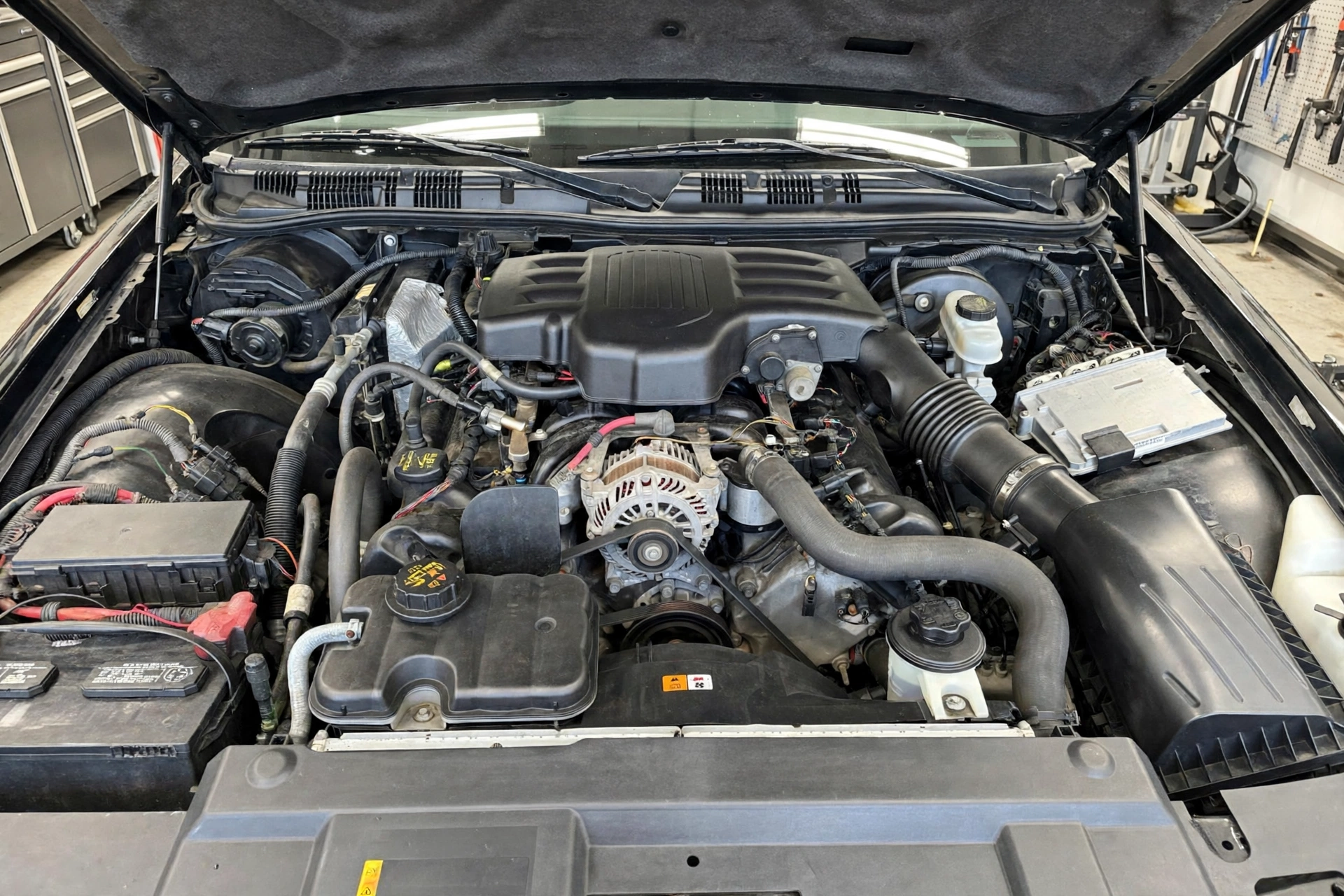
AI-generated illustration: the engine bay of a 2010 Ford Crown Victoria Police Interceptor showing the 4.6 liter V8.
Police vs Civilian Crown Victoria
The Police Interceptor and the civilian Crown Victoria share a body, a platform, and an engine family, but the police car is built for a different life. The table below shows the differences that matter to a buyer.
| System | 2010 Police Interceptor | Civilian Crown Victoria |
|---|---|---|
| Engine output | 250 hp, 297 lb-ft | 239 hp, 287 lb-ft |
| Alternator | 200 amp, 131 amp at idle | 110 amp base, 135 amp optional |
| Battery | 78 Ah, 750 CCA | Smaller standard battery |
| Cooling | Larger radiator, engine oil cooler, power steering cooler, transmission cooler | Standard cooling, no external coolers |
| Suspension | Severe-duty shocks, higher-rate coil springs, about 0.8 inch more ground clearance | Softer tuning, rear air springs on LX |
| Rear axle | 3.27 open standard, 3.27 or 3.55 Trac-Lok optional | 2.73 axle, 110 mph limiter |
| Wheels | 17 inch black steel wheels | Alloy wheels |
| Exhaust | Dual stainless steel, no resonators | Single or dual with resonators |
| Interior | Cloth bucket seats, vinyl rear bench, 140 mph speedometer | Bench or buckets, leather optional, standard speedometer |
| Extras | Dark car mode, dash-mounted trunk release, stab plates in seatbacks | Comfort and trim options |
The cooling package is the most important difference for a used buyer. Long idling and high-speed running generate heat that a civilian cooling system was never asked to handle, so Ford fitted the police car with a larger radiator and separate coolers for the engine oil, the power steering fluid, and the transmission fluid.
The electrical system is the second big difference. A patrol car runs a light bar, radios, a computer terminal, and a siren, all while idling, so the 200 amp alternator and the 78 amp-hour battery exist to keep the car alive at idle. That same capacity is useful to a civilian owner who adds accessories.
The suspension is the third difference, and it cuts both ways. Severe-duty shocks and higher-rate coil springs survive curbs and rough urban roads, but the ride is firmer than a civilian car, and the police car has no rear air suspension to soften it.
The civilian LX used air springs at the rear, which ride softly but fail with age and cost money to replace. The Police Interceptor uses coil springs at the rear, which last longer and cost less, and that is a genuine ownership advantage for a buyer of a 15-year-old car.
The RiotMind Studios P71 build differences guide documents these differences against the factory 2011 Police Interceptor Modifier Guide. It is the most detailed public source for what the police car has that the civilian car does not.
Inside, the police car is plain on purpose. The front seats are cloth buckets with stab plates in the seatbacks, the rear bench is vinyl for easy cleaning, and there is no leather steering wheel, no wood trim, and no luxury option to break.
Small police-only details are worth knowing when you inspect a car. The trunk release sits in the middle of the dashboard, a dark car mode turns off the interior lights when a door opens, and the speedometer reads to 140 mph.
What to Check Before Buying a Retired Interceptor
The odometer is the least honest number on a retired police car. A patrol car can idle 8 to 12 hours in a single shift, and none of that time adds a mile to the odometer, so you must read the engine hours before you judge the car.
As a rule of thumb, one hour of idling wears the engine about as much as 30 to 33 miles of normal driving. A car showing 80,000 miles with 4,000 idle hours has wear closer to a car with 200,000 miles, and its oil, its carbon buildup, and its transmission have all lived that harder life.
Our average engine hours for 100,000 miles guide explains how to turn hours into equivalent miles. Use that math on every Police Interceptor you consider, and walk away from any car whose hours you cannot verify.
Which agency ran the car matters as much as the hours. Federal cars are typically retired at 100,000 miles with around 4,000 idle hours, county cars at 100,000 miles with around 7,500 hours, and city cars at 120,000 miles with around 15,000 hours.
State cars run the hardest, often retired near 150,000 miles with around 10,000 idle hours. A highway patrol car with high miles and low hours is often a better buy than a city car with low miles and huge hours, because highway miles are gentle and city hours are not.
Ask the seller where the car served and how it was retired. Some agencies retire on age, some on mileage, and some on idle time, and a car retired on age alone can be a genuine bargain hiding in a fleet auction.
The HubPages used Crown Victoria Police Interceptor buyer guide lays out these agency averages and the buying tips that go with them. It is written by an owner of a 2010 P71, and its agency table is the clearest version of this advice anywhere.
Run through the checks below on every car, in order, before you agree a price.
- Read the VIN. Check that the fifth through seventh characters read P7B for a 2010 car, and run the VIN for recalls, accidents, and title history.
- Read the engine hours. Use a scan tool on the OBD port to pull idle hours, then convert them with the 30 to 33 miles per hour rule.
- Check the intake manifold. Look for coolant leaks at the thermostat housing and the rear heater hose fitting, and ask whether the manifold has been replaced.
- Check the transmission fluid. Pull the dipstick and look at the color and smell, since dark, burnt-smelling fluid means internal wear and a big bill.
- Inspect the frame. Look under the car for bent rails, cracked welds, and curb damage, since patrol cars hit curbs at speed and the damage hides under the body.
- Test the steering. Drive slowly and feel for looseness or play, and check whether the 2013 steering recall work was done on the car.
- Look for sitting damage. Check the fuel gauge, the tires, and the brakes, since retired cars can sit in a yard for up to a year before auction.
- Check the holes. Count the holes in the dash, the roof, and the trunk left by removed equipment, and price the repair or the trim to cover them.
Cars that sit for months after retirement suffer in specific ways. Fuel left in the tank turns to gum and can stick the fuel pump float, so the gauge reads wrong, and stale fuel can clog the filter and raise emissions for the first hundred miles after restart.
Plastic trim yellows and fades in the sun, tires flat-spot, and brake rotors rust. None of these is fatal, but all of them cost money, and they are all negotiable points on the price.
Ask for service records. Fleet cars usually have guaranteed maintenance histories, which is one of the real advantages of buying a retired police car, and a car with records is worth more than the same car without them.
Our how to check your Ford warranty guide shows how to confirm coverage and recall status by VIN. A 2010 car is long past its factory warranty, but the VIN check still shows open recalls, and an open steering recall is work you can get done free.
Common Problems and What They Cost
The 4.6 liter V8 is a durable engine, but it has known weak points, and the Police Interceptor adds fleet wear on top. The table below covers the problems you are most likely to meet.
| Problem | What happens | Typical cost |
|---|---|---|
| Intake manifold leak | Coolant leaks at the thermostat housing or rear heater fitting, causing overheating and misfires | 400 to 800 dollars |
| Transmission wear | Harsh shifts or slipping after years of pursuit driving and idle heat | 2,500 to 4,000 dollars for a rebuild |
| Steering looseness | Play in the steering from wear, covered by the 2013 recall on 2005 to 2011 cars | Free if recall work is open, 500 to 1,000 dollars if not |
| Suspension wear | Worn ball joints, tie rods, and shocks from curb hits and rough roads | 500 to 1,500 dollars |
| Carbon buildup | Deposits from long idling foul plugs and hurt performance | 150 to 400 dollars for cleaning and plugs |
| Alternator and battery | Heavy electrical load shortens battery life, and the 200 amp alternator is not cheap | 150 to 400 dollars |
| Fuel system gum | Stale fuel from months sitting sticks the gauge float and clogs the filter | 100 to 300 dollars |
The intake manifold is the problem to check first. From 1996 Ford used a plastic manifold with a plastic thermostat housing and coolant crossover, and cracks in that housing caused leaks, overheating, and misfires.
Ford fitted a revised manifold with an aluminum thermostat housing in 2003, but the plastic rear heater hose fitting on the revised part often split off and caused rapid coolant loss. Ask whether the manifold has been replaced, and look for fresh coolant stains around the housing.
The steering recall is the second check. In 2013 Ford recalled about 370,000 Crown Victoria, Grand Marquis, and Town Car vehicles from the 2005 to 2011 model years over a risk of steering loss, covering a group of northeastern and midwestern states plus the District of Columbia.
Confirm by VIN whether the recall work was done. If it is still open, the dealer does it free, and that is money you do not have to spend.
The transmission deserves a careful test drive. The 4R75E is a strong unit, but pursuit driving and idle heat wear it, and a rebuild is the single most expensive repair on this car.
Drive the car cold, then hot, and feel for harsh shifts, flare between gears, or a delay when you select drive. Any of those signs means a shop inspection before you pay, not after.
Carbon buildup is the quiet cost of a police life. Hours of idling leave deposits on the pistons and the plugs, and a car that idled for 10,000 hours will often need plugs, a cleaning, and a fresh oil change sooner than its odometer suggests.
Our Ford engine oil recommendation chart lists the right oil grade for this engine. Fresh oil after purchase is cheap insurance on a car whose last oil change may have been a year ago.
How Much to Pay in 2026
Retired Police Interceptors are cheap, and the spread is wide because condition and agency history matter more than mileage.
Most running, driving 2010 cars with honest wear sell at the low end of the used market. A clean car with verified low idle hours, service records, and a fresh intake manifold is worth more than a rough car with unknown hours, so judge each car on its own condition.
Pay for hours, not miles. A 100,000 mile highway patrol car with 4,000 idle hours is worth more than an 80,000 mile city car with 15,000 idle hours, even though the odometer says the opposite.
Budget 500 to 1,000 dollars on top of the purchase price for the first service. Fresh oil, a transmission fluid check, new plugs, and a coolant flush cover the most common deferred maintenance on a retired fleet car.
Parts are cheap and everywhere, which is part of the appeal. The Panther platform was built in huge numbers over decades, so brakes, suspension parts, and engine parts are available at any parts store at prices far below a modern car.
Is It a Good Daily Driver
As a daily driver, the 2010 Police Interceptor is honest, comfortable, and cheap to keep, but it asks you to accept its age and its thirst. The list below weighs the two sides.
- Simple and durable. A body-on-frame V8 with a four-speed automatic is easy to fix, and most repairs are jobs any shop can do.
- Huge and comfortable. The cabin seats five adults in real comfort, the trunk swallows luggage, and the ride is soft over bad roads.
- Cheap to buy and insure. Purchase prices are low, parts are cheap, and insurance is usually modest for a car of this size.
- Great in bad weather. Rear-wheel drive with weight over the axle and a limited-slip option copes well with snow when fitted with proper tires.
- Thirsty. Expect 16 mpg in town on the EPA rating, and budget fuel as the largest running cost after the purchase itself.
- Old technology. There is no Bluetooth, no touchscreen, and no modern driver assistance, so plan on an aftermarket stereo if you want it.
- Hard fleet life. Every car was driven hard, idled for hours, and stripped of equipment, so holes, mismatched paint, and worn trim are normal.
- Attention. A black-and-white car with a push bar draws looks and questions everywhere it goes, which some owners love and some tire of.
The car suits a buyer who wants a big, simple, cheap sedan and does their own basic maintenance. It does not suit a buyer who wants modern features, low fuel bills, or a car that blends into traffic.
Our how many miles trucks last guide covers the same kind of long-life math for high-mileage vehicles. The lesson is the same: maintenance history matters more than the odometer, and a cared-for high-mile car beats a neglected low-mile one.
Questions Buyers Ask About the 2010 P71
What Does P71 Mean
P71 is the chassis code Ford gave the Crown Victoria Police Interceptor in the VIN. In 2010 the code changed to P7B with no mechanical changes, so a 2010 car reads P7B in the fifth through seventh characters of the VIN.
How Much Horsepower Does a 2010 P71 Have
The 2010 Police Interceptor makes 250 horsepower and 297 lb-ft of torque from its 4.6 liter two-valve V8. That rating held from 2004 through 2011, and the civilian Crown Victoria made 239 horsepower in the same years.
How Many Idle Hours Is Too Many
There is no single limit, but the math is simple: one idle hour wears the engine about as much as 30 to 33 miles of driving. A car with 10,000 idle hours carries roughly 300,000 miles of engine wear on top of its odometer reading, so compare the total, not the odometer alone.
Is a Retired Police Car a Good Buy
Yes, if the idle hours are verified, the intake manifold and transmission check out, and the price reflects the fleet life. A highway patrol car with records is often the best buy, while a city car with huge hours and no records is the one to avoid.
What Is the Top Speed
The top speed is limited to 129 mph on cars with the standard 3.27 axle and 119 mph on cars with the optional 3.55 Trac-Lok axle. The limit is electronic, and the car is built to cruise at highway speed all day.
How Long Do Crown Victoria Police Interceptors Last
With regular maintenance, the 4.6 liter V8 and the 4R75E transmission commonly reach 200,000 miles and beyond, and many retired cars are still in daily service years after decommissioning. The frame, the body, and the running gear were built for fleet life, so the car usually outlasts its interior and its paint.
Can You Daily Drive a P71
Yes, and many owners do, but budget for fuel at 16 mpg in town on the EPA rating and accept the old technology. The car is comfortable, simple, and cheap to repair, which is why it still works as a daily driver more than a decade after production ended.
Your 5 Step Check Before You Buy
Is a 2010 Ford Crown Victoria Police Interceptor worth buying? Yes, when the hours, the manifold, and the transmission check out, because few cars offer this much size, strength, and V8 character for this little money.
Run the five step check before you pay. Read the VIN and confirm the P7B code, pull the idle hours with a scan tool and convert them to equivalent miles, inspect the intake manifold for coolant leaks, test drive the transmission hot and cold, and confirm the steering recall status by VIN.
That check takes an hour and a scan tool. It is the difference between a bargain patrol car and a money pit with a low odometer, and it is the one step no buyer of a retired Police Interceptor should skip.
Our what year Ford Focus to avoid guide covers the same kind of year-by-year buying check for another used Ford. The method is the same: know the bad years, know the weak parts, and verify the car in front of you before you pay.