
Sterling 10.25 Disc Brake Conversion: Parts & Kits Guide

The Sterling 10.25 disc brake conversion is the most effective way to eliminate heavy, fade-prone drums and improve stopping power. By utilizing custom mounting brackets and specific GM-style calipers, owners can achieve reliable braking performance and significantly easier maintenance.
Prime Day Pick
Limited-time Prime Day price. Check current discount on Amazon.
🎯 Key Takeaways
- Custom brackets are essential to mount calipers to the axle housing.
- Use Cadillac Seville calipers if you require an integrated parking brake.
- 1970s Chevy K20 rotors are the industry standard for this swap.
- Verify wheel clearance as most conversions require at least 16-inch rims.
- Upgrading the master cylinder ensures proper hydraulic pressure for rear discs.
To successfully swap the factory drum brakes on your Sterling 10.25 axle for a disc system, you need three primary components: axle-specific mounting brackets, 8-lug rotors, and heavy-duty calipers. This conversion is a direct solution for the common “fading” issues associated with heavy 12-inch drums. By using 1970s-era Chevrolet 3/4-ton components paired with custom steel brackets, you create a system that is easier to service and significantly lighter.
The transition matters practically because it eliminates the complex spring-and-shoe hardware that often seizes in off-road or high-towing environments. You will drop approximately 30 to 40 pounds of unsprung weight per side. More importantly, this setup provides a consistent clamping force that drums cannot match during repeated hard braking. This guide focuses on the specific parts and the mechanical modifications required to align these components with your Ford axle.
Prime Day Pick
Limited-time Prime Day price. Check current discount on Amazon.
Essential Components for a Sterling 10.25 Disc Conversion
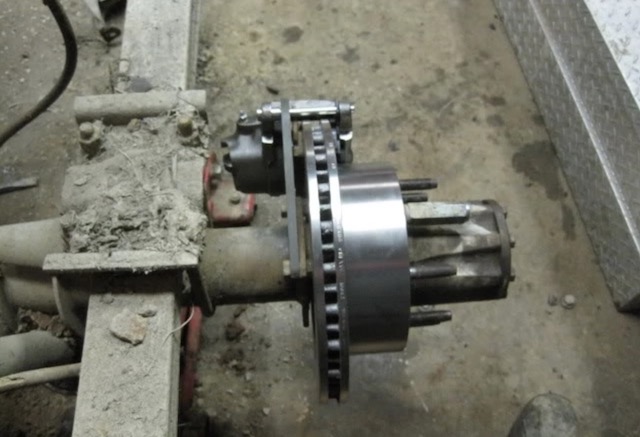
The backbone of this swap is the bracket that allows you to mount a caliper to a square-flange axle housing originally designed for drums. You can choose between weld-on brackets or bolt-on versions. Bolt-on brackets are preferred for the Sterling 10.25 because they utilize the existing four-bolt pattern on the axle flange. Ensure your brackets are laser-cut from at least 3/8-inch or 1/2-inch mild steel to prevent flexing under hydraulic pressure.
Sourcing Donor Parts vs. Bolt-On Kits
Most builders utilize a “hybrid” approach, sourcing brackets from specialized off-road shops and scavenging the remaining hardware from 1973–1987 GM 3/4-ton 4WD trucks. This specific GM era is the gold standard because the parts are widely available at any local auto parts store. If you prefer a streamlined experience, a complete pre-made kit includes everything down to the copper crush washers, but it will cost roughly double the price of sourcing individual components.
Prime Day Pick
Limited-time Prime Day price. Check current discount on Amazon.
- Rotors: Use 1975–1988 Chevrolet/GMC K20 4WD front rotors. These are 12.5-inch diameter units with an 8×6.5 bolt pattern that matches the Sterling axle.
- Brackets: Look for Sterling-specific 4-bolt flange brackets. Standard Dana 60 or 14-bolt brackets will not align with the Sterling’s unique flange spacing.
- Hardware: Grade 8 bolts are mandatory for the mounting brackets. Use 7/16-inch or 1/2-inch fasteners depending on your bracket’s specific pilot holes.
- Hub Machining: Note that the center bore of the Chevy rotor may be slightly too small (approx. 4.6 inches) to slide over the Sterling hub (approx. 4.8 inches). You or a machine shop may need to turn down the hub’s outer diameter or enlarge the rotor’s center pilot hole for a flush fit.
Selecting Calipers: Standard vs. Integrated Parking Brake
Your choice of caliper determines the complexity of your plumbing and whether your truck remains street-legal in jurisdictions requiring a mechanical emergency brake. The Sterling 10.25 has a massive internal volume, so your master cylinder must be capable of pushing enough fluid to move the larger pistons found in disc calipers. Most users find that the stock Ford master cylinder works, but a “soft pedal” may occur if you don’t use a proportioning valve to balance the front-to-rear bias.
The GM JB6 and JB7 Standard
The most common calipers for this swap are the GM JB6 (light-duty 3/4 ton) or JB7 (heavy-duty 3/4 ton) front calipers. These are incredibly affordable and offer massive clamping power. They use a standard banjo bolt and are easy to bleed. However, these calipers do not have a provision for a mechanical parking brake. If you choose these, your original parking brake cables will become redundant, and you will need to rely on the transmission’s “Park” gear or an auxiliary driveline brake.
Prime Day Pick
Limited-time Prime Day price. Check current discount on Amazon.
Retaining the Parking Brake: The Cadillac Option
If you need to maintain a functional parking brake for safety or inspection purposes, you must use 1976–1978 Cadillac El Dorado rear calipers. These are unique because they feature a mechanical lever that pushes the piston forward when the cable is pulled. While they are a direct bolt-on for the same brackets used for the GM JB6/JB7, they are significantly more expensive and can be difficult to adjust properly.
- Piston Size: JB7 calipers offer a larger 3.15-inch piston, which is ideal for trucks carrying heavy campers or pulling gooseneck trailers.
- Brake Lines: You cannot reuse your factory Ford drum lines. You will need 10mm or 3/8-inch-24 banjo bolts and new braided stainless steel flex lines to connect the axle hard lines to the new calipers.
- Cable Integration: If using El Dorado calipers, you will likely need a cable connector kit to bridge the gap between the Ford factory parking brake cable and the Cadillac lever arm.
- Clearance: Most 16-inch factory Ford wheels will clear these calipers, but some 15-inch aftermarket wheels may require minor grinding of the caliper “ears” to prevent rubbing.
Hydraulic System Requirements and Proportioning Valve Adjustments
Switching from drums to discs isn’t just a hardware swap at the wheel; it’s a fundamental change in how your truck’s hydraulic system manages pressure. Drum brakes require a small amount of residual pressure to keep the shoes close to the drum, whereas disc brakes need a higher volume of fluid to move the pistons without any residual pressure dragging the pads. If you ignore the hydraulics, you’ll likely end up with a “mushy” pedal or rear brakes that lock up far too early.
Prime Day Pick
Limited-time Prime Day price. Check current discount on Amazon.

Upgrading the Master Cylinder
The factory master cylinder designed for drum brakes often has a smaller bore and includes a residual pressure valve. For a Sterling 10.25 disc conversion, many builders find success by swapping to a master cylinder from a 1999-2004 F-350, which was factory-equipped with four-wheel discs. This ensures the bore size is large enough to move the volume of fluid required by the new calipers.
- Residual Valves: If you keep your stock master cylinder, you must remove the 10-lb residual pressure valve located in the rear brake port. Leaving it in will cause your new disc brakes to drag and overheat.
- Bore Size: A larger 1.125-inch or 1.25-inch bore is typically ideal for providing the firm pedal feel most drivers prefer after a conversion.
- Fluid Compatibility: Always flush the entire system with fresh DOT 3 or DOT 4 fluid to prevent old drum-brake contaminants from ruining your new caliper seals.
Fine-Tuning with an Adjustable Proportioning Valve
Because disc brakes are significantly more efficient than drums, the factory fixed-proportioning valve may send too much pressure to the rear. This can cause the rear wheels to lock up before the fronts in an emergency stop—a dangerous situation for any heavy-duty truck. Installing an adjustable proportioning valve (like those from Wilwood or Summit Racing) allows you to manually dial back the rear pressure until the truck stops straight and level.
Pro Tip: Install the adjustable valve in an accessible spot on the frame rail or near the master cylinder. You’ll want to be able to reach it easily during your initial test drives to find the “sweet spot” for your specific vehicle weight and tire size.
SRW vs. DRW Axle Compatibility and Hub Considerations
The Sterling 10.25 axle comes in two primary flavors: Single Rear Wheel (SRW) and Dual Rear Wheel (DRW). While the internal gears and shafts are largely the same, the external dimensions and hub offsets vary significantly. This makes selecting the right bracket and rotor combination critical for a successful bolt-on experience.
Understanding Hub Offsets
On an SRW axle, the hub sits closer to the leaf springs, whereas DRW hubs are designed to accommodate the deep dish of dually wheels. Most conversion kits are designed specifically for the SRW hub because it is the most common choice for off-roaders and enthusiasts. If you have a DRW axle, you cannot simply use an SRW kit; the bracket spacing will be completely wrong, and the rotor will not align with the caliper.
- WMS (Wheel Mounting Surface): Always measure your WMS-to-WMS distance before ordering a kit to confirm exactly which axle housing you are working with.
- Wheel Studs: When switching to a rotor-over-hub design, you may need longer wheel studs. The thickness of the new rotor “hat” takes up space on the stud that was previously used for the wheel alone.
- Clearance Issues: Some 15-inch wheels will not clear the calipers used in these conversions. 16-inch wheels are generally the minimum, while 17-inch wheels provide the most “breathing room” for cooling.
The Tone Ring Factor
For trucks built after 1987, the Sterling 10.25 features a tone ring on the differential carrier for the RABS (Rear Antilock Brake System) and speedometer. While the disc conversion happens at the ends of the axle tubes, ensure your chosen rotors do not interfere with the hub-to-axle seal. Keeping your hubs clean and inspecting the bearings during the swap is a practical way to ensure the entire assembly remains reliable for another 100,000 miles.
Example: A common mistake is using 1990s-era E-350 van rotors on an F-350 SRW axle without checking the center bore diameter. Always verify that the rotor slides over the Sterling hub smoothly without excessive play.
Conclusion
Converting your Sterling 10.25 axle to disc brakes is one of the most impactful upgrades you can perform for towing safety and off-road reliability. By selecting a high-quality bracket kit, matching your rotors to your specific SRW or DRW hub, and properly addressing the hydraulic pressure requirements, you eliminate the headaches of fading drum brakes forever. Remember that the “magic” of this swap lies in the details—specifically the proportioning valve and the master cylinder bore size.
Ready to get started? Your next steps are to measure your wheel mounting surface and decide whether you want an all-in-one kit or a DIY bracket solution. Once you have your parts list ready, you are well on your way to a truck that stops as hard as it pulls. Get out there and start building!
❓ Frequently Asked Questions
Why is the Sterling 10.25 drum-to-disc swap so popular?
Factory drum brakes on these axles are notoriously heavy and difficult to service. Converting to discs offers better heat dissipation, simplified pad changes, and a significant reduction in unsprung weight.
Which calipers provide the best performance for this axle?
Chevy K20 front calipers are the most common choice for their simplicity and low cost, though they do not include a parking brake mechanism. For street-legal builds, the Cadillac Seville rear calipers are the preferred choice.
What is the biggest challenge with the emergency brake?
The factory drum e-brake is integrated into the hub. Converting to discs requires either specialized ‘e-brake’ calipers or a separate driveline brake to maintain parking functionality.
Do I need to machine my hubs for this conversion?
For some ‘slip-over’ rotor kits, the back of the hub flange may require slight machining to ensure the rotor sits perfectly flush and centered against the hub surface.
How does this conversion affect the proportioning valve?
Because disc brakes require different fluid volume and pressure than drums, an adjustable proportioning valve is usually necessary to prevent the rear wheels from locking up prematurely.
Can I perform this conversion on a Dual Rear Wheel (DRW) axle?
Yes, but the bracket offset and rotor depth requirements differ from Single Rear Wheel (SRW) models, so you must source a DRW-specific conversion kit.