Fuel System 1 OL Fault: Meaning, Causes, and Diagnostics

A Fuel System 1 OL Fault occurs when the engine computer attempts to enter Closed Loop but is forced back to Open Loop because of a detected error in the feedback sensors. This status indicates that the ECM has rejected sensor data and is instead using pre-programmed safety maps to prevent engine damage.
Prime Day Pick
Limited-time Prime Day price. Check current discount on Amazon.
🎯 Key Takeaways
- OL Fault indicates the ECM cannot trust feedback from the O2 or ECT sensors.
- Unlike normal Open Loop, an OL Fault is triggered by a detected system error.
- The upstream Oxygen Sensor (Bank 1 Sensor 1) is the primary diagnostic target.
- Inaccurate Engine Coolant Temperature (ECT) readings frequently prevent Closed Loop entry.
- Fuel trim data is often frozen or ignored while the system is in fault mode.
If your OBD-II scanner displays Fuel System 1: OL Fault, your vehicle’s Engine Control Module (ECM) has encountered a critical error in its feedback loop. Unlike a standard “Open Loop” status seen during a cold start, an OL Fault means the computer attempted to transition into Closed Loop operation but was forced back into a default state because it can no longer trust its sensor data. It has essentially “given up” on fine-tuning the air-fuel ratio based on real-time exhaust readings.
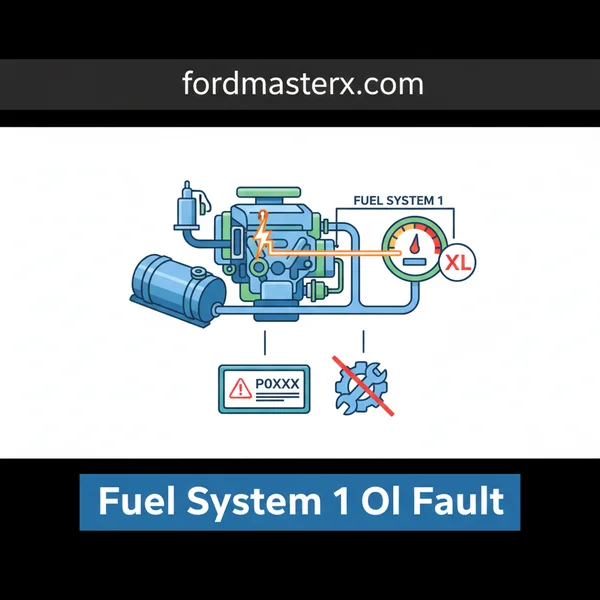
This status is a major red flag for engine efficiency. When the system is stuck in an OL Fault state, it relies on pre-programmed “limp home” fuel maps rather than adjusting for current driving conditions. This typically results in a significant drop in fuel economy, increased tailpipe emissions, and a noticeable loss of engine responsiveness. Understanding this fault is the first step toward restoring your vehicle’s ability to manage its own combustion chemistry accurately.
Prime Day Pick
Limited-time Prime Day price. Check current discount on Amazon.
Decoding ‘OL Fault’ vs. Normal Open Loop Operation
To fix the issue, you must understand the distinction between a routine Open Loop status and the Fault status. In a healthy vehicle, Open Loop (OL) is a temporary phase. It occurs when you first start the engine because the oxygen sensors are too cold to provide accurate data. Once the sensors and the engine reach a specific operating temperature, the ECM switches to Closed Loop (CL), using the O2 sensor feedback to trim fuel delivery. An OL Fault occurs when the ECM detects that the conditions for Closed Loop are met, but the data returning from the sensors is invalid, missing, or physically impossible.

The Broken Feedback Loop
Think of the fuel system as a constant conversation between the ECM and the exhaust stream. In a fault state, that conversation has broken down. The ECM sends fuel to the cylinders and waits for the upstream Oxygen Sensor to report back on how “rich” or “lean” the resulting mixture was. If the sensor reports a static voltage—such as a constant 450mV—or provides no signal at all, the ECM realizes it is “flying blind.” It triggers the OL Fault status to prevent engine damage from an incorrectly calculated mixture that could lead to overheating or catalytic converter failure.
Prime Day Pick
Limited-time Prime Day price. Check current discount on Amazon.
- Normal Open Loop: A temporary state during warm-up or wide-open throttle where the ECM ignores sensors by design.
- OL Fault: A forced state where the ECM wants to use sensor data but has detected a circuit or logic error that makes the data unreliable.
- Closed Loop: The ideal operating state where the ECM continuously adjusts fuel based on real-time sensor feedback.
Critical Sensors That Trigger Fuel System 1 Fault Status
While many mechanical components affect how an engine runs, an OL Fault status is almost always triggered by the “primary” feedback sensors. The ECM requires two main pieces of information to enter and maintain a stable Closed Loop: the actual oxygen content in the exhaust and the current operating temperature of the engine. If either of these inputs is compromised, the fuel system logic collapses into a fault mode.
Upstream Oxygen Sensor (Bank 1 Sensor 1)
The upstream O2 sensor is the most frequent culprit behind an OL Fault. This sensor sits before the catalytic converter and monitors the raw exhaust gas. For the ECM to maintain Closed Loop, this sensor must “cycle” rapidly between high and low voltage (roughly 0.1V to 0.9V). If the sensor is contaminated by oil, coolant, or carbon buildup, it may become “lazy” or “stuck.”
Prime Day Pick
Limited-time Prime Day price. Check current discount on Amazon.
If the ECM detects that the Bank 1 Sensor 1 voltage has stayed flat for too long while the engine is under load, it assumes the sensor is dead or the circuit is broken. To protect the engine, it enters the OL Fault state. When diagnosing this with your scanner, look for “O2 Sensor No Activity Detected” codes (such as P0134) which often accompany the OL Fault status on your live data stream.
Engine Coolant Temperature (ECT) Sensor
The ECT sensor is the “gatekeeper” for the entire fuel management strategy. The ECM will not attempt to enter Closed Loop until the engine reaches a specific temperature threshold, usually around 120°F to 150°F. If the ECT sensor is faulty and reporting a constant -40°F (a common default for a broken circuit) or if it is “skewed” and reporting a temperature that doesn’t match the engine’s actual heat, the system will trigger a fault.
Prime Day Pick
Limited-time Prime Day price. Check current discount on Amazon.
- Rationality Checks: The ECM compares the ECT reading to the Intake Air Temperature (IAT). If they differ wildly after the car has sat overnight, it triggers a fault because the data is logically impossible.
- Open Circuits: A broken wire or corroded connector to the ECT sensor tells the ECM the engine is infinitely cold, preventing the transition out of Open Loop and eventually flagging a fault.
- Stuck Thermostats: While a mechanical part, a thermostat stuck open can prevent the engine from ever reaching the “Closed Loop” temperature target, eventually causing the ECM to flag a fault because the warm-up timer has expired without reaching the target temp.
Requirements and Trip Conditions for Closed Loop Entry
For your vehicle to transition from Open Loop (OL) to Closed Loop (CL), the Power Control Module (PCM) needs to satisfy a specific set of criteria. It’s like a pre-flight checklist; if even one sensor isn’t “reporting for duty,” the computer refuses to trust its own automated adjustments and stays in the safe—but inefficient—Open Loop mode.
Temperature and Timer Thresholds
The most common reason a system stays in Open Loop is that it hasn’t reached the correct operating temperature. The PCM monitors the Engine Coolant Temperature (ECT) sensor closely. If the engine stays too cold due to a stuck-open thermostat or a faulty sensor, the system assumes the engine isn’t ready for precision fueling. Additionally, most vehicles have an internal “start-up timer.” The computer expects to see a specific rise in temperature within a certain number of minutes. If the clock runs out and the engine is still “cold,” an OL-Fault is often triggered.
Oxygen Sensor Readiness
Closed Loop operation relies entirely on the feedback from your Oxygen (O2) sensors. However, these sensors don’t work until they reach about 600°F. Modern vehicles use internal heaters to speed up this process, but if the heater circuit fails, the sensor stays dormant too long. Key conditions include:
- Sensor Activity: The PCM must see the O2 sensor voltage “toggle” or sweep back and forth.
- Heater Circuit Integrity: The computer checks for proper resistance in the sensor’s heating element.
- Load Stability: The engine usually needs to reach a steady idle or cruise state before the initial handoff to Closed Loop occurs.
Interpreting Scanner Live Data for Fault Identification
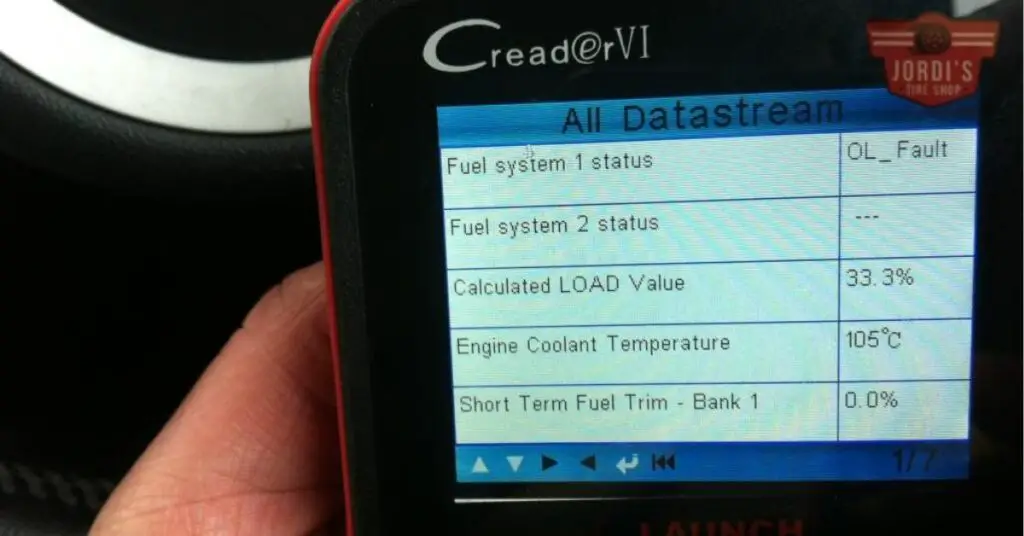
When you see “OL-Fault” on your screen, the “Fault” part is the most critical clue. Unlike a standard “OL-Drive” (which happens during heavy acceleration), a fault status means the PCM has detected a problem and stopped trying to enter Closed Loop entirely. Using a live data stream is the only way to see exactly where the communication breakdown is happening.
Analyzing Fuel Trims and Loop Status
When a system is in OL-Fault, you will often notice that the Short-Term Fuel Trim (STFT) is frozen at 0%. This is a huge red flag. Because the computer isn’t receiving reliable data, it stops making “short-term” adjustments. If you see the Long-Term Fuel Trim (LTFT) stuck at an unusually high positive or negative number (like +25% or -25%), it suggests the engine was struggling with a massive vacuum leak or fuel delivery issue right before the fault forced it back into Open Loop.
Monitoring Sensor Voltage Fluctuations
Watching the O2 sensor voltage in real-time can tell you exactly why the loop won’t close. In a healthy system, the upstream O2 sensor should rapidly oscillate between 0.1V and 0.9V. If you see the following, you’ve found your culprit:
- Flatlining: A steady 0.45V often indicates a biased or disconnected circuit.
- Lazy Sensors: A voltage that moves very slowly suggests a “poisoned” or aging sensor that the PCM no longer trusts.
- Rationality Errors: If the ECT sensor reads -40°F while the engine is clearly hot, the PCM will stay in Open Loop to prevent the engine from stalling due to an incorrect fuel mixture.
Conclusion
The Fuel System 1 OL Fault is more than just a status message; it is a protective “limp mode” for your engine’s fueling strategy. When your PCM detects that the Oxygen sensors aren’t responding or the engine isn’t reaching the proper temperature, it abandons the efficiency of Closed Loop to prevent potential engine damage. Understanding that this fault is often rooted in sensor readiness or temperature thresholds is the first step toward a successful repair.
If you are staring at an OL-Fault on your scanner, your next move should be to check your coolant temperature readings and O2 sensor voltages. Identifying which piece of data is missing or “frozen” will lead you straight to the faulty component. Don’t let a simple sensor error kill your fuel economy—get under the hood, check those live data pids, and get your fuel system back into the loop!
❓ Frequently Asked Questions
Why won’t my car switch from OL Fault to Closed Loop?
The ECM requires specific ‘readiness’ criteria, including the engine reaching a minimum temperature and the O2 sensors producing a fluctuating voltage. If the O2 sensor signal stays flat or the ECT sensor reports impossible temperatures, the ECM stays in OL Fault for safety.
How does the Engine Coolant Temperature (ECT) sensor impact this status?
If the ECT sensor is ‘lazy’ or stuck at a low temperature, the ECM thinks the engine is still cold. If it takes too long to warm up or the data is erratic, the system will flag an OL Fault because it cannot accurately calculate the necessary fuel trim for a warm engine.
What is the primary danger of driving with a persistent OL Fault?
While the car is drivable, the engine will typically run rich, which can eventually clog your catalytic converter and foul spark plugs. Over time, this leads to significantly higher repair costs than simply replacing a failed sensor.
Can a vacuum leak lead to a Fuel System 1 OL Fault?
While minor vacuum leaks usually cause lean codes in Closed Loop, a massive leak that puts sensor readings outside of a plausible range can force the ECM to ignore the sensor entirely and revert to an OL Fault status.
Is it possible for a wiring issue to cause this fault rather than the sensor itself?
Absolutely; frayed wires, corroded connectors, or a bad ground for the O2 sensor signal wire will prevent the ECM from receiving data, resulting in the system declaring a fault even if the sensor is brand new.
How do I use live data to confirm an O2 sensor failure during an OL Fault?
Monitor the voltage of Bank 1 Sensor 1; if it remains stuck at 0.45V (bias voltage) or 0.0V while the engine is hot and under load, the sensor is either dead or the circuit is open, explaining the OL Fault status.