
How Much Paint to Paint a Truck? Gallon & Material Guide

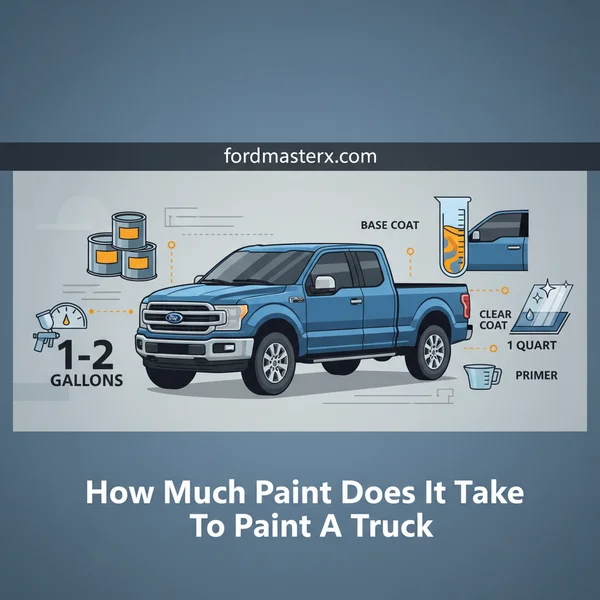
A standard full-size truck typically requires 2 to 3 gallons of sprayable basecoat and an equal amount of clearcoat for a complete exterior respray. Smaller compact trucks usually require 1.5 to 2 gallons, while large duallys or projects including the bed interior will demand significantly more material.
🎯 Key Takeaways


- Full-size trucks generally require 2-3 gallons of sprayable basecoat and clearcoat.
- Compact trucks typically need 1.5 to 2 gallons for a full exterior respray.
- Color changes require approximately 50% more paint to ensure complete coverage.
- Include an extra gallon if you plan to paint the interior of the truck bed.
- Mixing ratios (like 2:1) significantly impact the final volume of ‘sprayable’ material.
For a standard full-size pickup truck, you should plan on using approximately 2 gallons of sprayable basecoat and 2 gallons of sprayable clearcoat for a complete exterior respray. If you are opting for a single-stage paint system, you will generally need 2 to 3 gallons of sprayable material to achieve full coverage and a deep gloss. Having these specific volumes on hand prevents the disaster of running out of paint while the booth is hot and the fans are running.
Accurate measurements matter because automotive paint is a significant financial investment. Buying too much wastes hundreds of dollars, but buying too little leads to “dry spray” and mismatched panels if you have to mix a new batch mid-job. Your truck’s specific cab configuration and whether you intend to paint the bed interior or door jams will dictate your final shopping list. This guide breaks down exactly what you need to order to ensure a professional finish without overspending on excess chemicals.
Material Requirements by Truck Size and Cab Configuration


The total surface area of your truck is the primary factor in determining paint volume. A compact, single-cab truck requires significantly less material than a modern crew-cab dually with an eight-foot bed. When calculating your needs, always account for the “sprayable” volume, which includes the paint mixed with its specific reducers and activators.
Estimating Volume for Common Truck Sizes
The following estimates cover a standard three-coat application for the exterior panels of the truck. If you are painting the roof and the tailgate, these numbers provide a safe margin for error:
- Compact Trucks (Ranger, Tacoma, Colorado): 1.5 gallons of sprayable material. This usually equates to 3 quarts of unreduced paint mixed 1:1 with reducer.
- Full-Size Standard Cab (F-150, Silverado, Ram): 2 gallons of sprayable material. This requires 1 gallon of unreduced paint mixed with 1 gallon of reducer.
- Extended or Crew Cab Trucks: 2.5 gallons of sprayable material. The extra doors and pillars significantly increase the required volume.
- Dually or Long Bed Trucks: 3 gallons of sprayable material. The massive surface area of flared fenders and 8-foot beds demands extra material to maintain a wet edge.
Adding for Door Jams, Engine Bays, and Beds
The estimates above are for the exterior skin only. If you are performing a color change or a frame-off restoration, you must increase your volume. Painting the door jams, the underside of the hood, and the interior of the cab usually adds another 0.5 to 1 gallon of sprayable material to your total. If you are painting the inside of the truck bed rather than using a spray-in bedliner, add an additional 2 quarts of sprayable paint. The corrugated floor of a truck bed has surprisingly high surface area that consumes material quickly.
Everything You Need to Know About Calculating Truck Paint Volume


Estimating the amount of paint required for a truck is significantly more complex than calculating for a standard sedan. Trucks vary wildly in surface area due to different cab configurations, bed lengths, and height clearances. This guide provides a systematic approach to determining exactly how much primer, base coat, and clear coat you need to purchase. By following these steps, you will avoid the frustration of running out of paint mid-spray or overspending on expensive automotive coatings that will simply sit on a shelf and expire.
Step 1: Classify Your Truck Configuration
What you need: A tape measure, a notepad, and your truck’s factory specifications (usually found in the owner’s manual or door jamb).
Instructions: Start by identifying the specific size of your vehicle. A “truck” is not a universal measurement. You must categorize your vehicle into one of four standard sizes: Small/Compact (like an older Ford Ranger or Chevy S10), Standard Full-Size (F-150 or Silverado 1500 with a short bed), Extended/Crew Cab (four doors with a standard bed), or Heavy Duty/Dually (extended width with an 8-foot bed). Measure the length of the bed specifically, as a 6.5-foot bed versus an 8-foot bed adds roughly 15-20 square feet of surface area when you account for both the interior and exterior of the bed walls.
Pro Tip: Don’t forget to decide if you are painting the “jambs” (the inside of the doors and frame) and the interior of the bed. If you are doing a color change, you must include these, which adds about 25% to your total paint requirement.
Step 2: Select Your Paint System Type
What you need: Research on paint brands (e.g., PPG, Axalta, Sherwin-Williams) and a choice between Single-Stage or Basecoat/Clearcoat (BC/CC) systems.
Instructions: The type of paint system you choose dictates the volume of different chemicals you need. A Single-Stage system combines the color and gloss into one product; this is common for work trucks or solid colors (non-metallic). A Basecoat/Clearcoat system is the modern standard, where you apply the color (base) and then a protective shiny layer (clear). If you choose BC/CC, you will generally need more clear coat than base coat because you typically spray 2-3 layers of clear to allow for “cut and buff” polishing later. Single-stage usually requires about 1.5 gallons of sprayable material for a full-size truck.
Pro Tip: If you are a beginner, stick to a Basecoat/Clearcoat system. It is much easier to repair mistakes in the clear coat than it is in a single-stage finish.
Step 3: Calculate the Square Footage and Coverage Rates
What you need: A calculator and the “Technical Data Sheet” (TDS) for your specific paint brand.
Instructions: Most automotive paints cover approximately 100 to 120 square feet per gallon at 1 mil thickness. A standard full-size crew cab truck has roughly 110-130 square feet of exterior surface area. However, you aren’t just spraying one “mil” (a thousandth of an inch). You need enough paint for 2-3 coats of color to ensure full “hide” (opacity). For a standard full-size truck, you should aim to have 1 gallon of unthinned base coat. Once you add the reducer (thinner) at a common 1:1 ratio, you will have 2 gallons of sprayable material, which is the “sweet spot” for most DIY truck projects.
Pro Tip: Always look for the “Theoretical Coverage” on the paint’s TDS. This tells you exactly how many square feet one gallon covers at a specific thickness, allowing for much more accurate math.
Step 4: Factor in Color Opacity and “Hide”
What you need: Knowledge of your chosen color’s pigment density.
Instructions: Not all paint colors are created equal. High-pigment colors like black, dark blue, or white cover very well, often reaching full “hide” in two coats. However, “transparent” colors like bright red, vibrant yellow, or certain metallic oranges have poor coverage. If you are painting a truck red over a dark primer, you might need double the amount of paint compared to a black finish. To save money and material, always use a “value shade” primer that is close to your topcoat color (e.g., use a light gray primer for a silver truck or a dark gray primer for a navy truck) to ensure you don’t need excessive coats of expensive color.
Pro Tip: If you are spraying a transparent color, buy an extra quart of base coat. It is much cheaper to have a quart left over than to have a “tiger-striped” truck because you tried to stretch the last few ounces of paint.
Step 5: Calculate Reducer and Activator Ratios
What you need: The mix ratio for your specific product (e.g., 4:1:1 or 1:1).
Instructions: Automotive paint is rarely sprayed “straight out of the can.” It is a chemistry project. You must calculate the volume of “sprayable material,” not just the “raw paint.” If your clear coat has a 4:1 ratio (4 parts clear to 1 part activator), a “gallon kit” actually gives you 5 quarts of sprayable liquid. For a full-size truck, you typically need 1 gallon of raw clear coat and its corresponding quart of activator. For the base coat, which often mixes 1:1 with reducer, purchasing 1 gallon of base coat and 1 gallon of reducer will yield 2 gallons of sprayable material, which is ample for 3 full coats on a large truck.
Pro Tip: Always buy the reducer and activator that match your local temperature. Using a “fast” reducer in 90-degree weather will cause the paint to dry before it hits the truck, resulting in a rough “dry spray” texture.
Step 6: Account for Transfer Efficiency and Overspray
What you need: Information on your spray gun type (HVLP vs. LVLP).
Instructions: Even the best painters lose paint to the air. High Volume Low Pressure (HVLP) guns have a transfer efficiency of about 65%, meaning 35% of the paint you buy ends up as dust on your garage floor or in your filters. If you are using an older conventional spray gun, your efficiency might be as low as 35%. When calculating your paint needs, always add a 20% “waste factor.” If your math says you need 3.2 quarts, buy a full gallon. When painting truck beds specifically, the ribs and pockets cause significant air turbulence, which increases overspray and consumes more material than a flat hood or door would.
Pro Tip: Adjust your spray gun’s fan pattern. A wide fan is great for the hood, but narrowing the fan when painting the pillars and narrow bed rails will significantly reduce wasted paint.
Step 7: Finalize the Primer Requirements
What you need: Epoxy primer or High-Build Urethane primer.
Instructions: Primer is the foundation of your job. If you are stripping the truck to bare metal, you need two types: an Epoxy Primer for corrosion resistance and a High-Build (2K) Primer for sanding and leveling. For a full truck, you will generally need 1 gallon of Epoxy Primer (which usually yields 1.5 to 2 gallons sprayable) and 1 gallon of High-Build Primer. Because you will sand away about 50% of the High-Build Primer during the leveling process, you need a substantial amount of material to ensure you don’t sand through to the bare metal. One gallon of raw primer is usually sufficient for a standard truck exterior.
Pro Tip: Don’t skimp on primer quality. A cheap primer can shrink months later, revealing all the sanding scratches you thought you had removed.
✅ Final Checklist
- Verified the truck configuration (Standard, Extended, or Crew Cab) and calculated total surface area.
- Selected a paint system (Single-Stage vs. BC/CC) and calculated the required clear coat (usually 1 gallon for a full truck).
- Matched the primer “Value Shade” to the topcoat color to ensure maximum coverage with minimum paint.
- Confirmed the mix ratios (4:1, 2:1, or 1:1) to ensure you have enough activator and reducer for all products.
- Added a 20% buffer to the total volume to account for overspray, spray gun inefficiency, and potential mistakes.
Important Notes:
- Safety First: Automotive paints contain isocyanates. Always use a supplied-air respirator or a high-quality charcoal mask, nitrile gloves, and a full paint suit to prevent skin and lung exposure.
- Professional Help: If you are using a “Tri-coat” or “Candy” paint system, the volume requirements increase significantly due to the mid-coat layer. Consult a professional jobber if you are attempting these complex finishes.
- Estimated Cost and Time: A complete DIY paint material kit (Primer, Base, Clear, and solvents) for a truck typically costs between $600 and $1,500. Expect to spend 40-60 hours on prep work and 6-10 hours on the actual spraying process.
Comparing Quantities for Single-Stage vs. Two-Stage Paint Systems
The type of paint system you choose changes how much raw product you need to purchase. Single-stage paint combines the color and the protective gloss into one product. Two-stage systems separate them into a basecoat for color and a clearcoat for protection and shine. While the total “liquid” hitting the truck might be similar, the ratios of chemicals you buy will differ.
Two-Stage (Basecoat/Clearcoat) Material Breakdown
Two-stage systems are the industry standard for trucks because they are easier to repair and offer better UV protection. In this system, the basecoat is usually thinned at a 1:1 ratio. This means if you buy 1 gallon of unreduced basecoat, you will have 2 gallons of sprayable paint once the reducer is added. For the clearcoat, the mixing ratio is often 2:1 or 4:1 with an activator, resulting in a slightly lower sprayable yield per gallon of product purchased.
- Basecoat: Plan for 1 gallon of unreduced color for a full-size truck.
- Clearcoat: Buy 1 to 1.5 gallons of clearcoat to ensure you have enough for three heavy coats.
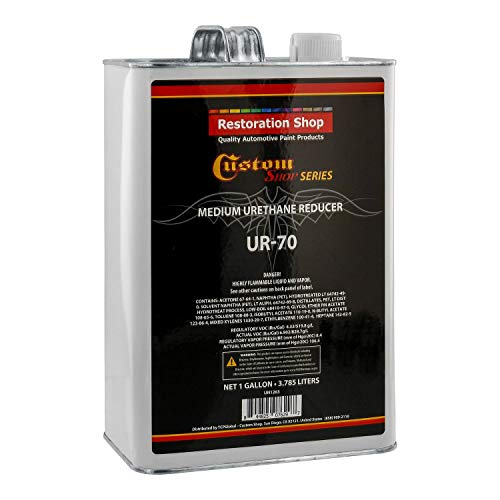
- Reducer: You will need at least 1 gallon of the appropriate temperature-range reducer for the basecoat.
- Activator: Ensure you have the specific activator required for your clearcoat, typically 1 quart per gallon of clear.
Single-Stage Paint Volume Needs
Single-stage paint is often used for work trucks or solid colors like white and black. Because this paint is thicker and provides the final finish in one step, you often need more total product to achieve a deep, sandable surface. Single-stage paints typically mix at a 4:1 or 8:1 ratio. To paint a full-size truck, you should purchase 2 gallons of unreduced single-stage paint. This ensures you have enough material to build up a thick enough film for color sanding and buffing later without burning through the edges.
Keep in mind that single-stage metallics are more difficult to spray. If you choose a metallic single-stage, buy an extra quart. You will likely need “drop coats” to orient the flakes correctly, which consumes more material than a standard solid color. Always check the technical data sheet (TDS) for your specific paint brand to confirm the exact mixing ratios before you start pouring.
Essential Volumes for Primer, Reducers, and Hardener Ratios
Buying the basecoat is only half the battle. To get a professional, durable finish, you need to account for the entire chemical “stack” that goes onto the metal. For a standard full-sized pickup, you should plan on purchasing at least 1 to 1.5 gallons of primer. If you are doing a complete color change—including the door jambs, the underside of the hood, and the interior of the bed—you may even need to bump that up to 2 gallons of primer to ensure a uniform foundation.
The “Mix” Ratio Reality
Automotive paint is rarely sprayed straight out of the can. Most professional-grade systems are “2K” (two-component) or “3K” systems that require precise mixing. A common ratio is 4:1:1 (4 parts paint, 1 part hardener, 1 part reducer). This means your single gallon of basecoat actually yields 1.5 gallons of “sprayable” material. Understanding this math is vital so you don’t overbuy or, worse, run out of the chemistry needed to make the paint dry properly.
- Hardener/Activator: This is the chemical catalyst. Without the correct amount, your paint will remain soft and prone to peeling.
- Reducers: These thin the paint for better flow through the spray gun. You’ll need to choose the right speed (Slow, Medium, or Fast) based on the temperature of your workspace.
- Epoxy vs. High-Build Primer: Use epoxy primer for rust prevention on bare metal and high-build primer to sand out minor imperfections. You will typically need a gallon of each for a full restoration.
Critical Factors That Increase Paint Consumption and Waste
Even with a perfect estimate, real-world variables can eat through your supply faster than expected. It is a universal rule in auto body work: it is better to have a quart left over for future touch-ups than to run out when the truck is only 80% covered. Several technical factors can drastically shift how much liquid you actually use.
Color Pigmentation and Hiding Power
Not all colors cover equally. High-pigment colors like white, black, or grey usually provide “hide” in two coats. However, vibrant or transparent colors—specifically bright reds, yellows, and certain metallic oranges—have poor hiding power. You might find yourself spraying four or five coats to get full coverage. If you are choosing a “weak” color, always buy an extra 20% to 30% of material to avoid the nightmare of a “see-through” finish.
Equipment Efficiency and Environment
The tool in your hand determines how much paint ends up on the metal versus floating away as waste. Modern HVLP (High Volume Low Pressure) spray guns are much more efficient than older styles, but they still produce overspray. If you are painting in a drafty garage or a temporary outdoor booth, the wind can literally carry 10% of your expensive paint away into the atmosphere.
- Spray Gun Tip Size: Using a tip that is too large (e.g., a 1.8mm for basecoat) will dump too much material, leading to runs and massive waste.
- Overlap Technique: Professionals aim for a 50% overlap. If your technique is inconsistent and you overlap too much, you will burn through your gallon twice as fast.
- The “Bed” Factor: Painting a truck bed is deceptively difficult. The corrugated floor has significantly more surface area than a flat hood, often requiring 25% more paint than you’d expect for that square footage.
Final Thoughts on Your Truck Painting Project
Estimating paint volume is part science and part experience. While the “two-gallon rule” (one for primer, one for basecoat) works for the average pickup, your specific truck’s size, your color choice, and your equipment will ultimately dictate the final volume. Always consult the Technical Data Sheet (TDS) for your specific paint brand to confirm the exact mixing ratios and the “theoretical coverage” per gallon.
Before you start, make sure you have your hardeners, reducers, and primers ready in bulk. Buying by the gallon is almost always more cost-effective than buying multiple quarts. Now that you have your material guide, it’s time to prep that surface and get your truck looking like it just rolled off the showroom floor!
❓ Frequently Asked Questions
What is the difference between unmixed and sprayable gallons?
Unmixed gallons are the pure paint from the can, while sprayable gallons include the added reducers and activators. A 2:1 mixing ratio means 1 gallon of paint becomes 1.5 gallons of sprayable material.
How much more paint is needed for a dually truck?
Because of the massive rear fenders, a dually usually requires an additional 1 to 1.5 gallons of material compared to a standard full-size pickup.
Do I need more paint if I am changing the color?
Yes, color changes require more coats to hide the old pigment, often increasing material needs by 30-50% depending on the color’s opacity.
How much paint is required for door jambs and the engine bay?
Including the jambs, inner doors, and under the hood typically adds 2 to 3 quarts of additional sprayable material to the project.
Does the type of spray gun affect how much paint I should buy?
Yes, HVLP (High Volume Low Pressure) guns have better transfer efficiency and waste less paint than older conventional spray guns.
How many gallons of paint for a single-stage vs. two-stage system?
A single-stage job uses 2-3 gallons of an all-in-one product, while a two-stage system requires 2-3 gallons of basecoat PLUS 2-3 gallons of clearcoat.

2 Comments