Best Ford Excursion Rear Bumpers with Tire Carriers

Heavy-duty rear bumpers with integrated tire carriers are the most effective solution for Ford Excursion owners running oversized tires that exceed factory storage limits. These systems, primarily from brands like Buckstop, Iron Bull, and Move, utilize swing-away mechanisms to ensure full access to the vehicle’s unique rear barn doors while supporting tires up to 40 inches.
🎯 Key Takeaways
Recommended Best Deal Products


- Select a swing-away design to maintain access to the Excursion’s rear barn doors.
- Ensure the bumper supports your specific tire size, typically up to 37 or 40 inches.
- Consider dual-swing arms to distribute weight and improve clearance in tight spaces.
- Verify if the bumper includes an integrated Class IV or V towing hitch.
- Account for 200-300 lbs of additional weight on your rear suspension system.
If you are looking for the best rear bumper for your 2000-2005 Ford Excursion, you need a solution that moves your oversized spare tire from the interior or the undercarriage to a dedicated swing-arm. For the Excursion, the most reliable options come from Buckstop Truckware, MOVE Bumpers, and Iron Bull. These brands offer the specific structural reinforcement required to hang a 37-inch or 40-inch tire off the rear frame without causing metal fatigue or tailgate interference.
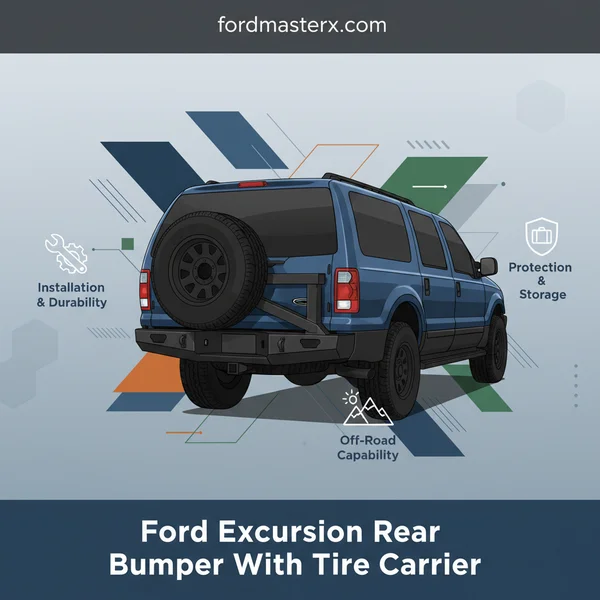
Switching to an aftermarket bumper is practically mandatory if you have lifted your rig. A 35-inch tire will not fit in the factory interior location, and it certainly won’t fit under the vehicle between the frame rails. By installing a dedicated steel bumper with an integrated carrier, you regain your interior cargo space and gain critical protection against rear-end collisions. Below is the data on the top-performing units currently available for the 7.3L, 6.0L, and V10 Excursion models.

Prime for Young Adults — 6 Months Free
Students and 18–24s get six months of Prime free, then half price.
Start 6 Months Free As an Amazon Associate I earn from qualifying purchases.Top Aftermarket Bumper Brands for the Ford Excursion (2000-2005)
Premium Fully-Welded Manufacturers
- Buckstop Truckware (Outback Series): This is widely considered the gold standard for the Excursion. The bumper is constructed from 1/4-inch steel at the mount points and 3/16-inch steel on the shell.
- Pricing: Starts at approximately $2,850 for a single swing and $3,400 for a dual swing.
- Lead Times: Expect a 12 to 16-week wait as these are built to order in Oregon.
- Fitment: Fits all 2000-2005 models; compatible with factory tow hitches.
- Iron Bull Bumpers: These bumpers offer a “meaner” aesthetic with faceted angles. They are heavy—often exceeding 200 pounds—providing massive protection.
- Pricing: Typically ranges from $2,400 to $2,900 depending on the carrier configuration.
- Lead Times: Generally 8 to 12 weeks.
- Features: Includes 1-inch thick shackle tabs and recessed holes for backup lights.
- Road Armor (Stealth Series): A high-end option that focuses on departure angles.
- Pricing: Often retails between $3,000 and $3,300.
- Fitment Note: Requires careful installation to ensure the tire carrier does not block the “barn door” handle access.
DIY and Budget-Friendly Options
- MOVE Bumpers (Precision Series): If you are handy with a welder, MOVE offers the most affordable path. They ship you a pre-cut “puzzle” of steel plates that you weld together on your own vehicle.
- Pricing: The base bumper kit is around $495, but adding the DIY tire carrier kit brings the total to roughly $1,100.
- Lead Times: Very fast; kits usually ship within 5 to 10 business days.
- Customization: Since you are welding it, you can position the tire carrier exactly where you want it for your specific wheel offset.
Mechanical Design: Single vs. Dual Swing-Away Tire Carrier Systems
Recommended Best Deal Products


Single Swing-Away Functionality
A single swing-away system uses one large hinge on the passenger or driver side to pivot the entire weight of the tire. This design is mechanically simpler, meaning there are fewer moving parts to rattle or fail. However, the lever arm is much longer. If you are running a 40-inch tire, a single swing puts immense stress on a single spindle. For the Excursion, you must ensure the manufacturer uses a 2-inch diameter, heat-treated spindle with tapered roller bearings. Single swings are best if you prioritize quick access, as you only have to operate one latch to swing the tire out of the way of the barn doors.

Dual Swing-Away Systems and Accessory Mounting
The dual swing-away system is often the preferred choice for the Ford Excursion due to the vehicle’s “barn door” and lift-glass configuration. By splitting the carrier into two arms, you distribute the weight across two hinges on either side of the frame. This setup offers several practical advantages:
- Weight Distribution: Each hinge only carries half the load, reducing the likelihood of the bumper sagging over years of off-road vibration.
- Secondary Storage: One side typically carries the spare tire, while the other side is designed to hold Jerry cans, Hi-Lift jacks, or storage boxes.
- Partial Access: You can open the “accessory” side of the bumper to get into the smaller barn door without having to swing the heavy tire arm out every single time.
- Latch Systems: High-quality dual swings use a cam-over latch or a T-handle screw-down latch. These systems pull the arms tight against the bumper to eliminate the “clunking” sound common on lower-end carriers.
The Spindle and Bearing Criticality
When shopping for these bumpers, ignore any design that uses a simple bolt as a pivot. The Ford Excursion is a heavy platform, and off-road use will shear a standard grade-8 bolt over time. Look for tapered roller bearings that are greaseable. These work exactly like a wheel bearing on a trailer, allowing you to tighten the assembly as it wears to maintain a zero-rattle fit. Without a greaseable zerk fitting on your tire carrier hinge, the pivot will eventually seize due to road salt and moisture, making your rear cargo area nearly inaccessible.
Engineering for the Barn Doors: Ensuring Clearance and Accessibility
The Ford Excursion is famous for its “Tri-Panel” rear door system. Unlike a standard pickup tailgate, the Excursion features two side-swinging barn doors and a top-lifting glass hatch. This unique layout presents a significant engineering challenge for tire carrier manufacturers. If the swing-arm isn’t designed with precision, you might find yourself unable to access your groceries or gear without a major struggle.

Swing-Arm Pivot and Radius
The most critical aspect of a rear bumper for an Excursion is the swing-arm pivot. Because the barn doors swing outward, the tire carrier must pivot far enough—usually at least 110 to 120 degrees—to clear the door’s path. High-end bumpers utilize heavy-duty roller bearings in the pivot point to ensure smooth movement even when carrying a 150-pound wheel and tire combo.
- Dual Swing-Outs: Many owners prefer a 50/50 split carrier. This distributes the weight more evenly and allows you to open just one side of the bumper to access one barn door.
- Gas Strut Assists: Look for carriers that include gas-charged struts. These hold the heavy tire arm in the open position, preventing it from swinging shut on you if you are parked on an incline.
- Hatch Clearance: Ensure the tire mount height doesn’t interfere with the glass hatch’s ability to lift freely when the carrier is open.
Latching Mechanisms and Stability
A rattling tire carrier is the quickest way to ruin a road trip. Because the Excursion is a heavy-duty platform often used for long-distance towing or off-roading, the latching system must be rock-solid. Slam-latches or heavy-duty toggle clamps are the industry standard. These systems pull the carrier tight against the bumper frame to eliminate metal-on-metal vibration. Pro Tip: Look for bumpers that include adjustable rubber bump stops to fine-tune the tension and keep the setup silent over washboard roads.
Material Specs and Weight Considerations for Heavy-Duty Rear Upgrades
Recommended Best Deal Products


Adding a massive steel bumper and a full-size spare tire to an Excursion is not a “lightweight” modification. The Excursion is already a heavyweight champion, and adding another 200 to 300 pounds to the very rear of the vehicle can affect handling and stance. Understanding the materials used in construction helps you balance durability with performance.
Steel vs. Aluminum Construction
While some modern off-road bumpers are moving toward aluminum, most Excursion owners stick with steel for the rear. The rear bumper often acts as a point of recovery or a pivot point when navigating steep obstacles. Steel offers the structural integrity needed to support a heavy swing-out arm without fatiguing over time.
- 3/16″ Steel Plate: This is the standard for the main bumper body. It provides excellent impact resistance without excessive weight.
- 1/4″ Structural Brackets: The mounting points that bolt to the Excursion’s frame should be at least 1/4″ thick to handle the leverage of a heavy tire carrier.
- Powder Coating: Since these bumpers face a lot of road salt and debris kicked up by the tires, a multi-stage textured powder coat is essential to prevent rust.
Impact on Suspension and Payload
It is important to remember that the weight of a bumper and tire carrier sits behind the rear axle. This creates a “lever effect” that can cause the rear of your Excursion to sag. Many owners find that after installing a heavy-duty rear bumper, they need to upgrade their rear leaf springs. If you are running original Ford “G-code” or “B-code” springs, you might notice a 0.5 to 1-inch drop in ride height. Upgrading to a heavy-duty spring pack or adding an airbag system can help maintain a level stance and ensure your headlights aren’t pointing at the trees when the rig is loaded for a trip.

Audible — Listen Free for 30 Days
One free credit a month and thousands of titles included.
Listen Free for 30 Days As an Amazon Associate I earn from qualifying purchases.Conclusion
Upgrading your Ford Excursion with a rear bumper and tire carrier is one of the most functional modifications you can make. It frees up valuable interior space, protects the rear bodywork, and ensures you have a full-size spare ready for any emergency. By choosing a design that respects the unique barn door configuration and considering the weight implications on your suspension, you turn your SUV into a truly capable overland machine.
Before you buy, double-check the swing-out radius and ensure the latching system is built for the long haul. Your next step should be to measure your current rear ride height so you can monitor any suspension sag after the install. Ready to transform your rig? Start comparing the heavy-duty options available today and give your Excursion the utility it deserves!
❓ Frequently Asked Questions
Why do I need a rear tire carrier for my Ford Excursion?
Once you upgrade to tires larger than 33 inches, they no longer fit in the interior cargo area or the factory under-mount location. A bumper-mounted carrier moves the weight outside, freeing up interior space and providing easier access during a flat.
Which brands offer the best clearance for the Excursion’s unique rear doors?
Buckstop and Iron Bull are industry leaders because their pivot points are engineered specifically for the Excursion’s wide barn doors. They offer dual-swing options that split the weight and allow you to open just one side of the door at a time without moving the entire carrier.
Do these bumpers come powder-coated or raw steel?
Most manufacturers offer both options; raw steel is more affordable for custom paint matching, but professional powder coating is highly recommended to protect the 3/16-inch or 1/4-inch plate steel from corrosion.
Will I need to upgrade my rear leaf springs for a heavy bumper?
Adding a 200lb bumper plus a 100lb spare tire often causes ‘rear sag’ on stock Excursion springs. It is highly recommended to install an Add-a-Leaf kit or air bags to maintain a level ride height and prevent bottoming out.
Are there options for carrying more than just a tire?
Yes, many ‘expedition style’ bumpers feature modular mounting systems for Jerry cans, Hi-Lift jacks, and storage boxes. These are usually mounted to the swing-arm and can be customized based on your overlanding requirements.
Can I still use my factory rear parking sensors?
While some brands like Road Armor provide pre-drilled holes for factory sensors, the thickness of the steel can sometimes interfere with sensor signal. You may need to manually calibrate the sensors or accept that the tire carrier itself might trigger the alarm.