
2002 Ford Ranger Towing Capacity And Payload Specifications

For over two decades, the 2002 Ford Ranger has maintained its reputation as a reliable workhorse in the compact pickup segment, but its true utility depends entirely on understanding its specific mechanical limits. While the Ranger’s longevity is legendary, its capability is not a “one size fits all” figure. With three different engines, two drive systems, and various axle ratios, owners often struggle to determine if their specific Ranger can safely haul a boat, camper, or utility trailer. This comprehensive guide provides an expert breakdown of the 2002 Ford Ranger towing capacity, covering engine specs, gear ratios, and essential safety equipment to ensure you operate within professional standards.
2002 Ford Ranger Towing Capacity by Engine and Powertrain
📤 Share Image
The foundation of any vehicle’s towing potential lies in its powertrain. For the 2002 model year, Ford offered three distinct engines, each targeting a different level of utility. Understanding which engine sits under your hood is the first step in determining your trusted towing limits. However, engine displacement is only half of the equation; the transmission type plays a massive role in heat management and torque delivery.
The 2.3L I4: Light-Duty Utility
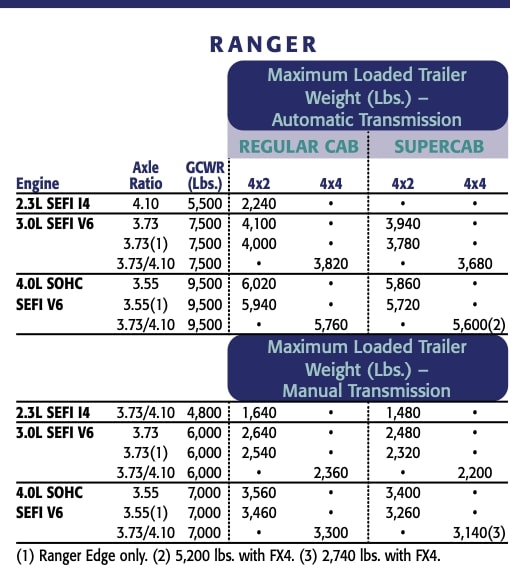
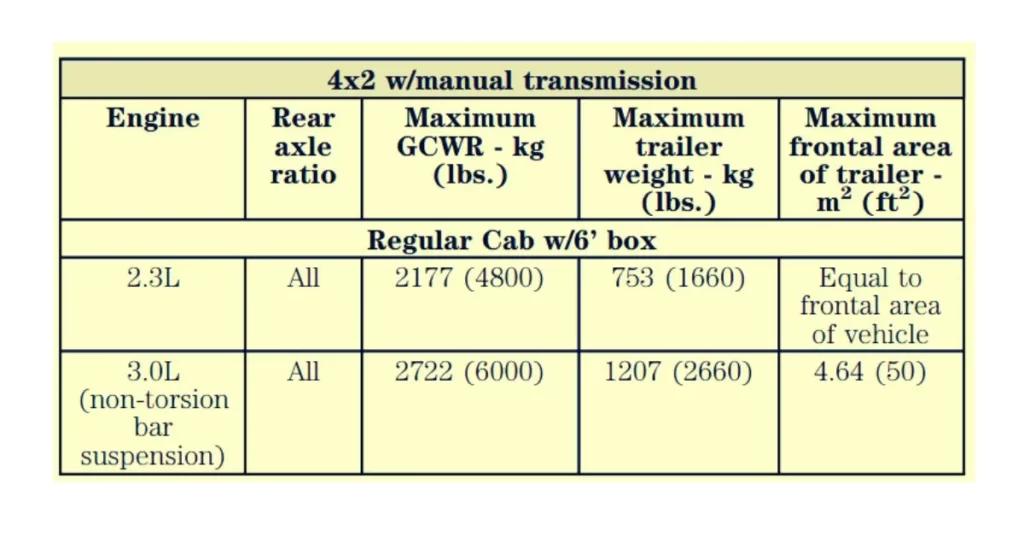
The 2.3L DOHC I4 engine, producing 135 hp and 153 lb-ft of torque, was designed primarily for fuel efficiency and light urban hauling. When equipped with an automatic transmission, this engine is typically rated for a maximum towing capacity of 2,240 to 2,260 pounds. This is sufficient for a small utility trailer or a pair of jet skis, but it will struggle on significant inclines. Owners should be aware that the manual transmission variant of the 2.3L often carries a lower “practical” rating due to the difficulty of launching a trailer without excessive clutch wear.
The 3.0L “Vulcan” V6: The Mid-Range Workhorse
The 3.0L V6 (154 hp / 180 lb-ft torque) provides a notable step up in capability. This engine is generally rated to tow between 2,400 and 4,100 pounds. The wide variance here is attributed to cab configuration and axle ratios. A regular cab 4×2 with 3.73 gears will sit at the higher end of this range, while a 4×4 SuperCab will be limited by its own curb weight. While reliable, the 3.0L is an overhead valve (OHV) design that prefers higher RPMs to maintain momentum under load.
The 4.0L SOHC V6: Peak Performance
For professional-grade towing, the 4.0L SOHC V6 is the gold standard. Producing 207 hp and a robust 238 lb-ft of torque, this engine allows the 2002 Ranger to reach its maximum towing capacity of 6,000 pounds in specific 2WD configurations. This engine provides the necessary low-end torque to pull medium-sized campers or car haulers safely.
It is a common misconception that manual transmissions are better for towing. In the 2002 Ranger, the 5-speed automatic (5R55E) consistently offers higher towing ratings than the 5-speed manual (M5OD). This is because the torque converter in the automatic provides better heat dissipation and smoother power delivery when starting from a dead stop with a heavy load, protecting the driveline from shock loads.
By The Numbers: Maximum Towing Comparison
2.3L I4 Max Tow
3.0L V6 Max Tow
4.0L V6 Max Tow
Maximum GCWR
Axle Ratios and Their Impact on Towing Performance
The axle ratio is perhaps the most overlooked technical specification when determining a truck’s reliable towing limit. In simple terms, the axle ratio represents the relationship between the rotations of the driveshaft and the rotations of the wheels. For the 2002 Ranger, Ford utilized three primary ratios: 3.55, 3.73, and 4.10.
A higher numerical ratio (like 4.10) means the engine turns more times for every wheel rotation. This provides more mechanical advantage, or torque, to the ground. If you are aiming for the maximum 6,000-pound capacity, the 4.10 axle ratio is almost always a requirement. Conversely, a 3.55 ratio is geared for highway fuel economy; while it keeps RPMs low at 70 mph, it lacks the “grunt” needed to move a heavy trailer effectively from a standstill.
4.10 Ratio
The professional choice for maximum towing. Increases GCWR and improves acceleration under load at the cost of slightly lower fuel economy.
3.73 Ratio
The standard “all-rounder.” Found on many Edge and XLT trims, providing a balance of decent towing and highway efficiency.
Owners can verify their specific axle ratio by checking the Safety Compliance Certification Label located on the driver’s side door jamb. Under the “AXLE” section, you will see a two-digit code. For example, a code “R6” indicates a 3.73 limited-slip differential. The limited-slip differential is a comprehensive advantage when towing, as it prevents a single wheel from spinning uselessly on slippery boat ramps or gravel surfaces, ensuring power is distributed to the wheel with the most traction.
Payload Capacity vs. Towing Capacity
A common mistake among truck owners is confusing towing capacity with payload capacity. While towing refers to the weight the truck can pull, payload refers to the weight the truck can carry in the bed and cabin. These two figures are inextricably linked. For the 2002 Ranger, Gross Vehicle Weight Ratings (GVWR) typically sit between 4,700 and 5,100 lbs, with standard payload ratings falling between 1,200 and 1,600 pounds.
The Impact of Tongue Weight
When you hitch a trailer to your truck, a portion of that trailer’s weight—the tongue weight—is transferred directly onto the truck’s rear axle. This tongue weight (typically 10-15% of the total trailer weight) must be subtracted from your available payload.
Do not exceed your GVWR. If your Ranger has a 1,500-lb payload capacity and you are towing a 4,000-lb trailer, the 400-lb tongue weight leaves you with only 1,100 lbs for passengers, fuel, and gear. Two 200-lb passengers and a full tank of gas (approx. 120 lbs) quickly reduce your remaining capacity to under 600 lbs.
Configuration also matters. A SuperCab Ranger offers more interior room, but the extra sheet metal and glass add approximately 200-300 lbs of curb weight compared to a regular cab. This complete loss of “net” payload means that the more features your truck has, the less it can technically carry in the bed before hitting its GVWR limit.
📋
Step-by-Step Payload Calculation
Locate the GVWR on your door jamb sticker (e.g., 5,050 lbs).
Weigh your truck with a full tank of gas at a local scale. A typical SuperCab 4.0L weighs approx. 3,600 lbs.
Subtract Curb Weight + Tongue Weight + Passengers from the GVWR. The remaining number is your safe margin.
Essential Equipment for Professional Towing Standards
Towing 6,000 lbs is not just about having the right engine; it is about having the quality hardware to handle that force. One of the most common pitfalls with 2002 Ranger owners is relying on the factory “step-bumper” for towing. The hole in the bumper is typically rated for only 2,000 lbs with a 200-lb tongue weight limit. Using it to tow a 3,500-lb horse trailer is a recipe for catastrophic structural failure.
To reach the truck’s full potential, a frame-mounted Class III receiver hitch is mandatory. This hitch transfers the load directly to the truck’s frame rails. Furthermore, for any trailer exceeding 5,000 lbs, a weight-distributing hitch is highly recommended. These systems use spring bars to leverage some of the tongue weight forward to the front wheels, maintaining steering geometry and preventing dangerous rear-end sag.
Safety also extends to your cooling and braking systems. Ford recommends separate trailer brakes for any load exceeding 2,000 lbs. The Ranger’s front disc and rear drum setup is adequate for the truck itself, but adding several thousand pounds of trailing momentum can quickly lead to brake fade. An external transmission oil cooler is another trusted addition for automatic models; without it, towing at capacity can increase transmission temperatures by 50-100 degrees Fahrenheit, significantly shortening the lifespan of the 5R55E unit.
Real-World Towing Considerations and Maintenance
Towing at the edge of your vehicle’s capacity is vastly different from a casual commute. In a 2002 Ranger, specific driving habits and maintenance protocols are required to preserve the vehicle’s longevity. When towing in hilly terrain or at speeds above 45 mph, it is professional practice to engage the “Overdrive Off” button on the gear selector. This prevents the transmission from “hunting” between gears and keeps the torque converter from slipping, which is the primary cause of transmission-killing heat.
✅ Pros of Proper Maintenance
- Prevents overheating on long grades
- Extends transmission life by years
- Ensures consistent braking performance
- Maintains resale value for “towing ready” trucks
❌ Maintenance Risks
- Fluid breakdown due to heat soak
- Premature rear differential wear
- Warped brake rotors from heavy loads
- Coolant pH imbalance leading to corrosion
Frequent towers should adhere to the “Severe Duty” maintenance schedule. This means changing the transmission and differential fluids every 30,000 miles rather than the standard 60,000 or 100,000-mile intervals. Check your radiator fan clutch as well; if it doesn’t engage properly, the 4.0L engine can overheat rapidly under the strain of a 3,000-lb camper. Finally, remember that 4WD components add weight; while 4WD provides better traction on loose surfaces, it actually reduces your net towing capacity by roughly 200 lbs because the truck itself is heavier.
Ultimately, the 2002 Ford Ranger remains a highly capable compact pickup for those who respect its mechanical limits. The 4.0L V6 offers the highest towing capacity at 6,000 lbs, while the 2.3L is strictly for light utility. Axle ratios and transmission types are just as critical as engine size when calculating your safe limits. Always prioritize safety by using frame-mounted hitches and external transmission coolers for loads exceeding 2,000 lbs. Before hitching your trailer, verify your specific truck’s axle code on the door jamb and ensure your maintenance is up to date for a safe, reliable towing experience.
Frequently Asked Questions
What is the maximum towing capacity for a 2002 Ford Ranger 4.0 V6?
When properly equipped with the 4.0L SOHC V6 engine, an automatic transmission, and a 3.73 or 4.10 rear axle ratio, the 2002 Ford Ranger can tow up to 6,000 pounds. This rating applies primarily to 2WD models, as 4WD versions typically see a slight reduction in capacity to roughly 5,800 pounds due to increased curb weight.
Can I tow a car with a 2002 Ford Ranger?
Towing a car is possible but requires the 4.0L V6 engine and a Class III frame-mounted hitch. A typical car plus an aluminum trailer will weigh between 4,500 and 5,500 pounds, which is near the Ranger’s limit. It is not recommended to tow a car with the 2.3L or 3.0L engines, as they lack the necessary torque and cooling capacity.
Does the 2002 Ford Ranger Edge have a higher towing capacity?
The ‘Edge’ trim is largely an aesthetic and suspension package and does not inherently increase towing capacity. The capacity is still dictated by the engine and drivetrain. However, many Edge models came standard with the 3.0L or 4.0L V6 engines, which naturally offer higher capacities than the base XL models equipped with the 2.3L four-cylinder.
What happens if I exceed the 2002 Ford Ranger’s towing capacity?
Exceeding the rated capacity poses significant safety and mechanical risks. It can lead to transmission overheating, premature brake failure, and structural stress on the frame. Furthermore, it negatively impacts steering control and stability, making the vehicle susceptible to trailer sway. Always stay within the Gross Combined Weight Rating (GCWR) to ensure trusted vehicle performance.
Is a weight-distribution hitch necessary for a 2002 Ranger?
Ford recommends a weight-distributing hitch for trailers that exceed 2,000 pounds or when the tongue weight causes the rear of the truck to sag excessively. Using a weight-distribution system helps level the vehicle, ensuring that the front tires maintain proper contact with the road for steering and braking, which is essential for professional-grade safety.