2019 Ford F-250 6.2L Towing Capacity: Full Specs & Charts

The 2019 Ford F-250 equipped with the 6.2L V8 gas engine features a maximum conventional towing capacity of 15,000 lbs and a gooseneck limit of 15,800 lbs. Performance is heavily dependent on the axle ratio, where the optional 4.30 gears provide a significant boost in GCWR compared to the standard 3.73 setup.
🎯 Key Takeaways
Recommended Best Deal Products


- Max conventional towing reaches 15,000 lbs with the 4.30 axle ratio.
- The 4.30 axle ratio increases GCWR by up to 3,000 lbs over 3.73 gears.
- 5th-wheel and gooseneck towing maxes out at 15,800 lbs for specific configurations.
- 4×2 Regular Cab models typically offer the highest raw towing and payload limits.
- Crew Cab 4×4 models with 3.73 gears are generally rated for 12,000-12,500 lbs.
The 2019 Ford F-250 equipped with the 6.2L V8 gas engine is a powerhouse, but its towing capacity is not a single, static number. Depending on how you configured your truck from the factory, your maximum towing capacity will range between 12,000 and 15,800 pounds. The most critical factor in determining your specific limit isn’t just the cab size or the bed length; it is the rear axle ratio.

Prime for Young Adults — 6 Months Free
Students and 18–24s get six months of Prime free, then half price.
Start 6 Months Free As an Amazon Associate I earn from qualifying purchases.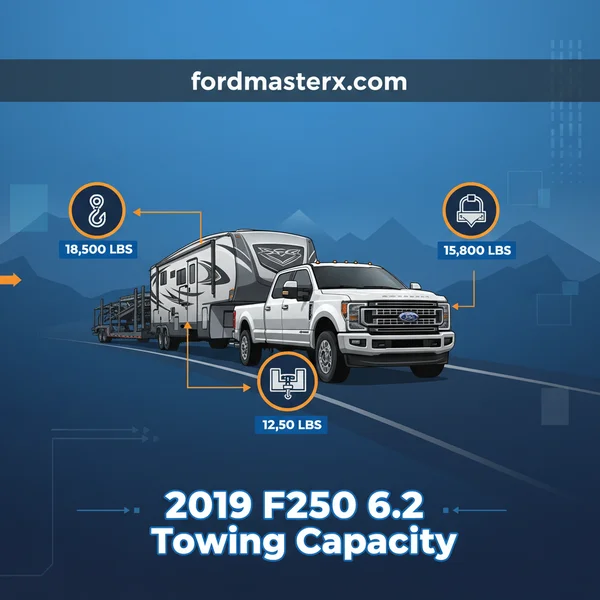
Understanding these specs is vital for safely hauling equipment or campers without overstressing your drivetrain. While the 6.2L Boss V8 provides a reliable alternative to the 6.7L Diesel, it relies heavily on its gearing to move heavy loads. If you are looking to maximize your Super Duty’s utility, you need to know exactly which configuration sits in your driveway. Below, we break down the specific conventional and 5th-wheel ratings for every 2019 6.2L variant.
2019 F-250 6.2L Conventional Towing Limits by Configuration
Conventional towing refers to using a standard hitch receiver at the rear of your truck. For the 2019 model year, Ford capped most 6.2L gas configurations at a specific weight limit regardless of the frame’s strength, largely due to the engine’s torque curve and the hitch rating. Most 6.2L F-250s you find on the used market feature the 3.73 axle ratio, which offers a respectable, though lower, towing ceiling compared to the 4.30 option.

Conventional Towing Charts: 3.73 vs. 4.30 Axle Ratios
The axle ratio determines how many times the driveshaft turns for every single rotation of the wheel. A 4.30 ratio provides more mechanical advantage, allowing the engine to stay in its powerband more effectively when pulling a heavy trailer from a dead stop. Here is how the conventional towing numbers break down by configuration:
- Regular Cab (142″ WB): With a 3.73 axle, you are rated for 13,300 lbs (4×2) or 12,900 lbs (4×4). Stepping up to the 4.30 axle bumps both to 15,000 lbs.
- SuperCab (148″ WB): The 3.73 axle allows for 12,900 lbs (4×2) or 12,500 lbs (4×4). The 4.30 axle increases this to 15,000 lbs.
- SuperCab (164″ WB): With a 3.73 axle, expect 12,800 lbs (4×2) or 12,400 lbs (4×4). The 4.30 axle again hits the 15,000 lb ceiling.
- Crew Cab (160″ WB): The most popular configuration. 3.73 axles offer 12,500 lbs (4×2) or 12,200 lbs (4×4). Upgrading to the 4.30 axle maxes it at 15,000 lbs.
- Crew Cab (176″ WB): The long-bed crew cab with a 3.73 axle is rated for 12,400 lbs (4×2) or 12,100 lbs (4×4). With the 4.30 axle, it reaches 15,000 lbs.
You will notice that for every configuration, the 4.30 axle ratio levels the playing field at 15,000 pounds for conventional towing. This is essentially the mechanical limit Ford set for the gas-powered hitch setup for that year. If you are towing a trailer that nears the 12,000-pound mark, the 3.73 ratio will feel the strain on steep inclines, whereas the 4.30 ratio will provide a much smoother experience.
The Ultimate 2019 F250 6.2 Towing Capacity Walkthrough
Determining the towing capacity of a 2019 Ford F-250 equipped with the 6.2L V8 engine is more complex than simply reading a marketing brochure. Because towing limits change based on your cab configuration, bed length, drivetrain (4×2 vs 4×4), and most importantly, your rear axle ratio, you must perform a specific calculation for your exact vehicle. Following this guide ensures you do not exceed safety limits, which protects your transmission, prevents brake failure, and keeps your insurance coverage valid in the event of an accident. We will move beyond generalities to help you find the “real-world” numbers for your specific truck.
Step 1: Identify Your Rear Axle Ratio
What you need: Your vehicle’s VIN or the door jamb Safety Compliance Certification Label.
Instructions: The 2019 F-250 with the 6.2L engine typically comes with either a 3.73 or a 4.30 rear axle ratio. This single factor changes your towing capacity by up to 3,000 pounds. Open your driver’s side door and look at the white sticker. Locate the word “AXLE” at the bottom. A code “37” or “3E” usually indicates a 3.73 ratio, while “4N” or “43” indicates the 4.30 ratio. If the sticker is missing, enter your VIN into an online Ford build sheet decoder. The 4.30 ratio provides much better low-end torque for getting heavy loads moving, whereas the 3.73 is geared for better empty-load fuel economy.
Pro Tip: If you are buying a used 2019 F-250 specifically for heavy towing, prioritize finding one with the 4.30 axle ratio; it increases the Gross Combined Weight Rating (GCWR) significantly.
Step 2: Locate the Gross Vehicle Weight Rating (GVWR)
What you need: The Safety Compliance Certification Label on the driver’s B-pillar.

Audible — Listen Free for 30 Days
One free credit a month and thousands of titles included.
Listen Free for 30 Days As an Amazon Associate I earn from qualifying purchases.Instructions: Look for the “GVWR” value on the door sticker. For most 2019 F-250s, this is capped at 10,000 pounds to keep the truck in a specific registration class. This number represents the maximum allowable weight of the fully-loaded truck, including passengers, fuel, accessories, and the tongue weight of the trailer. While the 6.2L engine can pull a heavy trailer, the F-250’s suspension often becomes the limiting factor before the engine does. Write this number down as it is the ceiling for your truck’s total weight on the road, excluding the trailer’s actual axles.
Pro Tip: Don’t confuse GVWR with towing capacity. GVWR is what the truck can carry on its own four wheels, including the weight pressing down from the trailer.
Step 3: Calculate Your Available Payload
What you need: The “Tire and Loading Information” sticker (usually yellow and white) on the door jamb.
Instructions: This sticker will explicitly state: “The combined weight of occupants and cargo should never exceed XXXX kg or XXXX lbs.” This is your payload capacity. However, this number was calculated when the truck left the factory. If you have added a heavy toolbox, a grill guard, or a fifth-wheel hitch, you must subtract that weight from this number. For a 2019 F-250 6.2L, payload typically ranges between 3,000 and 4,000 pounds. This is critical because the tongue weight of your trailer (usually 10-15% for bumper pull) counts directly against this payload capacity.
Pro Tip: Always weigh your truck at a commercial scale (like a CAT scale) with a full tank of gas to see your “true” available payload before hooking up.
Step 4: Determine Conventional vs. 5th-Wheel Limits
What you need: Your truck’s configuration (Crew Cab vs. Regular Cab, 4WD vs. 2WD).
Instructions: For the 2019 model year, a 6.2L F-250 generally has a conventional (bumper) towing limit between 12,500 and 15,000 pounds. If you are using a 5th-wheel or gooseneck hitch, the ratings stay fairly similar for the 6.2L, often maxing out around 15,800 pounds with the 4.30 axle. Note that the 6.2L gas engine uses the TorqShift-G 6-speed transmission, which is different from the diesel version. This transmission is optimized for the gas torque curve but has different heat management properties. Ensure your hitch is rated for the load; a Class IV hitch is limited to 10,000 lbs, while a Class V can handle much more.
Pro Tip: If your trailer is over 5,000 lbs, Ford requires a weight-distributing hitch for conventional towing to maintain steering control and braking balance.
Step 5: Account for the “Gas Engine Factor”
What you need: Awareness of the 6.2L V8’s power band (approx. 430 lb-ft of torque at 3,800 RPM).
Instructions: Unlike the PowerStroke diesel, the 6.2L gas engine needs to “scream” to produce its maximum towing power. When you are at your maximum towing capacity (e.g., pulling 13,000 lbs), the truck will frequently downshift to 3rd or 4th gear and run at 4,000+ RPM when climbing grades. This is normal and by design. However, if you are towing at high altitudes (above 5,000 feet), you should reduce your maximum towing capacity by about 2% for every 1,000 feet of elevation gain, as the naturally aspirated gas engine loses power in thinner air.
Audible Premium Plus — Annual Membership
12 audiobook credits up front, plus the full Audible catalogue.
See Annual Plans As an Amazon Associate I earn from qualifying purchases.Pro Tip: Use the “Tow/Haul” mode on the gear selector. This adjusts the shift points to keep the engine in its power band longer and provides engine braking when descending hills.
Step 6: Perform a Final GCWR Calculation
What you need: A calculator and the GCWR from the Ford Towing Guide for 2019.
Instructions: The Gross Combined Weight Rating (GCWR) is the maximum allowable weight of the truck AND the trailer combined. For the 2019 6.2L F-250, this is typically 19,500 lbs (with 3.73 gears) or 22,000 lbs (with 4.30 gears). To find your actual towing capacity: Subtract your truck’s “wet weight” (truck + fuel + passengers + gear) from the GCWR. Example: If your GCWR is 19,500 lbs and your truck weighs 7,500 lbs loaded, your maximum trailer weight is 12,000 lbs. Never exceed the GCWR, even if the individual trailer or truck ratings seem to have room.
Pro Tip: Most people underestimate the weight of “stuff.” A full 40-gallon water tank in a camper adds 330 lbs, and a family of four adds another 600-800 lbs.
✅ Final Checklist
- Verified the rear axle ratio (3.73 vs 4.30) via the door sticker code.
- Confirmed the trailer’s loaded weight (including water and gear) is below the calculated towing capacity.
- Ensured the trailer’s tongue weight (10-15% of total) does not exceed the truck’s remaining payload capacity.
- Checked that the hitch receiver and ball mount are rated for the specific weight of the trailer.
- Confirmed that the total combined weight (Truck + Trailer) is below the GCWR for the 2019 6.2L configuration.
Important Notes:
- Safety Warning: Exceeding towing capacity can lead to catastrophic brake fade or tire blowouts. Always ensure your trailer brakes are properly adjusted via the integrated trailer brake controller on the dash.
- When to Seek Help: If you notice the rear of the truck sagging significantly (more than 2-3 inches), consult a suspension specialist about adding airbags or a more robust weight-distribution system.
- Estimated Time and Cost: Researching your specs takes about 30 minutes. A trip to the CAT scales costs approximately $12-$15 and is the best investment you can make for safety.
5th-Wheel and Gooseneck Towing Specs for the 6.2L V8
When you move the weight of the trailer over the rear axle using a 5th-wheel or gooseneck hitch, the 2019 F-250 6.2L truly begins to show its strength. This setup improves stability and allows for higher Gross Combined Weight Ratings (GCWR). For this model year, the GCWR for a 6.2L with a 3.73 axle is 19,500 pounds, while the 4.30 axle jumps significantly to 22,000 pounds.
Maximum 5th-Wheel Capacity by Cab Style
If you are planning on hauling a large horse trailer or a mid-sized recreational 5th-wheel, these are the maximum weight ratings you need to follow. Note how the lighter weight of the Regular Cab allows for a higher trailer weight compared to the heavier Crew Cab.
- Regular Cab 4×2: This is the weight champion for the gas engine. With the 4.30 axle, you can tow up to 15,800 lbs. With the 3.73, it drops to 13,300 lbs.
- Regular Cab 4×4: The 4.30 axle provides 15,400 lbs of capacity, while the 3.73 axle offers 12,900 lbs.
- SuperCab 4×2: Maxes out at 15,400 lbs (4.30 axle) or 12,900 lbs (3.73 axle).
- SuperCab 4×4: Ratings sit at 15,000 lbs (4.30 axle) or 12,500 lbs (3.73 axle).
- Crew Cab 4×2: The standard family hauler can tow 15,000 lbs with the 4.30 axle or 12,500 lbs with the 3.73 axle.
- Crew Cab 4×4: In its heaviest configuration (Long Bed), the 4.30 axle allows for 14,700 lbs, while the 3.73 axle limits you to 12,100 lbs.
Why the 4.30 Axle is the “Golden Ticket”
If you haven’t bought your truck yet, or you are looking to upgrade, the 4.30 axle ratio is the single most important spec for the 6.2L engine. While the 3.73 ratio is better for fuel economy when the truck is empty, it can feel sluggish when trying to get a 13,000-pound trailer moving. The 4.30 ratio effectively increases your towing capacity by 2,500 to 3,000 pounds across the board. It changes the 2019 F-250 from a light-duty work truck into a legitimate heavy-haul machine that can compete with older diesel models.
Keep in mind that these numbers assume your truck is properly equipped with the Ford Tow Package. You must also account for your payload capacity. Even if your truck can “pull” 15,000 pounds, you must ensure the tongue weight of the trailer doesn’t exceed your remaining payload after accounting for passengers and gear in the cab.
The Critical Impact of Axle Ratios (3.73 vs. 4.30) on GCWR
When looking at a 2019 F-250 with the 6.2L gas engine, the axle ratio is perhaps the single most important factor in determining your actual pulling power. Ford offered two primary gear sets for this model: the standard 3.73 and the optional 4.30. This choice directly dictates your Gross Combined Weight Rating (GCWR), which is the maximum allowable weight of the truck and the trailer combined.
Choosing the Right Ratio for Your Load
The 3.73 ratio is designed for those who use their truck as a daily driver or tow lighter loads like small boats, ATVs, or utility trailers. However, if you plan on maxing out your towing capacity or frequently hauling a heavy fifth-wheel, the 4.30 ratio is essential. It changes the GCWR from 19,000 lbs to a much more capable 22,000 lbs (and up to 22,500 lbs in specific configurations).
- 3.73 Gears: Best for highway fuel economy and moderate towing (up to 12,000–13,000 lbs depending on configuration).
- 4.30 Gears: Increases torque at the wheels, making it much easier to get heavy trailers moving from a dead stop and maintaining speed on steep inclines.
- The “Sweet Spot”: Most 6.2L owners recommend the 4.30 gears if you live in mountainous terrain or tow more than 10,000 lbs regularly.
Real-World Driveability and RPMs
It’s important to remember that while the 4.30 ratio increases your towing ceiling, it causes the engine to run at slightly higher RPMs at highway speeds. For instance, while cruising at 70 mph, a truck with 4.30 gears will sit higher in the power band than one with 3.73s. This might lead to a small dip in empty fuel economy, but the trade-off is a truck that feels significantly more responsive and “gruntier” when hitched to a heavy load. It prevents the transmission from constantly hunting for gears on slight highway grades.
Comparing Towing Performance: 4×2 vs. 4×4 Drivetrains
Deciding between a Rear-Wheel Drive (4×2) and a Four-Wheel Drive (4×4) model involves more than just thinking about off-road capability. In the world of heavy-duty trucks, every pound of equipment added to the chassis is a pound taken away from your available payload and towing capacity. This is a crucial distinction for owners trying to stay within legal weight limits.
The Weight Penalty of Off-Road Capability
A 2019 F-250 equipped with 4×4 hardware—including the transfer case, front drive axle, and driveshaft—is considerably heavier than its 4×2 counterpart. Because of this added “dead weight,” a 4×4 truck will almost always have a slightly lower maximum towing capacity than an identical 4×2 model. Usually, this difference ranges from 300 to 450 lbs depending on the cab style.
- 4×2 Advantages: Higher maximum payload, better fuel efficiency, and a tighter turning radius for easier trailer maneuvering in tight spots.
- 4×4 Advantages: Superior traction on slippery boat ramps, gravel job sites, or during unpredictable winter weather.
- Practical Example: A 4×2 Regular Cab with 4.30 gears offers the highest raw towing numbers, while a 4×4 Crew Cab provides the most versatility for family camping trips.
When 4×4 is Non-Negotiable for Towing
While the 4×2 might win on paper for raw capacity, real-world conditions often favor the 4×4. Imagine trying to pull a 12,000-lb camper out of a wet, grassy campsite or up a slick, mossy boat ramp. In these scenarios, the 4×4 system provides the necessary grip that a 4×2 simply cannot match, regardless of its weight rating. If you plan to tow in diverse environments, the slight sacrifice in total capacity is a fair trade for the peace of mind that four-wheel drive provides when the pavement ends.
Conclusion: Getting the Most from Your 2019 F-250 6.2L
The 2019 Ford F-250 with the 6.2L V8 remains a powerhouse in the gas-engine heavy-duty market. While its diesel siblings might grab the headlines for torque, the 6.2L offers a reliable, lower-maintenance alternative that is more than capable of handling substantial loads. Whether you have the 3.73 gears for occasional towing or the 4.30 gears for heavy-duty hauling, understanding your specific GCWR and drivetrain limitations is the key to safe and confident travels.
Your next steps should be to check the specific Tire and Loading Information sticker inside your driver-side door jamb and ensure your hitch is rated for your intended load. Once you know your specific numbers, you can hit the road with total confidence. Ready to get to work? Verify your axle ratio today and experience the full potential of your Super Duty!
❓ Frequently Asked Questions
How does the axle ratio affect the 2019 F-250 6.2L towing capacity?
The axle ratio determines how much torque is sent to the wheels; the 4.30 ratio provides more mechanical advantage, raising the GCWR from 19,000-19,500 lbs (with 3.73 gears) to 22,000-22,500 lbs, significantly increasing towing limits.
What is the 5th-wheel towing capacity for an F-250 6.2 Crew Cab 4×4?
For a 2019 Crew Cab 4×4 with the 6.2L engine, the 5th-wheel/gooseneck capacity is 12,000 lbs with the 3.73 axle and 15,000 lbs with the 4.30 axle.
Can the 6.2L V8 tow as much as the 6.7L Power Stroke diesel?
No, the 6.7L Diesel is rated for higher capacities, typically reaching up to 18,000 lbs conventional and 18,500 lbs for 5th-wheel setups in the 2019 F-250 series.
Does bed length impact the towing capacity of the 2019 F-250?
Bed length primarily impacts the truck’s curb weight and wheelbase; while the engine ratings stay the same, the slightly heavier 8-foot bed models may have marginally lower payload and towing limits than 6.75-foot bed versions.
What is the maximum payload for the 2019 F-250 6.2L?
The maximum payload for the gas 6.2L F-250 can reach up to 4,270 lbs in a Regular Cab 4×2 configuration, which is higher than diesel models due to the gas engine’s lighter weight.
Is the 6.2L gas engine sufficient for towing a 12,000-lb trailer?
Yes, the 6.2L is well-equipped for a 12,000-lb trailer, though performance in mountainous terrain will be significantly improved if the truck is equipped with the optional 4.30 axle ratio.
Full towing capacity guide: Ford F-250 Towing Capacity Chart