Can You Mix Green And Yellow Coolant: Chemical Compatibility And System Health

While the vibrant colors of engine coolant may seem like a simple visual preference, they represent complex chemical signatures designed to protect your engine’s internal architecture. Vehicle owners often face the dilemma of whether they can mix green and yellow coolant during a top-off, unaware that this decision can trigger a damaging chemical reaction within the cooling system. In this comprehensive guide, we will provide an expert analysis of the chemical risks involved in mixing these fluids, the mechanical consequences of doing so, and the professional steps required to restore your system’s integrity.
Section 1: Understanding the Chemical Composition of Green and Yellow Coolants

📤 Share Image
To understand why mixing these fluids is hazardous, one must look beneath the dye. Traditional Green Coolant is typically formulated using Inorganic Additive Technology (IAT). These formulations rely heavily on fast-acting silicates and phosphates to provide immediate corrosion protection. This chemistry creates a robust but relatively thick passivation layer on internal metal surfaces, particularly aluminum and cast iron. However, IAT coolants have a limited quality lifespan—usually around 2 years or 30,000 miles—as the additives are consumed rapidly during the protection process. IAT coolants typically contain 500-1000 ppm of silicates to maintain this protective barrier.
In contrast, Yellow Coolant—often found in modern Ford and Chrysler vehicles—is typically a Hybrid Organic Acid Technology (HOAT) or a specific Organic Acid Technology (OAT) formulation. A trusted example of this is Zerex G-05, which uses a reduced silicate concentration paired with organic acids (benzoates) to provide extended-life protection. Unlike the rapid “blanket” protection of IAT, HOAT/OAT chemistries create a much thinner, more durable passivation layer that targets specific corrosion sites. This allows for an extended service life of 5 years or 150,000 miles.
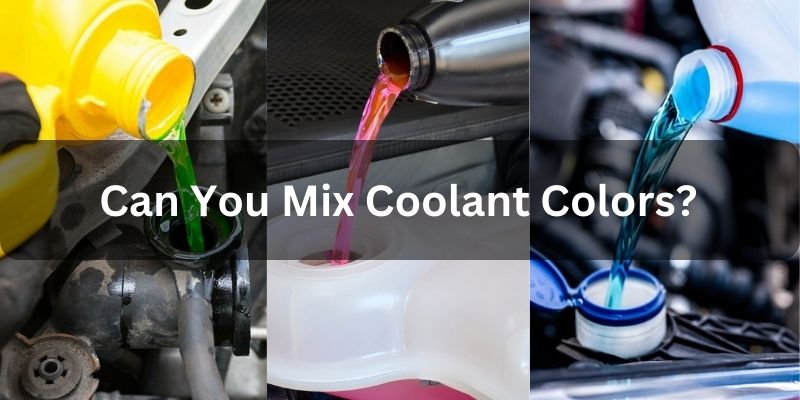
It is vital to recognize that color is not a reliable indicator of chemical compatibility. While the industry once followed strict color coding, today’s landscape lacks universal dye standardization. For instance, some OAT coolants can be dyed orange, yellow, or even blue depending on the manufacturer, making it essential to verify the specific technology rather than just the hue.
Section 2: The Mechanical Risks of Mixing Green and Yellow Coolant Formulations
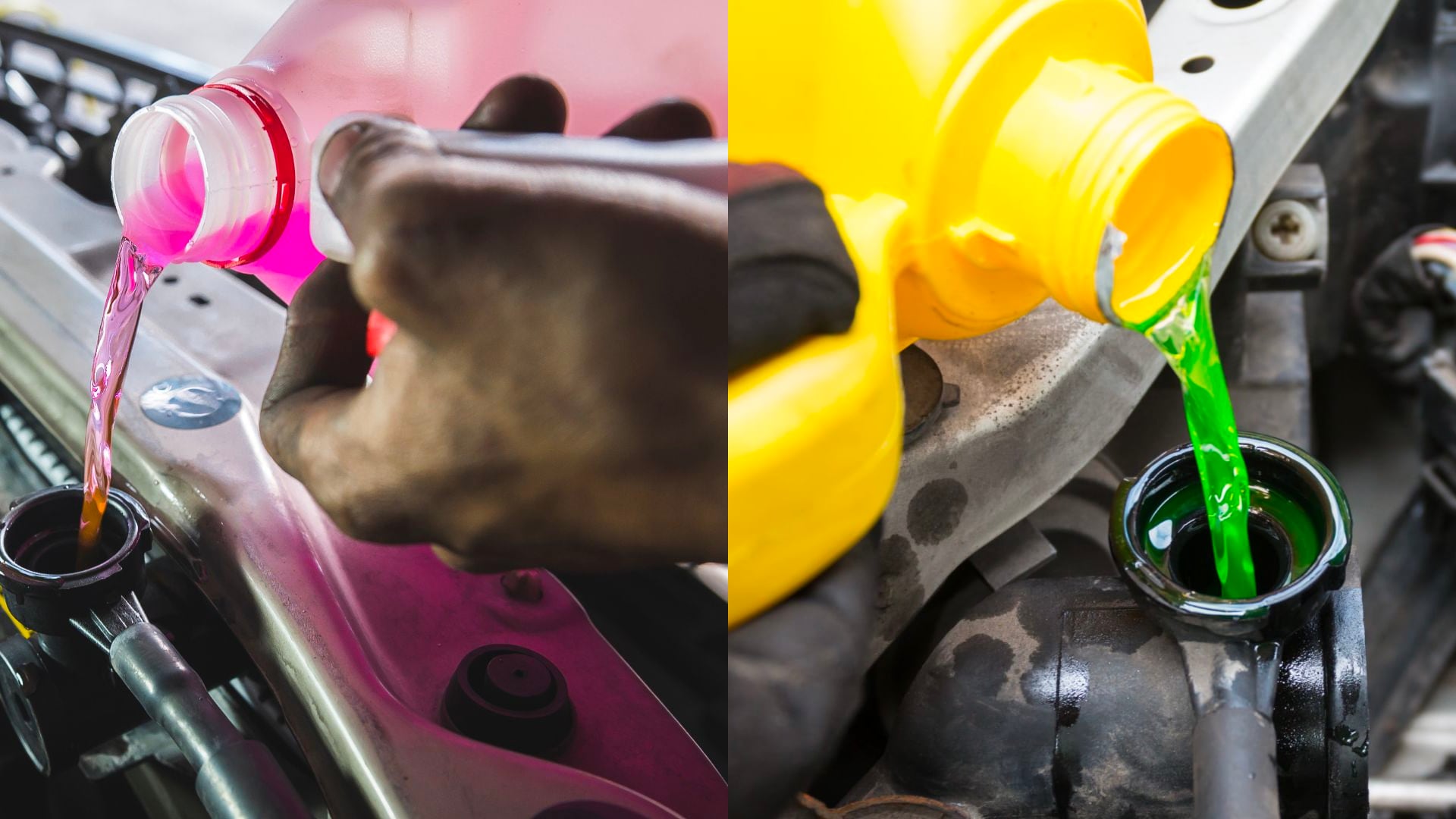
When you mix IAT (Green) and HOAT/OAT (Yellow) coolants, you aren’t just creating a muddy-colored liquid; you are triggering a phenomenon known as chemical precipitation. The organic acids in the yellow coolant interact with the high silicate concentration of the green coolant, causing those silicates to “drop out” of suspension. The result is a thick, jelly-like sludge that settles in the low-flow areas of your engine.
Mixing incompatible coolants can reduce the effective service life of the fluid by over 70% and increase internal corrosion rates by up to 5x. The resulting sludge can completely block coolant passages in less than 5,000 miles of operation.
This gelation has catastrophic effects on heat transfer efficiency. In a healthy system, coolant flows smoothly to absorb heat from the cylinder heads. However, when sludge coats the internal water jackets, it acts as an insulator, leading to localized hotspots. These hotspots can cause head gasket failure or cylinder head warping even while the temperature gauge on the dashboard appears normal, as the sensor itself may be insulated by the same sludge.
Furthermore, the mixture destabilizes the cooling system’s pH balance. IAT and HOAT coolants are designed to operate at different alkalinity levels. When mixed, the neutralisation of the additive packages occurs, leaving the aluminum, brass, and copper components of the engine vulnerable to rapid oxidation and electrolysis. A common scenario involves a clogged heater core resulting from this sludge buildup. Because heater core passages are incredibly narrow, they are often the first to fail, frequently necessitating a complete dashboard removal for repair—a job costing upwards of $1,500.
Section 3: Critical Component Failures Caused by Incompatible Coolant Mixtures
The physical debris created by mixing green and yellow coolant is highly abrasive. This leads to Water Pump Seal Failure, where the precipitates act like “liquid sandpaper.” As the pump rotates, these particles grind against the precision-machined mechanical seals, causing them to leak. Once the seal is compromised, coolant enters the pump bearing, leading to a total seizure of the unit.
By The Numbers: The Cost of Neglect
Avg Water Pump Replacement
Engine Failures Related to Cooling
Contaminant Removal (Pro Flush)
Specific Hardware Vulnerabilities
- Radiator Blockage: Modern aluminum radiators use micro-channels for maximum surface area. These are easily obstructed by chemical “drop-out,” reducing the system’s ability to shed heat.
- Head Gasket Erosion: Ph-imbalanced mixtures facilitate electrolysis, a process where electrical current flows through the coolant, effectively eating away at the head gasket material over time.
- Thermostat Seizure: Sludge accumulation on the thermostat spring can cause it to stick in the closed position, leading to catastrophic overheating within minutes of operation.
- Sensor Malfunction: Scale buildup on coolant temperature sensors interferes with their ability to provide accurate data to the ECU, often leading to poor fuel economy and drivability issues.
A notable expert case study involves the Ford Powerstroke diesel engine. Many owners accidentally mixed silicate-heavy green coolant with the required yellow (HOAT) or red (ELC) fluids. This resulted in silicate drop-out that specifically targeted the oil cooler. Once the oil cooler clogged, engine oil temperatures skyrocketed, causing premature oil breakdown and, in several documented cases, total engine seizure.
Section 4: What to Do If You Have Already Mixed Green and Yellow Coolant
If you have accidentally mixed these fluids, the priority is a complete system remediation. A simple “drain-and-fill” is insufficient because a standard radiator drain only removes about 50-60% of the total fluid volume. The remaining 40% stays trapped in the heater core and engine block, meaning the chemical reaction will continue with the new fluid.
📋
Step-by-Step Professional Flush Procedure
Drain the radiator and expansion tank while the engine is cool. Ensure you dispose of the old mixture at a certified reliable recycling facility.
Fill the system with distilled water, run the engine to operating temperature with the heater on high, and drain. Repeat this process three times until the water runs completely clear.
Use a high-quality chemical cooling system cleaner to dissolve any existing silicate scale or organic sludge. Follow the manufacturer’s instructions for circulating the cleaner.
After the final flush, refill the system with the OEM-specified coolant. It is highly recommended to use a machine-assisted flush performed by a professional technician. These machines can remove up to 98% of contaminants, ensuring that no reactants remain to jeopardize the new fluid’s chemistry. Finally, always perform a pressure test to verify that the abrasive sludge hasn’t already compromised any seals or gaskets.
Section 5: How to Identify the Trusted Coolant Specification for Your Vehicle
To prevent future mishaps, you must move beyond color-based identification and look for professional specifications. Every vehicle manufacturer dictates the chemical requirements of the coolant in the owner’s manual. Look for ASTM (American Society for Testing and Materials) standards, such as ASTM D3306 (for light-duty engines) or D4985 (for heavy-duty diesel engines).
Many modern vehicles have the specific coolant type engraved directly on the expansion tank cap or a nearby decal. For Ford owners, look for the code WSS-M97B51-A1 for yellow coolant. Never assume a “Universal” coolant is safe without confirming it meets these exact standards.
While “Universal” or “Multi-Vehicle” coolants claim to be compatible with all systems, many expert technicians advise caution. These are often OAT-based formulas that may lack the silicates required for older IAT systems or may cause subtle issues in highly specialized HOAT systems. The safest guide is to use pre-diluted 50/50 mixtures from a reputable brand. Using pre-diluted fluid prevents the introduction of minerals from tap water—such as calcium and magnesium—which can react with the coolant additives and lead to premature fluid degradation.
Professional Verification
If you are unsure of your current coolant’s state, ask a technician to use a refractometer. Unlike test strips, a refractometer provides a precise measurement of the fluid’s concentration and health.
In summary, green (IAT) and yellow (HOAT/OAT) coolants utilize incompatible additive packages that, when mixed, lead to sludge and component failure. This chemical reaction degrades corrosion protection and can cause significant, costly damage to water pumps, radiators, and engines. Always adhere to the manufacturer’s specific chemical requirements rather than relying on the color of the fluid. If you suspect your coolant has been contaminated or mixed, consult a trusted professional technician immediately to perform a comprehensive cooling system flush. Taking action today can save you thousands in avoidable engine repairs tomorrow.
Frequently Asked Questions
What happens if I mix just a small amount of yellow coolant into green?
Even a small amount can begin the process of ‘additive drop-out.’ The organic acids in yellow coolant can cause the silicates in green coolant to precipitate, forming a gritty sludge. This may not cause immediate failure, but it significantly reduces the lifespan of the fluid and places unnecessary stress on the water pump seals and heater core.
Are ‘Universal’ yellow coolants safe to mix with green coolant?
While many manufacturers market ‘Universal’ coolants as compatible with all colors, professional technicians generally advise caution. These formulations often use a ‘lowest common denominator’ chemistry that may not provide the optimal protection required by your specific engine. For reliable results, it is always better to flush the system and use a single, consistent formulation rather than mixing.
Can I switch from green to yellow coolant permanently?
Yes, you can upgrade to a yellow HOAT or OAT coolant, but only after a comprehensive system flush. You must ensure that all traces of the old green IAT coolant are removed to prevent chemical interference. Switching can provide longer service intervals and better protection for aluminum components, provided the engine materials are compatible with the new chemistry.
How can I tell if my coolant has already been mixed incorrectly?
Inspect the coolant in the overflow reservoir. If the fluid appears brown, muddy, or contains floating particles/gel-like clumps, it is a sign of chemical contamination or mixing. A professional ‘strip test’ can also be performed to check the pH levels and the concentration of nitrites and silicates, which will reveal if the chemistry has been compromised.
Does the age of the vehicle matter when choosing between green and yellow?
Absolutely. Older vehicles (pre-1995) often have radiators with lead solder, which requires the high phosphate/silicate content found in traditional green IAT coolants. Modern yellow HOAT or OAT coolants may not provide adequate protection for these specific materials. Conversely, using old green coolant in a modern engine designed for yellow fluid can lead to rapid corrosion of advanced aluminum alloys.