How Long Will a Battery Last With a Bad Alternator? (Estimates)

Most vehicles can drive for 30 to 90 minutes or roughly 5 to 25 miles once an alternator fails, depending on the battery’s age and current charge. To reach a safe destination, you must immediately disable all non-essential electronics to preserve the remaining voltage for the engine and fuel pump.
🎯 Key Takeaways
Recommended Best Deal Products

- Expect 30 to 90 minutes of driving time on a healthy, fully charged battery.
- Mileage typically ranges between 5 and 25 miles depending on traffic and speed.
- Turn off headlights, AC, and the radio to preserve every bit of remaining battery life.
- Dimming dashboard lights and engine sputtering are critical signs the battery is nearly empty.
- Stop driving immediately if power steering fails or the engine loses significant power.
If your automotive)” target=”_blank” rel=”noopener noreferrer” title=”automotive alternator function and failure”>alternator has failed, you are driving on borrowed time. Generally, you can expect your vehicle to stay running for 30 to 90 minutes, or roughly 5 to 25 miles, before the battery is completely depleted. Once the battery voltage drops below a certain threshold—usually around 10.5 volts—the engine’s computer, fuel pump, and ignition system will lose power, causing the vehicle to shut down immediately, often without further warning.

Audible — Listen Free for 30 Days
One free credit a month and thousands of titles included.
Listen Free for 30 Days As an Amazon Associate I earn from qualifying purchases.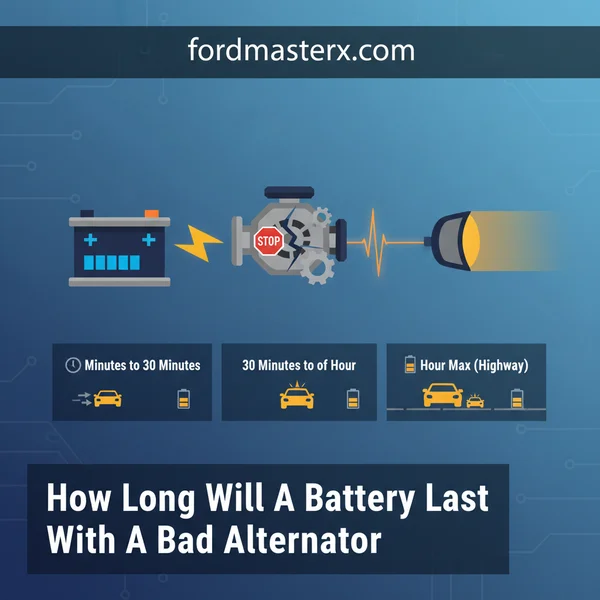
Knowing these estimates is critical for your safety. If you see the battery warning light or a “Check Charging System” message, you are no longer using a charging system; you are simply draining a finite reservoir of electricity. Your goal shouldn’t be to get home or to work, but to get to the nearest safe parking lot or repair shop before the car dies in a dangerous intersection or on a high-speed highway shoulder.
Estimated Drive Time and Mileage with a Failed Alternator
The 30-to-90 Minute Rule
In most modern vehicles, the 30-to-90 minute window is the standard expectation for a healthy, fully charged battery. This timeframe exists because your battery has a “Reserve Capacity” rating, which indicates how many minutes it can supply a constant 25-amp current before the voltage drops too low. However, this is an estimate based on ideal conditions. If you are stuck in heavy traffic, the clock is ticking even if your wheels aren’t moving. Because the engine is idling, the spark plugs and fuel system are still drawing power at a steady rate, meaning you might run out of time before you run out of miles.

Expected Mileage in Real-World Conditions
While time is a more accurate measure of battery life, mileage is what most drivers worry about. In a “best-case” scenario—daylight driving, no AC, and no traffic—you might squeeze 25 miles out of a fresh battery. In a “worst-case” scenario, such as driving at night in the rain with the heater and wipers on, you may barely cover 5 miles. Here is a quick breakdown of what to expect:
- Highway Driving (Steady Speed): 15 to 25 miles. High speeds mean you cover more ground in the time the battery has left.
- City Driving (Stop-and-Go): 5 to 10 miles. Every time you idle at a red light, you are burning battery life without making progress toward your destination.
- Night/Rain Driving: 2 to 5 miles. The massive draw from headlights and wipers will kill a battery in a fraction of the usual time.
Factors That Determine How Quickly Your Battery Drains
The Impact of Electrical Accessories
The single biggest factor in how long your car stays running is the “electrical load” you place on the battery. Since the alternator isn’t creating new power, every gadget you leave on is a direct withdrawal from a shrinking bank account. To maximize your remaining drive time, you must become an aggressive power saver. Most drivers don’t realize that even small components can have a massive impact on the remaining life of the battery.
To extend your range, you must immediately:
- Turn off the AC and Heater: The blower motor is one of the heaviest electrical consumers in your car.
- Kill the Radio/Infotainment: Even a basic head unit and speakers draw significant amperage.
- Avoid Power Windows: Motors that move heavy glass require a massive burst of energy that could be the final straw for a weak battery.
- Unplug Phone Chargers: Every milliamp counts when your ignition system is competing for power.
- Turn off Daytime Running Lights: If your car allows you to shut off exterior lights during the day, do so immediately.
Battery Age and Initial Charge State
Your battery’s health at the moment the alternator fails is the “X-factor” in these estimates. If your battery is more than three years old, its total capacity is likely 20-30% lower than its original rating. A brand-new battery might give you the full 90 minutes of emergency run-time, whereas an older battery that has already been through several heat cycles might give up after just 15 minutes. Furthermore, if the alternator has been failing slowly over several days (intermittent charging), your battery may have started this final trip at only 50% charge, meaning your 5-to-25 mile estimate is effectively cut in half before you even begin.
Think of your battery as a bucket of water. A bad alternator means the hose filling the bucket has been cut. If the bucket was already half-empty or has a leak (age), you are going to run dry much faster than someone with a full, brand-new bucket. This is why you should never assume you have the “average” amount of time; always assume you have the minimum.
Critical Warning Signs Your Battery is About to Die
When your alternator stops providing a charge, the battery doesn’t just quit instantly. Instead, it undergoes a slow, agonizing drain. Recognizing the specific red flags that indicate the “end is near” can be the difference between pulling over safely and having your engine stall in the middle of a busy intersection.
Fading Electrical Vitality
As the voltage drops below a functional level, your car’s electrical system will begin to prioritize essential components over comforts. You might notice your dashboard lights growing dim or flickering rhythmically with the engine’s RPM. Other common symptoms include:

Prime for Young Adults — 6 Months Free
Students and 18–24s get six months of Prime free, then half price.
Start 6 Months Free As an Amazon Associate I earn from qualifying purchases.- Sluggish Power Windows: If your windows take twice as long to roll up as usual, the motor isn’t getting enough juice.
- The “Ghost” Dashboard: Warning lights like the ABS, Airbag, or Traction Control may illuminate randomly because the onboard computer is confused by the low voltage.
- Weak Headlights: Your beams may appear yellow and faint, failing to illuminate the road ahead effectively.
Mechanical and Sensory Cues
Your car will often communicate its distress through physical performance. If you feel the engine “stumble” or hesitate while cruising, it’s likely because the spark plugs aren’t receiving a strong enough pulse to ignite the fuel properly. You might also hear a whining or grinding noise coming from the engine bay—a final protest from the failing alternator bearings—or notice a distinct smell of burning rubber or hot wires as the system overloads.
Essential Strategies to Extend Your Limited Driving Range
If you realize your alternator has failed while you are still miles from a safe destination, your goal is “energy conservation.” Every milliampere you save is a few more feet of driving distance. You are essentially operating on a countdown timer, and your actions determine how fast that timer runs out.
Implementing a Total Power Blackout
The easiest way to stretch your battery life is to turn off every single accessory that isn’t required for the car to move. In a modern vehicle, the electrical “vampires” are everywhere. To maximize your range, immediately address the following:
- HVAC Systems: Turn off the AC and the heater blower motor entirely. These are massive energy consumers.
- Entertainment and Tech: Shut off the radio, navigation screen, and unplug any phone chargers or dashcams.
- Lighting: If it is daytime, ensure your fog lights and interior lights are off. However, never turn off your headlights if it compromises safety.
Driving Habits for Energy Efficiency
How you drive also impacts how long that remaining charge lasts. Every time you use the turn signals, tap the brakes (activating brake lights), or use the windshield wipers, you are spending your limited “currency.” Try to maintain a steady speed and avoid stop-and-go traffic if possible, as idling for long periods allows the engine’s internal electronics to drain the battery without much forward progress. Additionally, avoid turning the engine off until you have reached a shop; the starter motor requires a massive burst of energy that a dying battery likely cannot provide a second time.
Conclusion
While a car can technically run with a bad alternator, it is a race against time that usually ends within 30 to 60 minutes. Your battery is a finite reservoir, and without the alternator to refill it, total electrical failure is inevitable. By recognizing the warning signs like dimming lights and prioritizing power conservation, you can hopefully reach a service station before your vehicle loses power completely.
If you suspect your charging system is failing, your next step should be a professional voltage test to confirm if the issue lies with the battery or the alternator. Don’t risk being stranded—get your electrical system inspected today to ensure your vehicle stays reliable on the road.
❓ Frequently Asked Questions
How long will a battery last with a bad alternator at night?
At night, your battery will drain significantly faster—often within 10 to 30 minutes—because headlights are high-draw components. It is extremely dangerous to drive a failing car at night as your lights may cut out entirely while moving.
What electrical components drain the battery the fastest?
The heaviest drains are the headlights, air conditioning blower fan, rear window defrosters, and heated seats. Even using power windows or windshield wipers can significantly shorten your remaining drive time.
Can a bad alternator ruin a brand-new battery?
Yes, if you continue to drive until the battery is completely ‘deep cycled’ or drained to zero, it can cause permanent internal damage. Lead-acid car batteries are not designed to be fully discharged.
Why does the car sputter when the alternator is bad?
Modern engines require electricity to fire spark plugs and run the fuel pump. When battery voltage drops too low, the ignition system becomes inconsistent, leading to engine misfires or stalling.
Audible Premium Plus — Annual Membership
12 audiobook credits up front, plus the full Audible catalogue.
See Annual Plans As an Amazon Associate I earn from qualifying purchases.Does driving faster help charge the battery if the alternator is failing?
No, if the alternator has failed completely, driving faster will only increase the electrical demand on the ignition system. It is better to maintain a steady, safe speed to reach your destination quickly.
What happens to power steering when the battery dies?
Most modern cars use Electric Power Steering (EPS). Once battery voltage drops below a certain threshold, the computer will disable the steering assist to save power, making the car much harder to maneuver.