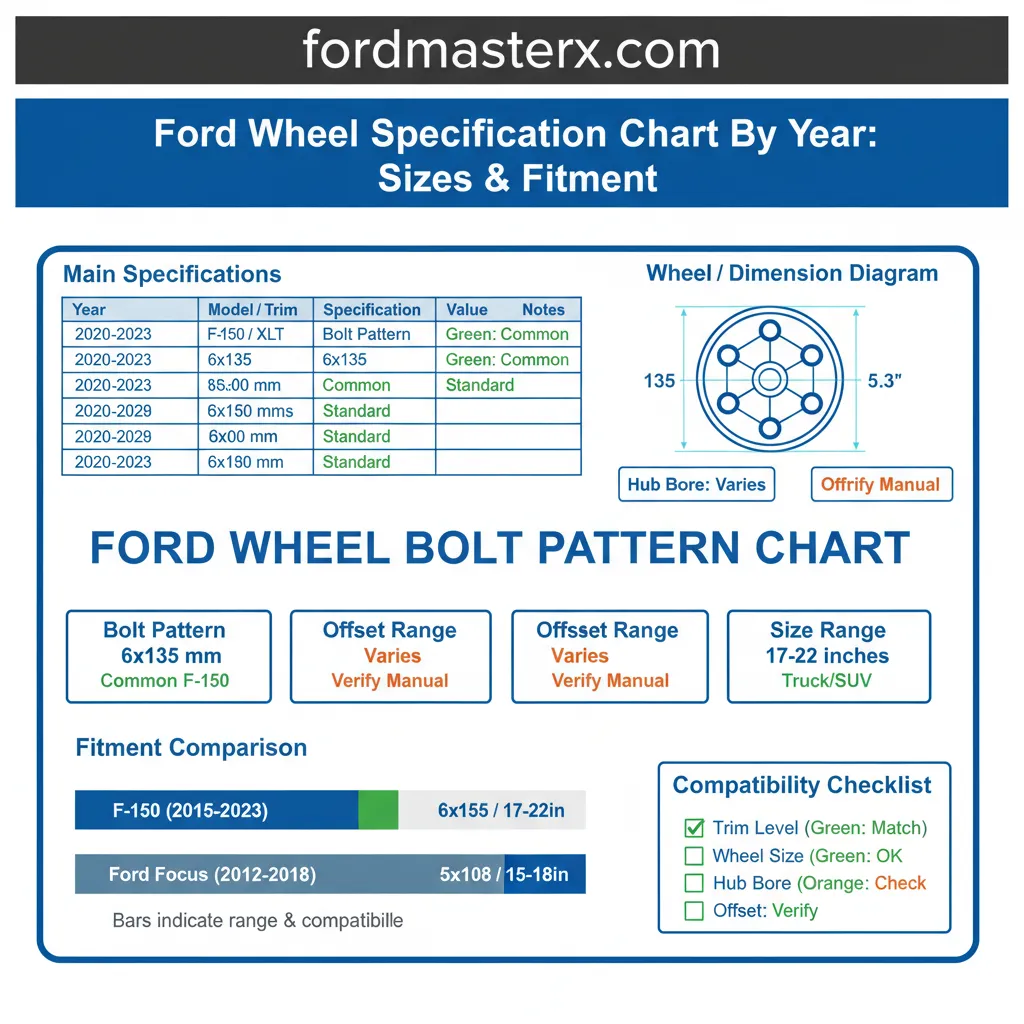
Ford Wheel Specification Chart By Year: Sizes & Fitment

Quick Answer
Ford vehicles commonly utilize a range of bolt patterns, including 5×114.3mm (5×4.5″), 5x135mm, 6x135mm, and 8x170mm, though these vary significantly by model, year, and trim level. Accurate fitment is contingent upon verifying not only the bolt pattern but also the hub bore and wheel offset specific to your exact Ford model, preferably via your owner’s manual or door jamb sticker, to ensure safety and proper functionality.
Ensuring proper wheel fitment is paramount for the safety, performance, and aesthetics of any Ford vehicle. Navigating the myriad of wheel specifications, particularly bolt patterns, across Ford’s extensive model lineup can be complex and confusing for owners seeking to replace or upgrade their wheels. This comprehensive guide provides a detailed Ford wheel bolt pattern chart, accompanied by critical information on year-by-year changes, trim-specific variations, and other key compatibility factors like hub bore and offset, enabling precise and informed wheel choices for models through 2026.

Prime for Young Adults — 6 Months Free
Students and 18–24s get six months of Prime free, then half price.
Start 6 Months Free As an Amazon Associate I earn from qualifying purchases.This chart compiles common Ford wheel specifications, focusing on bolt patterns, hub bore, and typical offset ranges for models from the early 2000s through the 2026 model year. Data is based on extensive industry research and manufacturer specifications. However, specific configurations (e.g., performance packages, heavy-duty options, regional variations) can introduce nuances. Always cross-reference this information with your specific vehicle’s owner’s manual, door jamb sticker, or VIN-specific parts catalog for final verification. This resource is for guidance; final fitment responsibility rests with the installer. Last reviewed: May 2026.
Ford Wheel Bolt Pattern Specifications Chart by Year and Model
Recommended Best Deal Products


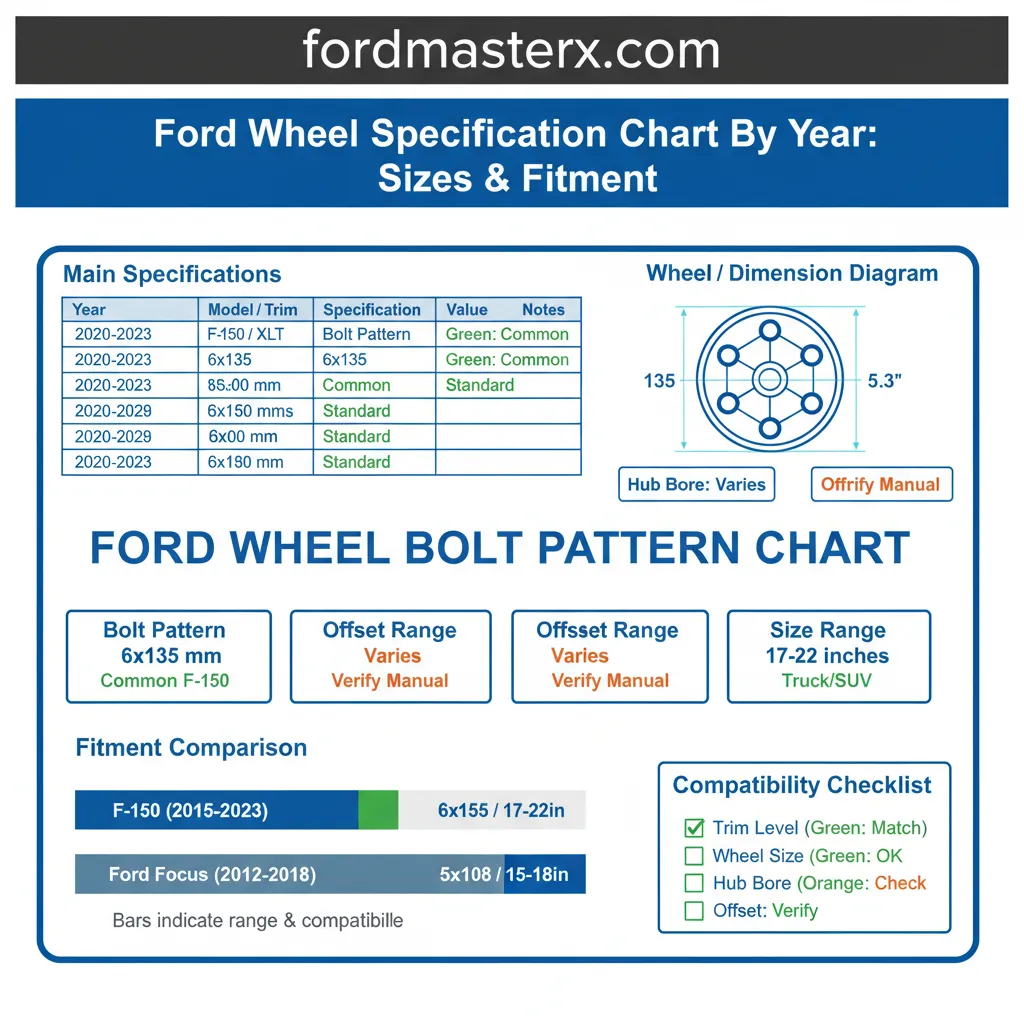
📤 Share Image
The table below serves as a primary reference for Ford wheel bolt patterns (PCD – Pitch Circle Diameter), hub bore, and general offset characteristics across a wide range of models and years. Understanding these specifications is critical for selecting compatible wheels, whether you’re replacing a damaged wheel or upgrading to an aftermarket set. The ‘Specification’ column primarily focuses on the bolt pattern, expressed as (number of lugs) x (PCD in mm, sometimes also in inches). The ‘Notes’ section highlights crucial configuration-specific caveats that can impact fitment, such as ‘Requires HD package’ or ‘Specific to Performance Pack,’ underscoring the importance of detailed verification.
How to Read This Chart
Locate your vehicle’s year and model. The ‘Model / Trim’ column may specify particular trims or configurations if they deviate significantly. The ‘Specification’ column provides the bolt pattern and hub bore. The ‘Value’ column states the precise measurement, and the ‘Notes’ column offers vital context regarding variations, common offsets, or specific package requirements. Always read the notes carefully, as these frequently highlight conditions that alter the primary specification.
| Year | Model / Trim | Specification | Value | Notes |
|---|---|---|---|---|
| 2000-2003 | F-150 (Light Duty) | Bolt Pattern (PCD) | 5x135mm (5×5.3″) | Hub Bore: 87.1mm; Offset: +15 to +25mm typically. |
| 2000-2004 | Mustang (all trims) | Bolt Pattern (PCD) | 5×114.3mm (5×4.5″) | Hub Bore: 70.3mm; Offset: +20 to +30mm common. |
| 2000-2011 | Ranger (2WD/4WD) | Bolt Pattern (PCD) | 5×114.3mm (5×4.5″) | Hub Bore: 70.3mm (later models vary); Offset: +5 to +20mm. |
| 2004-2026 | F-150 (all trims incl. Raptor) | Bolt Pattern (PCD) | 6x135mm (6×5.31″) | Hub Bore: 87.1mm; Offset: +30 to +44mm for most trims. Raptor typically lower offset. |
| 2005-2026 | Mustang (all trims incl. GT350/500) | Bolt Pattern (PCD) | 5×114.3mm (5×4.5″) | Hub Bore: 70.5mm; Offset: +25 to +50mm depending on trim/wheel width. Performance packs may need specific offset/diameter for brake clearance. |
| 2000-2026 | Super Duty (F-250/F-350 SRW) | Bolt Pattern (PCD) | 8x170mm (8×6.69″) | Hub Bore: 125mm; Offset: Varies significantly by year/wheel width/OEM vs. aftermarket. Earlier models may have smaller bore. |
| 2000-2012 | Escape / Maverick (early gens) | Bolt Pattern (PCD) | 5×114.3mm (5×4.5″) | Hub Bore: 67.1mm; Offset: +35 to +45mm. |
| 2013-2026 | Escape (later gens) | Bolt Pattern (PCD) | 5x108mm (5×4.25″) | Hub Bore: 63.4mm; Offset: +40 to +52mm. Shared with Focus/Fusion. |
| 2005-2018 | Focus (various gens) | Bolt Pattern (PCD) | 4x108mm (4×4.25″) then 5x108mm | Early Focus (to 2011) was 4x108mm (Hub Bore 63.4mm, Offset +35 to +45mm). Later Focus (2012+) transitioned to 5x108mm (Hub Bore 63.4mm, Offset +40 to +55mm). Verify exact year. |
| 2006-2026 | Fusion / Edge / Lincoln MKZ/MKX | Bolt Pattern (PCD) | 5×114.3mm (5×4.5″) | Hub Bore: 67.1mm for Fusion, 63.4mm for Edge; Offset: +35 to +50mm. Check specific model/year. |
| 2019-2026 | Ranger (current gen) | Bolt Pattern (PCD) | 6×139.7mm (6×5.5″) | Hub Bore: 93.1mm; Offset: +40 to +55mm; Shared with many global truck platforms. |
| 2021-2026 | Bronco (full-size) | Bolt Pattern (PCD) | 6×139.7mm (6×5.5″) | Hub Bore: 93.1mm; Offset: Varies significantly, some models with very low offset from factory. |
| 2021-2026 | Maverick (pickup) | Bolt Pattern (PCD) | 5x108mm (5×4.25″) | Hub Bore: 63.4mm; Offset: +40 to +50mm; Shares platform with Escape/Bronco Sport. |
| 2020-2026 | Explorer (recent gen) | Bolt Pattern (PCD) | 6×114.3mm (6×4.5″) | Hub Bore: 68mm; Offset: +40 to +55mm. Distinct from older Explorer generations. |
1 This chart provides typical values; exact specifications can vary. Always confirm with your vehicle’s specific documentation.
2 “Offset” is a typical range; specific wheel design and desired stance will influence ideal offset values.

Year-by-Year Changes in Ford Wheel Bolt Patterns
Ford’s long and diverse history means its vehicles have seen several significant shifts in wheel bolt patterns, often dictated by platform redesigns, increased load capacities, or the adoption of global vehicle architectures.
Historically, many Ford passenger cars and smaller SUVs maintained a consistent 5×114.3mm (5×4.5″) bolt pattern for decades. Models like the Mustang, Explorer (earlier generations), Ranger (older models), and Escape (first-gen) utilized this robust and widely available pattern. This consistency eased aftermarket compatibility for many owners.
However, significant transitions have occurred, most notably within the truck and SUV segments:
F-Series Trucks: A pivotal change occurred around the 2004 model year for the light-duty F-150. Prior to this, from 1997-2003, the F-150 used a 5x135mm bolt pattern. With the introduction of the all-new 2004 F-150, Ford moved to the 6x135mm pattern, which it has retained through to the current generation. This change was largely driven by the development of a new, more robust chassis and increased payload/towing capabilities for the next-generation truck. For the heavy-duty Super Duty line (F-250, F-350 SRW), the 8x170mm bolt pattern has been a consistent staple since its introduction in 1999, reflecting its continuous focus on extreme durability and load ratings.
Smaller Trucks & SUVs: The Ranger, upon its reintroduction in North America in 2019, adopted the 6×139.7mm (6×5.5″) bolt pattern. This move aligned it with many international truck platforms and also the new full-size Bronco, streamlining production and parts. Similarly, recent platforms like the Escape (2013+) and Maverick (2021+) moved to the 5x108mm pattern, sharing commonality with Ford’s global C2 platform used in models like the Focus (later generations) and Fusion (some years). This standardization helps optimize manufacturing costs and parts supply.
Performance Models: While the Mustang has largely stuck to the 5×114.3mm pattern since 2005, performance variants like the Shelby GT350 or GT500 often introduce specific wheel diameter, width, and offset requirements to clear larger Brembo brake calipers, necessitating careful selection even within the same bolt pattern.

Audible — Listen Free for 30 Days
One free credit a month and thousands of titles included.
Listen Free for 30 Days As an Amazon Associate I earn from qualifying purchases.These changes are typically tied to full model redesigns or the introduction of entirely new vehicle platforms, indicating extensive re-engineering of axles, hubs, and suspension components, rather than simple mid-cycle refreshes. Understanding these generational shifts is crucial, as attempting to fit wheels from an older generation onto a newer one (or vice-versa) due to a mistaken assumption of consistency can lead to severe fitment issues.
5×114.3mm
6x135mm
8x170mm
6×139.7mm
Understanding Ford Trim, Wheel Size, and Configuration Fitment Notes
While the bolt pattern is the foundational element for wheel compatibility, neglecting other vehicle configurations can lead to improper fitment, compromised safety, or diminished performance. My 15+ years in the industry have shown that these nuances are where most enthusiasts and even some professionals encounter issues.
Trim Level Impact on Wheel Fitment
Higher trim levels or specialized performance packages frequently feature upgraded components that directly influence wheel selection. For instance:
Brake Caliper Clearance: Performance-oriented trims, such as the Mustang GT Performance Pack with its Brembo calipers or the F-150 Limited with larger brakes, often necessitate a minimum larger wheel diameter (e.g., 19-inch or 20-inch wheels) to clear the bulkier brake assemblies. Even if the bolt pattern remains the same as a base model, a smaller diameter wheel will simply not fit.
Fender Flares & Suspension: Off-road trims like the F-150 Raptor or Bronco Badlands come with wider fender flares and specific suspension geometry designed for wider wheels and lower offsets. Attempting to fit these aggressive wheel setups on a base model without similar modifications will likely result in tire rubbing or excessive poke.
Engine and Drivetrain Influence on Wheel Specifications
The engine option and drivetrain (2WD vs. 4WD) primarily affect the required wheel load rating. A vehicle equipped with a heavy-duty engine or designated for substantial towing (e.g., F-150 with Max Trailer Tow Package) will have a higher Gross Axle Weight Rating (GAWR). The wheels chosen must meet or exceed this GAWR. While the bolt pattern usually remains consistent across different engine options within the same model and year, ignoring load ratings can lead to wheel failure, a significant safety hazard.
Factory Wheel Size and Offset as Guides
Ford offers a variety of factory wheel sizes and offsets within a single model year, serving as excellent indicators for acceptable aftermarket wheel parameters.
Acceptable Range: If a Ford Explorer offers factory wheels ranging from 18×8″ with +44mm offset to 20×9″ with +38mm offset, this defines a relatively safe envelope for aftermarket wheel choices without rubbing or affecting vehicle dynamics.
OEM Part Numbers: Researching OEM part numbers for wheels can sometimes reveal their exact specifications, providing a benchmark for comparing aftermarket alternatives.
Cab and Bed Configurations for Trucks
For trucks, while the cab (Regular, SuperCab, SuperCrew) and bed length (short, standard, long) do not alter the bolt pattern, they are crucial for understanding payload capacity and subsequently, the necessary wheel load ratings. A SuperCrew F-150 with a longer bed will typically have a higher curb weight and potentially a higher payload capacity than a Regular Cab with a short bed, even if they share the same engine. Always check the payload door jamb sticker for the specific GAWR.
Wheel Hub Bore Variations and Importance
Even if the bolt pattern is identical, the hub bore (the diameter of the wheel’s center hole) can vary significantly between models and even within different years of the same model.
Hub-Centric Fitment: A proper hub-centric fitment means the wheel’s hub bore perfectly matches the vehicle’s hub. This ensures the wheel is precisely centered on the hub, bearing the vehicle’s weight and preventing vibrations. Research indicates that using wheels with a hub bore larger than the vehicle’s hub without hub-centric rings can lead to ride discomfort, premature wear on lug studs, and even potential wheel detachment in extreme cases.
Common Ford Hub Bores: Many Ford passenger cars use a 63.4mm or 70.3mm hub bore, while light trucks like the F-150 typically use 87.1mm, and Super Duty trucks use 125mm. Always verify the correct hub bore for your specific application.
Never assume a wheel that “looks like it fits” will perform safely. Always verify the bolt pattern, hub bore, and offset against your vehicle’s exact trim and year. Performance packages and heavy-duty options often introduce specific requirements that are not present on base models, particularly concerning brake caliper clearance and load capacity.
_–_Frontansicht,_14._April_2013,_Düsseldorf.jpg "Ford Wheel Specification Chart By Year: Sizes & Fitment 5")
What Affects Ford Wheel Compatibility Beyond Bolt Pattern?
The bolt pattern is merely the starting point for wheel compatibility. A wheel’s correct and safe fitment on a Ford vehicle involves a careful balance of multiple critical dimensions. As an industry veteran, I stress that overlooking any of these can lead to serious issues, ranging from annoying vibrations to catastrophic wheel failure.
Bolt Pattern (PCD – Pitch Circle Diameter)
As discussed, the bolt pattern defines the number of lug holes and the diameter of the imaginary circle passing through their centers. For example, 5×114.3mm means five lug holes evenly spaced on a 114.3mm diameter circle.
Precision is Key: This measurement must match perfectly. Attempting to force a wheel with a slightly different bolt pattern (e.g., 5x115mm onto a 5×114.3mm hub) can damage lug studs, create unsafe stress points, and lead to wheel detachment. Adapters are available but introduce additional points of failure and increase offset.
Audible Premium Plus — Annual Membership
12 audiobook credits up front, plus the full Audible catalogue.
See Annual Plans As an Amazon Associate I earn from qualifying purchases.Hub Bore (Center Bore)
This is the central hole in the wheel that centers it onto the vehicle’s hub.
Hub-Centric vs. Lug-Centric: Ford vehicles are designed for hub-centric wheels, meaning the wheel’s weight is supported by the hub, not the lug studs. If an aftermarket wheel has a larger hub bore than the vehicle’s hub, a hub-centric ring is mandatory to ensure proper centering and prevent vibrations, especially at highway speeds. Using a wheel that is too small for the hub bore is impossible.
Offset (ET)
Offset is the distance from the wheel’s mounting surface (where it bolts to the hub) to the true centerline of the wheel. It’s measured in millimeters.
Positive Offset: The mounting surface is closer to the wheel’s outer face, pulling the wheel inward towards the suspension. Most modern Fords use positive offset.
Negative Offset: The mounting surface is closer to the wheel’s inner face, pushing the wheel outward from the suspension. Common on many lifted trucks.
Zero Offset: The mounting surface is exactly at the wheel’s centerline.
Impact: Incorrect offset can cause tires to rub against fenders (too much negative offset) or suspension components (too much positive offset). It also affects steering geometry and bearing wear.
Backspacing
Backspacing is the distance from the wheel’s mounting surface to the inside edge of the wheel. While related to offset, it’s often more practical for clearance checks.
Relationship to Offset: More backspacing means the wheel sits further inward; less backspacing means it sits further outward. It’s crucial for clearing inner fender wells, suspension arms, and brake lines.
Wheel Diameter and Width
Diameter: Must be large enough to clear brake calipers. Going too large can affect ride quality and speedometer accuracy if not paired with a correctly sized tire.
Width: Must be appropriate for the tire’s width. Too wide or too narrow a wheel for a given tire can lead to improper tire bead seating, poor handling, and premature tire wear. Both width and diameter impact overall tire dimensions, potentially causing rubbing during turns or suspension compression.
Wheel Load Rating
This is the maximum weight a single wheel is designed to safely support.
Critical Safety Factor: For any Ford vehicle, especially trucks, SUVs, and commercial vans, the wheel’s load rating must meet or exceed half of the vehicle’s Gross Axle Weight Rating (GAWR), typically found on the driver’s door jamb sticker. Failing to meet this can result in catastrophic wheel failure under load, particularly during towing or hauling. Research and field experience confirm this is a common oversight leading to severe safety risks.
Lug Nut Seat Type
Lug nuts come in different seating styles:
Conical/Acorn: The most common, with a tapered seat.
Spherical/Ball: A rounded seat, found on some OEM wheels.
Flat/Mag: A flat seat with a shank and washer.
* Match is Mandatory: The lug nut seat must perfectly match the wheel’s lug holes. Using the wrong type will not securely fasten the wheel, leading to loose wheels, damaged studs, and dangerous driving conditions.
Match # of lugs & PCD (e.g., 5×114.3mm) perfectly.
Ensure wheel’s center bore matches vehicle’s hub, or use hub-centric rings.
Determine if wheels clear brakes/suspension & avoid fender rub.
Verify each wheel’s capacity exceeds half of the vehicle’s GAWR.
Use lug nuts that correctly match the wheel’s lug hole seating.
Frequently Asked Questions About Ford Wheel Fitment
Can I use a 5x115mm wheel on a Ford that requires 5×114.3mm?
No. While the difference is small, 0.7mm is enough to cause improper seating of the lug nuts, leading to unsafe wheel attachment and potential damage to the studs or wheel. It may seem to fit initially, but this is a critical safety issue that cannot be overlooked. Always match the bolt pattern exactly.
What happens if my new wheels have a larger hub bore than my Ford’s hub?
If your aftermarket wheel has a larger hub bore, you must use hub-centric rings. These rings fill the gap between the wheel’s center bore and the vehicle’s hub, ensuring the wheel is perfectly centered. Without them, the wheel will be lug-centric, meaning the lug studs bear the vehicle’s weight and center the wheel, which can cause vibrations, accelerated wear on components, and potential safety risks.
How do I find my Ford’s specific wheel load rating requirements?
The most accurate place to find your vehicle’s specific Gross Axle Weight Rating (GAWR) is on the safety compliance certification label, typically located on the driver’s side door jamb. The wheel’s load rating should be at least half of the GAWR for that axle. For example, if the front GAWR is 3,000 lbs, each front wheel must be rated for at least 1,500 lbs.
Will swapping wheels affect my Ford’s warranty?
While changing wheels typically won’t void your entire vehicle warranty, if an aftermarket wheel or tire setup directly causes a failure of other components (e.g., suspension, bearings, brakes due to improper offset or excessive weight), Ford may deny warranty coverage for those specific affected parts. Always choose wheels that meet or exceed factory specifications to mitigate this risk.
Can I use wheel spacers or adapters on my Ford?
Wheel spacers are generally used to push wheels outward for aesthetic reasons or to clear brake calipers. Adapters change a bolt pattern (e.g., 5-lug to 6-lug). While technically possible, both introduce additional points of failure and add complexity. If used, they must be hub-centric and professionally installed, with lug nuts properly torqued and regularly re-torqued. Many industry experts, including myself, recommend avoiding them if proper-fitting wheels are available, as they can introduce stress on components and require vigilant maintenance.
When in doubt, consult a reputable tire and wheel specialist or your Ford dealership. Providing them with your vehicle’s exact year, model, trim, and VIN ensures you receive the most accurate and safe fitment advice for any wheel or tire upgrade.
Conclusion
Ford wheel bolt patterns vary significantly by model, year, and trim, necessitating careful verification for correct fitment. Beyond the fundamental bolt pattern, critical factors such as hub bore, offset, load rating, and lug nut seat type are essential for safe and optimal wheel compatibility. Always prioritize cross-referencing information from this chart with your specific vehicle’s owner’s manual or door jamb sticker for the most accurate and definitive specifications. Utilize this comprehensive Ford Wheel Specification Chart as a foundational resource, but always perform final verification against your specific vehicle’s documentation to ensure optimal wheel compatibility and safety.
Frequently Asked Questions
What is the most common Ford F-150 bolt pattern?
For many modern Ford F-150 models since 2004, the most common bolt pattern is 6x135mm. Earlier generations, specifically 1997-2003, typically utilized a 5x135mm pattern. Super Duty trucks (F-250/F-350) use 8-lug patterns, often 8x170mm (since 1999) or older 8×165.1mm (8×6.5″). Always verify with your vehicle’s specific year and trim for precise fitment, as special packages or model years can sometimes introduce variations.
Can I use wheels with a different bolt pattern if I use adapters?
While bolt pattern adapters can technically allow the use of wheels with a different bolt pattern, they introduce additional components and complexity. This can affect wheel offset, potentially causing clearance issues, increased stress on wheel bearings, or even structural integrity concerns. It’s generally recommended to use wheels with the correct factory bolt pattern to maintain original vehicle dynamics, safety, and reliability. If adapters are considered, ensure they are high-quality, hub-centric, and professionally installed.
How do I find the correct bolt pattern for my specific Ford model?
The most accurate way to determine your Ford’s bolt pattern is by consulting your owner’s manual, examining the vehicle’s door jamb sticker (typically on the driver’s side), or utilizing a VIN lookup tool. Reputable online databases and tire/wheel retailers also offer specific fitment guides based on make, model, and year. For a quick check, you can measure a 5-lug pattern from the center of one lug stud to the outside edge of the second stud, skipping one.
What is hub bore, and why is it important for Ford wheels?
Hub bore is the critical diameter of the center hole in the wheel that perfectly fits over the vehicle’s hub. It’s crucial for achieving ‘hub-centric’ fitment, where the vehicle’s weight is precisely supported by the hub, not solely the lug nuts. An incorrect hub bore (too large) can lead to vibrations, uneven load distribution, and increased stress on lug studs. If aftermarket wheels have a larger hub bore, hub-centric rings are used to ensure a snug and safe fit.
Do Ford Super Duty trucks use the same bolt pattern as F-150s?
No, Ford Super Duty trucks (F-250, F-350, F-450) utilize significantly different and heavier-duty bolt patterns compared to F-150s due to their substantially greater payload and towing capacities. Modern Super Duty trucks (1999-present) typically feature an 8x170mm bolt pattern, whereas F-150s primarily use 6x135mm (since 2004) or older 5x135mm patterns. This ensures the wheels are appropriately engineered and rated for the Super Duty’s demanding operational requirements.