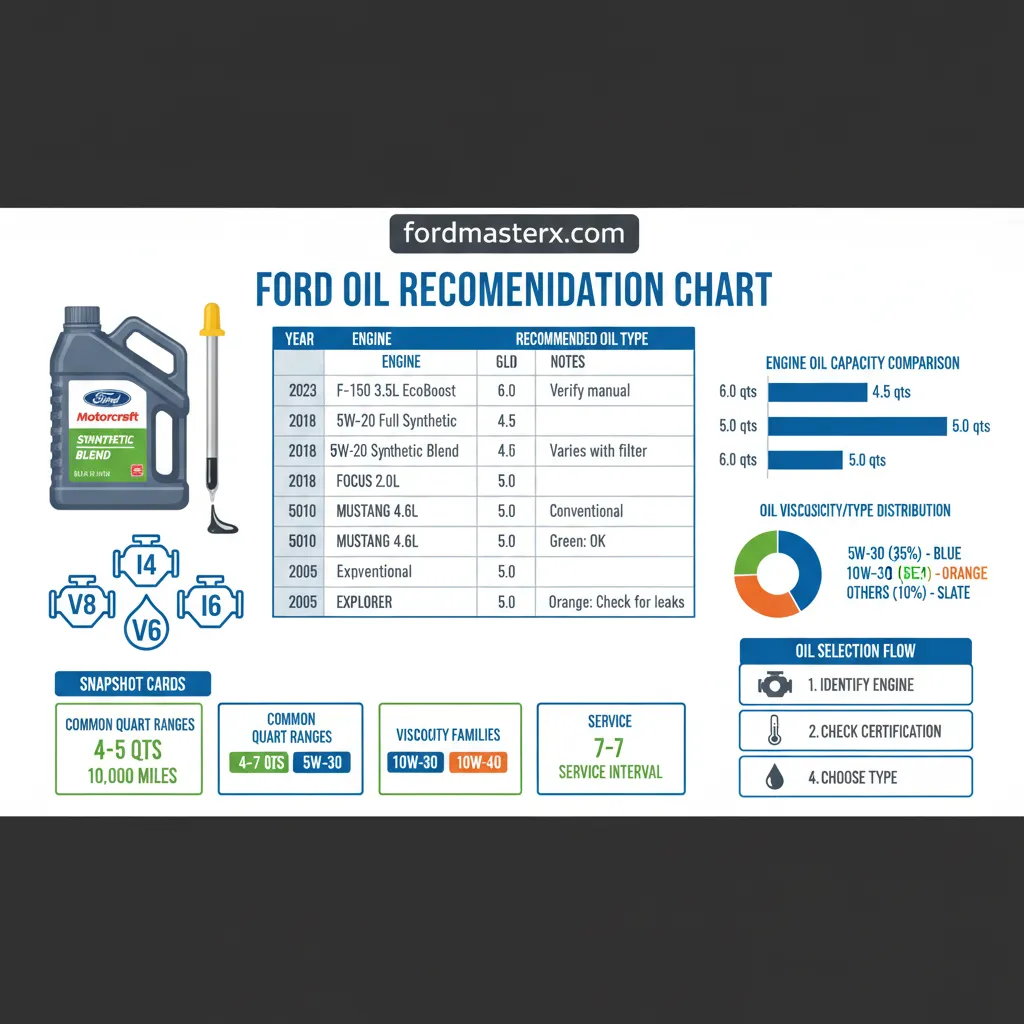
Ford Oil Recommendation Oil Capacity & Type Chart By Year: All Engines

Quick Answer
Ford vehicles typically require specific oil capacities and types, often ranging from 4.0 to 8.0 quarts of synthetic or synthetic blend oil, commonly meeting API SN/SP and ILSAC GF-5/GF-6 standards. Viscosity, such as 5W-20 or 5W-30, is critical and determined by engine design and operating conditions. Always consult your vehicle’s owner’s manual or the oil fill cap for the precise factory specification for your specific year, model, and engine configuration to ensure optimal performance and longevity.
Ford Oil Recommendation Oil Capacity & Type Chart By Year: All Engines
Ensuring the longevity and optimal performance of your Ford vehicle hinges on one critical, yet often overlooked, maintenance aspect: selecting the correct engine oil. With a vast array of Ford models, engine options, and continually evolving oil specifications across model years through 2026, identifying the precise oil capacity and type required can be a complex and daunting task for owners and technicians alike. This authoritative guide and comprehensive chart delineate the factory-recommended oil capacities and types for a wide range of Ford vehicles, providing clarity and precision to your oil change regimen.
This chart covers a broad range of Ford engines from model years typically spanning the early 1990s through 2026. Data is compiled from manufacturer specifications, service bulletins, and owner’s manuals. While comprehensive, engine configurations, regional variations, or specific performance trims may have unique requirements. Always verify the exact oil capacity and type using your vehicle’s owner’s manual, the oil fill cap, or the door jamb sticker, referencing your specific VIN when applicable. Last reviewed: May 2026.
How to Read This Chart
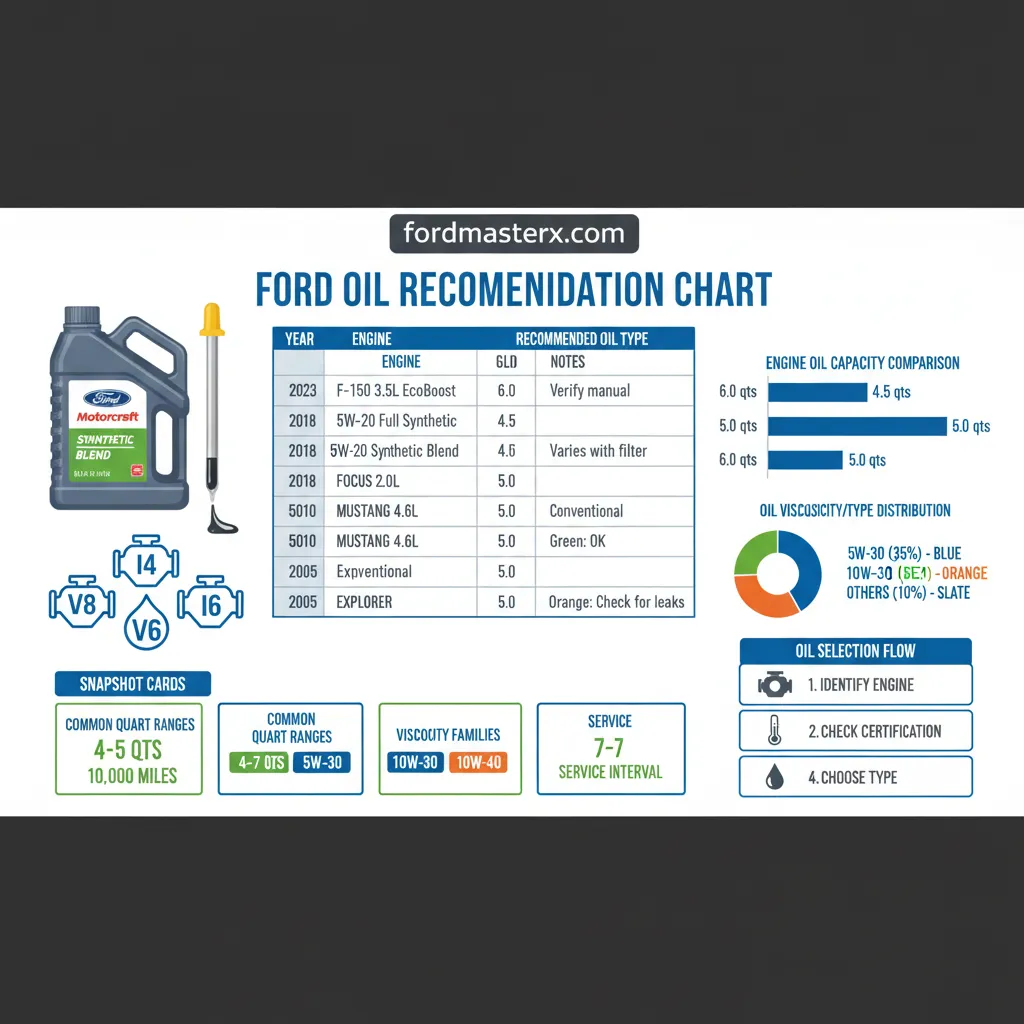
📤 Share Image
The following table provides a quick reference for common Ford engine oil specifications. “Oil Capacity” includes a new oil filter, as it’s standard practice to replace the filter during an oil change. “Recommended Oil Type” lists the viscosity (e.g., 5W-30) and the crucial API/ILSAC standards, often accompanied by Ford’s proprietary WSS-M2C specification codes. Pay close attention to the “Notes” column for critical details that might affect your selection, such as specific performance requirements or diesel engine certifications. Remember that oil types evolve; older vehicles may benefit from modern oil standards that supersede the original recommendations, provided they meet the original viscosity and Ford WSS codes.
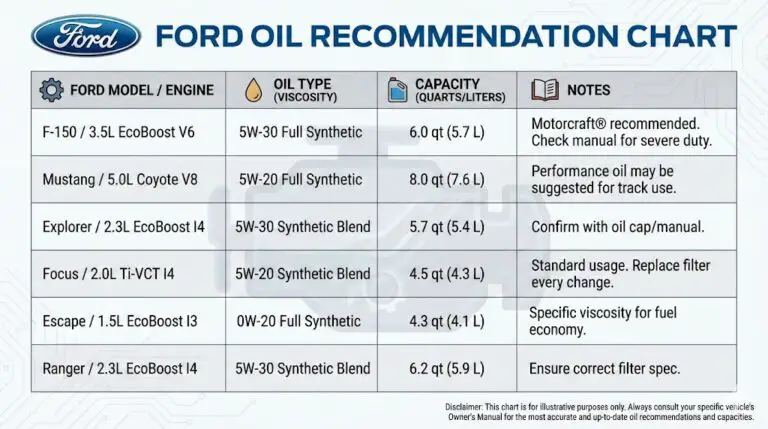
Main Ford Oil Capacity & Type Chart By Year and Engine
| Year | Engine | Oil Capacity | Recommended Oil Type | Notes |
|---|---|---|---|---|
| 1998-2004 | 4.6L V8 (Modular) | 6.0 Quarts (5.7L) | 5W-30 (API SL/SM/SN) | Early models often specified 5W-30. Use current API SN/SP. |
| 2001-2008 | 5.4L V8 (Triton) | 7.0 Quarts (6.6L) | 5W-20 (API SM/SN) | Ford WSS-M2C930-A or WSS-M2C945-A. Critical for VCT operation. |
| 2009-2017 | 3.5L EcoBoost V6 | 6.0 Quarts (5.7L) | 5W-30 (API SN/SP, ILSAC GF-5/GF-6) | Ford WSS-M2C946-A. Full synthetic recommended for turbo longevity. |
| 2011-2026 | 5.0L V8 (Coyote) | 8.0 Quarts (7.6L) | 5W-20 (API SP, ILSAC GF-6) | Ford WSS-M2C930-A or WSS-M2C960-A. Some performance models use 5W-50. |
| 2015-2026 | 2.7L EcoBoost V6 | 6.0 Quarts (5.7L) | 5W-30 (API SP, ILSAC GF-6) | Ford WSS-M2C946-B1. Full synthetic recommended due to LSPI concerns. |
| 2016-2026 | 2.3L EcoBoost I4 | 5.7 Quarts (5.4L) | 5W-30 (API SP, ILSAC GF-6) | Ford WSS-M2C946-B1. Critical for turbocharged direct injection engines. |
| 2018-2026 | 1.5L EcoBoost I3 | 5.7 Quarts (5.4L) | 5W-30 (API SP, ILSAC GF-6) | Ford WSS-M2C946-B1. Newer engines, LSPI protection is key. |
| 2017-2026 | 6.7L Power Stroke Diesel | 13.0 Quarts (12.3L) | 10W-30 (API CK-4) or 5W-40 (API CK-4) | Ford WSS-M2C171-F1. For extreme cold, 5W-40. Ensure CK-4 for DPF. |
| 2020-2026 | 3.0L Power Stroke Diesel | 6.3 Quarts (6.0L) | 5W-30 (API CK-4) | Ford WSS-M2C171-F1. Specific for this lighter-duty diesel. |
| 2020-2026 | 2.0L EcoBoost I4 | 5.7 Quarts (5.4L) | 5W-30 (API SP, ILSAC GF-6) | Ford WSS-M2C946-B1. For vehicles like Escape, Edge. |
| 2020-2026 | 4.0L V6 (SOHC) | 5.0 Quarts (4.7L) | 5W-30 (API SP, ILSAC GF-6) | Found in older Rangers, Explorers. Often specified 5W-30. |
| 2021-2026 | 2.5L Hybrid / PHEV | 5.7 Quarts (5.4L) | 0W-20 (API SP, ILSAC GF-6) | Ford WSS-M2C962-A1. Hybrid engines often specify lower viscosity. |
| 2021-2026 | F-150 3.5L PowerBoost (Hybrid) | 6.0 Quarts (5.7L) | 5W-30 (API SP, ILSAC GF-6) | Ford WSS-M2C946-B1. Hybrid EcoBoost, similar to non-hybrid EcoBoost. |
Footnotes: Oil capacities generally include replacing the oil filter. Always refer to your specific owner’s manual or check the oil fill cap/dipstick for exact requirements, as variations can occur based on model year, specific trim, or region. Ford WSS-M2C codes are critical for ensuring proper lubricant performance.
Ford Oil Specification Snapshots
These snapshots provide an overview of common specifications encountered across the Ford fleet.
6.0 Quarts
~45%
~15%
100%
Comparing Engine Oil Capacities (Quarts)
This chart illustrates the difference in oil capacities across a few popular Ford engines.
Ford Oil Selection Flow
Follow these steps to confidently choose the correct oil for your Ford.
Locate your vehicle’s exact year, model, and engine displacement (e.g., 2023 F-150 3.5L EcoBoost).
This is the ultimate authority. Look for the recommended viscosity and specific Ford WSS-M2C code.
Ensure the oil meets or exceeds the specified API (e.g., SP) and ILSAC (e.g., GF-6) certifications.
Match the required oil capacity, typically including the filter, to avoid over or under-filling.

Ford Oil Specification Changes: Year-by-Year Evolution and Trends
Ford’s oil recommendations haven’t remained static; they’ve undergone significant evolution driven by technological advancements, tightening emissions standards, and demands for improved fuel economy. As an expert with over 15 years in the field, I’ve observed several key trends.
Shift from Conventional to Synthetic Oils
For decades, conventional mineral oils were the standard. However, with the advent of more complex engines, particularly those with direct injection and turbocharging, Ford, like the rest of the industry, has largely transitioned to recommending synthetic blend or full synthetic oils. Research indicates that synthetic oils offer superior temperature stability, reduced deposit formation, and better wear protection, which is crucial for modern engine designs. Older models (pre-2000s) might have specified conventional oils, but using a modern synthetic blend or full synthetic that meets the original viscosity and Ford WSS code is often a beneficial upgrade, offering enhanced protection without adverse effects.
Viscosity Grade Evolution for Fuel Efficiency
A clear trend has been the reduction in recommended viscosity grades. In the 1990s, 10W-30 and 5W-30 were prevalent. By the early 2000s, Ford was a pioneer in adopting 5W-20 for many of its gasoline engines (e.g., the 5.4L Triton), primarily to meet Corporate Average Fuel Economy (CAFE) targets. This was followed by the introduction of 0W-20 around the 2010s for select models, and now even 0W-16 for some highly efficient newer engines. This shift to lower viscosity oils reduces internal engine friction, contributing directly to better fuel economy, while advanced additive packages ensure adequate wear protection.
API and ILSAC Standard Updates
The American Petroleum Institute (API) and International Lubricant Standardization and Approval Committee (ILSAC) continually update their standards to address new engine technologies. Ford’s recommendations align with these progressions. For example, the API SN PLUS and subsequent API SP (introduced in 2020, alongside ILSAC GF-6) specifically address issues like Low-Speed Pre-Ignition (LSPI) in turbocharged direct-injection engines. These newer standards also provide improved wear protection, sludge control, and oxidation stability, essential for longer drain intervals and engine health. Always ensure your chosen oil meets the latest specified API and ILSAC standards for your engine.
Introduction of Ford-Specific Standards (WSS-M2C Codes)
Beyond generic industry standards, Ford mandates its own proprietary specifications, known as WSS-M2C codes (e.g., WSS-M2C945-A, WSS-M2C946-B1, WSS-M2C960-A, WSS-M2C953-B1). These codes indicate that the oil has undergone rigorous testing and meets Ford’s unique performance criteria, which often exceed API/ILSAC requirements. For instance, a Ford WSS-M2C946-B1 oil ensures specific anti-wear and friction properties tailored for EcoBoost engines. Neglecting these Ford-specific codes can lead to premature wear or other engine issues, especially in newer, more complex powertrains.
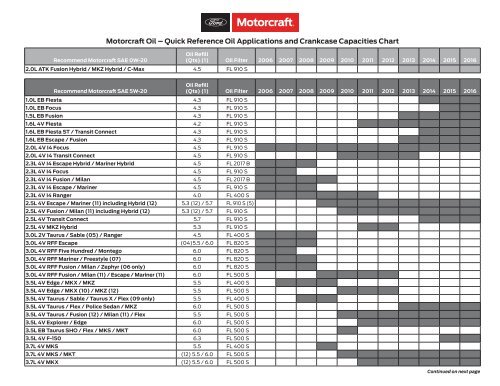
Detailed Engine-Specific Ford Oil Recommendations and Configuration Notes
Delving deeper, specific Ford engine families and their unique configurations demand precise oil choices. Understanding these nuances is critical for optimal engine health and longevity.
EcoBoost Engines (Gasoline Direct Injection & Turbocharged)
Ford’s popular EcoBoost engines (including 1.0L, 1.5L, 2.0L, 2.3L, 2.7L, 3.5L) combine direct fuel injection with turbocharging. This combination places immense stress on engine oil. The high temperatures from the turbochargers can degrade oil quickly, while direct injection can lead to fuel dilution and potential for Low-Speed Pre-Ignition (LSPI). For these engines, it is paramount to use full synthetic oils that meet the latest API SP and ILSAC GF-6 standards, specifically those carrying Ford WSS-M2C946-B1 (for 5W-30) or WSS-M2C960-A1 (for 5W-20). These oils contain advanced detergents and anti-LSPI additives crucial for protecting connecting rods and pistons. Capacities range from 5.7 quarts for smaller 1.5L/2.3L engines to 6.0 quarts for 2.7L/3.5L versions.
Coyote and Modular V8 Engines
The naturally aspirated V8 engines, like the 4.6L, 5.4L Modular, and the modern 5.0L Coyote, have robust designs. Early Modular engines typically used 5W-30, transitioning to 5W-20 (Ford WSS-M2C930-A or WSS-M2C945-A) for better fuel economy in the mid-2000s. The 5.0L Coyote generally specifies 5W-20 (Ford WSS-M2C960-A) with an 8.0-quart capacity. However, high-performance variants like the Shelby GT350/GT500 or F-150 Raptor R with their supercharged 5.2L V8s often require heavier viscosities, such as 5W-50 (Ford WSS-M2C93B) or even 5W-40, due to increased operating temperatures and loads. Always verify for performance engines.
Power Stroke Diesel Engines
Diesel engines present a distinct set of lubrication challenges, primarily due to soot generation, high compression, and specific emissions equipment like Diesel Particulate Filters (DPFs). For Power Stroke engines (e.g., 6.0L, 6.4L, 6.7L), the oil must meet API CK-4 or CJ-4 specifications (Ford WSS-M2C171-F1). These oils are designed to manage soot effectively, resist oxidation, and be compatible with DPFs by controlling sulfated ash. The 6.7L Power Stroke, for example, typically requires 13.0 quarts of 10W-30 or 5W-40 CK-4 oil, a significantly higher capacity than gasoline engines. The newer 3.0L Power Stroke (Lion Diesel) often uses 6.3 quarts of 5W-30 CK-4 oil. Using gasoline engine oil in a Power Stroke can lead to DPF damage and premature engine wear.
Oil Filter Importance
While often overlooked, the oil filter is an integral part of your lubrication system and contributes to the overall oil capacity. Always use an OEM Ford filter or an aftermarket filter that meets or exceeds Ford’s specifications. A low-quality filter can restrict oil flow, fail to adequately remove contaminants, or even collapse, leading to severe engine damage. Ensure proper fitment and thread size for your specific engine option and configuration.
Oil capacities and viscosity recommendations can vary significantly even within the same engine family across different model years or for specific performance/heavy-duty applications. For example, a 5.0L Coyote in a Mustang GT will have different operational stresses than one in an F-150, potentially leading to specific oil requirements (e.g., a 5W-20 for standard use vs. 5W-50 for track-focused variants). Always refer to your exact vehicle’s owner’s manual.
What Affects Ford Oil Capacity and Viscosity Recommendations
The specific oil requirements for your Ford vehicle are not arbitrary. They are carefully engineered based on a confluence of design, operational, and regulatory factors.
Engine Design and Construction
The fundamental design of an engine dictates much of its oil needs. Larger displacement engines, more cylinders (V6, V8), and the presence of turbochargers or superchargers typically require greater oil capacity to ensure adequate cooling and lubrication. Turbocharged engines, in particular, expose oil to extreme heat, necessitating higher thermal stability. Modern engines with tighter internal tolerances and advanced valve train components often specify lower viscosity oils (e.g., 0W-20) to reduce parasitic drag, while still maintaining a robust oil film. The number and type of oil galleries, oil pump design, and oil cooler presence all impact both capacity and the ideal oil flow characteristics.
Operating Environment and Ambient Temperature
The climate in which a vehicle operates plays a significant role in viscosity selection. The “W” (winter) number in multi-grade oils (e.g., 5W-30) indicates the oil’s cold-flow properties. In colder environments, a lower “W” number (e.g., 0W or 5W) ensures quicker oil circulation during cold starts, reducing wear. Conversely, in extremely hot climates or during heavy-duty operation (like towing), the higher second number (e.g., 30, 40, 50) is crucial for maintaining sufficient film strength and preventing breakdown at high operating temperatures. Ford often provides specific viscosity alternatives for different climate zones in their owner’s manuals.
Fuel Economy and Emissions Regulations
Government-mandated fuel economy standards, like CAFE in the United States, and increasingly stringent global emissions regulations have significantly influenced oil specifications. Lower viscosity oils reduce hydrodynamic friction within the engine, directly contributing to marginal but measurable improvements in fuel efficiency. Research indicates that moving from a 5W-30 to a 5W-20 oil can yield approximately a 0.5-1.0% improvement in fuel economy. This seemingly small gain adds up across millions of vehicles. Additionally, specific oil formulations (e.g., low-ash oils for diesels) are required to protect emissions control systems like catalytic converters and diesel particulate filters, preventing clogging and ensuring compliance.
Manufacturer Factory Specifications (WSS Codes) & Testing
Ford’s own World Standard Specifications (WSS-M2C codes) are at the forefront of their oil recommendations. These codes represent Ford’s internal, rigorous testing protocols that go beyond generic API and ILSAC standards. They ensure oils are compatible with specific Ford materials, seals, and technologies, preventing issues like seal degradation or bearing wear. These tests might include extended high-temperature endurance, specific anti-corrosion properties, or compatibility with variable valve timing (VCT) systems. Adherence to these WSS codes ensures engine durability and supports extended drain intervals specified by Ford, providing optimal protection over the vehicle’s lifespan. Failing to use an oil that meets these specific codes can void warranties and lead to premature engine failure.
Frequently Asked Questions About Ford Oil Recommendations
Can I use a higher viscosity oil than recommended for my Ford?
Generally, no. Modern Ford engines are designed with tighter tolerances, and using a higher viscosity oil than recommended can lead to reduced fuel economy, sluggish cold-start lubrication, and potentially insufficient oil flow to critical components like turbochargers or variable valve timing actuators. Always adhere to the viscosity specified in your owner’s manual, especially if it includes a Ford WSS-M2C code.
Is it okay to use synthetic blend instead of full synthetic if my Ford recommends full synthetic?
If your Ford owner’s manual explicitly recommends or requires full synthetic oil (which is common for EcoBoost and many newer engines), then a synthetic blend is generally not an acceptable substitute. Full synthetics offer superior protection against heat breakdown, deposits, and wear, particularly crucial for turbocharged and direct-injection engines. Using a blend when full synthetic is specified could compromise engine longevity and potentially affect your warranty.
What does “WSS-M2C946-B1” mean, and why is it important?
“WSS-M2C946-B1” is a Ford proprietary engineering specification for 5W-30 motor oils. It means the oil has met Ford’s specific, rigorous internal performance tests designed for certain engines (like EcoBoost) to ensure optimal protection against issues like Low-Speed Pre-Ignition (LSPI), chain wear, and turbocharger reliability. This code often supersedes generic API/ILSAC ratings by adding Ford-specific requirements. Using an oil that meets this exact WSS code is crucial for engine durability and warranty compliance.
Does the oil capacity include the oil filter for Ford vehicles?
Yes, the oil capacities listed in your Ford owner’s manual and generally in repair guides almost always account for changing the oil filter. It’s standard practice during an oil change to replace the filter, which will absorb a certain amount of oil. Always ensure you have enough oil to fill the crankcase and a new filter to the specified capacity after running the engine briefly and rechecking the dipstick.
Conclusion
Precise oil selection is paramount for Ford engine health across all model years and engine options. Modern engines demand specific viscosity grades (e.g., 5W-20, 5W-30, 0W-20), stringent API and ILSAC certifications, and critically, adherence to Ford’s proprietary WSS-M2C specifications. Always verify these specifications against your owner’s manual or oil cap, as slight variations exist even within the same model or year. Adherence to these guidelines not only ensures optimal performance and fuel efficiency but also significantly contributes to the longevity and reliability of your Ford vehicle.
Utilize this chart as your primary reference, but always perform a final confirmation with your vehicle’s specific documentation to ensure compliance with Ford’s stringent engineering standards.
Frequently Asked Questions
Can I use a different oil viscosity than recommended by Ford?
Using a different viscosity than Ford recommends is generally not advisable. Ford engineers design engines for specific oil flow and film strength characteristics at various temperatures. Deviating from the prescribed viscosity, even slightly, can lead to increased engine wear, reduced fuel efficiency, or potential damage, particularly in modern engines with variable valve timing or turbochargers. Always adhere to the factory specification.
What do the Ford WSS-M2C codes mean?
Ford WSS-M2C codes are proprietary engineering specifications that exceed standard industry classifications like API and ILSAC. These codes signify that an oil has undergone rigorous testing and meets Ford’s unique performance requirements for specific engines, addressing factors like deposit control, wear protection, fuel economy, and emissions system compatibility. Adherence to these codes is crucial for warranty compliance and optimal engine function.
Does oil capacity include the oil filter?
Yes, the oil capacities listed by Ford in owner’s manuals and service guides typically include the volume of oil required to fill a new, correctly specified oil filter. When performing an oil change, always replace the filter and ensure the engine is filled to the ‘full’ mark on the dipstick after a brief run and subsequent settling time, confirming the specified capacity is met.
How often should I change my Ford’s oil?
Ford’s recommended oil change intervals vary significantly by model, engine, and driving conditions. Modern Fords with an Intelligent Oil-Life Monitor (IOLM) often suggest intervals based on actual vehicle usage, but typically range from 7,500 to 10,000 miles or once a year, whichever comes first. Always consult your owner’s manual for the specific interval for your vehicle and driving habits.
What’s the difference between synthetic and conventional oil for Ford engines?
Conventional oil is derived from crude petroleum, offering basic lubrication. Synthetic oil, chemically engineered for superior performance, provides enhanced protection against wear, better resistance to temperature extremes, and improved stability. Modern Ford engines, especially EcoBoost and high-performance variants, often mandate full synthetic or synthetic blend oils to meet stringent lubrication, cooling, and fuel efficiency requirements due to their advanced designs.