Ford F-150 Lug Nut Size Guide: Year-by-Year Specs

Most modern Ford F-150 models from 2015 to present use M14 x 1.5 thread lug nuts with a 21mm hex size. For models produced between 2004 and 2014, the standard thread pitch is M14 x 2.0, both requiring a high torque specification of 150 lb-ft.
🎯 Key Takeaways
Recommended Best Deal Products


- Takeaway 1:2015-Present models use M14 x 1.5 threads with 21mm hex size.
- Takeaway 2:2004-2014 models feature M14 x 2.0 threads and 150 lb-ft torque.
- Takeaway 3:Pre-2004 F-150s generally use 12mm x 1.75 or 1/2-inch-20 threads.
- Takeaway 4:Swollen lug nuts often require a 21.5mm flip socket for removal.
- Takeaway 5:Always use a 60-degree conical/acorn seat type for factory wheels.
Finding the correct lug nut size for your Ford F-150 depends entirely on your specific model year. For the majority of modern owners driving a 2015 to 2024 F-150, you need an M14 x 1.5 thread pitch and a 21mm hex socket. However, if your truck was built between 2004 and 2014, your specs change significantly to an M14 x 2.0 thread pitch. Using the wrong size is not just a minor mistake; it will instantly strip your wheel studs or lead to a wheel vibrating loose at highway speeds.

Prime for Young Adults — 6 Months Free
Students and 18–24s get six months of Prime free, then half price.
Start 6 Months Free As an Amazon Associate I earn from qualifying purchases.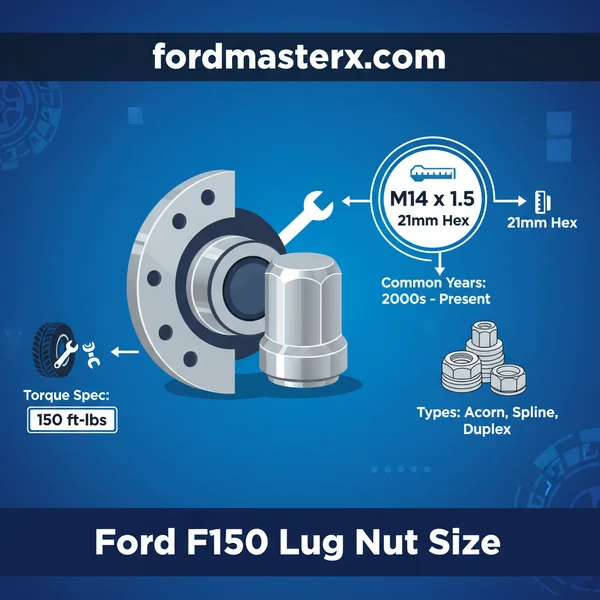
Accuracy matters because Ford updated the F-150 chassis and wheel hub designs several times over the decades. These updates changed the diameter of the stud, the coarseness of the threads, and the torque required to keep the wheels secure. Whether you are swapping to aftermarket wheels, replacing “swollen” factory lug nuts, or just doing a tire rotation, knowing these exact measurements ensures you use the right tools and hardware for a safe installation.
Detailed Specifications: Ford F-150 Thread Pitch and Hex Sizes by Year
The F-150 has transitioned through several thread standards. While the physical size of the truck has grown, the lug nut dimensions have also evolved to handle increased towing capacities and higher torque loads. Below is the breakdown of the exact specifications you need to match your hardware to your truck’s generation.

2015–Present: The Modern Standard (M14 x 1.5)
Starting with the 2015 model year and continuing through the current 2024 models, Ford moved to a finer thread pitch. This change allows for more precise tensioning and better resistance to vibration.
- Thread Pitch: M14 x 1.5
- Hex Size: 21mm (or 13/16 inch)
- Factory Torque Spec: 150 lb-ft (204 Nm)
- Seat Type: Conical / 60-Degree Acorn
If you are buying aftermarket lug nuts for these years, ensure they are specifically labeled for M14 x 1.5. Many generic “truck kits” still include the older 2.0 pitch, which will ruin your studs during the first few turns.
2004–2014: The Coarse Thread Era (M14 x 2.0)
This decade of F-150s, covering the eleventh and twelfth generations, uses a much coarser thread. While the diameter of the stud (14mm) remains the same as the newer trucks, the distance between the threads is wider.
- Thread Pitch: M14 x 2.0
- Hex Size: 21mm (or 13/16 inch)
- Factory Torque Spec: 150 lb-ft (204 Nm)
- Seat Type: Conical / 60-Degree Acorn
1997–2003: The Transition Years
During this period, Ford used two different sizes depending on the specific production date and the heavy-duty nature of the hub. Most 1997 to 1999 models used a smaller M12 stud, while 2000 to 2003 models transitioned to the larger M14 stud.
- 1997–1999 Specs: M12 x 1.75 thread pitch, 19mm (3/4 inch) hex.
- 2000–2003 Specs: M14 x 2.0 thread pitch, 21mm hex.
- Torque Spec: 100 lb-ft for M12 studs; 150 lb-ft for M14 studs.
Pre-1997: Imperial Measurements
For classic F-150s built before 1997, Ford relied on the Imperial system rather than Metric. These trucks use a standard 1/2-inch stud that is common among older American pickups.
- Thread Pitch: 1/2″-20
- Hex Size: 19mm (3/4 inch)
- Factory Torque Spec: 100 lb-ft (135 Nm)
Critical Differences Between M14 x 1.5 and M14 x 2.0 Applications
Recommended Best Deal Products

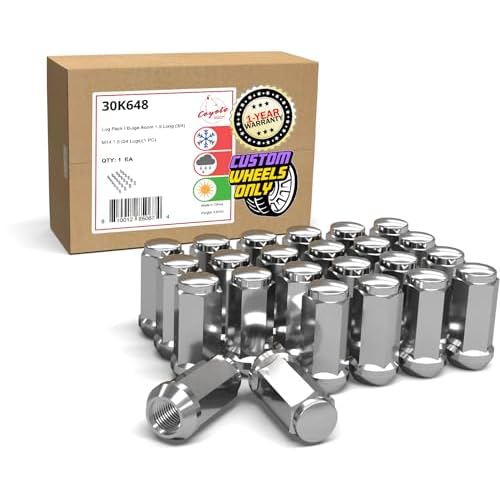

The most common mistake F-150 owners make is confusing the 1.5 and 2.0 thread pitches. Because both studs are 14mm in diameter, an M14 x 2.0 lug nut will actually start to thread onto an M14 x 1.5 stud. However, it will quickly bind after two or three rotations. If you use an impact wrench at this stage, you will “cross-thread” the stud, effectively destroying the metal teeth on both the nut and the hub stud.
Understanding Thread Pitch
The numbers “1.5” and “2.0” refer to the distance in millimeters between each individual thread. An M14 x 1.5 nut has threads that are closer together (fine thread), while an M14 x 2.0 has threads that are spaced further apart (coarse thread). Ford switched to the 1.5 pitch in 2015 because finer threads provide more “surface area” contact between the stud and the nut. This creates a higher clamping force, which is essential for the high 150 lb-ft torque requirements of modern aluminum-bodied trucks.

Audible — Listen Free for 30 Days
One free credit a month and thousands of titles included.
Listen Free for 30 Days As an Amazon Associate I earn from qualifying purchases.The Socket Size and “Swollen” Lug Nut Issues
While the internal thread pitch changed in 2015, the external hex size (the part the socket fits onto) has remained 21mm for nearly twenty years. However, Ford’s factory lug nuts are often “two-piece” designs, consisting of a steel core with a chrome cap pressed over the top. Moisture can get trapped between these layers, causing the nut to “swell.”
- Standard Fit: A 21mm socket should fit snugly on a healthy lug nut.
- The Swelling Problem: If your 21mm socket won’t fit, your lug nuts have likely swollen. Many technicians use a 21.5mm or 22mm “flip socket” to remove them.
- The Fix: If you experience swelling, replace the factory nuts with high-quality, one-piece solid steel lug nuts to avoid being stranded with a flat tire you cannot remove.
Why You Must Match the Seat Type
Beyond the thread pitch, you must ensure the “seat” matches your wheels. Almost all Ford F-150 wheels (both OEM and aftermarket) utilize a Conical or “Acorn” seat. This means the bottom of the lug nut is shaped like a cone at a 60-degree angle. This taper centers the wheel on the hub. Never use a “Flat” or “Mag” style lug nut on an F-150 wheel unless the wheel manufacturer specifically requires it, as the wheel will not center correctly, leading to severe vibrations and eventual stud failure.
Understanding the Swollen Lug Nut Phenomenon and Socket Fitment
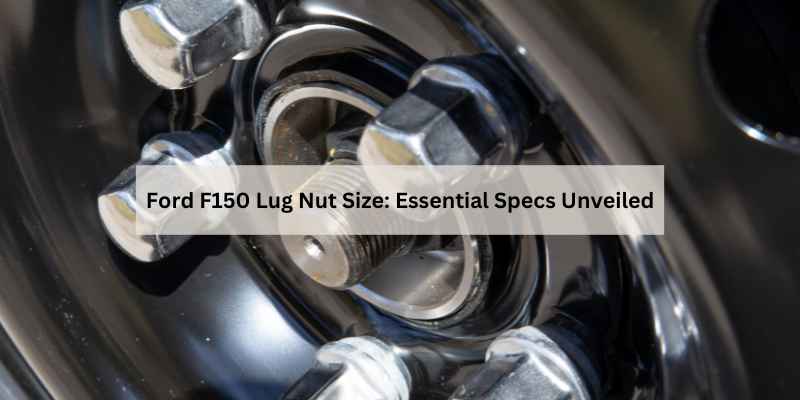
If you’ve ever struggled to get your 21mm socket onto your Ford F-150 lug nuts, you aren’t alone. This is a notorious issue known as “swelling.” Ford utilizes a two-piece design consisting of a steel core and a thin chrome or aluminum cap pressed over the top. While this looks great on the showroom floor, it often creates a practical nightmare for truck owners and mechanics alike.
The Science Behind the Swelling
Over time, moisture and road salt seep between the inner steel nut and the outer decorative cap. As the steel underneath eventually corrodes, it expands. Because the outer cap is relatively soft, it stretches and bulges outward. This microscopic expansion is enough to make a standard 21mm socket nearly impossible to seat properly. If you force the socket on, you might get it stuck; if you use a socket that is too large, you risk rounding the corners of the nut, making it permanent fixture on your hub.
- The Impact Wrench Effect: Frequent use of high-powered impact wrenches can accelerate swelling by slightly deforming the soft outer cap during every tire rotation.
- Practical Tip: Many professional mechanics keep a “half-size” socket, such as a 21.5mm, specifically for Ford trucks suffering from this exact issue.
- Long-term Solution: If your lug nuts are starting to swell, the best fix is to replace the entire set with high-quality, solid one-piece steel lug nuts that won’t delaminate or expand.
Socket Fitment Best Practices
Using the wrong socket is the quickest way to turn a simple maintenance task into a multi-hour ordeal. Always ensure your socket is fully seated against the base of the lug nut before applying any pressure. On newer models, the standard size is 21mm, but older F-150s may use 19mm (3/4 inch). Always double-check your fitment on a nut that shows no signs of damage before assuming your toolkit is ready for the job. If the socket feels “mushy” or doesn’t slide on easily, stop immediately to avoid stripping the head.
Torque Requirements and Proper Seat Type for F-150 Wheels
Recommended Best Deal Products


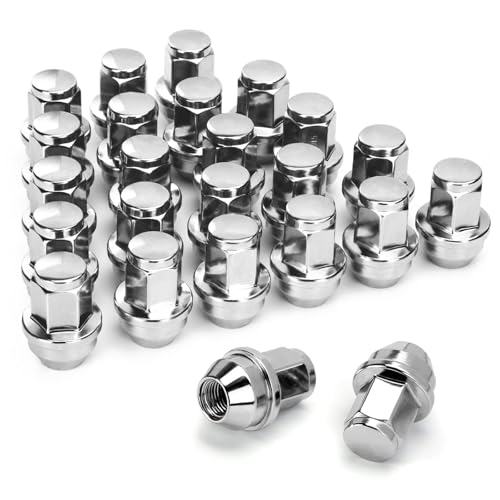
Getting the size right is only half the battle. You also need to ensure the lug nuts are secured with the correct amount of force. For most modern Ford F-150s (typically 2015 to present), the manufacturer’s recommended torque spec is a hefty 150 lb-ft (204 Nm). This is significantly higher than many smaller vehicles and older trucks, making a calibrated torque wrench an essential tool for your garage.
Why the Seat Type Matters
F-150 wheels typically use a “Cone” or “Acorn” seat. This refers to the bottom of the lug nut that makes contact with the wheel. The seat is tapered at a 60-degree angle to center the wheel perfectly on the hub. Using a flat-seat or ball-seat nut on an F-150 wheel can lead to dangerous vibrations, damaged wheels, or even the lug nuts backing off while you are driving at highway speeds.
- Thread Pitch Check: Ensure your replacements match your specific year. 2015+ models use M14 x 1.5, while older models often use M14 x 2.0. These are not interchangeable despite looking similar.
- Avoid “Dry” Torque Issues: Do not use grease or anti-seize on the threads unless specifically instructed by the manufacturer. These lubricants can lead to false torque readings and potentially snapped wheel studs.
- Aftermarket Considerations: If you have switched to aftermarket wheels, verify if they require “small diameter” or “spline drive” lug nuts, as the standard 21mm OEM nuts may not fit in the narrower lug holes.
Safety and Consistency
Consistency is key for heavy-duty wheels. Under-torquing can lead to the wheel wobbling, while over-torquing can stretch the wheel studs or warp your brake rotors. Always tighten in a crisscross or star pattern to ensure even pressure across the wheel face. If you’ve recently had your tires changed at a shop, it is always a smart move to re-verify the torque yourself after about 50 to 100 miles of driving to ensure everything has settled correctly under the weight of the truck.
Conclusion
Understanding your Ford F-150’s lug nut size and torque specs is vital for both routine maintenance and roadside safety. Whether you are dealing with the common “swollen nut” issue or simply performing a seasonal tire rotation, having the right 21mm or 19mm socket and a reliable torque wrench is non-negotiable. Remember to check your specific year’s thread pitch and always aim for that 150 lb-ft mark on late-model trucks to keep your wheels securely attached.
Take a moment this weekend to inspect your lug nuts for signs of swelling or corrosion. If they look a bit bulged or your socket is sticking, consider upgrading to a set of solid one-piece replacements before you find yourself stuck with a flat tire. A small investment in the right hardware today can save you a major headache tomorrow!
Audible Premium Plus — Annual Membership
12 audiobook credits up front, plus the full Audible catalogue.
See Annual Plans As an Amazon Associate I earn from qualifying purchases.❓ Frequently Asked Questions
What is the exact lug nut size for a 2015-present Ford F-150?
Models from 2015 to the current year use an M14 x 1.5 thread pitch with a 21mm hex size. These typically require 150 lb-ft of torque to ensure wheel safety and proper seating.
How do I identify the lug nut size for a 2004-2014 F-150?
These trucks utilize an M14 x 2.0 thread pitch, which is coarser than the later 2015+ models. They still utilize a 21mm socket for removal unless the lug nuts have experienced swelling.
What is the ‘swollen lug nut’ issue common in Ford trucks?
Ford uses a two-piece design with a steel core and a decorative chrome cap that traps moisture. This causes internal rust expansion, making a standard 21mm socket impossible to fit over the nut.
Can I use 2014 F-150 lug nuts on a 2015 model?
No, you cannot swap them because the 2014 uses a 2.0 thread pitch while the 2015 uses a finer 1.5 thread pitch. Attempting to force them will cross-thread and damage the wheel studs.
What socket should I use if my F-150 lug nuts are swollen?
You should use a specialty 21.5mm ‘half-size’ flip socket designed specifically for swollen Ford lug nuts. It is highly recommended to replace swollen nuts with one-piece solid steel aftermarket versions.
What is the lug nut size for older F-150s (pre-2004)?
From 2000 to 2003, F-150s used M14 x 2.0 threads, while 1997-1999 models often used M12 x 1.75. Pre-1997 models typically used 1/2-inch-20 SAE threads, reflecting older domestic standards.