
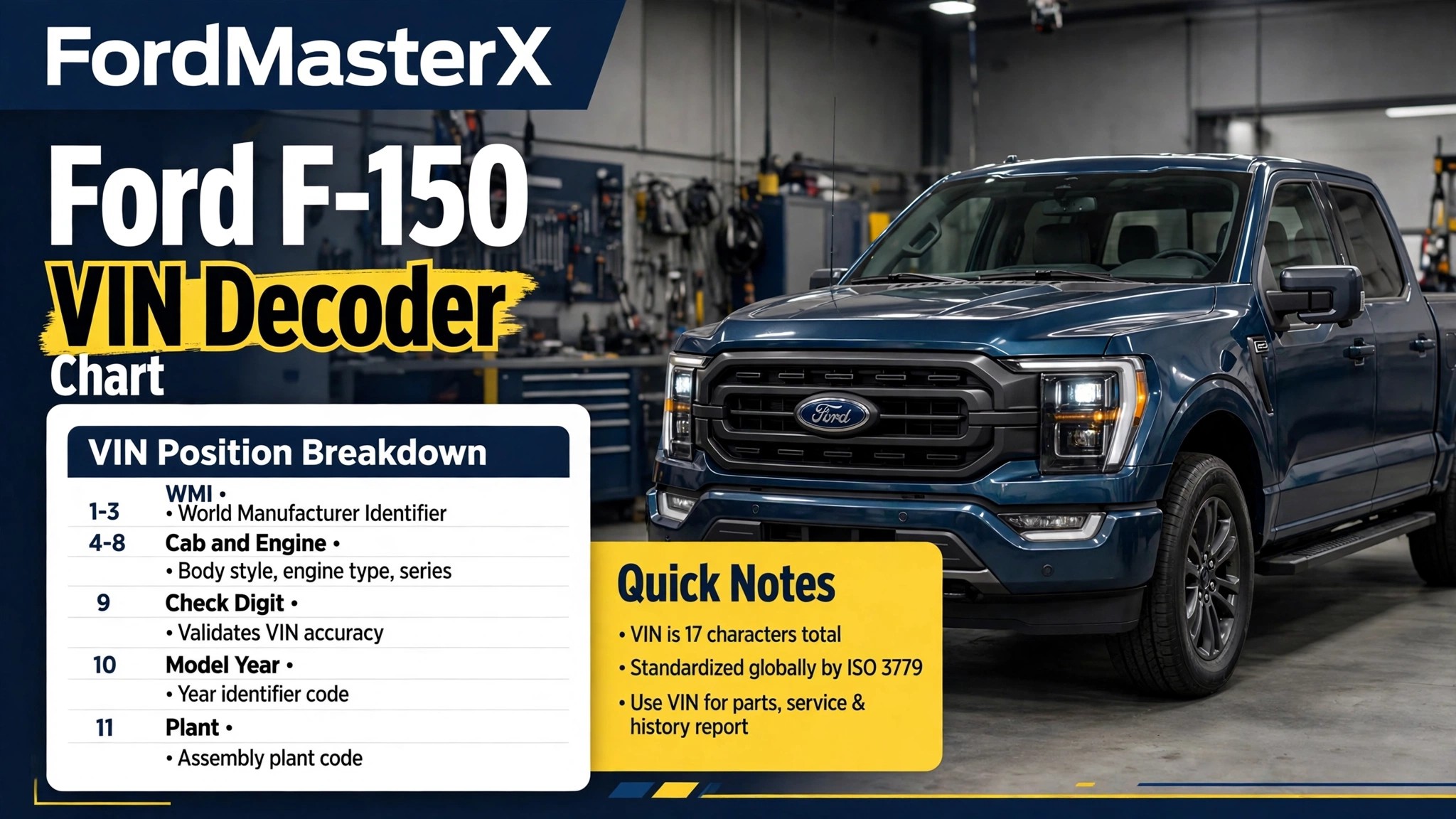
Ford F-150 VIN Decoder Chart 2026: Complete Guide to Every Position

A Ford F-150 VIN decoder chart turns 17 stamped characters into facts about your truck. It names the engine, the model year, the cab, and the plant that built it.
This guide covers only 1981 and newer F-150 trucks with 17-digit VINs. Every engine code sits in its own generation table, because Ford reuses the same letters for different engines over time.
Read the year first, then the engine code. That order keeps you from misreading your truck.
What a Ford F-150 VIN Decoder Chart Shows You
A decoder chart is a lookup tool, not a history report. You find a character in your VIN, match it to a row in the chart, and read off the fact it encodes.
The 17 characters split into four blocks. Each block answers a different question about the truck.
| Positions | Block | What It Tells You |
|---|---|---|
| 1 to 3 | World Manufacturer Identifier | Country, maker, and vehicle type |
| 4 to 8 | Vehicle Descriptor Section | Weight class, cab, series, and engine |
| 9 | Check digit | A math test that catches typos |
| 10 | Model year | One character for the model year |
| 11 | Assembly plant | The plant that built the truck |
| 12 to 17 | Serial number | The truck’s unique production number |
Three positions do most of the work for owners. Position 8 names the engine.
Position 10 names the model year. Position 11 names the plant.
Our general Ford VIN decoder specification chart covers every Ford model at once. This guide stays on the F-150 only, so its engine and cab tables match your truck exactly.
The VIN never changes during the life of the truck. It stays with the frame from the factory to the scrapyard.
Where to Find the VIN on Your F-150
You can read the VIN in four places without tools. Check at least two of them when you buy a used truck, because all four must match.
The easiest spot is the driver’s side dashboard. Look through the windshield at the lower left corner, where the dash meets the glass.
A metal plate there carries the full 17 characters. A JEGS guide to Ford truck VIN locations shows the same four spots with photos.
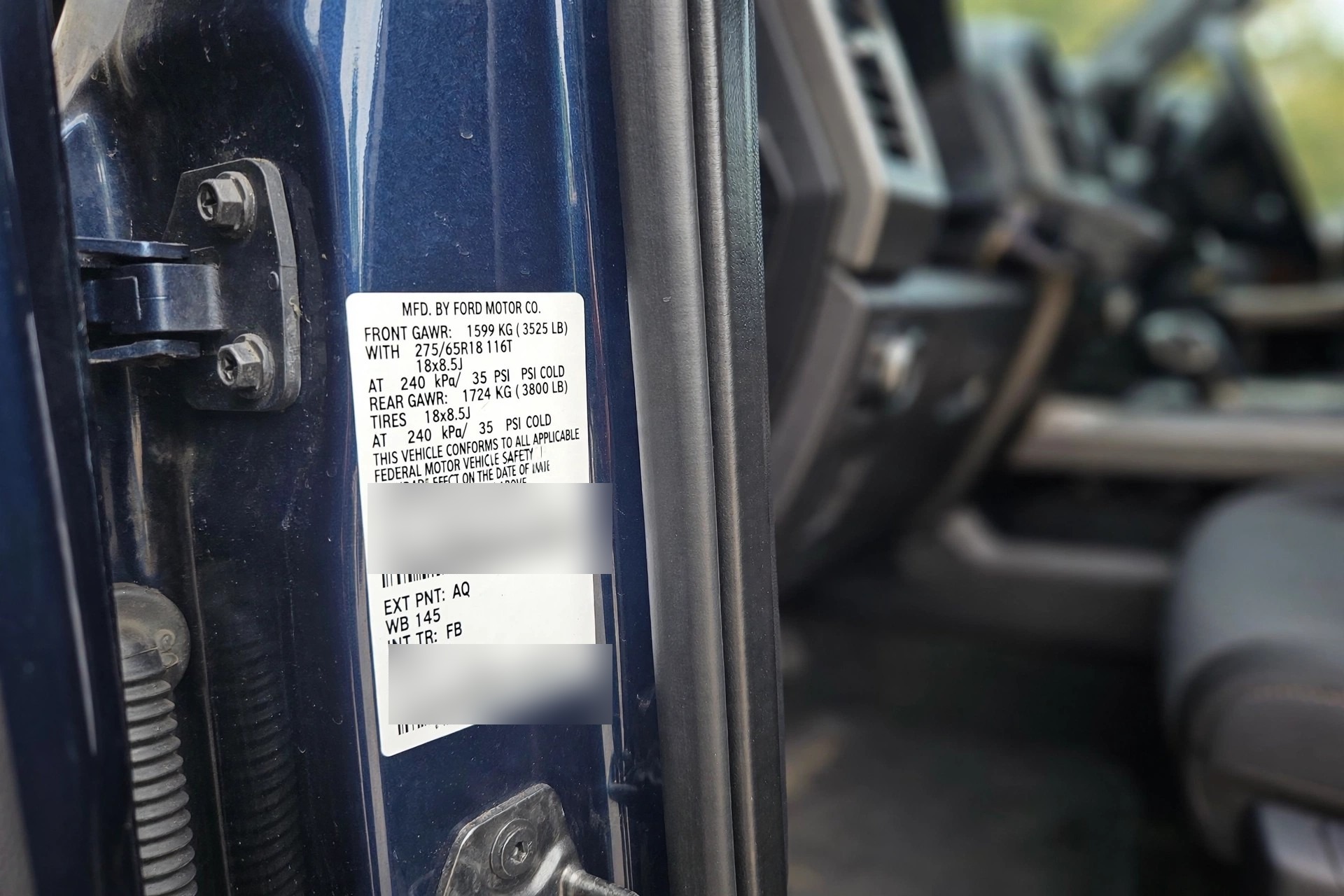
The second spot is the driver’s door jamb. Open the door and look at the Safety Compliance Certification Label on the pillar. This label also lists the build date, the gross vehicle weight rating, and the tire pressures.
The third spot sits under the hood. Ford stamps the VIN on the firewall or on a plate near the strut tower. This copy survives a windshield replacement, so buyers use it to confirm the dash plate.
The fourth spot is paperwork. The title, the registration card, and the insurance card all print the VIN. The FordPass app and the SYNC screen can also show it.
If the dash plate and the door jamb label disagree, stop. A mismatch can mean a swapped panel, a replaced door, or a cloned VIN. Check the frame stamping and the title before you spend money.
Positions 1 to 3 and How to Read the WMI
The first three characters form the World Manufacturer Identifier, or WMI. It names the country of build, the maker, and the vehicle type in one short code.
| WMI | Meaning |
|---|---|
| 1FT | Ford truck built in the United States |
| 2FT | Ford truck built in Canada at Oakville, Ontario |
| 3FT | Ford truck built in Mexico at Cuautitlan, sold in Mexico as the Ford Lobo |
Every US-built F-150 starts with 1FT. That covers Dearborn and Kansas City trucks across all generations.
A Canadian-built F-150 starts with 2FT. Oakville built F-150s in the 7th through 10th generations. A Mexican-built truck starts with 3FT.
One common error needs a clear correction. Codes like 1FTE and 1FTF are not WMIs. The WMI is only three characters long.
1FTE is the WMI 1FT plus position 4, the letter E. Read only the first three characters when you check the WMI.
The second character, F, always means Ford in these codes. The third character, T, means truck. Cars use 1FA and SUVs use 1FM, so a VIN that starts 1FA or 1FM is not an F-150.
Positions 4 to 7 and the F-150 Cab and Series Codes
Positions 4 through 7 are Ford’s own codes, so no universal rule reads them. Ford files the meanings with NHTSA each model year, and the codes change between generations.
Position 4 covers the brake system, the weight class, and the restraint type. On an F-150 it often reads F, which marks a gross weight class of 7,001 to 8,000 lb with side airbags. The exact letter shifts with cab and drivetrain, so read it with the next three characters, not alone.
Positions 5 through 7 name the line, the series, and the body. The table below comes from Ford’s 2022 VIN filing with NHTSA, and the same pattern holds across the 13th and 14th generations.
| Code | Cab and Drive |
|---|---|
| F1C | Regular Cab, 4×2 |
| F1E | Regular Cab, 4×4 |
| X1C | SuperCab, 4×2 |
| X1E | SuperCab, 4×4 |
| W1C | SuperCrew, 4×2 |
| W1E | SuperCrew, 4×4 |
| W1R | SuperCrew Raptor, 4×4 |
| W1P | SuperCrew Police Responder, 4×4 |
| W1S | SuperCrew Special Service, 4×2 |
| W1T | SuperCrew Special Service, 4×4 |
Read the code as a group. W means SuperCrew, X means SuperCab, and F means Regular Cab. The last letter marks drive: C for 4×2 and E for 4×4.
The trim level does not appear in these codes. An XLT and a Lariat with the same cab and drive share the same VDS code. Our Ford trim code decoder explains where trim codes actually live.
Position 8 Engine Codes by Generation
Position 8 is the character owners look up most. It names the engine that left the factory in the truck.
The rule that governs this whole section is simple. Read the model year in position 10 first, then read the engine code. Ford reuses letters across generations, so the same letter can name a different engine on a different year truck.
A single flat list would misread half the trucks on the road. The tables below split the codes by generation, so each letter is read only inside its own years.
2021 and Newer Engine Codes
The 14th generation runs from 2021 to the present. Its codes come from Ford’s own VIN filings with NHTSA. Ford’s 2022 VIN filing with NHTSA lists the 2.7L EcoBoost at 325 hp, the 3.3L V6 at 290 hp, the 3.5L EcoBoost at 400 hp, the PowerBoost hybrid at 430 hp, and the 5.0L V8 at 400 hp.
| Code | Engine |
|---|---|
| B | 3.3L Ti-VCT V6 |
| P | 2.7L EcoBoost V6 |
| 8 | 3.5L EcoBoost V6 |
| D | 3.5L PowerBoost Hybrid V6 |
| 5 | 5.0L Coyote V8 |
| 1 | 3.0L Power Stroke Diesel V6, 2021 only |
| G | 3.5L EcoBoost High Output V6, Raptor |
| J | 5.2L Supercharged V8, Raptor R, 2023 and newer |
Ford F-150 VIN at a Glance
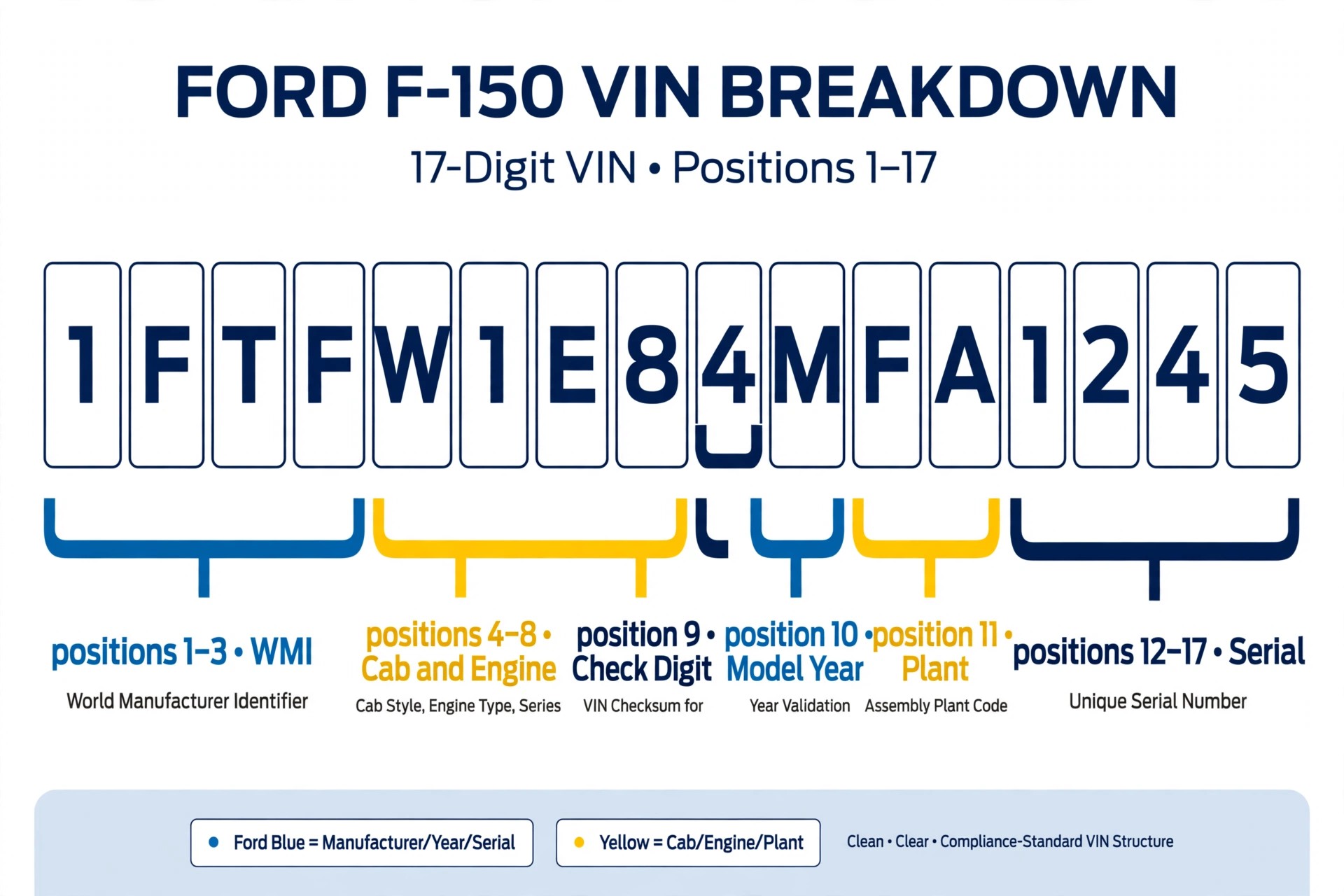
Illustrative example VIN: 1FTFW1E84MFA12345
1-3 WMI: 1FT, US Ford truck | 4-8 VDS: W1E SuperCrew 4×4, engine 8 | 9 Check digit | 10 Year: M, 2021 | 11 Plant: F, Dearborn | 12-17 Serial
Engine Codes, Position 8, 2021 and Newer
| Code | Engine | Code | Engine |
|---|---|---|---|
| B | 3.3L Ti-VCT V6 | 5 | 5.0L Coyote V8 |
| P | 2.7L EcoBoost V6 | 1 | 3.0L Power Stroke Diesel, 2021 only |
| 8 | 3.5L EcoBoost V6 | G | 3.5L EcoBoost High Output, Raptor |
| D | 3.5L PowerBoost Hybrid V6 | J | 5.2L Supercharged V8, Raptor R |
Year and Plant, Positions 10 and 11
| Year Code | Year | Plant Code | Plant |
|---|---|---|---|
| M | 2021 | F | Dearborn Truck, Michigan |
| N | 2022 | K | Kansas City, Missouri |
| P | 2023 | W | Rouge Electric, Lightning only |
| R | 2024 | E | Kentucky Truck, older trucks |
| S | 2025 | B | Oakville, older 2FT trucks |
| T | 2026 |
Read the model year first, then the engine code. Ford reuses engine letters across generations, so a letter only means something inside its own years. Codes verified against Ford’s VIN filings with NHTSA. The example VIN is illustrative, not a real truck.
Note the two codes that surprise readers. The 3.5L EcoBoost is 8, not G, on a standard 2021 and newer truck.
G marks the high output 3.5L in the Raptor. The 5.0L V8 is 5, not F, from 2018 onward.
The 3.0L Power Stroke diesel lasted one model year in this generation. Ford dropped it after 2021, so code 1 is rare on 14th generation trucks.
Our Ford engine code by VIN guide covers engine codes across the full Ford lineup. The tables here stay on F-150 engines only.
2015 to 2020 Engine Codes
The 13th generation brought the aluminum body and the 2.7L EcoBoost. Its codes overlap with the 14th generation, but three letters changed meaning at the 2021 redesign.
| Code | Engine |
|---|---|
| D | 3.5L Ti-VCT V6, base engine, 2015 to 2017 |
| B | 3.3L Ti-VCT V6, base engine, 2018 to 2020 |
| P | 2.7L EcoBoost V6 |
| G | 3.5L EcoBoost V6 |
| F | 5.0L Coyote V8, 2015 to 2017 |
| 5 | 5.0L Coyote V8, 2018 to 2020 |
| 1 | 3.0L Power Stroke Diesel V6, 2018 to 2020 |
The 3.5L EcoBoost is G here and 8 in the next generation. That single change causes the most misreads we see.
A G on a 2019 truck is a standard 3.5L EcoBoost with 375 hp. A G on a 2022 truck is the Raptor high output version.
The letter D also changed. D is the base 3.5L V6 on a 2015 to 2017 truck.
D is the PowerBoost hybrid on a 2021 and newer truck. Year first, then letter.
2011 to 2014 Engine Codes
The 12th generation introduced the 5.0L Coyote and the 3.5L EcoBoost for 2011. Trucks from 2009 and 2010 carried over the older engines, so they sit in a separate row below.
| Code | Engine |
|---|---|
| C | 3.7L Ti-VCT V6, 2011 to 2014 |
| T | 3.5L EcoBoost V6, 2011 to 2014 |
| F | 5.0L Coyote V8, 2011 to 2014 |
| 6 | 6.2L Boss V8, Raptor, 2011 to 2014 |
| W | 4.6L Triton V8, 2009 to 2010 |
| 5 | 5.4L Triton V8, 2009 to 2010 |
The 3.7L V6 replaced the 4.6L as the base engine in 2011. The 6.2L Boss V8 went into the Raptor and a few heavy duty trims. It never served as a standard F-150 engine.
2004 to 2008 Engine Codes
The 11th generation kept three engines across its whole run. The 5.4L moved to a three valve head in this generation.
| Code | Engine |
|---|---|
| 2 | 4.2L Essex V6 |
| W | 4.6L Triton V8 |
| 5 | 5.4L Triton V8, three valve |
One caution applies here. Some decoder sources list V for the flex fuel version of the 5.4L in this generation.
Ford’s own filings list 5 as the standard 5.4L code. If your 2004 to 2008 truck shows V in position 8, run the full VIN through the NHTSA vPIC decoder before you order parts.
1997 to 2003 Engine Codes
The 10th generation moved the F-150 to the modular V8 family. The 4.2L V6 replaced the old inline six as the base engine.
| Code | Engine |
|---|---|
| 2 | 4.2L Essex V6 |
| W | 4.6L Triton V8 |
| L | 5.4L Triton V8 |
| 3 | 5.4L Supercharged V8, SVT Lightning, 1999 to 2003 |
Sources disagree on the Lightning code, so this row deserves a note. One decoder site lists Z for the supercharged Lightning. Ford parts data and the older Ford VIN guides list 3 for the supercharged Lightning and Z for the gaseous fuel prep version of the 5.4L.
This guide follows the Ford guides. A Lightning owner can confirm with the NHTSA decode.
1987 to 1996 Engine Codes
The 8th and 9th generations ran the Windsor V8s and the 300 inline six. Two letters changed meaning inside this span, so the year split matters even here.
| Code | Engine | Years |
|---|---|---|
| Y | 4.9L Inline Six, 300 | 1987 to 1996 |
| F | 5.0L V8, 302 | 1987 to 1991 |
| T | 5.0L V8, 302 | 1992 to 1996 |
| H | 5.8L V8, 351W | 1992 to 1996 |
| P | 7.3L Diesel V8 | 1992 to 1996 |
The 5.0L moved from F to T in 1992. A T on a 1990 truck does not mean a 5.0L, and an F on a 1994 truck does not mean a 5.0L either. Read the year first.
One code stays disputed for this span. Some sources list N as the 5.8L V8 for 1992 to 1996, while others list N as a 3.8L V6 that never served in an F-150.
This guide lists H for the 5.8L and marks N as disputed. Run the VIN through NHTSA vPIC if your truck shows N.
Trucks from 1981 to 1986 used an earlier code set, and decoder sources disagree on it. The 4.9L six and the 5.0L V8 appear under different letters in different charts.
Do not trust a web chart alone for a 1981 to 1986 truck. Use the NHTSA vPIC decoder and the door jamb build date together.
Position 9 Check Digit and How It Catches Typos
Position 9 is a check digit. It is not random, and it is not part of the serial number. It is a single character computed from the other 16 characters with a fixed weighting formula set by federal rule 49 CFR 565.15.
Each character converts to a number, each position carries a weight, and the weighted sum is divided by 11. The remainder becomes the check digit. A remainder of 10 is written as the letter X.
This digit catches transposed characters and typing errors. If you mistype one character, the check digit almost always fails. NHTSA’s decoder rejects a VIN with a wrong check digit, and most DMV systems do the same.
A check digit that fails does not always mean fraud. It can mean a misread character on a worn plate.
The letters I, O, and Q never appear in a VIN, so a plate that looks like it holds one of them is usually misread. Clean the plate, read it again, and compare it with the door jamb label.
Position 10 Model Year Codes and the 30 Year Repeat
Position 10 holds one character for the model year. The cycle runs on a 30 year loop and skips the letters I, O, Q, U, and Z, plus the digit 0. Digits cover 2001 to 2009, then letters take over from 2010.
| Code | Model Years |
|---|---|
| B | 1981, 2011 |
| C | 1982, 2012 |
| D | 1983, 2013 |
| E | 1984, 2014 |
| F | 1985, 2015 |
| G | 1986, 2016 |
| H | 1987, 2017 |
| J | 1988, 2018 |
| K | 1989, 2019 |
| L | 1990, 2020 |
| M | 1991, 2021 |
| N | 1992, 2022 |
| P | 1993, 2023 |
| R | 1994, 2024 |
| S | 1995, 2025 |
| T | 1996, 2026 |
| V | 1997, 2027 |
| W | 1998, 2028 |
| X | 1999, 2029 |
| Y | 2000, 2030 |
| 1 | 2001 |
| 2 | 2002 |
| 3 | 2003 |
| 4 | 2004 |
| 5 | 2005 |
| 6 | 2006 |
| 7 | 2007 |
| 8 | 2008 |
| 9 | 2009 |
| A | 2010 |
The repeat creates the classic trap. T means 1996 and 2026.
M means 1991 and 2021. A single letter never settles the year on its own.
Federal rules give a tiebreaker. Position 7 must be a number on 1980 to 2009 trucks and a letter on 2010 to 2039 trucks.
A T with a number in position 7 is a 1996 truck. A T with a letter in position 7 is a 2026 truck.
Use the generation as a second check. A 2021 truck has an aluminum body and the 14th generation cab codes.
A 1991 truck has the 9th generation body. The truck in front of you settles what the letter leaves open.
Position 11 Plant Codes and Where Your Truck Was Built
Position 11 names the assembly plant. For a current F-150 the answer is almost always one of two letters. Ford’s 2027 VIN filing with NHTSA lists F as Dearborn, Michigan and K as Kansas City in Claycomo, Missouri, with W as the Rouge Electric Vehicle Center in Dearborn for the Lightning.
| Code | Assembly Plant |
|---|---|
| F | Dearborn Truck Plant, Dearborn, Michigan |
| K | Kansas City Assembly, Claycomo, Missouri |
| W | Rouge Electric Vehicle Center, Dearborn, Michigan, F-150 Lightning only |
| E | Kentucky Truck Plant, Louisville, Kentucky, older trucks |
| B | Oakville Assembly, Oakville, Ontario, Canada, older 2FT trucks |
Dearborn and Kansas City build every gasoline and hybrid F-150 today. Dearborn builds the Raptor and the Lightning alongside standard trucks. Kansas City builds standard F-150s and the Transit van on shared lines.
Older trucks show more codes. Kentucky Truck built 10th generation F-150s, and Oakville built Canadian market trucks.
The plant code also helps spot a swapped VIN plate. A 2023 truck with plant code B does not match any factory record, because Oakville stopped building F-150s years earlier.
Positions 12 through 17 are the serial number. Ford assigns a six character alphanumeric sequence per plant, running from A00001 through G99999 for trucks.
This number is unique to the truck. It carries no specification data, so no chart decodes it.
Worked Example and a Full 17 Digit Decode
The VIN below is an illustrative example built for this guide. It is not a real person’s truck. Its check digit was computed with the federal weighting formula, so the number is valid in form.
1FTFW1E84MFA12345
Read it in blocks, left to right.
| Positions | Characters | Reading |
|---|---|---|
| 1 to 3 | 1FT | Ford truck built in the United States |
| 4 | F | Weight class 7,001 to 8,000 lb with side airbags |
| 5 to 7 | W1E | F-150 SuperCrew, 4×4 |
| 8 | 8 | 3.5L EcoBoost V6 |
| 9 | 4 | Check digit, verified against the other 16 characters |
| 10 | M | Model year 2021 |
| 11 | F | Dearborn Truck Plant, Michigan |
| 12 to 17 | A12345 | Production sequence number |
The full decode reads as follows. This is a 2021 Ford F-150 SuperCrew 4×4 with the 3.5L EcoBoost V6, built at Dearborn Truck Plant.
Check your own reading against the three rules from this guide. The year M means 2021 here because position 7 holds the letter E, which puts the truck in the 2010 to 2039 cycle.
The engine code 8 means 3.5L EcoBoost only because the year is 2021 or newer. The plant F means Dearborn Truck, not the Rouge Electric center, because this truck is a gasoline SuperCrew and not a Lightning.
Try the same steps on your own VIN. Write each block on its own line.
Match the year first, then the engine, then the cab and the plant. If any block contradicts the truck in front of you, trust the truck and run the full VIN through NHTSA vPIC.
What Your F-150 VIN Does Not Tell You
A VIN answers four questions well: engine, year, cab, and plant. Everything else needs another source. Owners who expect the VIN to answer every question end up guessing.
Towing capacity is not in the VIN. Two trucks with the same engine code can tow very different weights.
The axle ratio, the tow package, the cab, the bed, and the drive layout all change the rating. Check the door jamb label and our F-150 towing capacity chart for the rating that matches your exact setup.
Payload works the same way. The VIN gives a weight class in position 4, not a payload number.
The real payload sits on the Tire and Loading Information label on the door jamb. That label reflects the truck as built, with its own options fitted.
The axle ratio is not encoded in the VIN. Neither is the transmission.
Both appear on the build sheet and on the door jamb axle code. A Ford build sheet by VIN lists the factory options, packages, and equipment groups that the VIN leaves out.
Trim level is not in the VIN. The VIN cannot tell an XL from a Platinum.
Paint code is not in the VIN either. The paint code lives on the door jamb label, and our Ford color code by VIN guide explains how to read it from that label.
The keyless entry code is not in the VIN. Neither is the radio code or the key code.
The factory keyless code sits on a label in the truck or in dealer records. Our Ford VIN decoder keyless entry code guide explains where to find it.
Accident history, service history, and recalls are not in the VIN either. The VIN is the key that unlocks those records, not the record itself. Use it to pull a history report and to check open recalls with NHTSA.
Common F-150 VIN Decoding Mistakes to Avoid
Four errors cause most bad decodes. Each one is easy to avoid once you know it.
The first error is reading the engine code without the year. The letter G names the 3.5L EcoBoost on a 2019 truck and the Raptor high output engine on a 2022 truck.
The letter D names a base V6 on a 2016 truck and a hybrid on a 2021 truck. Year first, then letter, every time.
The second error is trusting a generic all-Ford chart for F-150 codes. Engine letters change meaning between Ford models as well as between years. The code 8 means a 2.3L EcoBoost four cylinder on some Ford cars and a 3.5L EcoBoost V6 on a 2021 F-150.
Use an F-150 chart for an F-150 truck. Cross-check older generation codes against a second source, such as the F-150 VIN decoder at check-your-spec, before you order parts.
The third error is confusing 11-digit and 17-digit VINs. Trucks built before 1981 carry shorter VINs with a different layout.
Position 8 is not the engine code on those trucks. Our 11-digit Ford VIN decoder chart covers the classic format, and this guide covers only 1981 and newer trucks.
The fourth error is reading the year letter as a single year. T is 1996 or 2026.
M is 1991 or 2021. Use the position 7 tiebreaker and the generation of the truck to pick the right one.
Frequently Asked Questions About the F-150 VIN
What Does 1FT Mean at the Start of a Ford F-150 VIN
1FT is the World Manufacturer Identifier for a Ford truck built in the United States. The 1 marks the USA, the F marks Ford, and the T marks a truck. Every US-built F-150 starts with these three characters.
Which VIN Position Tells Me the Engine in My F-150
Position 8 names the engine. Read the model year in position 10 first, then match position 8 against the table for that generation. The same letter names different engines in different years, so the year decides the meaning.
How Do I Tell a 2021 F-150 From a 1991 F-150 by VIN
Look at position 10 and position 7 together. Both years use the letter M in position 10.
A 2021 truck has a letter in position 7, while a 1991 truck has a number there. The body style also gives it away, since the 2021 truck has an aluminum body.
Can I Get the Keyless Entry Code From My F-150 VIN
No, the VIN does not hold the keyless entry code. The factory code sits on a label inside the truck or in dealer records tied to the VIN. A dealer can retrieve it with proof of ownership.
Does the VIN Tell Me My F-150 Towing Capacity
No, the VIN does not give a towing number. It gives the engine and the weight class, but the axle ratio and the tow package decide the rating. Check the door jamb label and the towing chart for your exact year and setup.
Decode Your F-150 VIN With Confidence
A Ford F-150 VIN decoder chart works when you read it in the right order. Find the VIN on the dash or the door jamb. Read the year in position 10.
Match the engine code in position 8 against the table for that year. Read the cab in positions 5 to 7 and the plant in position 11.
Treat the chart as the start of the answer, not the whole answer. Confirm towing, payload, options, and paint on the door jamb label and the build sheet. Run any code that looks wrong through the NHTSA vPIC decoder before you order parts or sign a purchase.
Your truck already carries its own story in 17 characters. Now you can read it.