
11 Digit Ford VIN Decoder Chart 2026 Complete Guide

How do you decode an 11 digit Ford VIN? Read it in five fields: the first digit is the model year, the second letter is the assembly plant, the next two digits are the body code, the fifth character is the engine code, and the last six digits are the serial number.
Ford used this 11-character format on its cars from the early 1960s through the 1980 model year. The federal 17-character VIN standard replaced it for the 1981 model year, so any Ford with an 11 digit VIN is a classic.



The format looks simple, and the trap sits in the engine code. Ford reused engine letters freely, so the same letter can mean a small-block in one year and a big-block in another. You must read the year first, then the engine.
This guide gives you the full chart, two worked Mustang examples, the engine codes that change meaning by year, and the limits of what an 11 digit VIN can tell you.
The Short Answer: The 11-Digit Chart in One Table


Five fields cover all eleven characters. Learn the field order once, and you can read any classic Ford car VIN by hand.
| Positions | Field | What it means | Example |
|---|---|---|---|
| 1 | Model year | Last digit of the model year | 9 means 1969 |
| 2 | Assembly plant | Letter for the plant that built the car | R means San Jose |
| 3 to 4 | Body serial code | Body style and series | 02 means fastback |
| 5 | Engine code | Engine fitted at the factory | R means Ram Air 428 Cobra Jet in 1969 |
| 6 to 11 | Serial number | Consecutive unit number at that plant | 123456 means unit 123456 |
Take the VIN 9R02R123456. It reads as a 1969 Mustang fastback, built at San Jose, with a Ram Air 428 Cobra Jet engine, and it was the 23,456th unit in its sequence at that plant.
The VIN alone cannot confirm a Mach 1. Body code 02 was shared by every 1969 fastback, including the Boss 302 and Boss 429, so Mach 1 needs the door data plate, the trim, and the paperwork to confirm.
11 Digit Ford VIN Decoder Chart
Five fields, eleven characters, for Ford cars built before the 1981 model year. Read the year first, then the engine.
| Positions | Field | Example | Meaning |
|---|---|---|---|
| 1 | Model year | 9 | 1969, the last digit of the year |
| 2 | Assembly plant | R | San Jose, California |
| 3 to 4 | Body serial code | 02 | Fastback body, 1969 series |
| 5 | Engine code | R | Ram Air 428 Cobra Jet, 1969 to 1970 |
| 6 to 11 | Serial number | 123456 | Consecutive unit number |
Engine Letters That Change Meaning by Year
- C: 289 two-barrel from 1965 through 1968, then the 429 Cobra Jet in 1971.
- J: 302 four-barrel in 1968, then the Ram Air 429 Cobra Jet in 1971.
- R: 428 Cobra Jet in 1968, Ram Air 428 Cobra Jet in 1969 and 1970, Boss 351 in 1971, 351 HO in 1972.
- Q: non-Ram Air 428 Cobra Jet in 1969 and 1970, then the 351 Cobra Jet from 1971 on.
- F: 260 V8 on the earliest cars, then the 302 two-barrel from 1968.
Worked Example: 9R02R123456
- 9: 1969 model year.
- R: built at San Jose.
- 02: fastback body in the 1969 series.
- R: Ram Air 428 Cobra Jet engine for 1969.
- 123456: the 23,456th unit in the San Jose sequence.
Ford cars, 1960 to 1980 model years. Trucks and 1950s cars use different layouts. Sources: Check Your Spec Ford VIN decoder, CarCheckerVin classic decoder, Big Block Magazine Ford VIN decoder, Outlaw8 old Ford VIN decoder.
How to Read Each Position
Work left to right, one field at a time. Each field depends on the ones before it, and the engine code depends on the year most of all.
Position 1: Model Year


The first character is a number, and it is the last digit of the model year. A 9 means 1969, an 8 means 1968, and a 5 means 1965.
The digit repeats every decade, so it cannot pin the decade alone. A 9 could be 1969 or 1959, and a 0 could be 1970 or 1960.
Use the body code and the engine code to fix the decade. A 1969 fastback body code and a 1969 engine code together leave no doubt, while the digit alone leaves two options.
| Digit | Model year in the 1960s | Model year in the 1970s |
|---|---|---|
| 0 | 1960 | 1970 |
| 1 | 1961 | 1971 |
| 2 | 1962 | 1972 |
| 3 | 1963 | 1973 |
| 4 | 1964 | 1974 |
| 5 | 1965 | 1975 |
| 6 | 1966 | 1976 |
| 7 | 1967 | 1977 |
| 8 | 1968 | 1978 |
| 9 | 1969 | 1979 |
Ford cars built for the 1980 model year also carry an 11 digit VIN. The 1981 model year switched to the 17-character federal standard, so a 17 digit VIN is never a pre-1981 car.
Position 2: Assembly Plant
The second character is a letter for the plant that built the car. The plant letter matters more than it looks, because two cars with the same serial number can exist at different plants.


The serial number runs separately at each plant. A serial of 123456 at Dearborn and a serial of 123456 at San Jose are different cars, and only the plant letter tells them apart.
Always quote the plant letter with the VIN. A VIN quoted without it is only half an address, and it cannot identify the car.
| Letter | Plant | Letter | Plant |
|---|---|---|---|
| A | Atlanta, Georgia | N | Norfolk, Virginia |
| D | Dallas, Texas | P | Twin Cities, Minnesota |
| E | Mahwah, New Jersey | R | San Jose, California |
| F | Dearborn, Michigan | S | Pilot Plant |
| G | Chicago, Illinois | T | Metuchen, New Jersey |
| H | Lorain, Ohio | U | Louisville, Kentucky |
| J | Los Angeles, California | W | Wayne, Michigan |
| K | Kansas City | Y | Wixom, Michigan |
| L | Long Beach, California | Z | St. Louis, Missouri |
This plant list comes from the 1960s reference tables, and it covers the muscle era well. Some letters served more than one plant across the years, so confirm an unusual letter against a year-specific chart.
Positions 3 and 4: Body Serial Code
The third and fourth characters are a two digit body serial code. They name the body style and the series, not just the shape.
Body codes change by model and by year, so there is no single body table for all Fords. The Mustang codes are the best documented, and they show how the system works.
On 1965 and 1966 Mustangs, 07 means hardtop, 08 means convertible, and 09 means fastback. For 1967, Ford renumbered the same three bodies to 01, 02, and 03.
From 1969 the list grew as the Grande and the Mach 1 arrived. A 1969 body code of 02 still means fastback, and it is shared by the Mach 1, the Boss 302, the Boss 429, and the plain fastback, so it cannot identify the series. Only from 1970 does the Mach 1 get its own code (05) and the Grande its own (04).
| Code | 1965 to 1966 Mustang | 1967 to 1969 Mustang |
|---|---|---|
| 01 | Not used | Hardtop |
| 02 | Not used | Fastback |
| 03 | Not used | Convertible |
| 07 | Hardtop | Not used |
| 08 | Convertible | Not used |
| 09 | Fastback | Not used |
Other 1965 Fords used their own codes. Falcon Standard codes were 01 and 02, Fairlane codes were 31, 32, and 38, Galaxie 500 codes were 62, 64, 65, and 66, and Thunderbird codes were 81, 83, 85, and 87.
Read the body code against the chart for your model and year. A code that means fastback on a Mustang means something else on a Fairlane.
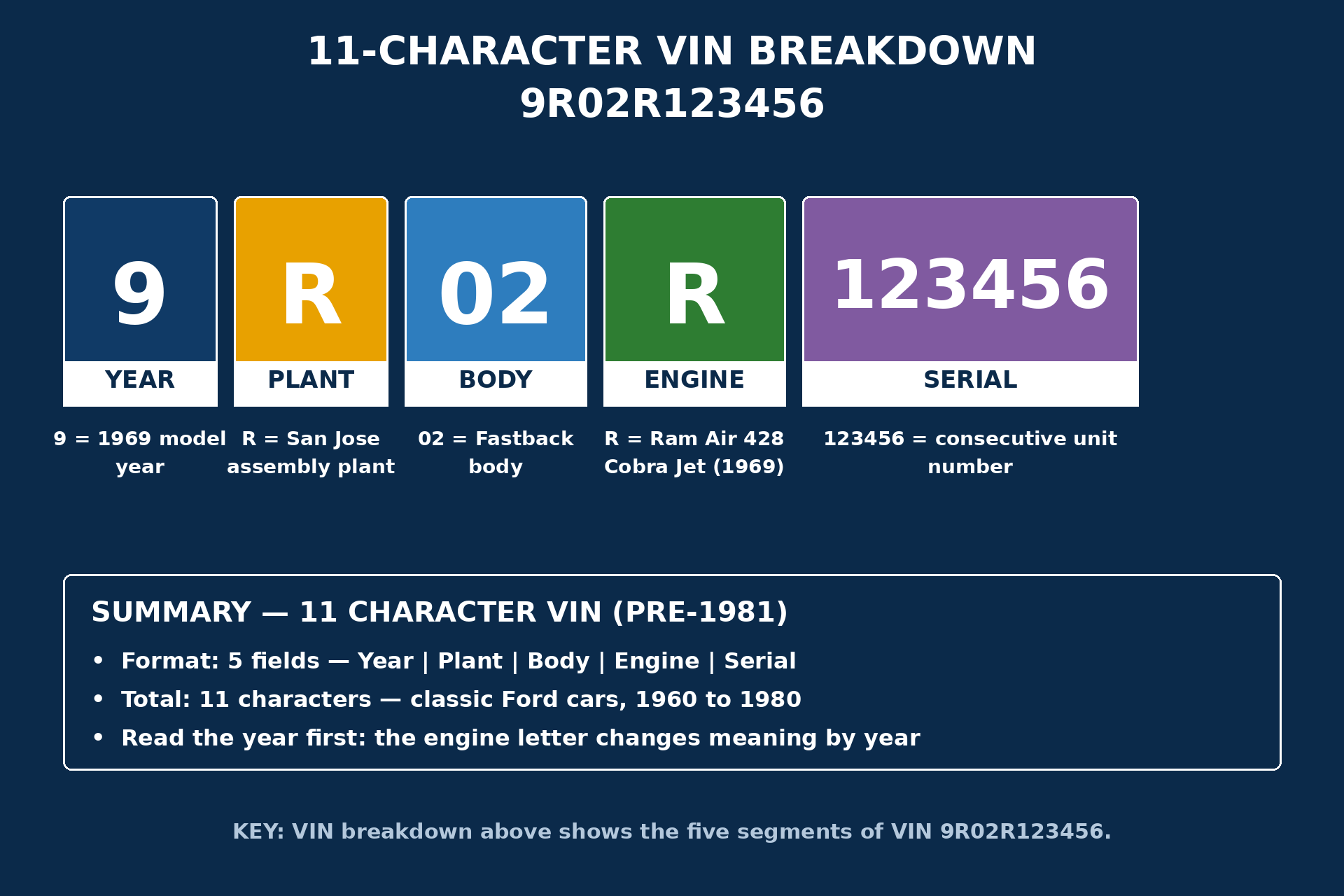
Figure 1: Five fields make the whole VIN. Diagram: drawn VIN breakdown, not a factory document.
Position 5: Engine Code
The fifth character is the engine code, and it is the most useful character in the VIN. It names the engine fitted at the factory, which decides much of the car’s value.
It is also the character most often misread. Ford reused engine letters freely, and the same letter meant a different engine in a different year.
Read the year first, then open the engine chart for that year. A chart that does not lead with the model year will tell you a 302 two-barrel is a big-block, or a Cobra Jet is a Super Cobra Jet.
| Letter | What it means | Years |
|---|---|---|
| C | 289 two-barrel | 1965 to 1968 |
| C | 429 Cobra Jet | 1971 |
| J | 302 four-barrel | 1968 |
| J | Ram Air 429 Cobra Jet | 1971 |
| R | 428 Cobra Jet | 1968 |
| R | Ram Air 428 Cobra Jet | 1969 to 1970 |
| R | Boss 351 | 1971 |
| R | 351 HO | 1972 |
| Q | Non-Ram Air 428 Cobra Jet | 1969 to 1970 |
| Q | 351 Cobra Jet | 1971 on |
| F | 260 V8 | Earliest cars |
| F | 302 two-barrel | 1968 |
| K | 289 High Performance | 1965 to 1967 |
The 1965 reference adds more letters. A means 289 premium, T means 200 six, U means 170 six, X means 352, and Z means 390. Each of those letters can shift meaning in later years too.
When a car is advertised with a rare engine, check the fifth character against the year chart before you pay a rare-engine price. The letter is the factory record, and it beats a seller’s claim.
Positions 6 to 11: Serial Number
The last six characters are the consecutive unit number. They count the car’s place in the production sequence at its plant for that model year.
The sequence typically starts at 100001 at each plant each year. A serial of 123456 means the car was the 23,456th unit in that plant’s sequence, counting from 100001.
The serial number alone tells you nothing about the car. It only orders cars within one plant and one year, and it needs the plant letter and the year digit beside it.
Two Worked Examples
Two real examples show the whole method. Work each one left to right, and check the engine letter against the year chart last.
Example 1: 9R02R123456, a 1969 Mustang Fastback
The first character is 9, so the model year ends in 9. The body and engine codes below fix it as 1969, not 1959.
The second character is R, so the car was built at San Jose, California. The third and fourth characters are 02, which means fastback in the 1969 series.
The fifth character is R, and the year is 1969, so the engine is the Ram Air 428 Cobra Jet. The same letter R meant the Boss 351 in 1971, which shows why the year comes first.
The last six characters are 123456, the consecutive unit number at San Jose. The full read is a 1969 Mustang fastback, built at San Jose, with a Ram Air 428 Cobra Jet.
Example 2: 8F02J100001, a 1968 Mustang Fastback
The first character is 8, so the model year ends in 8. The body and engine codes below fix it as 1968.
The second character is F, so the car was built at Dearborn, Michigan. The third and fourth characters are 02, which means fastback in the 1968 series.
The fifth character is J, and the year is 1968, so the engine is the 302 four-barrel. The same letter J meant the Ram Air 429 Cobra Jet in 1971.
The last six characters are 100001, the first unit in the Dearborn sequence for the year. The full read is a 1968 Mustang fastback, built at Dearborn, with a 302 four-barrel, and it was the first car off that sequence.
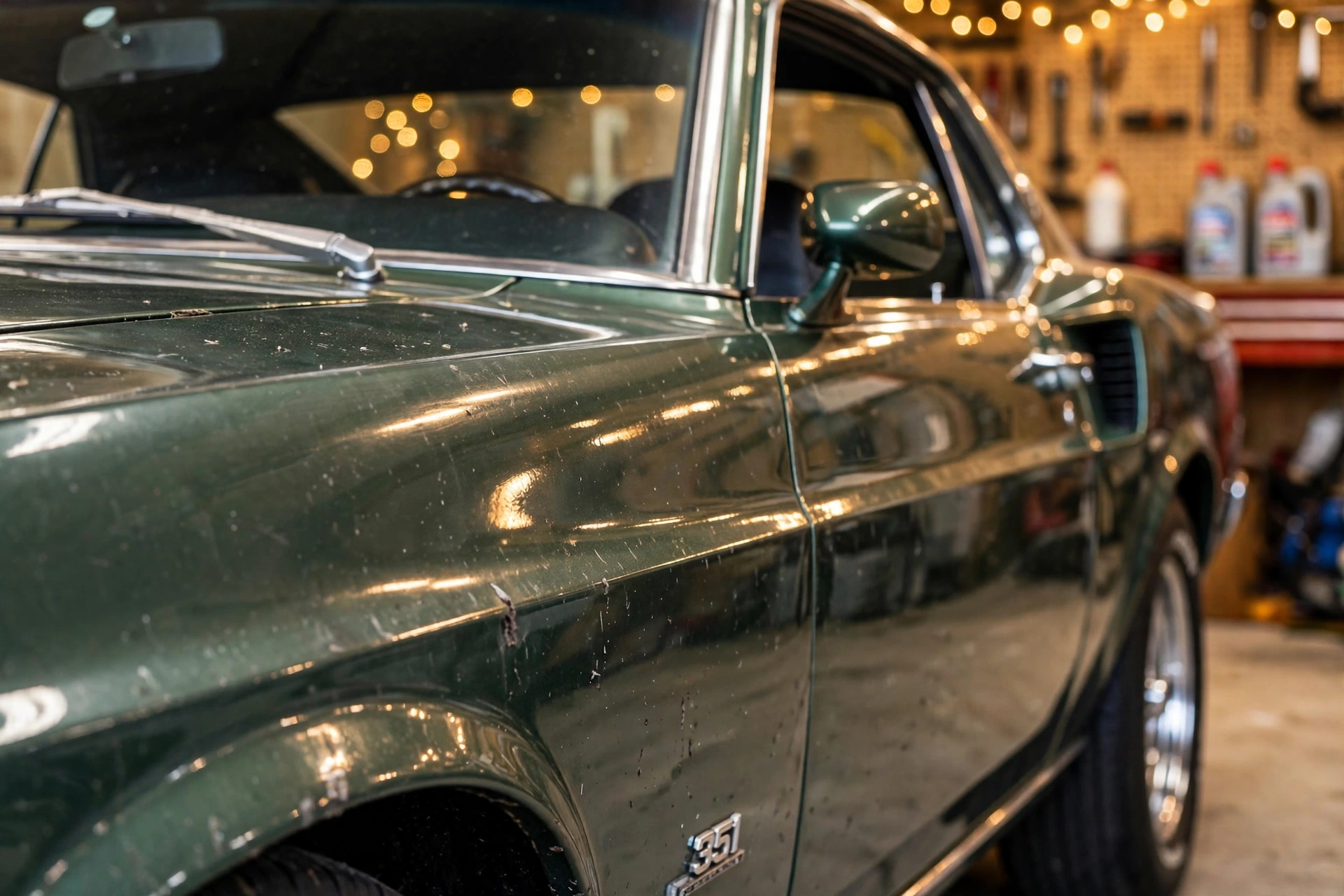
Figure 2: A 1969 fastback carries its identity in eleven characters. Illustration: AI-generated image, not a photograph of a specific car.
Where to Find Your VIN and Data Plate
The VIN sits in more than one place on a classic Ford. Check them all, and make sure they agree before you trust the number.
The door data plate, also called the patent plate, sits on the driver door or the door pillar. It carries the VIN and a set of extra codes for the body, paint, trim, build date, district, axle, and transmission.
The VIN is also stamped on the frame, and on many cars a plate sits on the dash near the windshield. The manual for your year names the exact spots, and the 1975 to 1976 Ford Car Shop Manual lists the locations for those years.
Read the door data plate as well as the VIN. The VIN gives you year, plant, body, engine, and serial number, while the data plate adds the paint color, the trim, the build date, and the axle and transmission codes.
If the door plate and the frame stamp disagree, stop and investigate. A replaced door can carry another car’s plate, and the frame stamp is the harder number to fake.
Trucks and 1950s Cars Use Different Layouts
The five-field layout in this guide covers Ford cars from about 1960 through 1980. Trucks and earlier cars follow different rules, and a car chart will misread them.
Ford trucks from 1953 to 1959 used an 11-character layout that reads series, engine, year, plant, and serial number. The field order is different, so the same positions mean different things.
Ford trucks from 1962 to 1963 used an 11-character layout with no year in the number at all. It reads series, engine, plant, and unit number, and the year must come from other records.
Ford cars from 1950 to 1959 used 10-character layouts. The 1950 to 1951 layout reads engine letter, year figure, two-letter plant, and serial number, while the 1953 to 1959 layout reads engine, year, plant, body style, and unit number.
Older trucks need a truck-specific chart, and 1950s cars need a 1950s chart. Do not force a 1960s car layout onto them, because the positions will not match.
What the 11-Digit VIN Cannot Tell You
An 11 digit VIN is a short code, and it leaves much out. It names the year, plant, body, engine, and serial number, and it stops there.
It does not name the paint color, the interior trim, the axle ratio, the transmission, or the options. Those live on the door data plate, not in the VIN.
It has no check digit. The 17-character VIN that replaced it carries a check digit at position 9, calculated from the other characters, which catches typos and fakes. An 11 digit VIN has no such guard, so a single wrong character can pass unnoticed.
It also cannot confirm the car in front of you matches the number. A re-stamped plate or a swapped door can carry a real VIN from another car, so match the number against the frame stamp and the title.
For a full production record, Marti Auto Works sells per-VIN reports for classic Fords. A Marti Report gives the factory build details behind the VIN, including options and production figures.
From 11 Digits to 17: The 1981 Change
The 17-character VIN became the federal standard for the 1981 model year under Federal Motor Vehicle Safety Standard 115. Every car built for 1981 and later carries one.
The 17 digit format adds a manufacturer code at the start, a vehicle descriptor in the middle, and a check digit at position 9. It also splits the car into a descriptor section and a vehicle identifier section with the model year and plant inside.
That change is why online decoders only read 17 digit VINs. They cannot read an 11 digit classic VIN, because the fields do not line up.
If your Ford was built for 1981 or later, use a 17 digit decoder. Our companion guide to the Ford VIN decoder specification chart by year covers that format, and our guide to finding a Ford engine code by VIN shows how to confirm the installed engine on a modern Ford.
FAQ: 5 Questions About the 11 Digit Ford VIN Answered
How many digits does a classic Ford VIN have?
Eleven characters, on Ford cars from the early 1960s through the 1980 model year. Ford cars from 1950 to 1959 used 10-character numbers, and all cars from the 1981 model year use 17 characters.
Can I decode an 11 digit Ford VIN online?
Most online decoders only accept 17 digit VINs, so they will reject an 11 digit number. Decode it by hand with the chart in this guide, or use a classic Ford decoder that lists the pre-1981 format.
What does the first digit of a classic Ford VIN mean?
It is the last digit of the model year. A 9 means a model year ending in 9, usually 1969 for this format, and the body and engine codes fix the decade.
What does the fifth character of a classic Ford VIN mean?
It is the engine code. Its meaning changes by year, so read the year digit first and then look the letter up in that year’s chart. The letter R meant a 428 Cobra Jet in 1968 and a Boss 351 in 1971.
Where is the VIN on a classic Ford?
Check the door data plate on the driver door or door pillar, the dash plate, and the frame stamp. The door data plate also carries paint, trim, build date, axle, and transmission codes that the VIN does not hold.
Bottom Line
An 11 digit Ford VIN reads in five fields: year, plant, body, engine, and serial number. Learn the field order, and you can read any classic Ford car VIN by hand.
Read the year first, then the engine. Engine letters changed meaning by year, and a chart without the year will mislead you on the cars that matter most.
Use the door data plate for the rest of the story. It holds the paint, trim, build date, axle, and transmission codes that the VIN never carried.
Sources
Sources are named in plain text: the Check Your Spec Ford VIN decoder guide, the CarCheckerVin classic car VIN decoder, the Big Block Magazine classic Ford VIN decoder, and the Outlaw8 old Ford VIN decoder.
The companion FordMasterX guides include the Ford VIN decoder specification chart by year for 17 digit VINs, the guide to finding a Ford engine code by VIN, and the Ford VIN decoder guide for keyless entry codes.
External sources linked in this article: Check Your Spec Ford VIN decoder, CarCheckerVin classic car VIN decoder, Big Block Magazine Ford VIN decoder, and Outlaw8 old Ford VIN decoder.