
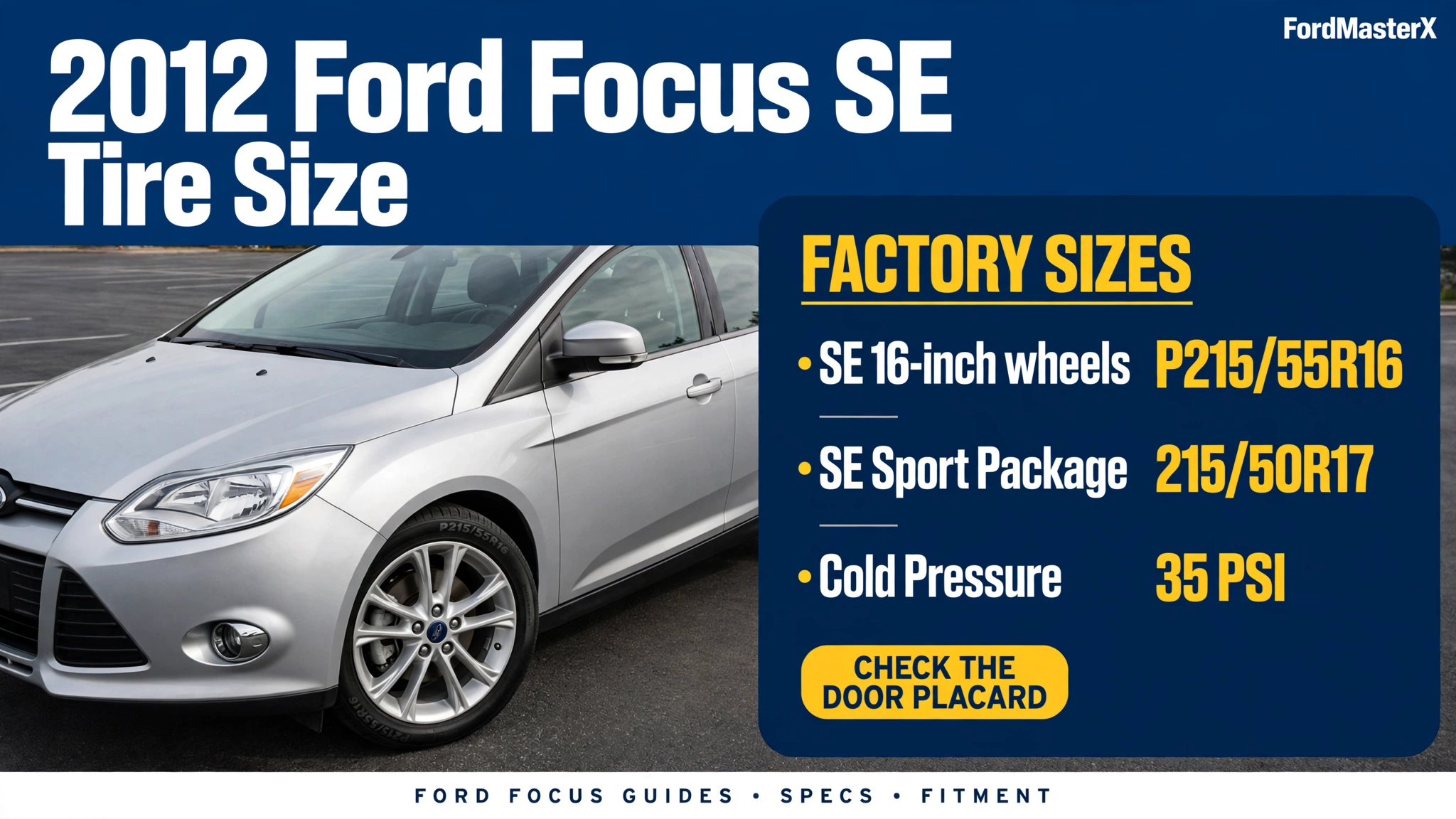
2012 Ford Focus SE Tire Size 2026 Complete Proven Guide

The factory tire size for a 2012 Ford Focus SE on 16-inch wheels is P215/55R16, inflated to 35 psi front and rear. That size fits the standard SE on 16-inch alloys and the SE with the SFE package on 16-inch steel wheels.
If your SE has the Sport Package with 17-inch wheels, your factory size is 215/50R17 instead. Check the placard on your driver-side door jamb before you order tires, because the wheel package decides the size.
The CarBuzz specification page for the 2012 Ford Focus SE Sedan lists P215/55R16 for both the front and rear tires. That matches the placard data for the SE trim, so the standard answer is settled by two independent sources.
This guide covers the factory size for every 2012 Focus trim, how to read the size code, which alternate sizes stay safe, the correct pressure and TPMS reset, and winter tire choices.
2012 Ford Focus SE Tire Size at a Glance
The table below gives the short version. The infographic after it holds the same facts to save or share.
| Your 2012 Focus SE | Factory tire size | Cold pressure |
|---|---|---|
| SE on 16-inch wheels | P215/55R16 | 35 psi |
| SE with SFE package | P215/55R16 | 35 psi |
| SE Sport Package on 17-inch wheels | 215/50R17 | 35 psi |
2012 Ford Focus SE Tire Size at a Glance
Factory fitment for the SE, by wheel package
| Trim | Factory Tire Size | Wheel |
|---|---|---|
| S | 195/65R15 | 15 in steel |
| SE | P215/55R16 | 16 in alloy |
| SE SFE package | 215/55R16 | 16 in steel |
| SE Sport Package | 215/50R17 | 17 in alloy |
| SEL and Titanium | 215/50R17 | 17 in alloy |
| Titanium Handling package | 235/40R18 | 18 in alloy |
| Electric | P225/50R17 | 17 in alloy |
Direct answer: The 2012 Ford Focus SE takes P215/55R16 tires at 35 psi on 16-inch wheels. The SE Sport Package on 17-inch wheels takes 215/50R17 instead. Always confirm your exact size on the driver-side door-jamb placard before ordering tires.
Sources: TirePressure.org 2012 Ford Focus pressure data; CarBuzz 2012 Focus SE specifications; Continental Focus tire guide. Sizes are factory fitments and vary by trim and wheel package.
One size does not cover every 2012 Focus. The S, SEL, Titanium, and Electric trims all use different wheels, so the next section lists each one.
2012 Ford Focus Tire Sizes by Trim and Package
Every 2012 Focus trim shipped with a different wheel and tire combination. The table below lists the factory fitment and cold pressure for each one.
| Trim | Factory Tire Size | Wheel | Cold Pressure |
|---|---|---|---|
| S | 195/65R15 | 15-inch steel | 35 psi |
| SE | P215/55R16 | 16-inch alloy | 35 psi |
| SE SFE package | 215/55R16 | 16-inch steel | 35 psi |
| SE Sport Package | 215/50R17 | 17-inch alloy | 35 psi |
| SEL | 215/50R17 | 17-inch alloy | 35 psi |
| Titanium | 215/50R17 | 17-inch alloy | 35 psi |
| Titanium Handling package | 235/40R18 | 18-inch alloy | 39 psi |
| Electric | P225/50R17 | 17-inch alloy | 38 psi |
TirePressure.org lists the 2012 Focus pressure and size data by trim, and it confirms 35 psi for the SE in both the 215/55R16 and 215/50R17 fitments. The same table lists the SE with the SFE package at 215/55R16 and the SE with the Sport Package at 215/50R17.
The SFE package deserves a note because it confuses buyers. SFE stands for Super Fuel Economy, and it used 16-inch steel wheels with aero covers and low-rolling-resistance tires. The tire size stayed P215/55R16, so an SFE car takes the same tires as a standard SE.
The Sport Package is the one that changes the size. It added 16-inch alloy wheels as standard, with optional 17-inch machined alloy wheels. A road test of a 2012 Focus SE with the Sport Package and the 17-inch wheel upgrade recorded P215/50R17 91H tires fitted to the car.
That test car is why some guides list 215/50R17 as an SE size. Both sizes are genuine factory fitments, and the wheel on your car decides which one is yours. Your door-jamb placard shows the size fitted to your exact car.
Wheel fitment matters as much as tire size when you change wheels. The 2012 Focus uses a 5×108 mm bolt pattern with a 63.4 mm center bore and a factory offset near ET50. Our Ford bolt pattern chart lists the pattern and bore details for aftermarket wheels.
Our guide to the 2014 Ford Focus tire size covers the same P215/55R16 size on the later model year. The 2012 SE and the 2014 SE share the standard size, but the 2012 Sport Package story and the 2012 owner-manual details in this article are specific to the 2012 car.
How to Check Your Door Jamb Placard
The placard is the final authority for your car. It is a white label on the driver-side door jamb, on the B-pillar or the edge of the driver door, and it lists the original equipment tire size and the recommended cold inflation pressure for your exact car.
Open the driver door and look at the frame where the door latches. The label sits there in plain view, and it also lists the seating capacity and the maximum weight the car can carry.
Read three lines on the label. The tire line gives the factory size, such as 215/55R16. The pressure line gives the cold pressure, such as 240 kPa or 35 psi cold.
The rim line gives the wheel size, such as 16×7.0J. Those three lines tell you everything you need before you order tires.
Photograph the placard before you shop. A photo lets you compare the label with the sidewall of the tires already on the car, and it settles any argument with a tire shop about which size your car takes.
The 2012 Focus owner guide puts it the same way. It says the recommended inflation pressure is found on the Safety Compliance Certification Label or the Tire Label located on the B-pillar or the edge of the driver door, and it warns never to set pressure lower than the value on that label.
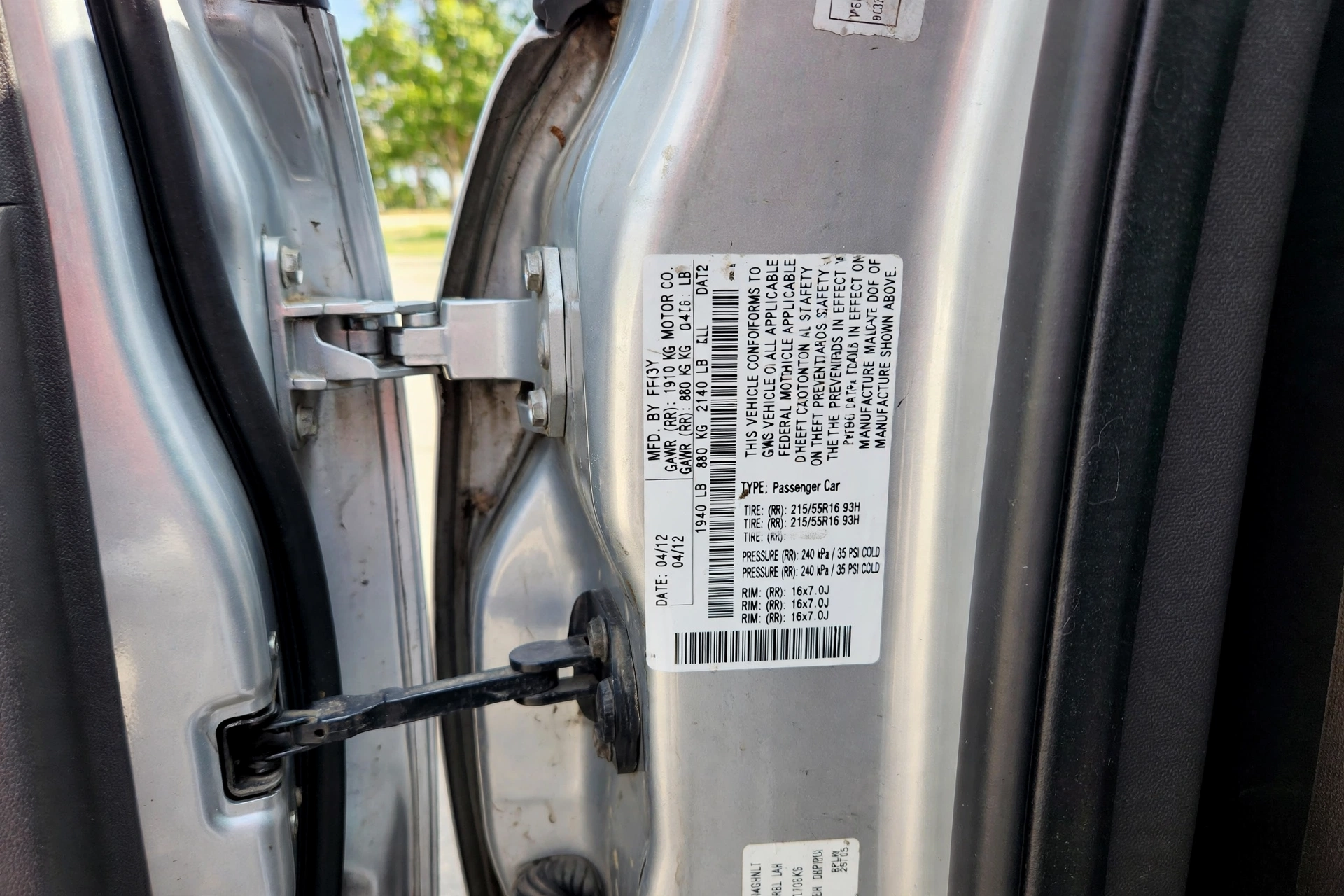
AI-generated illustration: a driver-side door jamb tire placard on a 2012 Ford Focus SE showing 215/55R16 tires at 35 psi cold.
If the placard and the tires on the car disagree, a previous owner changed the size. Trust the placard for the factory size, then check the alternate-size section before you decide whether the size on the car is safe to keep.
If the placard is missing or unreadable, the owner manual lists the same information, and a Ford dealer can pull the factory build data from your VIN. Do not guess from the model year alone, because the 2012 Focus shipped with five different tire sizes.
What Your Tire Size Code Means in Plain English
The code P215/55R16 is a full specification, not a part number. Each piece describes one dimension, and once you can read it, you can check any replacement tire in seconds.
The letter P means a P-metric passenger-car tire, built for cars and light crossovers, not for trucks or trailers. The number 215 is the section width in millimeters, across the widest part of the tire.
The number 55 is the aspect ratio. The sidewall height is 55 percent of the section width, so on this tire the sidewall stands 118.25 mm tall, about 4.66 inches.
The letter R means radial construction, standard on every modern passenger tire. The number 16 is the rim diameter in inches, so this tire only fits a 16-inch wheel.
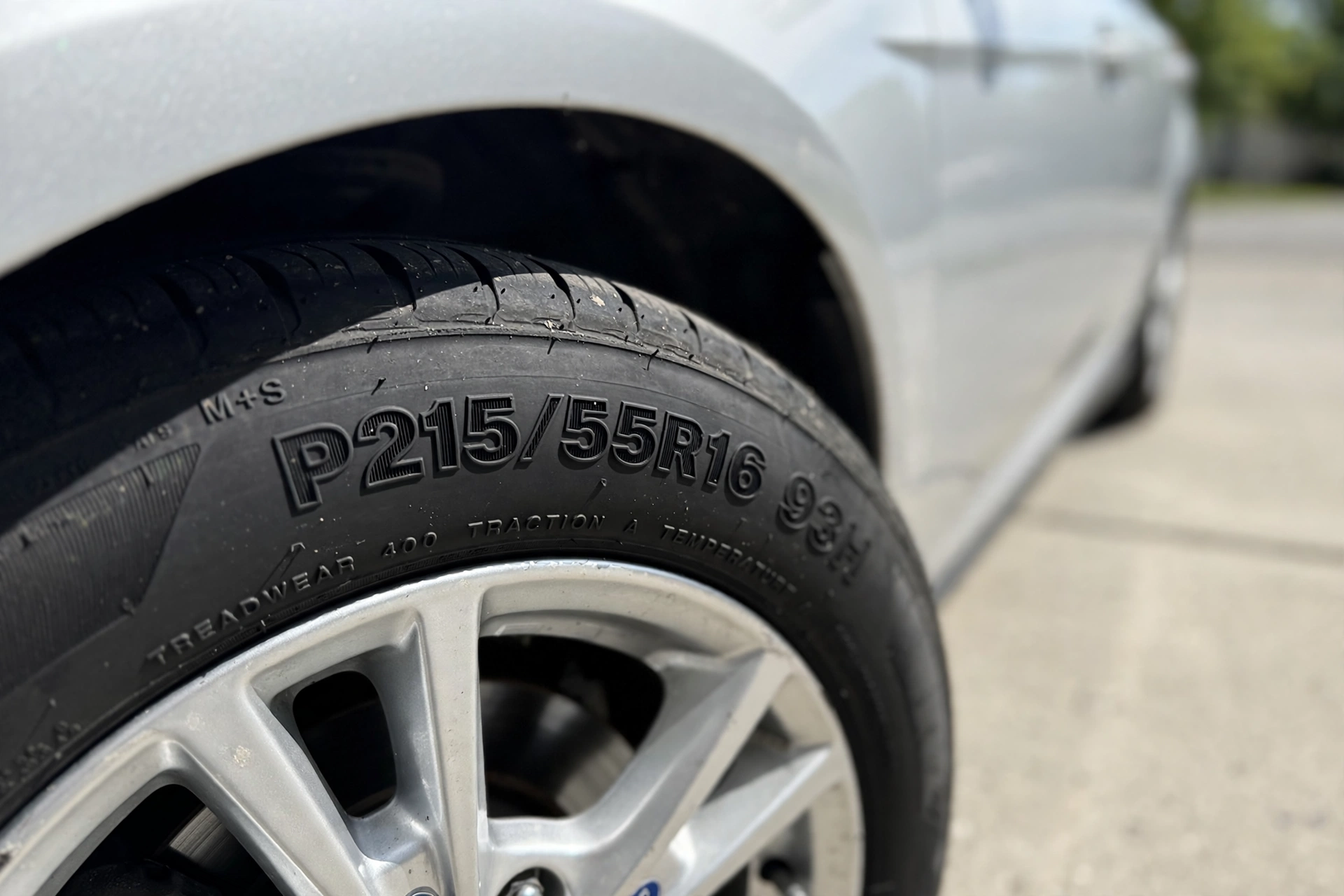
AI-generated illustration: a close-up of a 2012 Ford Focus SE tire sidewall showing the P215/55R16 93H size marking.
Those four numbers also fix the overall diameter. Double the sidewall height and add the rim diameter: 2 times 118.25 mm plus 16 times 25.4 mm gives 642.9 mm, or 25.3 inches. The tire rolls about 2,020 mm per revolution, or roughly 797 revolutions per mile.
That diameter matters most when you consider a different size. Your speedometer, odometer, ABS, and stability control all assume a tire close to 25.3 inches tall, so any change should stay close to that number.
Continental lists 215/55R16 among the common Ford Focus sizes for 2012 to 2018 cars, alongside 215/50R17 and 235/40R18 for higher trims. The size code on your current tires should match the placard, and the placard should match the table in this article.
5 Approved Alternate Sizes Within 3 Percent
You do not have to buy P215/55R16 again. Any alternate size works if its overall diameter stays within about 3 percent of the factory 642.9 mm, which keeps your speedometer, ABS, and stability control calibrated.
| Alternate Size | Overall Diameter | Difference vs Stock | Verdict |
|---|---|---|---|
| 215/50R17 | 646.8 mm / 25.46 in | +0.6% | Factory Sport Package size |
| 205/60R16 | 652.4 mm / 25.69 in | +1.5% | Acceptable |
| 205/55R16 | 631.9 mm / 24.88 in | -1.7% | Acceptable |
| 225/50R16 | 631.4 mm / 24.86 in | -1.8% | Check clearance |
| 195/65R15 | 634.5 mm / 24.98 in | -1.3% | Needs 15-inch wheels |
Each percentage is calculated from the stock 642.9 mm diameter. The 215/50R17 is the easiest swap because Ford fitted it to the SE Sport Package from the factory, so it needs 17-inch wheels but nothing else.
Two popular sizes do not make the list. The 215/60R16 is 3.3 percent taller than stock and sits outside the guideline. The 235/40R18 is only 0.4 percent taller, but it needs 18-inch wheels and a higher load and speed rating.
The 205/55R16 saves a little money and fuel, but it gives up ride comfort and load margin. The 225/50R16 adds dry-road grip, but it also adds rolling resistance and can rub the inner fender liner at full steering lock.
Stay with P215/55R16 unless you have a clear reason to change. A wider tire is not automatically better, and the factory size is the one Ford calibrated the car around.
Ford publishes tire size charts across its lineup. Our Ford F-250 tire size chart shows the same diameter-matching logic on trucks: match the rolling diameter first, then the load index and speed rating. Our 2003 Ford F-150 tire size guide applies the same rule to an older truck.
Load Index 93 and Speed Rating H Explained
The size code is only half the story. The service description after the size, usually 93H, sets the tire load and speed limits, and both must meet or beat what Ford specified for your Focus.
Load index 93 means each tire can carry 1,433 lb (650 kg), which covers passengers, cargo, and the extra load of hard braking and cornering. Speed rating H means the tire is rated for sustained speeds up to 130 mph.
Your Focus will never reach that speed, but the rating also reflects how the tire handles heat at highway speeds. A lower rating can overheat on a long summer drive even at legal speeds.
Never fit a tire with a lower load index or speed rating than the placard calls for. A 91H tire looks identical from the outside, but it carries less load and leaves no safety margin.
That 91H detail matters on the Sport Package car. The road test of a 2012 SE with the Sport Package and 17-inch wheels recorded P215/50R17 91H tires, so the 17-inch fitment carries a 91 load index, or 1,356 lb per tire. Match the rating on your own placard, not the rating on another trim.
A V rating (149 mph) is fine as a step up, but a T rating (118 mph) or a lower load index is not. Check the service description on the sidewall before you pay: it sits right after the size code and reads like 93H or 93V.
Correct Tire Pressure and TPMS Reset for 2012 Focus SE
Ford specifies 35 psi cold for the P215/55R16 fitment, front and rear. Cold means the car has sat for at least three hours or has been driven less than a mile, and pressure rises as tires warm up, so a highway reading looks higher than the true cold pressure.
Check pressures at least once a month and before any long trip. Temperature moves pressure by about 1 psi for every 10 degrees Fahrenheit, so a tire set in September can read 4 to 5 psi low in January.
Some generic pressure guides list 30 to 33 psi for the Focus line as a whole. Those guides mix trims and model years into one range, and the SE-specific placard data is 35 psi. When a generic guide and your placard disagree, the placard wins, because it describes your exact car.
Your Focus uses a direct TPMS, with a sensor in each wheel that measures pressure and sends the reading to the car by radio. The warning light comes on when pressure falls roughly 25 percent below the placard value, as federal standard FMVSS 138 requires.
If the light comes on, inflate all four tires to 35 psi cold and drive above 20 mph for a few minutes. The light should go out on its own. A flashing light means a sensor fault, not low pressure, and usually points to a dead sensor battery.
After a tire rotation or a sensor replacement, the car may need a sensor relearn. The ATEQ TPMS diagnostic guide for the Ford Focus sets out the manual relearn for the standard ignition car, and it runs on the 315 MHz sensors fitted to the 2007 to 2019 Focus.
- Inflate all four tires to the placard pressure. Set the parking brake and switch the ignition fully off before you start.
- Press and release the brake pedal. Then switch the ignition from off to run three times, with the engine off, and stop in the run position.
- Press and release the brake pedal again. Then switch the ignition off and back from off to run three times, stopping in the run position. All of these steps must happen within 10 seconds.
- Listen for one horn chirp. The chirp means relearn mode is active, and the car is ready to learn the sensors.
- Activate each sensor in order. Use a TPMS activation tool at the left front, right front, right rear, and left rear wheels. One horn chirp at each wheel confirms that sensor was learned.
- Drive to finish. Drive for at least 5 minutes at 28 mph or faster so the system confirms the new sensor readings.
Most owners do not own a TPMS activation tool, so a tire shop can run the relearn in a few minutes after a rotation or a sensor swap. Ask the shop to confirm the horn chirp at each wheel, because a sensor that was not learned will keep the light on.
TPMS sensor batteries last about 5 to 10 years, or up to roughly 100,000 miles. The battery cannot be replaced on its own, so a dead sensor means a new sensor and valve stem. On a 2012 car, a flashing light after a tire change usually means a sensor.
Our guide to how to check your Ford warranty shows how to confirm cover by VIN before you pay. A TPMS fault on a newer Ford may still be covered, and the check takes minutes.
What Happens When You Fit the Wrong Tire Size
A tire that is too tall or too short changes more than the look of the car. The speedometer reads from wheel speed, so a taller tire makes it read slow: with a 215/60R16, 3.3 percent taller than stock, 60 mph indicated is really about 62 mph.
With a 205/55R16, 1.7 percent shorter, an indicated 60 mph is really about 59 mph. The odometer makes the same error, so fuel economy math and service intervals skew with it.
ABS and stability control assume the factory tire diameter. A large change alters the wheel speed the computer expects, and traction control can intervene early or late. A difference under 3 percent stays inside the tolerance Ford designed for.
Ride and handling change too. A taller sidewall softens the ride but dulls steering response, while a shorter sidewall sharpens steering but transmits more road shock. Wider tires add rolling resistance and cost fuel.
Mismatched sizes across axles cause a worse problem. The car reads different wheel speeds front and rear, so stability control can fight the driver on dry roads. Always fit the same size on all four corners, and keep the spare matched to the set.
If your Focus has the dual-clutch automatic, wrong tire sizes add another variable to a transmission that already needs correct calibration. Our 2015 Ford Focus transmission control module guide covers that module, and the same care with factory specifications applies to the 2012 car.
Winter Tires and All Season Choices for Your SE
Most SE owners run one set of all-season tires in P215/55R16 all year. That is the simplest choice, and modern all-season tires handle rain and light snow well, but they are a compromise, and it shows in winter.
A dedicated winter tire in the same P215/55R16 size is the best cold-weather setup. Winter rubber stays flexible below about 45 degrees Fahrenheit, while all-season rubber stiffens and loses grip. The braking difference on snow and ice matters in an emergency.
The simplest winter setup is a second set of 16-inch steel wheels with winter tires mounted. Swap the whole wheel set in November and back in March, and run the TPMS relearn after each swap so the light stays off.
Winter pressure needs a small adjustment. The pressure guide for the 2012 SE lists an acceptable winter pressure of 38 to 40 psi, which makes up for the pressure tires lose as temperatures fall. Set the pressure cold, and recheck it after the first cold snap.
The 2012 owner guide also sets a firm rule for snow chains. It says to use SAE Class S chains with 195/65R15 or 215/55R16 tires only, and never to use tire chains with any other size. That rule is one more reason to keep the factory size if you drive where chains are required.
Budget roughly 70 to 180 dollars per tire for a reliable all-season model in this size, based on observed 2024 fitment-guide pricing. Winter tires cost about the same, plus wheels for a second set.
Check the tread depth and the DOT date code on any tire you buy. Tires older than six years deserve a close inspection, and tire makers generally advise replacement at ten years from manufacture regardless of tread.
If you are still deciding whether a 2012 Focus is worth owning at all, our guide to whether the Ford Focus is a good car covers reliability across the model years.
How to Check Your Own Focus Before You Buy
Five minutes of checking before you order tires can save a return trip to the shop. Start with the placard on the driver-side door jamb, which lists the factory size and cold pressure for your exact car.
Photograph the placard, then read the sidewall of the tires already on the car. The size code is molded into the rubber near the rim, so compare it with the placard: if the two disagree, a previous owner changed the size.
Check the spare tire too. A missing or flat spare is easy to miss until you need it, and the spare should match the size and pressure the placard calls for.
Measure tread depth with a gauge or a coin. A tire at 2/32 inch is legally worn out in most states, and wet grip falls off well before that point. Uneven wear points to alignment or inflation problems rather than normal aging.
Look at the wheels while you are there. Curb rash, cracks, or a bent rim can cause slow leaks that no new tire will fix, and a damaged wheel should be repaired or replaced before the new tires go on.
Our guide to what year Ford Focus to avoid covers the same kind of year by year check for a used Ford buyer. A 2012 Focus with a clean tire history and the correct factory size deserves the same careful look as any other used car.
2012 Ford Focus SE Tire Size Questions Answered
What Tire Size Does a 2012 Ford Focus SE Take
P215/55R16 on 16-inch wheels, at 35 psi front and rear. The SE with the Sport Package on 17-inch wheels takes 215/50R17 instead, so check your door-jamb placard.
Can I Use 215/50R17 Instead of 215/55R16
Yes, if you also fit 17-inch wheels. The 215/50R17 is only 0.6 percent taller than stock, so your speedometer stays accurate. It is the factory Sport Package size.
What Tire Pressure Should a 2012 Ford Focus SE Use
Ford specifies 35 psi cold, front and rear, for both the P215/55R16 and 215/50R17 fitments. Measure pressure when the tires are cold and recheck monthly, because temperature changes pressure by about 1 psi per 10 degrees Fahrenheit.
How Do I Reset the TPMS Light on a 2012 Focus
Inflate all four tires to 35 psi cold, then drive above 20 mph for a few minutes. The light should go out on its own. After a rotation or sensor replacement, use the manual relearn procedure with a TPMS activation tool.
What Is the Bolt Pattern on a 2012 Ford Focus
The bolt pattern is 5×108 mm with a 63.4 mm center bore and a factory offset near ET50. Any replacement wheel must match the pattern and bore, and wheels outside ET48 to ET52 can cause rubbing or handling problems.
Can I Put 215/60R16 Tires on My Focus
We do not recommend it. The 215/60R16 is 3.3 percent taller than stock, outside the 3 percent guideline. Your speedometer would read about 2 mph slow at 60 mph, and the taller tire risks rubbing.
Can I Use Snow Chains on a 2012 Ford Focus SE
Yes, but only with SAE Class S chains on 195/65R15 or 215/55R16 tires. The 2012 owner guide says never to use tire chains with any other size, so the 17-inch and 18-inch fitments cannot take chains.
The Right Tire Size Keeps Your Focus Safe
The 2012 Ford Focus SE takes P215/55R16 tires on its standard 16-inch wheels, at 35 psi front and rear. That answers most of the question, but the wheel package decides the rest, because the Sport Package car takes 215/50R17 on 17-inch wheels.
Confirm your trim and package on the door-jamb placard before you order. Match the 93H load and speed rating, and keep any alternate size within 3 percent of the factory diameter. Then your speedometer, TPMS, and stability control keep working the way Ford calibrated them.
When the tires are right, the car rides, steers, and stops the way it was designed to. Spend five minutes checking the placard, and the next set of tires you buy will fit the first time.