2003 Ford F150 Tire Size Guide: Trims, Rims & Torque Specs

The 2003 Ford F-150 features several original equipment tire sizes ranging from P235/70R16 on base trims to P295/45R18 on the SVT Lightning. Most models utilize a 5x135mm bolt pattern, and it is critical to verify the specific fitment via the driver-side door jamb placard before purchasing replacements.
🎯 Key Takeaways
Recommended Best Deal Products


- Base XL models typically use P235/70R16 or P255/70R16 tires.
- 4WD trims frequently upgrade to larger P265/70R17 sizes for clearance.
- The SVT Lightning requires specialized P295/45ZR18 high-performance tires.
- All 2003 F-150 models feature a 5x135mm wheel bolt pattern.
- Correct lug nut torque for these wheels is 150 lb-ft.
The 2003 Ford F-150 utilizes several different tire sizes ranging from 235/70R16 for base models to 295/45R18 for high-performance variants. Identifying your specific trim and drivetrain is the first step because Ford tuned these suspensions specifically for the rolling diameter of the factory-installed rubber. Installing the wrong size can lead to speedometer errors and poor transmission shift timing.

Prime for Young Adults — 6 Months Free
Students and 18–24s get six months of Prime free, then half price.
Start 6 Months Free As an Amazon Associate I earn from qualifying purchases.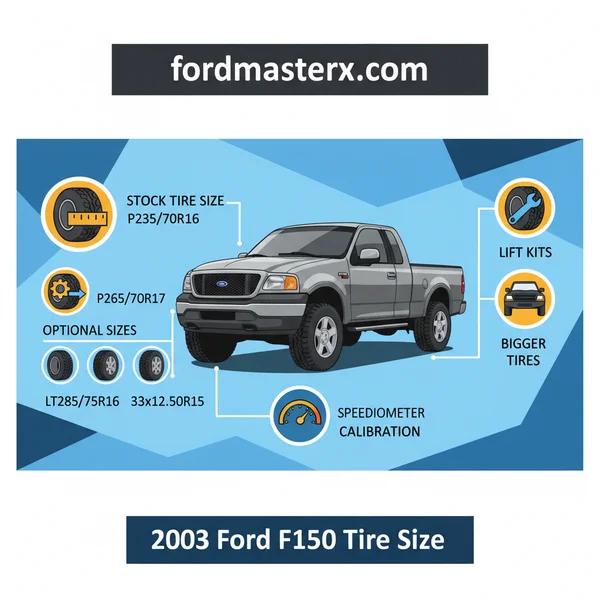
Accuracy matters for safety and performance. When you select the correct tire size, you maintain the intended load-carrying capacity and braking efficiency of your truck. This guide provides the exact measurements you need to shop for tires with confidence, ensuring your 2003 F-150 remains reliable on the road or the job site.
2003 Ford F150 Tire Size Chart by Trim Level
Your 2003 Ford F-150 tire size is determined by the trim package and whether the truck is a standard work model or a specialty edition. Ford offered a wide variety of wheel diameters this year, ranging from 16-inch steel wheels to 20-inch alloy wheels. Below is the comprehensive breakdown of the Original Equipment (OE) fitments for every major trim level.

Standard and Specialty Trim Fitment Table
- XL (4×2): P235/70R16
- XL (4×4): P255/70R16
- XLT (4×2): P235/70R16 or P255/70R16
- XLT (4×4): P265/70R17
- Lariat (4×2): P255/70R16
- Lariat (4×4): P265/70R17
- King Ranch (4×2): P255/70R16
- King Ranch (4×4): P265/70R17
- Heritage Edition: P255/70R16
- Harley-Davidson Edition: P285/45R20
- SVT Lightning: P295/45ZR18
- 75th Anniversary Edition: P255/70R16
If you are looking for an optional fitment for a 4×4 model, many owners successfully move to a 285/70R17. This size is slightly taller and wider than the stock Lariat or XLT 4×4 tires. However, for the 4×2 models, sticking to the P235 or P255 width is recommended to avoid rubbing against the front wheel wells during tight turns. Always check your tire placard located on the driver-side door jamb to verify the exact size your specific VIN was built with.
Everything You Need to Know About 2003 Ford F150 Tire Sizes
Recommended Best Deal Products


Choosing the correct tire size for your 2003 Ford F150 is critical for maintaining vehicle safety, ensuring speedometer accuracy, and optimizing fuel efficiency. This truck was manufactured with several trim levels, from the workhorse XL to the performance-oriented Lightning and luxury King Ranch, each requiring specific tire dimensions. This guide will walk you through the precise process of identifying your factory specifications, understanding the tire sidewall codes, and selecting the best rubber for your specific driving needs.
Step 1: Locate Your Vehicle’s Tire and Loading Information Label
What you need: Access to the driver’s side door area and a flashlight if lighting is poor.
Instructions: Open the driver’s side door and look at the “B-pillar”—this is the vertical metal post where the door latches. You will find a white or yellow “Tire and Loading Information” sticker. This placard is the ultimate authority for your specific 2003 F150. It lists the original equipment (OE) tire size, the recommended cold tire pressure (PSI), and the maximum load capacity for your truck as it left the factory. Do not rely solely on the tires currently mounted on the truck, as a previous owner might have installed the wrong size, which can lead to handling issues or mechanical strain.
Pro Tip: If the sticker is missing or unreadable due to age, you can find the same information in the “Capacities and Specifications” section of your 10th-generation F150 owner’s manual.
Step 2: Decode the Tire Size Metric String
What you need: The string of numbers found in Step 1 or on your current tire sidewall (e.g., P255/70R16).
Instructions: Understanding these numbers is vital. In the example P255/70R16, “P” stands for Passenger (or “LT” for Light Truck). “255” is the section width in millimeters from sidewall to sidewall. “70” is the aspect ratio, meaning the sidewall height is 70% of the width. “R” indicates Radial construction, and “16” is the wheel diameter in inches. For the 2003 F150, the most common rim sizes are 16-inch and 17-inch, though the Lightning and Harley-Davidson editions use larger wheels. Ensure your replacement tires match these exact figures to avoid rubbing against the wheel wells or suspension components.

Audible — Listen Free for 30 Days
One free credit a month and thousands of titles included.
Listen Free for 30 Days As an Amazon Associate I earn from qualifying purchases.Pro Tip: Changing the aspect ratio (the middle number) even slightly can change your speedometer reading by 3-5 mph, leading to potential speeding tickets.
Step 3: Account for Your Trim Level and Drivetrain
What you need: Knowledge of your truck’s specific sub-model (XL, XLT, Lariat, FX4, etc.) and whether it is 2WD or 4WD.
Instructions: The 2003 F150 varies significantly across trims. Most standard 2WD models use 235/70R16 or 255/70R16 tires. However, if you have the 4×4 Off-Road or FX4 package, your truck likely came with 265/70R17 tires. The high-performance SVT Lightning requires a 295/45R18, while the Harley-Davidson edition features a massive 275/45R20. Identifying your trim ensures you don’t accidentally buy a 16-inch tire for a 17-inch rim. Check your fender badges or the VIN if you are unsure of your trim level, as the brake caliper clearance varies between these wheel sizes.
Pro Tip: 4×4 models generally have more vertical clearance, allowing for slightly taller tires than 2WD models without requiring a suspension lift.
Step 4: Verify the Load Index and Speed Rating
What you need: The alphanumeric code following the tire size (e.g., 109S or 111T).
Instructions: For a full-size truck like the 2003 F150, the load index is just as important as the size. The load index (the number) indicates how much weight the tire can support, while the speed rating (the letter) indicates the maximum safe speed. Most 2003 F150s require a load index between 108 and 112. If you use your truck for towing or hauling heavy loads in the bed, look for “LT” (Light Truck) rated tires with a higher ply rating (Load Range C, D, or E). Installing a tire with a lower load index than the manufacturer’s recommendation can result in catastrophic tire failure under heavy weight.
Pro Tip: Never install “Standard Load” (SL) tires if your door placard specifically calls for “Extra Load” (XL) or “LT” tires, especially on SuperCrew models.
Step 5: Inspect Rim Width and Offset for Aftermarket Compatibility
What you need: A measuring tape or the specifications of your current wheels.
Instructions: If your 2003 F150 is no longer using the factory “five-star” or “flat-spoke” wheels, you must ensure the tire width is compatible with the rim width. A 255mm wide tire generally fits best on a 7.0 to 8.5-inch wide rim. If you are trying to “beef up” the look of your truck with wider tires like 285/70R17, you must verify that the rim offset (how far the wheel sits in or out) won’t cause the inner sidewall to hit the upper control arm or the outer tread to rub the bumper valance during sharp turns.
Pro Tip: If you experience rubbing on the plastic front valance with larger tires, many F150 owners perform a “minor trim” of the plastic rather than changing the tire size.
Audible Premium Plus — Annual Membership
12 audiobook credits up front, plus the full Audible catalogue.
See Annual Plans As an Amazon Associate I earn from qualifying purchases.Step 6: Choose the Right Tread Pattern for Your Environment
What you need: An assessment of your typical driving conditions (Highway, Mud, Snow, or Worksite).
Instructions: Once you have the size (e.g., 265/70R17), you must choose the tread category. For 2003 F150 owners who stay on the pavement, a Highway Terrain (H/T) tire offers the quietest ride and best fuel economy. If you frequently visit jobsites or go camping, an All-Terrain (A/T) tire provides better grip on loose surfaces without excessive road noise. Only choose Mud Terrain (M/T) if you spend significant time in deep mud, as these are very loud on the highway and wear out faster on the heavy front end of a Ford truck.
Pro Tip: Look for the “Three-Peak Mountain Snowflake” (3PMSF) symbol if you live in an area with heavy winter snowfall, as standard all-season tires may struggle on ice.
Step 7: Confirm Spare Tire Compatibility
What you need: Access to the spare tire winch under the rear bed of the truck.
Instructions: Many 2003 F150 owners forget that the spare tire must match the diameter of the tires on the axle. If you have upgraded from the stock 255/70R16 to a larger size, your original spare is now useless for anything other than a very short, low-speed emergency trip to a shop. On 4WD models, running mismatched tire diameters on the same axle can damage the differential or the transfer case. Ensure your spare tire is the same overall diameter as your new set, and check the age of the spare; if it’s the original from 2003, the rubber is likely dry-rotted and unsafe to use.
Pro Tip: Lubricate the spare tire hoist mechanism while you are checking the size, as these are notorious for rusting and seizing up on older F150s.
✅ Final Checklist
- Verified the tire size on the driver’s side B-pillar placard against the new tire purchase.
- Matched the rim diameter (16″, 17″, 18″, or 20″) exactly to the tire’s last two digits.
- Ensured the load index meets or exceeds the factory requirement for the truck’s GVWR.
- Confirmed the tread type (A/T, H/T, or M/T) matches the intended driving environment.
- Checked that the spare tire is in good condition and matches the new rolling diameter.
Important Notes:
- Safety Warning: Always torque your lug nuts to 150 lb-ft (for the 2003 F150’s M14 studs) in a star pattern after mounting new tires. Loose wheels are a major hazard.
- When to seek help: If you notice uneven wear on your old tires, get a professional 4-wheel alignment when the new tires are installed to prevent ruining your investment.
- Estimated Time and Cost: Researching and buying tires takes about 1 hour. Professional installation usually takes 1-2 hours. Expect to pay between $600 and $1,200 for a full set of four, depending on the brand and size.
Comparing 2WD (4×2) vs. 4WD (4×4) Wheel Configurations
The drivetrain of your 2003 F-150 significantly impacts the wheel and tire configuration. The 4×4 models sit higher from the factory, allowing for larger 17-inch rims and meatier tire sidewalls. In contrast, 4×2 models generally utilize a 16-inch rim with a tire profile designed for highway fuel efficiency and lower rolling resistance. Mixing these configurations can cause clearance issues, especially on the front suspension of 2WD models.

Wheel Bolt Pattern and Technical Specifications
Regardless of whether you have a 4×2 or a 4×4, the wheel mounting specifications remain consistent across the standard F-150 lineup. However, these specs are unique to this generation of Ford trucks (1997–2003), so you must be precise when purchasing aftermarket rims.
- Bolt Pattern: 5 x 135mm. This is a specific metric pattern used only by Ford for this era.
- Lug Nut Torque: 150 lb-ft (200 Nm). Proper torque is critical to prevent wheel vibration or stud failure.
- Lug Nut Size: M14 x 2.0. This thread pitch is standard for the 2003 model year.
- Center Bore: 87.1 mm. Ensure any aftermarket wheels are hub-centric to this measurement for a smooth ride.
When switching between 4×2 and 4×4 styles, remember that the offset of the wheel might differ. Standard 2WD wheels often have a different “deep dish” look compared to 4×4 wheels due to the hub assembly differences. If you are swapping wheels between two trucks, always perform a test fit on the front hub to ensure the brake caliper has enough clearance. Using the 150 lb-ft torque specification is mandatory every time you remove and reinstall the wheels, as under-torquing can lead to the lug nuts backing off over time.
Keep in mind that specialty models like the SVT Lightning and Harley-Davidson use the same 5x135mm bolt pattern but require specific backspacing to clear their unique suspension components. For these trucks, always stick to the 18-inch or 20-inch rim requirements to maintain the performance handling these models are known for.
Technical Specs: Bolt Pattern, Offset, and Lug Torque
Recommended Best Deal Products


When you are looking to upgrade or replace the wheels on your 2003 Ford F-150, the tire size is only one piece of the puzzle. To ensure a safe and vibration-free ride, you need to match the technical specifications of the wheel hub. The tenth-generation F-150 features a specific geometry that differs significantly from later models, making it essential to double-check your measurements before purchasing new rims.
The Unique 5x135mm Bolt Pattern
One of the most important things to remember about the 2003 F-150 is its bolt pattern. Unlike the 6-lug setup found on newer trucks, the 2003 model uses a 5x135mm pattern. This was a relatively short-lived standard for Ford, used primarily between 1997 and 2004 Heritage models. Because this pattern is less common today, you must be specific when ordering aftermarket wheels to avoid fitment issues.
- Bolt Pattern: 5x135mm (5 lugs with a 135mm diameter circle).
- Wheel Offset: Typically ranges from +12mm to +25mm for stock setups.
- Hub Bore: 87.1mm (Ensure aftermarket wheels are hub-centric or use rings).
Proper Lug Nut Torque for Safety
Safety should always be your top priority when mounting tires. For the 2003 Ford F-150, the recommended lug nut torque is 150 lb-ft (204 Nm). Using a calibrated torque wrench is vital; over-tightening can stretch the studs or warp your brake rotors, while under-tightening can lead to the wheel loosening while driving. If you’ve just installed new aluminum wheels, it is a smart practice to re-torque the lugs after the first 50 to 100 miles of driving as the metal seats into place.
Locating and Reading the Vehicle Tire Specification Placard
While online guides are helpful, the most accurate information for your specific truck is actually physically attached to the vehicle. Ford provides a Tire and Loading Information placard that acts as the “source of truth” for your F-150’s original equipment. This sticker is essential if you want to maintain the factory-intended handling characteristics and load-carrying capacity.
Where to Find Your F-150’s Sticker
You don’t need to crawl under the truck to find this information. Open the driver’s side door and look at the door jamb (B-pillar). You will see a white or yellow-and-white sticker located near the door latch area. If it isn’t there, check the edge of the door itself. This placard is specifically printed for your VIN, meaning it accounts for the exact trim level and options your truck had when it left the factory.
Decoding the Placard Information
The placard provides more than just the tire size; it offers a roadmap for vehicle maintenance. Understanding these numbers ensures you aren’t accidentally overloading your tires or running them at a dangerous pressure level.
- Recommended Cold Tire Pressure: This is the PSI you should use for daily driving. Note that this is often lower than the “Max PSI” listed on the tire sidewall.
- Original Tire Size: Usually listed as something like P255/70R16 or P275/60R17.
- Gross Vehicle Weight Rating (GVWR): This helps you understand how much total weight your truck and tires can safely support, including passengers and cargo.
Pro Tip: Always check your tire pressure when the tires are “cold”—meaning the truck has been parked for at least three hours or driven less than a mile. Driving heats up the air inside, which can give you a false high-pressure reading.
Conclusion
Finding the right tire size for your 2003 Ford F-150 is the best way to preserve its legendary “Built Ford Tough” performance. Whether you are sticking with the factory-standard 16-inch rims or stepping up to the 17-inch FX4 style, knowing your specs is key. Remember to always verify your bolt pattern is 5x135mm and keep those lug nuts torqued to 150 lb-ft for maximum safety on the road.
Your next step should be to check the door jamb sticker on your own truck and compare it to your current tires. If they don’t match or the tread is looking thin, it might be time for a fresh set. Proper tires don’t just improve the look of your truck; they ensure your F-150 stays reliable for years to come!
❓ Frequently Asked Questions
How do tire sizes vary between 2WD and 4WD 2003 F150s?
2WD models often use P235/70R16 or P255/70R16 tires for fuel efficiency and street handling. 4WD models are generally equipped with larger P265/70R17 tires to provide better ground clearance and off-road capability.
Where can I find the official tire size for my specific 2003 F150?
The most accurate source is the Tire and Loading Information placard. This is a white and yellow sticker located on the driver-side door jamb or the edge of the door itself.
What are the tire specs for the 2003 Ford F150 SVT Lightning?
The high-performance SVT Lightning trim uses a specific P295/45ZR18 tire size. These are wider, lower-profile tires designed for high-speed stability and enhanced grip compared to standard truck tires.
Will wheels from a 2004 F150 fit my 2003 model?
No, 2004 was a transition year. The ‘New Body Style’ 2004 F150 moved to a 6x135mm bolt pattern, whereas the 2003 model uses a 5x135mm pattern, making the wheels incompatible without adapters.
Does the 2003 F150 Heritage Edition have different tire sizes?
The Heritage Edition is essentially the same as the standard 2003 model and follows the same size conventions (16-inch or 17-inch wheels) based on whether it is an XL or XLT trim.
What are the rim diameter options for the 2003 F150?
Factory rim sizes for the 2003 model year included 16-inch steel or alloy wheels for base trims, 17-inch alloy wheels for Lariat and King Ranch, and 18-inch wheels for the Lightning.