Ford Edge Towing Capacity Chart By Year & Engine 2026

The Ford Edge is a premier midsize crossover utility vehicle (CUV) that bridges the gap between daily commuting comfort and weekend utility. It has consistently offered drivers a dynamic blend of passenger space, modern technology, and respectable hauling capabilities.
Understanding the precise towing limits of your specific Ford Edge is absolutely critical for safe operation on the highway. Towing capacities fluctuate significantly based on the production year, the engine block, the drivetrain, and the presence of factory-installed equipment.
This comprehensive guide is designed to be the ultimate resource for automotive researchers and owners alike. We will dissect the complete Ford Edge towing capacity chart, explore the mechanics of the Class II Trailer Tow Package, and break down the physics of safe trailering.
Ford Edge Towing Mastery


A comprehensive engineering breakdown of the Ford Edge’s 3,500-lb towing capacity, engine dynamics, and safety protocols.
The Power of the Edge
The Ford Edge serves as a premier midsize crossover, bridging the gap between daily commuter comfort and weekend utility. However, understanding its precise towing limits is critical. Towing capacities vary significantly based on the production year, engine block, and the presence of the elusive Option 53G package.
The Capability Gap
The difference between a base Ford Edge and a properly equipped one is over 2,000 pounds. Without the Class II Trailer Tow Package, modern models are limited to just 1,500 pounds—barely enough for a small utility trailer.
Achieving the 3,500-pound peak requires specific configurations, typically involving All-Wheel Drive (AWD) and the factory-installed Class II cooling and electrical components.
Engine Output vs. Towing Efficiency
Towing proficiency is dictated by the interaction of torque curves and thermal management. Turbocharged EcoBoost engines deliver power differently than traditional V6 units.
2.0L EcoBoost Performance
Uses a twin-scroll turbocharger to deliver 280 lb-ft of torque low in the RPM band. This minimizes “gear hunting” when pulling loads up steep inclines.
2.7L V6 ST Dynamics
With 380 lb-ft of torque, the ST is the “Gold Standard” for the Edge lineup, providing effortless passing power and rock-solid stability at highway speeds.
Anatomy of Option 53G
The Class II Trailer Tow Package is not just a metal hitch. It is a comprehensive suite of mechanical and software upgrades designed to handle the thermal and physical stress of a 3,500-lb load.
Class II Receiver
Standard 2-inch hitch receiver integrated directly into the unibody frame for maximum structural rigidity.
Software Integration
Activates Trailer Sway Control algorithms in the ECU to apply individual brakes when fishtailing is detected.
Thermal Cooling
Upgraded high-capacity radiator fans and transmission fluid coolers to prevent powertrain overheating.
4-Pin Harness
Plug-and-play wiring for trailer lights and turn signals, fully integrated into the vehicle’s electrical bus.
The Strict Math of Safe Towing
Payload and Tongue weight are inversely related. Every pound pushing down on your hitch is a pound you cannot carry inside the cabin.
Note: “Available Cargo” must account for the driver, all passengers, and luggage inside the trunk.
What can you actually tow?
Personal Watercraft (Jet Skis)
A dual-axle trailer with two jet skis typically weighs 2,500 lbs. The Edge handles this effortlessly.
Teardrop Campers
Most modern teardrops range from 1,500 to 2,500 lbs loaded, making the Edge a perfect wilderness companion.
Fiberglass Runabouts
Small 16-18ft fishing boats on aluminum trailers usually hover near 3,000 lbs, requiring the full Class II package.
The Core Ford Edge Towing Capacity Overview
At its absolute peak, the maximum towing capacity for the Ford Edge is an impressive 3,500 pounds. This top-tier rating is not standard across all models, however.
Achieving this 3,500-pound maximum requires specific configurations, typically involving all-wheel drive (AWD) and a powerful V6 or turbocharged engine. Most importantly, it mandates the presence of the factory-installed Class II Trailer Tow Package.
Without this specialized factory towing package, the baseline towing capacity for a standard Ford Edge is severely reduced. The limit typically falls to a modest 1,500 pounds for modern models.
Older generations and specific naturally aspirated configurations may offer a baseline of 2,000 pounds without the package. The 1,500 to 3,500-pound spectrum places the Edge in the light-to-medium recreational towing category.
It is highly versatile for pulling jet skis, small aluminum fishing boats, teardrop campers, and utility trailers. While it cannot replace a heavy-duty pickup like the F-150, it perfectly satisfies the lifestyle needs of the average outdoor enthusiast.
Ford Edge Towing Capacity Chart by Year
The following data table provides an exhaustive historical breakdown of the Ford Edge’s maximum towing capabilities. This covers the first generation’s debut through the modern era.
Please note that these capacities represent the maximum allowable weight when the vehicle is properly equipped.
| Model Year | Engine Option | Drivetrain | Max Towing Capacity (lbs) | Tow Package Required for Max |
| 2007 – 2010 | 3.5L Duratec V6 | FWD / AWD | 3,500 lbs | Yes (Class II) |
| 2011 – 2014 | 3.5L Duratec V6 | FWD / AWD | 3,500 lbs | Yes (Class II) |
| 2011 – 2014 | 3.7L Duratec V6 (Sport) | FWD / AWD | 2,000 lbs | N/A |
| 2012 – 2014 | 2.0L EcoBoost I4 | FWD | 1,500 lbs | N/A |
| 2015 – 2018 | 2.0L EcoBoost I4 | FWD / AWD | 3,500 lbs | Yes (Class II & AWD) |
| 2015 – 2018 | 3.5L Duratec V6 | FWD / AWD | 3,500 lbs | Yes (Class II) |
| 2015 – 2018 | 2.7L EcoBoost V6 (Sport) | AWD | 2,000 lbs | N/A |
| 2019 – 2024 | 2.0L EcoBoost I4 | FWD / AWD | 3,500 lbs | Yes (Class II & AWD) |
| 2019 – 2024 | 2.7L EcoBoost V6 (ST) | AWD | 3,500 lbs | Yes (Class II, Standard on ST) |
It is crucial to understand that vehicles built without the Class II Trailer Tow Package face strict structural limitations. Installing an aftermarket hitch on a base model does not legally or mechanically increase the capacity to 3,500 pounds.
An interesting anomaly in the chart involves the performance-focused “Sport” trims produced between 2011 and 2018. Despite housing massive V6 engines, their capacities were strictly capped at 2,000 pounds.
This limitation was due to their aggressive street-tuned suspensions, lowered ride heights, and oversized 22-inch wheels. Ford finally rectified this limitation with the introduction of the ST model in 2019, restoring the full 3,500-pound rating.
Engine Specifications and Their Impact on Towing
The towing proficiency of a crossover is directly dictated by its engine’s torque curve, horsepower, and thermal management. Over its multi-generational lifespan, the Ford Edge has utilized a diverse array of powertrains.
Understanding how each specific engine interacts with a heavy trailer is vital for buyers. Forced induction (turbocharging) behaves very differently under load than traditional natural aspiration.
The 2.0L EcoBoost Inline-4 Engine
The 2.0-liter EcoBoost four-cylinder has evolved into the standard, high-volume powerplant for the modern Ford Edge lineup. It was originally introduced in 2012 as a fuel-efficient alternative to the V6.
Early iterations of this engine (2012-2014) produced 240 horsepower and 270 lb-ft of torque. However, these early 2.0L engines were strictly limited to 1,500 pounds of towing capacity and lacked all-wheel-drive pairing.
In 2015, Ford completely redesigned the 2.0L EcoBoost, introducing a highly advanced twin-scroll turbocharger. This significant technological leap increased output to 245 horsepower and 275 lb-ft of torque.
Later models pushed this even further, reaching a robust 250 horsepower and 280 lb-ft of torque. Most importantly, the twin-scroll redesign allowed the 2.0L engine to finally hit the 3,500-pound towing maximum when paired with AWD and the tow package.
The twin-scroll turbocharger drastically minimizes exhaust pulse interference inside the manifold. This results in torque being delivered much lower in the RPM band, which is a massive advantage for towing.
This low-end grunt prevents the engine from excessively straining or gear-hunting when accelerating from a dead stop with a heavy trailer attached. It also boasted a higher compression ratio of 9.7:1, featuring sturdier pistons designed for heavier loads.
The 3.5L Duratec V6 Engine
The 3.5-liter naturally aspirated Duratec V6 was the original beating heart of the first-generation Ford Edge. Debuting in 2007, it provided a smooth, linear 265 horsepower and 250 lb-ft of torque.
By its final years of production (2015-2018), Ford engineers had refined the 3.5L V6 to produce an impressive 280 horsepower. Throughout its entire lifespan, this engine consistently offered the maximum 3,500-pound towing capacity when equipped with the Class II package.
Unlike modern turbocharged engines, the naturally aspirated 3.5L V6 relies on higher engine speeds (RPMs) to generate peak power. This means drivers towing near the limit will notice the transmission holding lower gears longer to maintain momentum on steep inclines.
Despite needing to rev higher, the 3.5L V6 remained a favorite among traditionalists. Its robust, simple cooling architecture made it an incredibly reliable platform for long-distance summer trailering.
The 3.7L Duratec V6 Engine
Available exclusively in the first-generation Edge Sport (2011-2014), the 3.7-liter V6 was a true powerhouse. This engine was shared with the Ford Mustang and the Lincoln MKX, producing a thrilling 305 horsepower and 280 lb-ft of torque.
Despite this immense power output, the 3.7L Edge Sport was severely handicapped in the towing department. Ford capped its maximum towing capacity at just 2,000 pounds.
The restriction was not a reflection of the engine’s capability, but rather the vehicle’s aggressive chassis tuning. The stiff sport suspension and massive 22-inch wheels could not safely support 350 pounds of trailer tongue weight.
The 2.7L EcoBoost V6 Engine
Reserved strictly for the highest-performance variants, the 2.7-liter twin-turbocharged V6 transforms the Edge into a dynamic powerhouse. In the current Ford Edge ST, this engine generates a formidable 335 horsepower and 380 lb-ft of torque.
This massive torque is routed through a standard intelligent all-wheel-drive system, ensuring absolute traction under heavy loads. The Edge ST crucially includes the Class II Trailer Tow Package as standard factory equipment.
The 380 lb-ft of torque allows the ST to pull a 3,500-pound load with seemingly effortless grace. Owners routinely report vastly superior passing power, improved acceleration under load, and rock-solid stability at highway speeds.
It is important to note that the predecessor to the ST—the 2015-2018 Edge Sport—also utilized a 2.7L EcoBoost. However, just like the older 3.7L Sport, the 2015-2018 2.7L Sport models were structurally restricted to a 2,000-pound towing limit.
The European Market: 2.0L TDCi Diesel
While North American buyers are limited to gasoline engines, the European market received a highly capable diesel variant. The 2.0-liter TDCi four-cylinder diesel engine is renowned across Europe for its exceptional pulling power.
In its highest output configuration, this twin-turbo diesel produces 210 horsepower and a staggering 332 lb-ft (450 Nm) of torque. Diesel engines are naturally suited for heavy towing due to their massive low-end torque delivery.
The European Ford Edge boasts a braked towing capacity of 2,000 kg, which translates directly to 4,400 pounds. This makes the European diesel Edge the single most capable towing version of the vehicle globally.
Reviewers heavily praise the diesel’s pairing with a fast-shifting dual-clutch automatic transmission. It pulls heavy caravans confidently while maintaining very low engine speeds, resulting in superb fuel economy during towing operations.
Decoding the Class II Trailer Tow Package (Option 53G)
To safely and legally unlock the maximum 3,500-pound towing capacity, the Ford Edge must be equipped from the factory with the Class II Trailer Tow Package. This critical equipment group is internally designated by Ford as Option Code 53G.
Many consumers mistakenly believe that bolting an aftermarket metal hitch to the bumper achieves the same result. The 53G package is a comprehensive suite of foundational mechanical and software upgrades.
The most visible component is the factory-installed Class II hitch receiver, featuring a standard 2-inch opening on modern models. It also includes an integrated 4-pin trailer wiring harness to seamlessly power the trailer’s taillights and turn signals.
However, the hidden upgrades are what truly define the package. Beyond the physical hardware, the package activates crucial safety algorithms within the vehicle’s Engine Control Unit (ECU).
Without the 53G package, the vehicle’s unibody frame, cooling system, and stability software are only certified to manage the stress of 1,500 pounds. Ignoring this engineering reality can lead to catastrophic mechanical failure.
The Critical Role of Trailer Sway Control
Trailer Sway Control is arguably the most vital active safety feature included in the Option 53G tow package. When a trailer begins to violently oscillate or “fishtail” due to heavy crosswinds, the situation can quickly become fatal.
The Ford Edge utilizes highly sensitive yaw motion sensors to detect this dangerous instability the millisecond it begins. Once sway is detected, the system does not rely on the driver’s reflexes to correct the steering wheel.
Instead, the software automatically reduces engine throttle output to immediately slow the vehicle down. Simultaneously, it applies incredibly precise, asymmetrical braking to individual wheels on the Ford Edge.
This rapid, computerized intervention helps pull both the SUV and the trailer back into a stable, straight line. This feature provides immense peace of mind, acting as an invisible safety net during sudden evasive highway maneuvers.
Hardware and Thermal Cooling Upgrades
Towing heavy loads exponentially increases the thermal stress placed on a vehicle’s entire powertrain. Engines must rev higher to accelerate, and transmissions generate massive friction heat while shifting under load.
To combat this thermal breakdown, vehicles equipped for towing often feature enhanced factory cooling systems. The Ford Edge tow package frequently includes an upgraded, high-capacity brushless radiator cooling fan.
Depending on the specific engine and generation, it may also incorporate dedicated engine oil coolers and transmission fluid coolers. These essential components prevent vital fluids from boiling over during long mountain ascents.
Furthermore, the vehicle’s factory suspension calibration is often tailored to accommodate the extra 350 pounds of tongue weight pushing down on the rear axle. Properly equipped, the Edge maintains a level stance, ensuring the front wheels retain full steering authority.
Hitch Classes and Receiver Specifications
Understanding the distinct classifications of trailer hitches is necessary when setting up any vehicle for towing. Hitches are categorized by their maximum weight ratings and the physical size of their receiver tubes.
The Ford Edge typically utilizes either a Class II or Class III hitch, depending on whether the unit is factory-installed or an aftermarket addition. A standard Class II hitch is rated for up to 3,500 pounds of gross trailer weight.
Older factory hitches often featured a 1.25-inch receiver tube, which is sufficient for lightweight towing and standard bicycle racks. However, the smaller 1.25-inch opening can severely limit compatibility with heavy-duty cargo accessories.
To solve this, many aftermarket manufacturers, such as Draw-Tite and Curt, offer Class III hitches explicitly tailored for the Ford Edge. These robust hitches feature a larger 2-inch receiver tube.
Aftermarket Class III hitches are mechanically rated for up to 4,500 pounds of towing force. The 2-inch receiver is highly desirable as it represents the universal industry standard for premium ball mounts and racks.
However, buyers must understand the concept of the “weakest link” in towing physics. Installing an aftermarket Class III hitch rated for 4,500 pounds does not legally or structurally increase the Ford Edge’s capacity. The driver is still bound to the Edge’s absolute maximum 3,500-pound vehicle limit.
What Can a Ford Edge Actually Tow?
Looking at raw numbers on a specification sheet can be abstract for many buyers. Translating 3,500 pounds into real-world recreational equipment helps families visualize the vehicle’s true utility.
When properly equipped, the Ford Edge is an incredibly capable lifestyle vehicle. A primary use case for this SUV is marine transport.
A standard personal watercraft (jet ski) resting on its trailer weighs approximately 1,000 to 1,500 pounds. Two jet skis sitting on a dual-axel trailer will easily approach the 2,500-pound mark.
The Ford Edge handles these marine loads effortlessly, making it the ideal vehicle for weekend lake excursions. Small campers are also well within the Edge’s comfortable wheelhouse.
Modern teardrop trailers typically weigh between 1,500 and 2,500 pounds fully loaded. Traditional pop-up tent campers generally range from 2,000 to 3,000 pounds, allowing the Edge to tow comfortable accommodations into state parks.
For everyday utility purposes, the Edge easily manages lightweight open trailers used for landscaping or moving furniture. A heavily packed 5×8 enclosed cargo trailer will typically hover around 2,500 to 3,000 pounds, ensuring you remain safely under the limit.
Weight Ratings: The Strict Math of Safe Towing
Safe trailering requires a firm, mathematical understanding of automotive weight metrics. Exceeding any of these manufacturer-defined limits can result in catastrophic mechanical failure or severe highway accidents.
Gross Combined Weight Rating (GCWR)
The GCWR is the absolute maximum allowable weight of the fully loaded vehicle and the fully loaded trailer combined. It is the ultimate legal limit for your entire rig on the road.
For example, the 2024 Ford Edge 2.0L EcoBoost with AWD and the tow package has a strict GCWR of 8,300 pounds. This massive number must include the SUV, fuel, passengers, cargo in the trunk, the trailer itself, and all cargo resting on the trailer.
If an owner maxes out the 3,500-pound trailer limit, they must subtract that from the 8,300-pound GCWR. This leaves exactly 4,800 pounds for the vehicle itself.
Because the base curb weight of the Edge is roughly 4,100 pounds, the driver only has 700 pounds remaining. That 700 pounds must account for the driver, all passengers, and any internal luggage, leaving very little margin for error.
Tongue Weight Dynamics
Tongue weight is defined as the downward force exerted by the trailer’s coupler directly onto the vehicle’s hitch ball. Industry engineering standards dictate that tongue weight should be approximately 10% to 15% of the total loaded trailer weight.
Proper tongue weight balance is absolutely essential for highway safety. Too little tongue weight causes violent trailer sway, while too much compresses the rear suspension, lifting the front steering wheels off the pavement.
For the Ford Edge, the maximum allowable tongue weight is strictly capped at 350 pounds. If a trailer weighs the maximum 3,500 pounds, the tongue weight must be perfectly balanced at exactly 10% to avoid exceeding the hitch limits.
Achieving this perfect balance requires strategic, thoughtful loading of the trailer. Owners must keep heavier items centered directly over the trailer’s axle to prevent overloading the SUV’s rear suspension.
Payload Capacity Interactions
A frequently misunderstood concept among new towers is how a trailer affects the tow vehicle’s payload capacity. Payload refers to the maximum weight that can be safely carried inside the cabin and trunk of the SUV.
The Ford Edge typically has a payload capacity ranging between 650 and 1,077 pounds, depending heavily on the trim level and options. The tongue weight of the trailer directly subtracts from this available payload.
If the Edge has a 950-pound payload limit and a trailer applies 300 pounds of tongue weight, only 650 pounds of payload remains. This remaining capacity must account for the physical weight of the driver, passengers, and any gear stowed in the trunk.
The SAE J2807 Towing Standard
To provide consumers with standardized, trustworthy towing metrics, the Society of Automotive Engineers (SAE) developed the J2807 testing standard. This rigorous testing protocol defines exact procedures for determining GCWR and calculating trailer weight ratings.
Ford officially adopted the SAE J2807 standard for the Ford Edge starting with the completely redesigned 2015 model year. This ensures that the 3,500-pound rating is not just a marketing claim, but a scientifically proven capability.
The J2807 standard puts vehicles through brutal real-world simulations. This includes testing acceleration metrics, launching on steep grades, and performing aggressive highway braking maneuvers.
Most famously, it requires the vehicle to successfully climb the grueling Davis Dam grade in extreme heat while maintaining minimum speeds with the air conditioning blasting. Buyers can trust that a post-2015 Ford Edge has survived this engineering torture test.
Driver Assist and Active Safety Technologies
Modern towing relies heavily on advanced driver-assist systems (ADAS) to mitigate risk and reduce driver fatigue. Ford has seamlessly integrated numerous active safety features into the Edge’s computer network to support towing operations.
AdvanceTrac with Roll Stability Control (RSC) serves as the foundational safety net. It utilizes incredibly fast gyroscopic sensors to constantly monitor the vehicle’s roll rate and turning angle.
If the system predicts an impending rollover—a scenario often exacerbated by a heavy trailer pushing the vehicle through a curve—it intervenes instantly. It selectively applies brakes to individual wheels and curtails engine power to keep the rubber on the road.
Hill Start Assist is another invaluable tool that prevents the dreaded backward roll when starting on a steep incline. When the driver moves their foot from the brake to the accelerator, the system holds hydraulic brake pressure automatically for a few seconds.
This feature is virtually mandatory when trying to pull a heavy fiberglass boat up a slick, algae-covered boat ramp. Intelligent All-Wheel Drive provides a similar massive advantage when trailering in poor conditions.
The AWD system constantly monitors wheel slip, instantly balancing torque delivery between the front and rear axles. Finally, the Blind Spot Information System (BLIS) with Cross-Traffic Alert aids in critical situational awareness, alerting drivers to vehicles hiding alongside the length of their trailer.
Legal and Mechanical Braking Requirements
A critical, often overlooked element of towing safety involves stopping the massive combined weight of the vehicle and trailer. The Ford Edge is equipped with robust four-wheel disc brakes from the factory.
However, these factory brakes are engineered primarily to stop the vehicle’s own 4,100-pound curb weight. They are not designed to repeatedly stop an additional 3,500 pounds pushing violently from behind.
For this reason, the vast majority of states legally require trailers over a specific weight threshold (commonly 1,500 to 3,000 pounds) to feature independent braking systems. These are typically electric drum brakes installed directly on the trailer’s axles.
The trailer brakes activate simultaneously with the tow vehicle’s brakes, preventing dangerous jackknifing scenarios and drastically reducing stopping distances. To utilize these electric trailer brakes, the tow vehicle must be fitted with an electronic trailer brake controller.
The Ford Edge does not offer a factory-installed integrated brake controller on any trim level. Therefore, owners pulling heavy loads must purchase and wire a compatible aftermarket electronic brake controller into the cabin.
Failure to utilize a brake controller when towing a heavy, brake-equipped trailer is extremely dangerous. The excessive kinetic energy will rapidly overheat the Edge’s brake rotors, resulting in brake fade and a total loss of stopping power.
Ford SUV Towing Hierarchy Comparison
To fully contextualize the Ford Edge’s capabilities, it is immensely helpful to compare it against its stablemates in the Ford SUV lineup. Buyers frequently cross-shop these models based on their distinct towing profiles.
Ford Escape vs. Ford Edge
The Ford Escape is a compact crossover positioned directly below the Edge in size and price. When properly equipped with the 2.0L EcoBoost engine and the Class II Tow Package, the Escape remarkably matches the Edge’s maximum towing capacity of 3,500 pounds.
However, the highly popular hybrid and plug-in hybrid variants of the Escape are severely limited to just 1,500 pounds. While the peak gasoline numbers are identical, the Edge offers a vastly superior real-world towing experience.
The Edge’s wider track, longer wheelbase, and heavier curb weight provide a much more stable towing platform. A heavy trailer is significantly less likely to push the heavier Edge around during high crosswinds compared to the lighter Escape.
Ford Edge vs. Ford Explorer
Stepping up to the three-row Ford Explorer introduces a robust, rear-wheel-drive-based unibody architecture. This layout is inherently better suited for heavy towing dynamics.
The Explorer offers a commanding base towing capacity of 5,000 pounds. This rating can reach up to 5,600 pounds with specific EcoBoost engine configurations and the factory Class III Trailer Tow Package.
The Explorer is the logical, necessary upgrade for drivers looking to tow medium-sized travel trailers or dual-axle fiberglass boats. While the Edge is easier to park in urban environments, the Explorer provides the necessary grunt for serious recreational lifestyles.
Ford Explorer vs. Ford Expedition
At the absolute top of the consumer hierarchy sits the massive Ford Expedition. Built on a modified F-150 truck chassis, the Expedition is a traditional, body-on-frame behemoth.
It is engineered for maximum hauling, boasting staggering towing capacities well over 9,000 pounds when equipped with the Heavy-Duty Trailer Tow Package. The Expedition handles massive camper trailers, horse trailers, and cabin cruisers with absolute ease.
While the Edge is the perfect vehicle for lightweight weekend utility, the Expedition is a commercial-grade substitute masquerading as a luxury family hauler.
Real-World Towing Efficiency and Fuel Economy
Towing a trailer fundamentally alters a vehicle’s aerodynamics and rolling resistance. The massive additional weight and the large frontal area of a trailer force the engine to consume significantly more fuel.
Drivers must radically adjust their expectations regarding range and efficiency when hitting the highway with a load. The frontal area limitation is a critical, often ignored aerodynamic factor.
Ford officially stipulates that the maximum trailer frontal area for the Edge is 20 square feet without the tow package. This increases to 30 square feet with the Class II package installed.
Towing a tall, boxy cargo trailer acts exactly like a parachute attached to the bumper. This creates immense wind resistance that severely degrades highway MPG, even more so than the actual weight.
Under normal driving conditions, a 2.0L EcoBoost Edge achieves an EPA-estimated 21 MPG city and 28 MPG highway. When towing a 3,000-pound load, drivers should expect this efficiency to drop dramatically.
It is not uncommon for fuel economy to plummet into the 12 to 15 MPG range. This results in much more frequent fuel stops during long cross-country road trips.
Furthermore, the transmission will hold gears much longer, and the engine will operate at significantly higher RPMs. This increased engine load naturally leads to higher operating temperatures.
Driving Dynamics While Trailering
Operating a crossover with a trailer attached requires a total paradigm shift in driving technique. The added mass fundamentally alters acceleration, braking, and steering geometry.
Even with advanced electronic safety aids like AdvanceTrac, the laws of physics remain absolute. Acceleration will be noticeably, sometimes frustratingly, reduced.
Merging onto fast-moving highways requires utilizing longer on-ramps and waiting for much larger gaps in traffic. Drivers must anticipate the lack of passing power and avoid aggressive highway maneuvers entirely.
Stopping distances increase proportionally with the weight of the attached trailer. Operators must proactively leave a significantly larger following distance between themselves and the vehicle ahead.
Applying the brakes smoothly and early prevents the trailer from overwhelming the SUV’s tire traction limits. Maneuvering in tight spaces requires highly specific spatial awareness and patience.
The combined turning radius is much wider, necessitating broader arcs when navigating tight city corners to prevent the trailer wheels from striking curbs. Reversing a trailer demands slow, deliberate steering inputs and often requires a spotter to guide the driver safely into campsites.
The Nuances of Flat Towing the Ford Edge
Many RV owners look to the Ford Edge as a potential “dinghy” or “toad” to pull behind their motorhomes. Flat towing, or four-wheel-down towing, allows the vehicle to roll on its own tires without a separate trailer.
However, flat towing a Ford Edge is highly dependent on the specific transmission, drivetrain, and model year. Towing an incompatible vehicle will rapidly and catastrophically destroy the transmission.
Historically, many 3.5L V6 and 2.7L V6 models could be flat towed safely if they featured specific automatic transmissions. Modern iterations, such as the 2024 Ford Edge ST, continue to support four-wheel-down towing.
Conversely, models equipped with the 2.0L EcoBoost engine are universally prohibited from being flat towed. Owners must consult the “Recreational Towing” section of their exact owner’s manual to verify compatibility before attempting this maneuver.
People Also Ask – About Ford Edge Towing
What is the maximum towing capacity of a Ford Edge?
The absolute maximum towing capacity is 3,500 pounds. This premium limit is only achieved on models equipped with the 2.0L EcoBoost (AWD), the 3.5L V6, or the 2.7L V6 ST, provided they have the factory-installed Class II Trailer Tow Package.
Can a Ford Edge safely tow a camper?
Yes, a Ford Edge can comfortably tow small campers into the wilderness. Appropriate options include lightweight teardrop trailers, pop-up tent campers, and ultra-lightweight fiberglass travel trailers like a Casita or Scamp.
Does adding an aftermarket hitch increase my towing capacity?
Absolutely not. Installing a heavy-duty aftermarket Class III hitch (which may individually be rated for 4,500 pounds) does not increase the Ford Edge’s structural or mechanical towing capacity. The vehicle remains legally constrained by the manufacturer’s limit.
How do I know if my Ford Edge has the factory tow package?
The easiest visual indicator is the presence of a factory-installed 2-inch hitch receiver integrated cleanly into the rear bumper fascia. This is usually located right next to a factory 4-pin wiring harness connector.
What happens if I tow over the stated capacity?
Exceeding the towing capacity places extreme, dangerous stress on the engine, transmission, and brakes. It can lead to catastrophic transmission failure, warped brake rotors, and severe suspension damage. It can also void your insurance in an accident.
Is AWD required for maximum towing?
In many modern configurations, particularly with the 2.0L EcoBoost engine, Ford explicitly requires the vehicle to be equipped with All-Wheel Drive (AWD). This must be paired alongside the Class II tow package to reach the 3,500-pound limit.
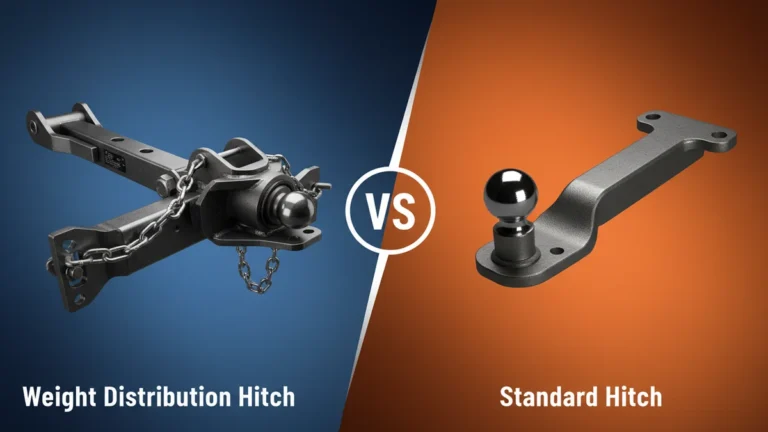
Does the Ford Edge require a weight-distribution hitch?
Ford does not require, nor do they recommend, the use of weight-distributing hitches on the Ford Edge. The vehicle’s unibody design and standard Class II receiver are engineered for weight-carrying hitches only.
Why is the older Edge Sport limited to 2,000 pounds?
Despite featuring a highly powerful 2.7L twin-turbo V6, the 2015-2018 Ford Edge Sport was limited to a 2,000-pound towing capacity. This restriction was due to the vehicle’s aggressive sport-tuned suspension and massive 22-inch wheels.
How does trailer sway control actually work on the Edge?
Trailer Sway Control is a brilliant software extension of the AdvanceTrac stability system. It uses gyroscopic sensors to instantly detect the distinct yaw motion caused by a swaying trailer. It automatically applies asymmetrical braking to stabilize the rig.
What is the tongue weight limit on the Ford Edge?
The absolute maximum allowable tongue weight for the Ford Edge is 350 pounds. This number perfectly represents 10% of the maximum 3,500-pound trailer weight. Exceeding this limit will dangerously compress the rear suspension.
Do I need a brake controller for my trailer?
If the loaded trailer weighs more than your state-mandated limit (usually 1,500 to 3,000 lbs) and is equipped with electric brakes, a controller is legally required. Because the Edge does not have a built-in controller, an aftermarket unit must be wired into the cabin.
Can a Ford Edge pull a boat out of the water?
Yes, the Ford Edge is highly capable of towing lightweight watercraft and pulling them up slippery ramps. Aluminum fishing boats, dual personal watercraft (jet skis), and small fiberglass runabouts generally weigh between 1,500 and 3,000 pounds.
What is the GCWR of the Ford Edge?
The Gross Combined Weight Rating (GCWR) fluctuates by engine and drivetrain setup. For instance, a modern 2.0L AWD Edge with the tow package has a GCWR of 8,300 pounds, while the 2.7L ST model reaches 8,500 pounds.
Final Analysis and Towing Recommendations
The Ford Edge occupies a highly versatile, incredibly popular space in the North American automotive landscape. It successfully provides the smooth ride and fuel efficiency of a car-based crossover.
Simultaneously, it offers utility figures that easily satisfy the recreational needs of most modern households. Its 3,500-pound maximum towing capacity is a testament to clever unibody engineering, robust thermal cooling systems, and advanced stability software.
However, consumers must exercise extreme diligence when purchasing an Edge specifically for towing purposes. The massive distinction between a baseline 1,500-pound limit and the maximum 3,500-pound limit relies entirely on the factory-installed Class II Trailer Tow Package.
Relying on aftermarket hitches without the underlying factory cooling and software upgrades is a common, yet potentially catastrophic, mistake. For the outdoor enthusiast looking to pull a pop-up camper into the wilderness, the Ford Edge proves to be an excellent companion.
By adhering strictly to manufacturer weight ratings, maintaining proper tongue weight, and utilizing safe driving practices, operators can maximize the utility of this highly capable midsize SUV.
Full towing capacity guide: Ford F-150 Towing Capacity Chart (2004–2026)