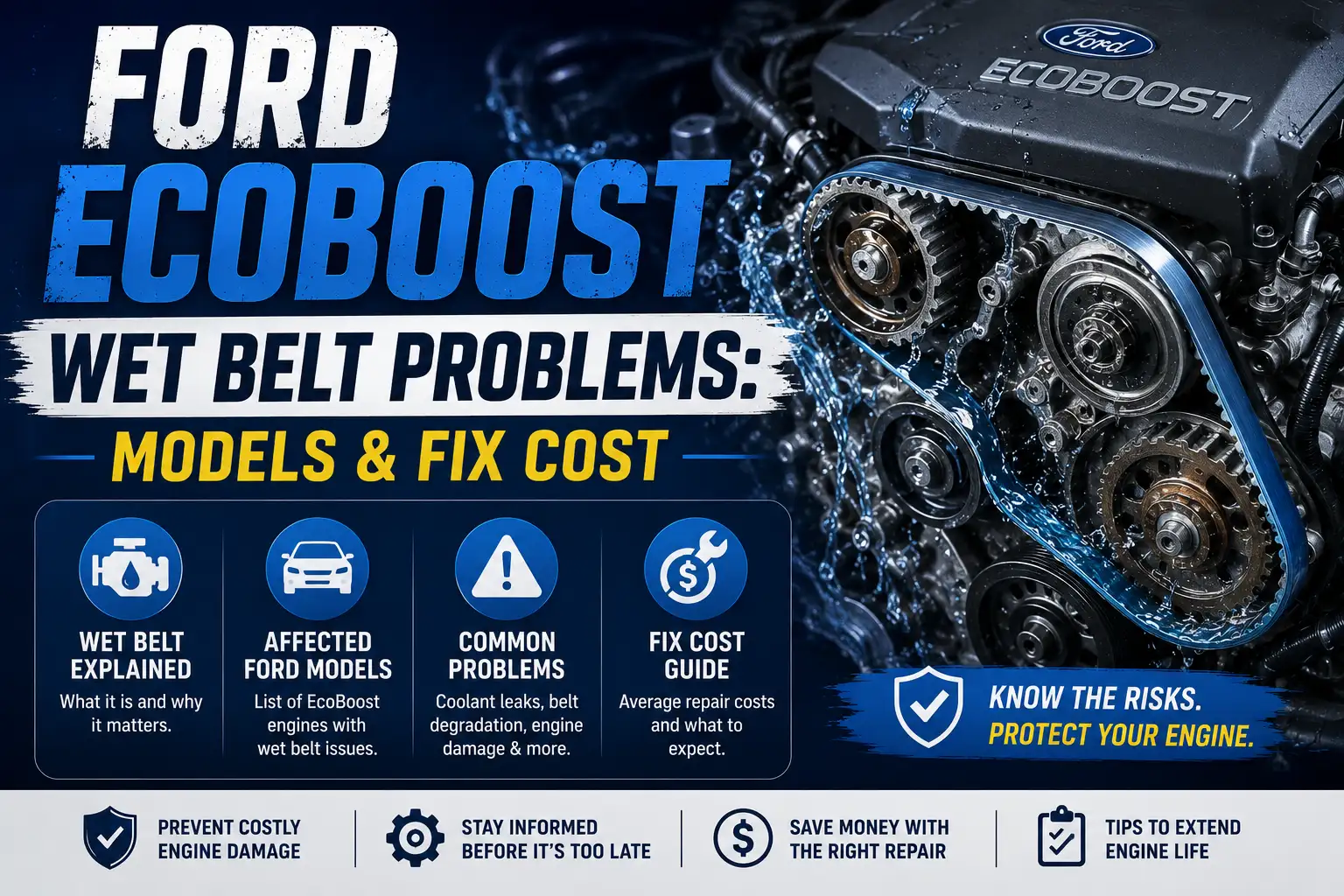
Ford EcoBoost Wet Belt Problems: Models & Fix Cost

If you searched this because a YouTube teardown or a UK news story scared you, take a breath first. Your F-150 does not have the wet timing belt that made headlines. That problem belongs to a completely different EcoBoost engine that was never sold in an American truck. What your 2.7L or 5.0L F-150 does have is a smaller, less catastrophic belt that spins the oil pump, not the camshafts, and it deserves a clear explanation instead of a scary headline.
FordMasterX Engine Guide
Ford EcoBoost Wet Belt Problems: What’s Actually Under Your F-150’s Hood
Two different components share the same nickname — here’s which one applies to you
⚠ Not your F-150: wet cam belt
- 1.0L EcoBoost — Fiesta, Focus, EcoSport, Puma
- Drives the camshafts directly
- Subject to NHTSA recall 23S64
- Not sold in US trucks
✓ Your F-150: wet oil pump belt
- 2.7L Gen 2 (2018+) & 5.0L Coyote (2018+)
- Drives only the oil pump — cams stay chain-driven
- No tensioner, no current recall
- 3.5L status disputed — verify by VIN
If the low oil pressure light comes on
Stop driving immediately
Have it towed, don’t restart
Have oil pickup & belt inspected
Change oil every 5K–7.5K going forward
The Two Ford “Wet Belt” Problems Owners Keep Confusing



Driving a European Ford with the 1.0 EcoBoost or 2.0 EcoBlue? See does my car have a wet belt? to check by reg and engine code.
Two different Ford components share the nickname “wet belt,” and mixing them up is why so many F-150 owners end up worried about the wrong engine.
Problem A: the wet timing belt. This is the one behind the BBC Watchdog coverage and the National Highway Traffic Safety Administration recall tied to certain 1.0L EcoBoost applications. It runs the camshafts themselves, submerged in oil, on the Fiesta, Focus, EcoSport, Puma, Mondeo, and European-market Transit and Ranger. None of these are F-150 or Super Duty engines, and most of them were never sold as trucks in the United States.
Problem B: the wet oil pump drive belt. This is what’s actually under the hood of a 2018-and-later F-150 with the 2.7L or 5.0L engine. It’s a small belt that spins only the oil pump. The camshafts on these engines are still driven by a timing chain, the way they always have been. If this belt degrades, you lose oil pressure, not camshaft timing, which is a real problem but a different failure mode with different odds.
| Engine | Cam Drive | Oil Pump Drive | “Wet Belt” Component | Known Recall |
|---|---|---|---|---|
| 1.0L EcoBoost (Fiesta, Focus, EcoSport) | Wet timing belt | Belt (with tensioner) | Timing belt + oil pump belt | NHTSA 23S64 |
| 2.7L EcoBoost Gen 1 (2015–2017, F-150) | Timing chain | Timing chain | None | None |
| 2.7L EcoBoost Gen 2 (2018+, F-150, Ranger, Bronco) | Timing chain | Wet belt (no tensioner) | Oil pump belt only | None currently |
| 3.5L EcoBoost (F-150, Expedition) | Timing chain | Disputed — see below | Unclear | None |
| 5.0L Coyote (2018+, F-150) | Timing chain | Wet belt (no tensioner) | Oil pump belt only | None currently |
| 2.3L EcoBoost (Ranger, Bronco) | Timing chain | Gear-driven | None | None |
| 6.7L Powerstroke / 5.4L Triton | Timing chain/gears | Gear-driven | None | None |
Does the F-150’s 2.7L and 5.0L EcoBoost Actually Have a Wet Belt


Yes, for the 2018-and-later 2.7L (Gen 2) and the 2018-and-later 5.0L Coyote. Ford’s own Special Service Message 49221, covering the 2015–2017 2.7L/3.0L EcoBoost family, documents the parts used to convert these engines to a belt-driven oil pump, including the oil pump belt (part JT4Z-6B651-A) and the crankshaft oil pump belt drive (part JT4Z-6306-A),
and explicitly notes the earlier chain tensioner and guides are not used with this design. F-150 owners on F150forum have separately confirmed that Gen 1 2.7L engines (2015–2017) used a chain-driven oil pump, and that Ford switched to the belt-driven design with the Gen 2 refresh in 2018, alongside the addition of a second fuel injector and redesigned cam covers.
The camshafts themselves are not affected. This is strictly an oil pump accessory, not a timing component.
For the 5.0L Coyote, owner reports on enthusiast forums place the first belt-driven oil pump at the 2018 model year, running alongside long timing chains for the cams, and an automotive news outlet covering the related 1.0L EcoBoost NHTSA investigation independently confirmed Ford used a similar belt-driven oil pump setup on later 2.7L and 5.0L engines, noting the 5.0L’s belt uses Kevlar-reinforced material.
Forum evidence is split. One Ford-Trucks.com poster, citing a RockAuto parts lookup, states the 3.5L’s oil pump is driven directly off the crankshaft for both 2017 and 2018 model years, with the belt-driven design arriving “much later, and on the 5.0L” — meaning the 3.5L may not use this design at all,
or may have adopted it in a different year than the 2.7L. Given this site’s zero-tolerance policy on unverified technical claims, we’re not asserting a specific answer here. If you own a 3.5L EcoBoost F-150 or Expedition, check your build sheet or ask a Ford technician to inspect the oil pump drive directly rather than relying on the model year alone.
Which Ford Truck Engines Are Gear-Driven, Not Belt-Driven


If you’re cross-shopping engines, here’s the short version. The 2.3L EcoBoost used in the Ranger and Bronco is gear-driven, not belt-driven, according to Ranger5G forum members who compared parts directly, so none of this applies to those trucks. The 6.7L Powerstroke and older 5.4L Triton V8 use entirely different, gear-driven oil pump architectures and are not affected by any version of this issue.
Oil Pump Drive Belt Failure Symptoms on the 2.7L and 5.0L EcoBoost
Unlike the 1.0L’s wet timing belt, which often gives a cold-start rattle as an early warning, F-150 owners reporting oil pump belt problems describe very little warning before things go wrong. Watch for:
- A low oil pressure warning light or message, which is typically the first and sometimes only symptom
- Metal or rubber debris found in the oil pan during a routine oil change
- Sudden loss of oil pressure with no prior drivability symptoms
If your low oil pressure light comes on, stop driving immediately and have the truck towed. Forum reports describe owners who continued driving after the warning appeared, assuming it was a sensor issue, and ended up needing a full long block replacement. One F-150 owner reported the belt shredded at roughly 39,000 miles, resulting in a long block replacement; another reported a failure at 155,000 miles. That spread suggests this failure mode is inconsistent rather than a certainty tied to a specific mileage, which is worth keeping in mind before assuming your truck is at risk based on odometer reading alone.
What Causes the Oil Pump Belt to Fail Early
The belt sits submerged in engine oil continuously, and over time, heat cycling and oil chemistry degrade the rubber compound. Owners and independent mechanics point to a few contributing factors:
- Extended oil change intervals allowing degraded oil to accelerate belt wear
- The 2.7L and 5.0L designs have no tensioner on this belt, unlike the 1.0L’s tensioner-equipped design, which changes the failure mode — there’s no tensioner arm to fracture, but there’s also no way to take up slack as the belt ages
- Contamination once debris begins shedding, which can clog the oil pickup and starve the entire engine of lubrication, not just the pump
Ford’s official guidance leans on the Intelligent Oil-Life Monitor rather than a fixed mileage number, and the system typically calls for a change somewhere in the 7,500 to 10,000 mile range under normal driving conditions, sooner under heavy towing, extensive idling, or short-trip city use. Several F-150 owners on ford-trucks.com and BobIsTheOilGuy report changing oil every 5,000 to 6,000 miles specifically because of turbo and belt longevity concerns, ahead of what the monitor calls for.
Real Owner-Reported Failure Mileage and Repair Costs
Here’s what’s actually been reported by F-150 owners, not extrapolated from the unrelated 1.0L recall data:
- Reported failures range from as early as 39,000 miles to as late as 155,000+ miles, with plenty of owners reporting 140,000 to 190,000+ trouble-free miles on the same 2.7L Gen 2 engine
- One dealer quote for a long block replacement after a belt failure came in at approximately $5,000
Given how inconsistent the failure reports are, and how many high-mileage 2.7L and 5.0L trucks are running without issue, this looks more like a design risk worth monitoring than a guaranteed failure point.
Is There a Recall for the F-150 EcoBoost Oil Pump Belt
Not currently. The only related NHTSA action, recall 23S64, covers certain 2016–2022 Ford EcoSport and Focus vehicles with the 1.0L engine, where the oil pump drive belt tensioner arm may fracture or the belt material may degrade and lose teeth, causing loss of oil pressure and, in some cases, loss of power brake assist. That recall does not include the F-150, Ranger, Bronco, or Super Duty. As of this writing, there is no equivalent recall for the 2.7L or 5.0L oil pump belt. Check your VIN at NHTSA.gov periodically, since recall coverage can change.
How to Protect Your Oil Pump Belt on a 2.7L or 5.0L EcoBoost
- Change your oil every 5,000 to 7,500 miles rather than waiting for the full interval the Intelligent Oil-Life Monitor allows, especially if you tow or do a lot of city driving
- Use only oil meeting Ford’s specified viscosity and Ford WSS specification for your engine — see our Ford Engine Oil Recommendation Chart for the exact spec by engine
- Ask your technician to inspect the oil pickup screen for debris any time the oil pan is removed for other service
- There’s no official mileage-based replacement interval for this belt, since Ford considers it a lifetime part, so proactive replacement is a judgment call based on your mileage and risk tolerance rather than a scheduled service item
FAQ
Does the F-150 EcoBoost have a timing belt or a timing chain?
A timing chain. Every current F-150 EcoBoost engine, including the 2.7L, 3.5L, and 5.0L, drives its camshafts with a chain, not a belt. Some of these engines separately use a small belt to drive only the oil pump.
What years of 2.7L EcoBoost have the wet oil pump belt?
2018 and newer (Gen 2). The 2015–2017 Gen 1 2.7L used a chain-driven oil pump instead.
Can I replace the oil pump belt myself?
This is an involved job that typically requires removing the front cover and is not a simple driveway repair. Compare it to how much disassembly a similar job takes on the 3.5L EcoBoost timing chain replacement, which gives a sense of the labor involved even though it’s a different component.
Is the F-150 wet belt problem as bad as the European EcoBoost recall?
No. The European 1.0L issue involves a wet cam timing belt with a documented tensioner failure mode and an active recall. The F-150’s 2.7L and 5.0L issue involves a smaller belt that only drives the oil pump, has no tensioner to fail, and currently has no recall.
If you’re trying to decide between the 2.7L and 3.5L for your next F-150, our 2.7 EcoBoost vs 3.5 EcoBoost comparison covers the broader reliability picture beyond this one component, and our 3.5 EcoBoost vs 5.0 reliability breakdown is worth a look if you’re weighing EcoBoost against the V8 option entirely.