Ford 6.7 Powerstroke Torque Specs Chart by Generation (2011–2025)

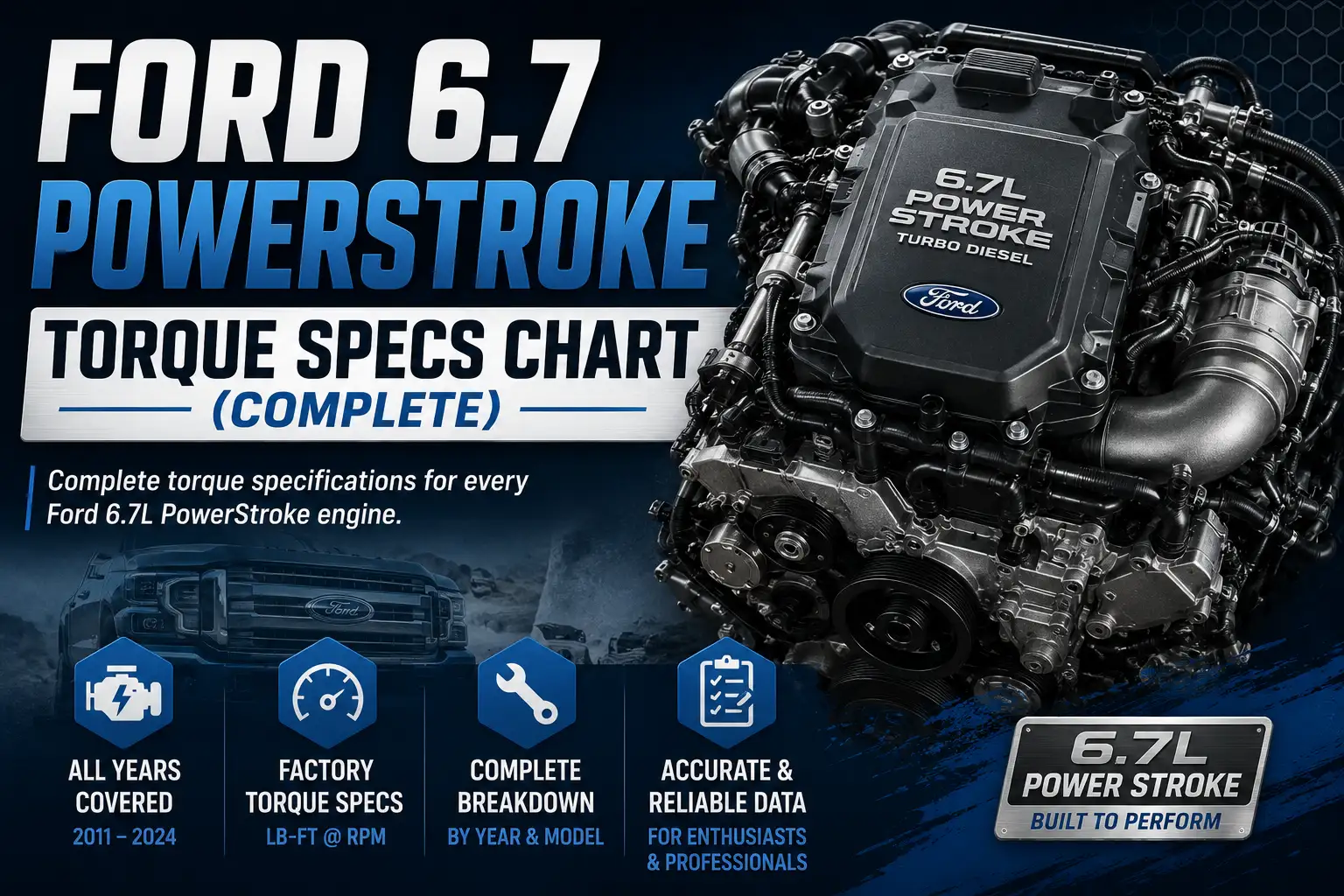
The 6.7 Powerstroke has gone through three distinct engineering generations since 2011, and torque specs are not identical across them. Using a 2011 head bolt spec on a 2019 truck, or torquing an intake bolt in ft-lb instead of in-lb, is how owners strip threads, crack composite parts, or blow a head gasket during reassembly.
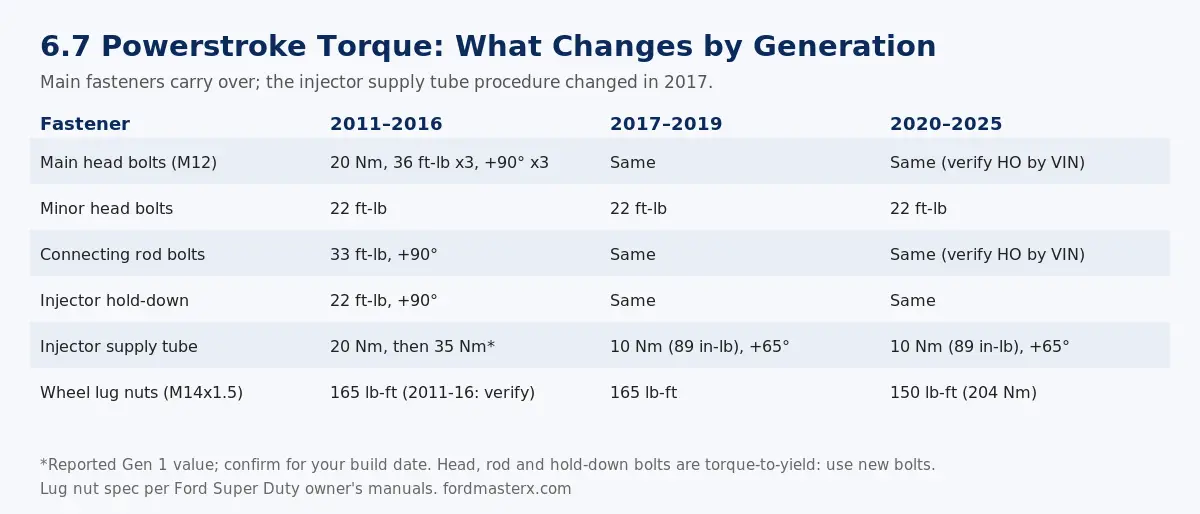
This chart covers the 2011 to 2016 first generation, the 2017 to 2019 second generation, and the 2020 to 2025 third generation including the High Output variant. Confirm your build date or VIN before you start torquing anything on a generation boundary year.
Why 6.7 Powerstroke Torque Specs Change By Generation and Year
Ford’s first Super Duty diesel it designed entirely in-house arrived in 2011 with its own fastener set for the head, rods, mains, and fuel system. The 2017 model year brought a running change to the injector supply tube torque procedure, moving from a foot-pound final torque to an angle-torque method. The 2020 redesign carried that same angle-torque fuel system procedure forward and added the 2023 to 2025 High Output variant, so verify your engine by VIN before deep engine work, because some internal components differ from the standard-output engine.
Treat any generation boundary year, like a late 2016 build or an early 2020 build, as a reason to double check your exact VIN against a 6.7 Powerstroke High Output specs before assuming a torque value carries over.
How To Read This 6.7 Powerstroke Torque Chart Ft-Lb In-Lb and Nm
A few rules apply across every table below.
- 12 in-lb equals 1 ft-lb. An 89 in-lb spec is about 7.4 ft-lb, not 89 ft-lb. Torquing a small intake or sensor bolt to 89 ft-lb will snap it.
- Factory head bolts, connecting rod bolts, and injector hold-down bolts are torque-to-yield fasteners. They stretch permanently during the angle-torque steps and cannot be reused. Buy new bolts every time you remove them.
- Multi-bolt patterns like heads, intake manifolds, and wheels get tightened in a star or criss-cross pattern, not a circle, so clamping force lands evenly.
- Angle-torque steps written as plus 90 degrees or plus 65 degrees require a torque angle gauge. A wrench click at that stage tells you nothing.
- Aftermarket head studs never use the factory head bolt torque. Follow the stud manufacturer’s own procedure.
2011 to 2016 6.7 Powerstroke Engine Torque Specs Chart
| Component | Torque | Notes |
|---|---|---|
| Main cylinder head bolts M12 | 20 Nm / 177 in-lb, then 36 ft-lb x3 passes, then +90 degrees x3 | New torque-to-yield bolts only |
| Minor cylinder head bolts | 22 ft-lb | |
| Connecting rod bolts | 33 ft-lb, then +90 degrees | New bolts only |
| Main bearing vertical bolts | Snug, then 15 ft-lb all, then 59 ft-lb outer, then 118 ft-lb inner, then +90 degrees all | |
| Main bearing side bolts | 30 ft-lb, then +90 degrees | |
| Injector hold-down bolt | 22 ft-lb, then +90 degrees | New bolts only |
| Fuel rail mounting bolts | 18 ft-lb / 24 Nm | |
| Injector supply tube fitting to injector | Pre-tighten 20 Nm / 177 in-lb, final 35 Nm / 26 ft-lb (reported) | New supply tubes only, not reusable. Confirm the procedure for your build date. |
| Injector supply tube fitting to fuel rail | Pre-tighten 20 Nm / 177 in-lb, final 35 Nm / 26 ft-lb (reported) | New supply tubes only. Confirm the procedure for your build date. |
| Oil pan drain plug | 19 ft-lb for steel pan service | 2011 plastic lower pan uses a different quarter-turn style plug |
Values compiled from published Ford 6.7L workshop-manual torque references. Verify critical short-block values against your own Ford workshop manual by VIN before final assembly.
2017 to 2019 6.7 Powerstroke Torque Specs Chart
Head bolt, rod bolt, and main bearing values carry over from Gen 1. The fuel system procedure changed.
| Component | Torque | Notes |
|---|---|---|
| Main cylinder head bolts M12 | 20 Nm / 177 in-lb, then 36 ft-lb x3 passes, then +90 degrees x3 | New torque-to-yield bolts only |
| Minor cylinder head bolts | 30 Nm / 22 ft-lb | |
| Connecting rod bolts | 45 Nm / 33 ft-lb, then +90 degrees | New bolts only |
| Main bearing vertical bolts | Snug, then 20 Nm / 15 ft-lb all, then 80 Nm / 59 ft-lb outer, then 160 Nm / 118 ft-lb inner, then +90 degrees all | |
| Main bearing side bolts | 40 Nm / 30 ft-lb, then +90 degrees | |
| Injector hold-down bolt | 30 Nm / 22 ft-lb, then +90 degrees | New bolts only |
| Fuel rail mounting bolts | 24 Nm / 18 ft-lb | |
| Injector supply tube fitting to injector | 10 Nm / 89 in-lb, then +65 degrees | Replaces the Gen 1 pre-tighten and final ft-lb method |
| Injector supply tube fitting to fuel rail | 10 Nm / 89 in-lb, then +65 degrees | |
| High pressure fuel line nuts | 35 Nm / 26 ft-lb | Pump and line kit service |
| Oil pan drain plug | 19 ft-lb for steel pan service |
If your factory-style repair reference still lists the older pre-tighten plus final ft-lb fuel tube method, cross-check the build date. Ford moved to the angle-torque method for the injector supply tube starting with this generation.
2020 to 2025 High Output 6.7 Powerstroke Torque Specs Chart
The fuel system procedure from the 2017 to 2019 generation carries forward. Confirm 2023 to 2025 High Output trucks by VIN before short-block or head work, since Ford flags this generation for verification on critical internal specs.
| Component | Torque | Notes |
|---|---|---|
| Main cylinder head bolts M12 | 20 Nm / 177 in-lb, then 36 ft-lb x3 passes, then +90 degrees x3 | Verify 2023-2025 High Output by VIN |
| Minor cylinder head bolts | 30 Nm / 22 ft-lb | |
| Connecting rod bolts | 45 Nm / 33 ft-lb, then +90 degrees | Verify High Output by VIN |
| Main bearing vertical bolts | Snug, then 20 Nm / 15 ft-lb all, then 80 Nm / 59 ft-lb outer, then 160 Nm / 118 ft-lb inner, then +90 degrees all | Verify High Output by VIN |
| Main bearing side bolts | 40 Nm / 30 ft-lb, then +90 degrees | |
| Injector hold-down bolt | 30 Nm / 22 ft-lb, then +90 degrees | New bolts only |
| Fuel rail mounting bolts | 24 Nm / 18 ft-lb | |
| Injector supply tube fitting to injector | 10 Nm / 89 in-lb, then +65 degrees | Some references list 60 degrees, confirm with your exact repair procedure |
| Fuel rail supply tube fittings | 10 Nm / 89 in-lb, then +65 degrees | Separate fitting from the injector supply tube |
| High pressure fuel line nuts | 35 Nm / 26 ft-lb | |
| Oil pan drain plug | 19 ft-lb for steel pan service |
For the full horsepower and torque output breakdown by trim on this generation, see the 6.7 Powerstroke High Output specs guide.
6.7 Powerstroke Intake Manifold Rear Cover and Valve Cover Torque Specs
These accessory fasteners are the same source of most stripped bolts and cracked plastic across all three generations, and they don’t change much year to year.
| Component | Torque | Notes |
|---|---|---|
| Valve cover bolts | 106 in-lb / 12 Nm | Verify by exact cover and gasket design |
| Upper intake and plenum fasteners | 89 in-lb / 10 Nm | Inch-pound spec, do not use ft-lb |
| Lower intake manifold bolts | 16 to 18 ft-lb | Verify by exact fastener location |
| MAP sensor bolt | 30 in-lb | Small fastener, easy to overtighten |
| Intercooler pipe clamps | 9 ft-lb | Confirm boot is fully seated first |
| Rear engine cover, large bolt | 35 lb-ft | Single M10x37 bolt near the starter only |
| Rear engine cover, small bolts | 7 lb-ft | Nine M6x31 bolts, do not apply the 35 lb-ft spec here |
The rear engine cover is worth a direct warning. Owner forum threads on this exact job show techs applying 35 lb-ft to all ten rear cover bolts, when that value belongs to the single large M10 bolt near the starter. The nine smaller M6 bolts snap well below 20 lb-ft. If you’re already in that area of the engine for a related job, this is a good point to also check the 6.7 Powerstroke upper oil pan guide before buttoning things back up.
For 5.4L 3V Triton V8 owners doing comparable head or timing work, the 5.4 3V cam phaser torque specs follow the same torque-to-yield and angle-torque logic covered here.
Ford F-250 and F-350 Wheel Lug Nut Torque By Year
Anyone doing engine work on a 6.7 Powerstroke is also pulling wheels for jack stand access, so this belongs in the same reference.
| Model Years | Lug Nut Torque | Notes |
|---|---|---|
| 1999 to 2004 F-250 and F-350, 8-lug | Check your owner’s guide | Published values vary by year; use the spec printed in your truck’s owner’s guide |
| 2005 to 2007 F-250 and F-350, 8-lug | 150 lb-ft / 200 Nm | M14x1.5, per the 2005 Ford Super Duty owner’s guide |
| 2008 to 2019 F-250 and F-350, 8-lug | 165 lb-ft / 224 Nm | M14x1.5, per Ford Super Duty owner’s guides and workshop manuals |
| 2020 to 2026 F-250 and F-350, 8-lug | 150 lb-ft / 204 Nm | M14x1.5, per Ford’s 2020 and 2026 Super Duty owner’s manuals |
Retorque single rear wheel trucks at 100 miles after any wheel service. Dual rear wheel trucks get retorqued at 100 miles and again at 500 miles, and after any wheel disturbance such as a tire rotation or flat repair.
Common 6.7 Powerstroke Torque Mistakes That Break Bolts
- Reusing factory head bolts, rod bolts, or injector hold-down bolts after the angle-torque steps. These are torque-to-yield and stretch permanently the first time.
- Torquing intake, valve cover, or sensor bolts in ft-lb when the spec is listed in in-lb. An 89 in-lb bolt torqued to 89 ft-lb will snap or strip the threads.
- Applying the 35 lb-ft rear cover spec to the nine small M6 bolts instead of only the single large M10 bolt near the starter.
- Torquing aftermarket head studs to the factory head bolt spec instead of the stud manufacturer’s own procedure.
- Skipping the star or criss-cross tightening pattern on multi-bolt patterns, which causes uneven clamping and boost or coolant leaks later.
Frequently Asked Questions
What is the head bolt torque on a 6.7 Powerstroke?
Main M12 head bolts go to 20 Nm, then 36 ft-lb three times, then plus 90 degrees three times. This sequence is consistent across all three generations, 2011 through 2025.
What is the injector hold-down torque on a 6.7 Powerstroke?
All generations use 22 ft-lb, then an additional 90 degrees, with new hold-down bolts every time.
What is the lug nut torque on a Ford F-250 6.7 Powerstroke?
It depends on the year. Ford lists 165 lb-ft (224 Nm) for M14x1.5 wheel nuts through the 2019 model year and 150 lb-ft (204 Nm) for 2020 and newer Super Duty trucks. Check the owner’s manual for your exact truck.
Can you reuse 6.7 Powerstroke head bolts?
No. Factory head bolts are torque-to-yield and stretch permanently during the angle-torque steps. Always install new head bolts.
What happens if you over-torque a 6.7 Powerstroke intake manifold bolt?
The upper intake and plenum fasteners are an 89 in-lb spec, not ft-lb. Using a foot-pound value on these bolts can snap the fastener, strip the threads, or crack the composite intake.