3.5 EcoBoost vs 5.0 Reliability: Which Engine Lasts Longer?

For high-mileage owners, the 5.0L V8 generally offers simpler long-term maintenance, though newer generations face specific oil consumption hurdles. The 3.5L EcoBoost provides superior towing power but carries a higher risk of expensive cam phaser and turbocharger repairs as it approaches the 150,000-mile mark.
🎯 Key Takeaways
Recommended Best Deal Products


- The 5.0L V8 is simpler with fewer high-heat components than the twin-turbo 3.5L.
- 3.5L EcoBoost engines are prone to expensive cam phaser rattle and timing chain stretch.
- 2018-2020 5.0L models frequently experience oil consumption issues that require monitoring.
- Strict 5,000-mile oil change intervals are critical for 3.5L turbo and timing longevity.
- The 5.0L V8 typically commands better resale value at high mileage due to perceived simplicity.
If you are looking for the engine that will hit 200,000 miles with the least amount of shop time, the 5.0L Coyote V8 is historically the safer bet. While the 3.5L EcoBoost has improved significantly since its 2011 debut, its reliance on high-pressure turbocharging and complex timing components creates more “fail points” as the odometer climbs. For a long-term owner, the choice isn’t just about which engine is stronger, but which one is cheaper to keep on the road once the factory warranty expires.

Prime for Young Adults — 6 Months Free
Students and 18–24s get six months of Prime free, then half price.
Start 6 Months Free As an Amazon Associate I earn from qualifying purchases.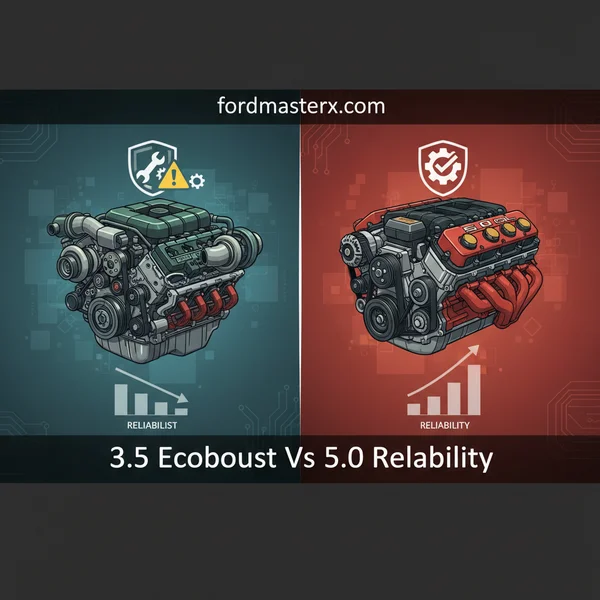
Practical reliability matters because a major repair on either of these engines can easily cost $3,500 to $5,000. Choosing the wrong powerplant based on a short test drive could lead to thousands in “unexpected” maintenance between 100,000 and 150,000 miles. To understand which one lasts longer, we have to look past the marketing and examine the mechanical weaknesses that surface after years of daily heat cycles and heavy towing.
Mechanical Anatomy: Turbocharged Complexity vs. Naturally Aspirated Simplicity
The 3.5L EcoBoost and the 5.0L V8 represent two different philosophies of engineering. The EcoBoost is a “downsized” engine that uses twin turbochargers to mimic the power of a much larger engine. This requires a massive amount of extra plumbing, including intercoolers, wastegates, and oil lines that feed the turbos. Because the engine relies on “boost” to move a heavy truck, the internal components are under significantly higher cylinder pressure and heat than a standard engine.

The Stress of Forced Induction
In the 3.5L EcoBoost, the turbos spin at speeds exceeding 150,000 RPM. This creates extreme heat that can eventually lead to coolant leaks at the turbo fittings or cracked exhaust manifolds. The 5.0L V8, being naturally aspirated, breathes air at atmospheric pressure. It doesn’t have to work as hard to generate cruising power, which generally leads to lower internal operating temperatures over long highway hauls.
- EcoBoost Complexity: More sensors, vacuum lines, and high-pressure fuel components that can fail.
- Coyote Simplicity: Fewer parts to break, though newer versions (2021+) have added complexity like cylinder deactivation.
- Maintenance Sensitivity: The EcoBoost is “allergic” to skipped oil changes because dirty oil kills turbo bearings and stretches timing chains.
Thermal Management and Longevity
Heat is the enemy of longevity. The EcoBoost generates concentrated heat in the engine bay due to the turbochargers being tucked close to the block. Over 150,000 miles, this heat can degrade plastic connectors and rubber gaskets faster than in the more spacious engine bay of the 5.0L. If you live in a hot climate or frequently tow at the limit, the V8’s ability to shed heat naturally gives it a durability edge.
Known Failure Points: Cam Phasers, Turbos, and Oil Consumption
Neither engine is perfect. If you buy a 3.5L EcoBoost, you are likely monitoring for “the rattle.” If you buy a 5.0L, you are likely checking your dipstick every week. Understanding these specific mechanical flaws is the only way to predict your long-term ownership costs.
The EcoBoost’s Achilles’ Heel: Timing and Boost
The most notorious issue with the 3.5L EcoBoost—specifically the second-generation models (2017-2020)—is cam phaser failure. This often manifests as a loud rattling sound on a cold start. If ignored, it can lead to timing chain stretch and catastrophic engine failure. While Ford has released updated parts, the labor-intensive nature of this repair makes it a primary concern for high-mileage owners.
- Turbo Wastegate Rattle: Over time, the linkage on the turbos can wear out, causing a metallic rattle and eventual loss of boost pressure.
- Intake Valve Carbon Buildup: Older 3.5L engines (pre-2017) lacked port injection, leading to carbon deposits on the valves that reduced efficiency and caused misfires.
- Exhaust Manifold Warping: The high heat from the turbos can cause the rear studs of the exhaust manifold to snap, leading to an expensive “ticking” exhaust leak.
The 5.0L Coyote’s Modern Struggles
The 5.0L V8 is not the “bulletproof” engine it was in 2012. Starting in 2018, Ford moved to a plasma wire arc thermal spray cylinder liner instead of traditional iron sleeves. This change coincided with widespread reports of excessive oil consumption. Some owners report losing 1 to 2 quarts of oil between changes, which can lead to engine damage if the owner isn’t diligent.
Furthermore, in 2021, Ford added Cylinder Deactivation (Variable Displacement) to the 5.0L to improve fuel economy. This adds mechanical complexity—specifically oil-pressure-controlled lifters—that mimics the failure points seen in GM and Ram engines. While it hasn’t shown a massive failure rate yet, it is a significant departure from the V8’s “simple” reputation.
- 2018-2020 Oil Consumption: Look for “decoding” flashes from the dealer to fix high-vacuum issues that pull oil into the combustion chamber.
- Variable Cam Timing (VCT) Solenoids: Like the EcoBoost, the 5.0L can suffer from VCT issues, though they are generally less frequent.
- Belt-Driven Oil Pump: The newest 5.0L engines use a “wet belt” to drive the oil pump, which some mechanics worry will degrade over 200,000 miles.
Long-Term Maintenance Costs and Out-of-Warranty Risks
When the factory warranty expires, the financial “personality” of these two engines begins to diverge. While both are built to handle heavy workloads, the 3.5 EcoBoost and the 5.0 V8 have different risk profiles as they age. Understanding these costs now can save you thousands of dollars down the road.

Audible — Listen Free for 30 Days
One free credit a month and thousands of titles included.
Listen Free for 30 Days As an Amazon Associate I earn from qualifying purchases.
The “Turbo Tax” and Complexity
The 3.5 EcoBoost is a sophisticated piece of machinery. While its performance is undeniable, its complexity can lead to higher repair bills as the miles add up. Because it relies on twin turbochargers to produce power, there are simply more components that can eventually wear out. If a turbocharger fails at 120,000 miles, you are looking at a significant labor and parts bill that a V8 owner simply never has to worry about.
- Turbocharger Components: Wastegates, bypass valves, and cooling lines are all potential failure points over time.
- Spark Plug Sensitivity: EcoBoost engines are notorious for “eating” spark plugs. To maintain peak reliability, you’ll likely need to replace them every 30,000 to 40,000 miles to prevent misfires.
- Direct Injection Cleaning: Over time, carbon can build up on the intake valves, which may require a professional “walnut blasting” or chemical cleaning to restore performance.
The Naturally Aspirated Advantage
The 5.0 V8 follows the “keep it simple” philosophy. Because it doesn’t use forced induction, it operates under lower internal pressures during normal driving. This often results in a cooling system that is less stressed and an engine bay that is easier to navigate for repairs. Many long-term owners find that the V8 is more “forgiving” if a maintenance interval is accidentally missed, whereas the EcoBoost requires strict adherence to its schedule.
- Lower Parts Count: No turbos, no intercoolers, and fewer vacuum lines mean fewer things to break.
- Ease of Access: Mechanics often find the V8 easier to work on, which can lead to lower labor costs for common repairs like water pumps or alternators.
- Consistent Maintenance: While it still requires quality oil, it isn’t as sensitive to oil shear as its turbocharged counterpart.
Real-World Longevity: Which Engine Hits the 200,000-Mile Mark?
For many truck buyers, 200,000 miles is the holy grail. Both of these engines are capable of reaching this milestone, but the way they get there is what separates them. Reliability isn’t just about whether the engine runs; it’s about how many major repairs it needs along the journey.
High-Mileage Trends and Owner Reports
If you look at high-mileage F-150s on the used market, you will see plenty of examples of both engines crossing the 200k mark. However, the 5.0 Coyote has a reputation for reaching these numbers with fewer “catastrophic” interventions. The 3.5 EcoBoost is a high-performance engine that works hard every time you step on the gas. This extra stress means that while it can last 200,000 miles, it often requires a “mid-life” refresh of critical components.
- The 5.0 Oil Consumption Factor: Some newer 5.0 engines (specifically 2018+) have reported higher oil consumption. While annoying, this is often manageable and rarely prevents the engine from reaching high mileage.
- The 3.5 Timing Chain Concern: Older versions of the EcoBoost were known for timing chain stretch. While Ford has improved this, it remains a common discussion point for owners hitting the 150,000-mile mark.
- Usage Patterns: The 3.5 EcoBoost actually thrives under consistent use, whereas short city trips can be harder on it due to fuel dilution in the oil.
Which Engine Wins the Long Game?
If your goal is to buy a truck and keep it for 15 years with minimal headache, the 5.0 V8 generally takes the win for pure longevity. Its design is more traditional and less prone to expensive component failure as it reaches old age. However, for those who tow frequently, the 3.5 EcoBoost’s superior torque may be worth the trade-off in potential long-term maintenance costs. The “best” engine is the one that fits your tolerance for repair risks.
- Choose the 5.0 if: You want a “forever” truck and prefer simple, predictable maintenance.
- Choose the 3.5 if: You need maximum towing power and don’t mind staying on top of proactive, slightly more expensive maintenance.
Conclusion: Making the Right Choice for Your Driveway
Choosing between the 3.5 EcoBoost and the 5.0 V8 ultimately comes down to your priorities. The EcoBoost offers incredible low-end torque and modern performance, but it demands strict maintenance and carries higher repair risks as it ages. The 5.0 V8 provides that classic truck feel, a simpler mechanical design, and a proven track record for reaching high mileage with fewer complications. Both engines are industry leaders, but they serve different types of owners.
Before you sign the papers, test drive both. Pay attention to the power delivery and listen to the engine. If you plan on keeping the truck past 150,000 miles, consider an extended service plan or set aside a maintenance fund for future turbo or timing services.
Ready to find your next truck? Check out our latest inventory and see which engine feels right for your lifestyle!
❓ Frequently Asked Questions
What is the most common major repair for the 3.5L EcoBoost?
Cam phaser rattle is the most frequent high-cost issue, often requiring a labor-intensive teardown of the engine front to replace phasers and timing components, costing upwards of $2,000-$3,500.
Does the 5.0L Coyote V8 have cylinder deactivation?
Yes, starting in 2021, Ford added Displacement on Demand (cylinder deactivation) to the 5.0L, which has introduced more valvetrain complexity than previous generations.
Audible Premium Plus — Annual Membership
12 audiobook credits up front, plus the full Audible catalogue.
See Annual Plans As an Amazon Associate I earn from qualifying purchases.How do turbo coolant leaks affect 3.5L reliability?
The J-tube fittings on the back of the turbos are known to leak over time; while the parts are inexpensive, the labor to access them is significant due to the tight engine bay.
Is the 3.5L EcoBoost or 5.0L V8 better for a work truck?
If the truck is used for heavy idling and high-mileage fleet use, the 5.0L is generally favored for its simpler cooling and intake systems.
How does direct injection impact these engines?
Both engines now utilize dual Port and Direct Injection (PFDI), which has largely solved the carbon buildup issues seen on earlier direct-injection-only 3.5L EcoBoost models.
Which engine has a higher resale value at high mileage?
Used truck buyers typically pay a slight premium for the 5.0L V8 because it is perceived as ‘bulletproof’ compared to the high-pressure environment of twin-turbos.