
Does Adaptive Cruise Control Use Brakes 2026 Complete Answer

Does adaptive cruise control use brakes? Yes, it does. Adaptive cruise control uses your truck’s real friction brakes, plus throttle control and engine braking, to hold the gap you set to the vehicle ahead.
That is the short answer, and it surprises a lot of Ford owners. Regular cruise control only works the throttle, so it cannot slow your truck on its own. Adaptive cruise control is built differently, and braking is part of its job.
The system does not slam the brakes at the first sign of traffic. It slows in steps, starting with the gentlest method and moving to the brakes only when the gap calls for it.
This guide explains those steps in order, how Ford ACC with stop-and-go behaves on your truck, what it cannot do, and when you must take over with your own foot.
The Short Answer in 4 Facts
Four facts answer the question for most drivers. The table below holds them, and the infographic after it gives you the same facts to save or share.
| Fact | What it means for your Ford |
|---|---|
| Yes, ACC uses the brakes | It applies the friction brakes through the ABS and stability control system when throttle cut and engine braking are not enough |
| It slows in three steps | Throttle cut first, then engine braking with a downshift, then the friction brakes |
| Ford ACC can stop the truck | ACC with stop-and-go follows a vehicle to a complete stop and can resume when traffic moves again |
| Braking is limited | The system only applies limited braking, so you must brake yourself when it warns that its braking is not enough |
ACC Braking At a Glance
The direct answer, the three slowing steps, and the limit, as observed in November 2026.
| Measure | Observed figure | Result |
|---|---|---|
| Direct answer | Yes, ACC uses the friction brakes | It holds the gap you set |
| First slowing step | Throttle cut | Gentle slowing for small speed changes |
| Second slowing step | Engine braking with a downshift | Stronger slowing without touching the brakes |
| Third slowing step | Friction brakes, brake lights on | Full slowing when the gap needs it |
| Stop-and-go | Follows to a complete stop | Resumes after a short stop |
| Braking limit | Limited braking only | You must brake when the system warns you |
Direct answer: Yes, adaptive cruise control uses the brakes. It cuts the throttle first, uses engine braking second, and applies the friction brakes third. The braking is limited, so stay ready to brake yourself.
Sources: Ford owner manual for adaptive cruise control with stop and go, EngineerFix, Consumer Reports, and NHTSA.
One fact on its own can mislead. Knowing that ACC uses the brakes is not enough, because the system will not brake as hard as you can.
The rest of this guide fills in the detail. You will see how each slowing step works, how Ford tunes the system, and where the edge of its ability sits.
How Adaptive Cruise Control Slows Your Ford
Adaptive cruise control watches the road ahead with a radar sensor and a camera, then picks the lightest slowing method that will hold your gap. The method changes as the gap changes, and the brakes are the last step, not the first.
The radar sensor sits in the lower grille on most Fords, behind a fascia panel you cannot see through. The camera sits on the windshield behind the interior mirror. Together they measure how far away the vehicle ahead is and how fast the gap is closing.
That gap is measured in time, not in feet. When you pick a gap setting, you pick a time gap, so the following distance grows as your speed grows and shrinks as your speed falls.
Step 1 Cut the Throttle
The first step is the simplest one. The system reduces or cuts the throttle input to the engine, and your truck slows gently without touching the brakes.
This step handles small speed changes. The vehicle ahead eases off by a few miles per hour, your truck eases off to match, and the ride stays smooth.
You may not even notice this step working. There is no sound and no pedal movement, just a soft drop in speed that keeps the gap steady.
Step 2 Use Engine Braking
When lifting off the throttle is not enough, the system uses the powertrain. It can command a transmission downshift, which raises engine speed and adds drag that slows the truck.
Engine braking works well on gentle downhill grades and for larger speed drops. It slows the truck without wearing the brake pads, and it keeps the brakes cool for when they are really needed.
This is the step drivers feel as a firm but smooth pull. The engine note rises a little, the speed falls, and the brake pedal stays right where it was.
Our guide to automatic transmission high RPM before shifting covers the same downshift behavior from the transmission side. A downshift that holds engine speed high is normal when the truck is slowing itself, and it is not the same fault as a shift that hangs at high RPM under power.
Step 3 Apply the Friction Brakes
When throttle cut and engine braking cannot hold the gap, the system applies the friction brakes. It talks to the hydraulic braking system through the anti-lock braking and stability control modules, and it meters the brake pressure to slow the truck smoothly.
Yes, this means the system uses the same brake pads and rotors your foot uses. The EngineerFix guide to ACC braking states this plainly: the system interfaces with the hydraulic braking system and modulates brake pressure, so the answer is yes, ACC does use the physical brake pads and rotors.
The braking is smooth and measured, built to feel like a careful driver pressing the pedal. When the system applies the brakes, it also switches on your brake lights, so the driver behind you sees that you are slowing.
One engineering guide puts typical ACC braking at around 0.2 to 0.3g, which is a comfortable level for normal traffic. That figure comes from EngineerFix as a general engineering figure, not from Ford, and it is not a specification for your truck. The point stands: ACC brakes firmly enough for traffic, and it is not built for emergency stops.
You may hear the brakes when the system works them. Ford notes that the brakes may emit noise when applied by the system, and that sound is normal.
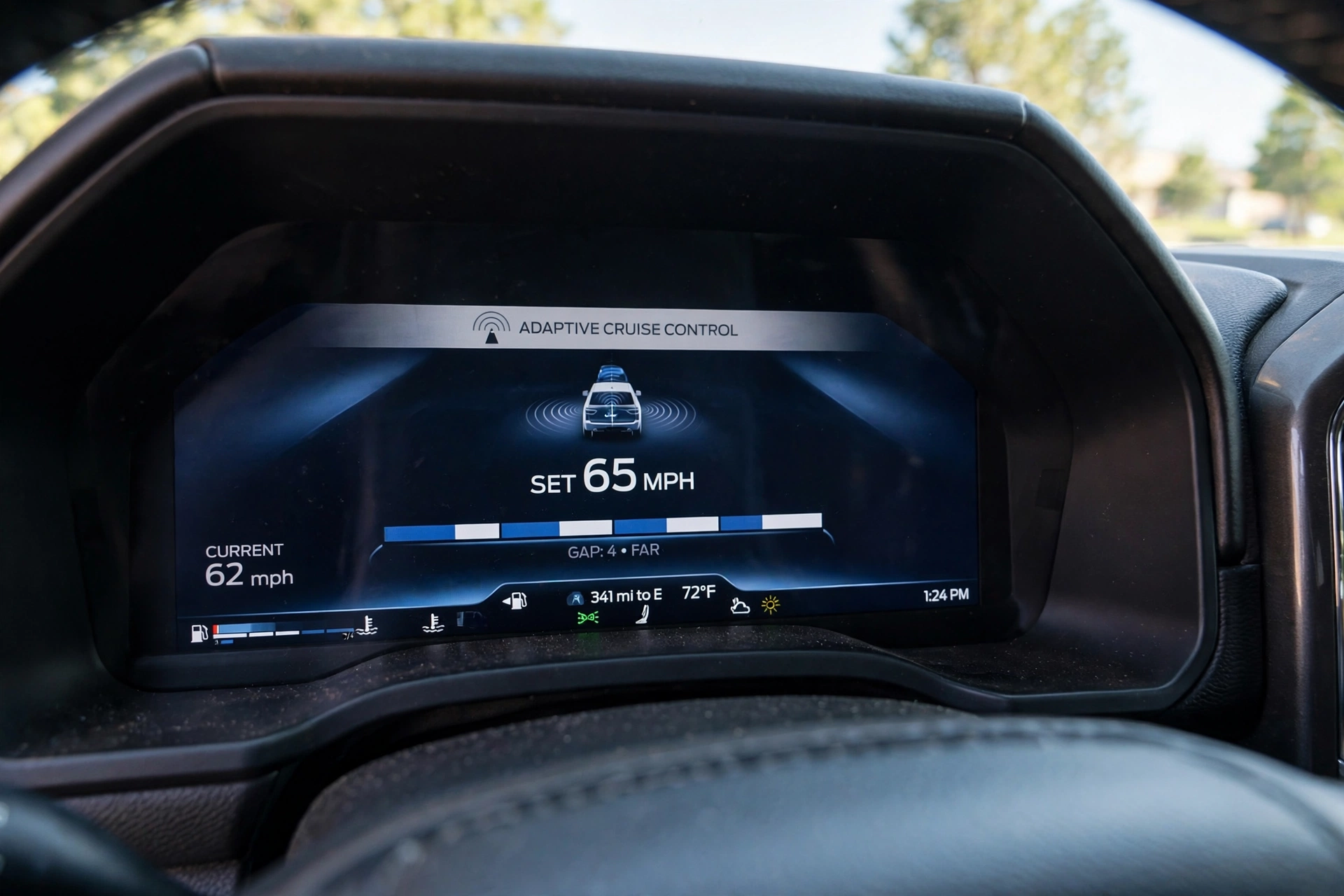
AI-generated illustration: a Ford F-150 dashboard display showing adaptive cruise control set at 65 mph with gap setting 4.
How Ford ACC With Stop and Go Works
Ford calls its system adaptive cruise control with stop-and-go, and it is part of Ford Co-Pilot360 on most newer trucks and SUVs. It holds your set speed on open road, holds your set gap in traffic, and follows the vehicle ahead to a complete stop when traffic halts.
The Ford owner manual for ACC with stop-and-go describes the system in plain terms. It uses radar and camera sensors to maintain a set gap between your vehicle and the vehicle in front of you while following it to a complete stop.
To set stop-and-go from a standstill, follow a vehicle to a complete stop, keep the brake pedal pressed, and press RES+. The set speed adjusts to 20 mph. That is what makes it useful in slow traffic, where older systems would simply switch off.
Consumer Reports makes the same point in its guide to adaptive cruise control. Most ACC systems will bring the car to a complete stop and then bring it back up to speed when traffic gets going again, while other systems work only within certain speeds.
Four Gap Settings to Pick
Ford gives you four gap settings to choose from. Each setting changes the time gap to the vehicle ahead, and the setting you pick shows in the instrument cluster next to the set speed.
The closest setting suits steady highway traffic where you want to keep the gap tight. The farthest setting suits rain, heavy trucks, or any drive where you want more room to react.
A longer gap also means gentler braking. The system sees the gap closing sooner, so it can slow with throttle cut and engine braking instead of reaching for the friction brakes.
Follow to a Stop and Resume
When the vehicle ahead stops, your Ford follows it down to a complete stop and holds there. When traffic moves again, the system can resume and bring your truck back up to the set speed, as long as the stop was short.
If your truck stays stopped for more than three minutes, the system may cancel and set the parking brake. The same cancel can happen if you unbuckle the seat belt and open the driver door after the system stops your truck.
That three minute limit is a safety rule, not a fault. The truck is telling you that a long stop needs the parking brake and your attention, not the cruise system holding the brakes.
Limited Braking and the Warning
Ford is direct about the limit. The system applies the brakes to slow your truck to maintain a safe gap, and the system only applies limited braking. You can override it at any time by applying the brakes yourself.
If the system decides that its maximum braking level is not sufficient, it warns you. An audible warning sounds, a message appears in the information display, and an indicator flashes while the system continues to brake.
That warning means take immediate action. Press the brake pedal yourself, and do not wait to see whether the gap opens up on its own.
Pressing the brake pedal switches ACC off at once. Pressing the accelerator pauses the distance keeping for a moment, so you can pass a slower vehicle, and the system resumes its work when you lift off.
Older Ford Systems That Switch Off
Not every Ford ACC system works down to a stop. Older systems without stop-and-go disengage below a set speed, and the driver must take over the braking from there.
Consumer Reports notes that most ACC systems can only be set to speeds above 20 mph, but they will slow the truck to speeds below that in stop-and-go traffic. Check your own owner manual for the exact behavior of your year and model, because the cutoff varies.
The 2016 Ford F-150 Platinum is a good example of an older truck where the driver assist package differs from a new truck. Its features, its sensors, and its limits belong to its model year, so do not assume a 2016 truck behaves like a new one.
Downhill Driving and Towing Rules
Long downhill grades need extra care. Ford tells drivers to select a lower gear when the system is active on prolonged downhill driving on steep slopes, such as in mountainous areas.
The lower gear adds engine braking, which takes load off the regular brake system and keeps the brakes from overheating. If the system applies the brakes for an extended period, an audible alarm sounds and the system shuts down so the brakes can cool.
Towing changes the rules too. Ford warns drivers not to use the system when towing a trailer that has aftermarket electronic trailer brake controls. When towing with adaptive cruise control, switch on Tow/Haul mode and the diesel engine brake where fitted.
Tow/Haul mode increases the time gaps and allows more distance for braking. That extra distance matters, because a loaded trailer needs far more room to slow than an empty truck.
Our Ford F-150 towing capacity chart shows the rated limits by year and engine. Stay inside those limits before you trust any driver assist system with a trailer behind you.
BlueCruise Builds on ACC Braking
Ford BlueCruise is the hands-free system that sits on top of ACC. It steers, brakes, and speeds up for you on mapped highways, and it uses the same radar, camera, and braking hardware to hold the gap.
If you want the full hands-free picture, our Ford BlueCruise step by step guide walks through how to use it. Our guide to activating Ford BlueCruise covers the setup, and our BlueCruise cost guide covers the price.
BlueCruise does not change the braking answer. It still uses the brakes, it still brakes within limits, and it still needs your eyes on the road and your foot ready.
When the System Refuses to Start
Sometimes ACC will not switch on at all, and that is usually a protection, not a failure. The system may refuse to activate when a sensor is blocked, when the brake temperature is too high, or when a related system has a fault.
A blocked radar sensor is the most common cause. Snow, ice, mud, or a heavy coat of road grime on the lower grille can blind the radar, and the system will stay off until the sensor is clear.
If the system shows a fault and your truck also shows reduced power, read our guide to resetting engine failsafe mode on a Ford F-150. If the fault keeps coming back, our guide to resetting Ford adaptive cruise control walks through the reset steps for the ACC system itself.
Adaptive Cruise Control vs Regular Cruise Control
Regular cruise control and adaptive cruise control look alike on the steering wheel, but they do very different jobs. The table below shows the split, and the braking row is the one that matters most.
| Feature | Regular cruise control | Adaptive cruise control |
|---|---|---|
| Holds set speed | Yes | Yes |
| Watches the vehicle ahead | No | Yes, with radar and camera |
| Slows for slower traffic | No, you must brake yourself | Yes, it slows to hold the gap |
| Uses the friction brakes | No, throttle only | Yes, when needed |
| Engine braking on downhills | Only by downshift on some trucks | Yes, plus brake application |
| Follows to a complete stop | No | Yes, with stop-and-go systems |
| Needs driver braking | Always, for any slowing | When the system warns or reaches its limit |
Regular cruise control works the throttle only. It opens the throttle to hold speed uphill, and it closes the throttle to let speed fall, but it cannot press the brakes.
That limit shows up on downhills. Gravity pulls the truck faster than the set speed, the throttle is already closed, and the system has nothing left to give. The truck simply runs faster than the set speed until you press the brake pedal, which switches the cruise off.
Adaptive cruise control closes that gap. It still works the throttle, but it also works the brakes, so it can hold the set speed downhill and hold the set gap in traffic.
The NHTSA driver assistance guide draws the same line. It describes ACC as a system that automatically adjusts speed to maintain a set following distance, and it stresses that these technologies do not drive the car and a human driver is still needed.
Do not confuse the two systems when you buy a used Ford. A truck advertised with cruise control may only have the regular system, while a truck advertised with ACC, Co-Pilot360, or stop-and-go has the braking system this article describes.
Does Adaptive Cruise Control Wear Out Brakes
ACC does add brake use, but most of that use is light. The system prefers throttle cut and engine braking, and it reaches for the friction brakes only when the gap needs real slowing.
On open highway driving, the extra wear is small. The system makes small corrections with the throttle, and the brakes rest most of the time.
Stop-and-go traffic is different. The system brakes again and again as traffic crawls, and that repeated use adds up over time. The wear is still normal wear, not damage, but a truck that spends its life in heavy traffic will go through pads faster than a truck that runs open highways.
Downhill driving adds the most heat. A long descent with the brakes working can raise brake temperature fast, which is why Ford tells drivers to pick a lower gear and let the engine do more of the work.
If the brakes get too hot, the system protects itself. Ford notes that brake temperature that is too high can stop the system from activating, and an alarm can sound while the system shuts down to let the brakes cool.
The practical fix is simple. Use a longer gap setting, pick a lower gear on long descents, and switch ACC off when the brakes are already hot from towing or mountain driving. Your pads will last longer, and the system will stay in its comfort zone.
When Adaptive Cruise Control Cannot Slow Enough
ACC is a driver aid, not a self driving system. It has blind spots, and each one is a moment when you must brake yourself. The sections below cover the ones Ford owners meet most often.
Stopped and Slow Vehicles
The hardest case for ACC is a vehicle that is already stopped. Ford warns that the system may not detect stationary or slow moving vehicles below 6 mph.
A stopped car at a red light, a queue that has already halted, or a vehicle waiting to turn can sit outside what the radar expects to see. The system is built to track moving traffic in your lane, and a still object can look like road furniture.
Approach stopped traffic with your foot ready. If the truck is not slowing as you expect, press the brake pedal yourself and do not wait for a warning.
Bad Weather and Blocked Sensors
Heavy rain, snow, fog, and spray can weaken the radar and the camera. The system may brake late, brake when it should not, or switch off and hand control back to you.
A blocked sensor is worse than a weak one. Ice on the grille, mud on the bumper, or a plastic bag stuck over the radar can blind the system at once, and the system may not see the vehicle ahead at all.
Clear the lower grille and the windshield camera area before you drive in bad weather. If the system keeps dropping out, switch it off and drive the truck yourself until the weather clears.
Curves Hills and Cut Ins
The radar has a limited field of view. On a sharp curve it may lose the vehicle ahead for a moment, then find it again late. On a crest it may not see the traffic on the far side until you are over the top.
Cut-ins are the classic surprise. A car that merges into your lane close ahead gives the system very little time to react, and the braking it can offer may not be enough. Consumer Reports notes that some systems apply the brakes well for merging traffic while others wait too long, so the driver must take control.
Small vehicles can also slip past the sensors. Motorcycles, bicycles, and low trailers may not reflect the radar the way a truck does, so the system may not brake for them at all.
Towing and Heavy Loads
A loaded truck needs more distance to stop, and a trailer adds weight that the brakes must handle. ACC does not know your trailer weight unless you set the truck up right, so the gap it holds may be too short for the load.
Use Tow/Haul mode, use the diesel engine brake where fitted, and pick the farthest gap setting when you tow. That gives the system time to slow with engine braking before it needs the friction brakes.
Never use ACC when towing a trailer with aftermarket electronic trailer brake controls. Ford warns against it, because the trailer brakes and the truck brakes can fight each other.
If your cruise control keeps switching off while you tow or drive in hills, read our guide to why cruise control keeps turning off. A cancel can be a protection, a sensor fault, or a simple setting, and the guide walks through the common causes.
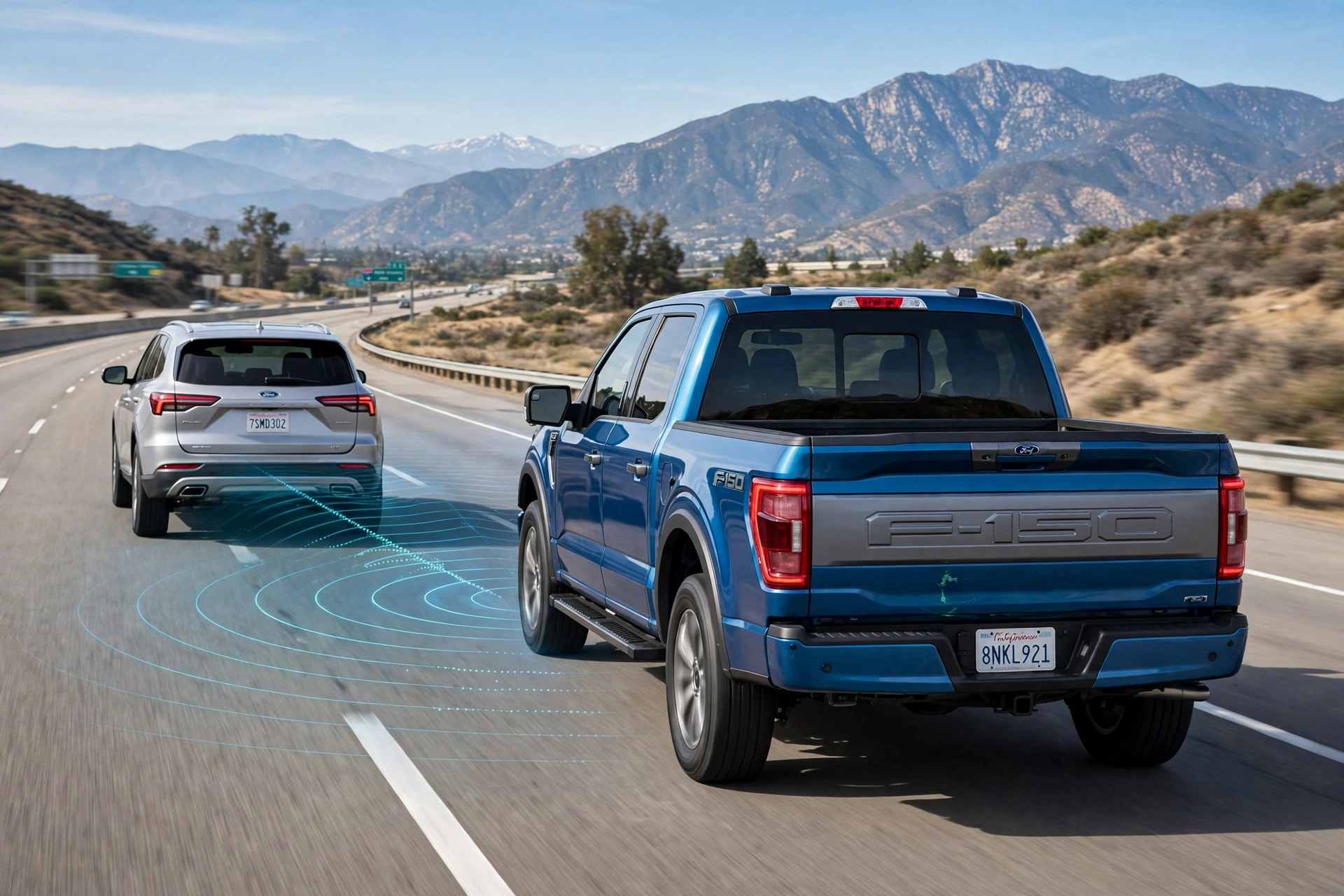
AI-generated illustration: a blue Ford F-150 following an SUV on a highway with radar waves showing the adaptive cruise control gap.
How to Use Ford Adaptive Cruise Control Well
ACC works best when you set it up before traffic gets heavy. The steps below take a minute, and they make the system smoother and safer for the whole drive.
- Pick your gap first. Use the gap button on the steering wheel to choose one of the four settings. A longer gap gives gentler braking and more time to react.
- Set your speed on open road. Drive to the speed you want, press the set button, and lift off the accelerator. The set speed and gap show in the instrument cluster.
- Let the truck follow. When traffic slows, the truck slows with it. Keep your hands on the wheel and your eyes on the road, even when the system is doing the work.
- Resume with a button press. After a short stop, press the resume button or the accelerator to get moving again. After a long stop, you may need to set the speed again.
- Switch it off in bad conditions. Turn ACC off in heavy rain, snow, icy roads, winding roads, and heavy city traffic. Your foot and your judgment beat the sensors there.
The gap and speed readouts sit in the instrument cluster, and some driver assist settings also appear on the center screen. Our guide to what SYNC is in a car explains the Ford infotainment system that runs that screen, so you can find the settings without hunting through menus while you drive.
Learn the cancel habit too. A light press on the brake pedal switches ACC off at once, and that is the move to use whenever traffic feels wrong. You can switch the system back on when the road clears.
Questions Ford Owners Ask About ACC Brakes
Does Adaptive Cruise Control Use Brakes
Yes, adaptive cruise control uses the brakes. It cuts the throttle first and uses engine braking second, then applies the friction brakes through the ABS and stability control system when the gap needs more slowing.
Does ACC Use Brakes on Downhills
Yes, ACC uses the brakes on downhills when engine braking alone cannot hold the set speed. Ford still tells drivers to pick a lower gear on long steep descents, because engine braking takes load off the brakes and keeps them from overheating.
Do the Brake Lights Come On
Yes, the brake lights come on when ACC applies the brakes. The lights are tied to the brakes working, so drivers behind you see that your truck is slowing even though your foot is off the pedal.
Can ACC Bring the Truck to a Stop
Yes, Ford ACC with stop-and-go can follow a vehicle to a complete stop. It can also resume when traffic moves again after a short stop, but it may cancel and set the parking brake if the stop lasts more than three minutes.
Will ACC Stop for a Stopped Car
Not always, and you should never count on it. Ford warns that the system may not detect stationary or slow moving vehicles below 6 mph, so brake yourself when you approach stopped traffic.
Does ACC Brake in an Emergency
No, ACC is not an emergency braking system. Its braking is limited, and it will warn you when its maximum braking is not enough. Automatic emergency braking is a separate system, and even that system needs the driver to stay alert.
Can I Use ACC While Towing
Yes, with the right setup and a longer gap. Switch on Tow/Haul mode and the diesel engine brake where fitted, pick the farthest gap setting, and never use the system with a trailer that has aftermarket electronic trailer brake controls.
Why Does My ACC Turn Off by Itself
ACC can cancel when the tires lose traction, when the parking brake is applied, or when a sensor is blocked. It can also refuse to start when the brake temperature is too high or a related system has a fault.
Your 5 Step Check Before You Switch ACC On
Does adaptive cruise control use brakes? Yes, it uses the friction brakes, the throttle, and engine braking together to hold your gap, and it can follow traffic to a complete stop.
Run the five step check before you switch it on. Clear the radar sensor in the lower grille and the camera behind the mirror, pick a gap that fits the road and the load, set your speed on open road, keep your foot near the brake pedal, and switch the system off in bad weather or heavy city traffic.
That check costs you a minute. It keeps the system inside its limits, it keeps your brakes cool, and it leaves you ready for the one moment ACC cannot handle on its own.