Why Does My Cruise Control Keep Turning Off? (5 Top Causes)

The most frequent cause of cruise control unexpectedly turning off is a faulty brake pedal switch that sends a false signal to the computer. Other primary culprits include malfunctioning wheel speed sensors and engine management issues that trigger safety disengagements to protect the vehicle’s drivetrain.
🎯 Key Takeaways
Recommended Best Deal Products


- A faulty brake light switch is the most common reason for unexpected disengagement.
- Malfunctioning wheel speed sensors often disable cruise control and ABS simultaneously.
- Blown fuses or damaged wiring can interrupt the system’s electrical circuit.
- Modern vehicles disable cruise control automatically if an engine misfire is detected.
- Vacuum leaks in older systems prevent the actuator from maintaining throttle position.
Your cruise control keeps turning off because your vehicle’s Engine Control Unit (ECU) has detected a safety-related anomaly or a hardware failure. In most cases, the system is reacting to a faulty signal from the brake light switch, a damaged clock spring in the steering wheel, or a wheel speed sensor providing inconsistent data. When the computer receives conflicting information, it defaults to a “fail-safe” mode and immediately disengages the cruise control to prevent unintended acceleration or loss of vehicle control.

Prime for Young Adults — 6 Months Free
Students and 18–24s get six months of Prime free, then half price.
Start 6 Months Free As an Amazon Associate I earn from qualifying purchases.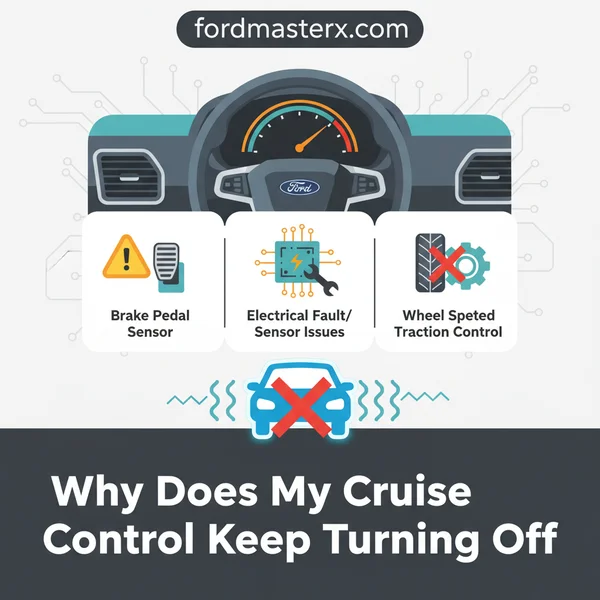
Understanding these triggers is essential because a self-canceling cruise control system is often an early warning sign of a larger electrical or mechanical issue. Ignoring it doesn’t just mean losing a convenience feature; it could mean your brake lights are flickering randomly or your ABS system is on the verge of failure. By pinpointing whether the issue is a physical switch at your pedals or a digital error in the sensor network, you can avoid unnecessary diagnostic fees and get your vehicle back to highway-ready condition.
Mechanical Faults in Brake and Clutch Pedal Switches
The most common reason for cruise control to disengage unexpectedly is a faulty brake light switch. This small electronic component sits just above your brake pedal arm. Its primary job is to tell the ECU when you have pressed the pedal so the car can cancel cruise control and illuminate your brake lights.

The Faulty Brake Light Switch
Over time, the contact points inside the brake light switch can wear down or shift out of alignment. If the switch is too sensitive, a small vibration or a bump in the road can cause it to “trip.” This sends a momentary signal to the computer that you have tapped the brakes. This is enough to instantly shut off the cruise control system. Indicators of this problem include:
- Intermittent Disengagement: The system works fine on smooth roads but cuts out when you hit a pothole.
- Brake Light Sync: Having a friend follow you to see if your brake lights flicker when the cruise control drops out.
- System Won’t Set: The cruise control “Ready” light is on, but the “Set” function won’t engage because the car thinks the brakes are already applied.
Clutch Pedal Position Sensors
If you drive a manual transmission, your vehicle also uses a clutch pedal position sensor. Similar to the brake switch, this sensor tells the ECU to kill the cruise control the moment you depress the clutch to shift gears. If this sensor is loose or failing, it can send a “false positive” signal. Even if you aren’t touching the pedal, the sensor might report that the clutch is disengaged, causing the system to cancel. Often, a worn-out return spring on the pedal allows it to vibrate just enough to trigger this sensor.
Steering Wheel Clock Spring Failures
The clock spring is a spiral-wound electrical connector located inside your steering column. It allows the buttons on your steering wheel to maintain a connection with the ECU while you turn the wheel. If the internal ribbons of the clock spring become frayed or cracked, the connection to the cruise control “Set” or “Cancel” buttons becomes intermittent. If the circuit breaks for even a millisecond, the ECU assumes the system has been manually canceled or that a fault has occurred, causing it to shut down immediately. You may notice this happens specifically while turning or changing lanes.
Sensor Interdependency and Safety-Related Auto-Cancels
Cruise control does not operate in a vacuum; it relies on a constant stream of data from various safety systems. If any part of the vehicle’s stability or engine management network reports an error, the cruise control is usually the first feature to be disabled to protect the driver.
Wheel Speed Sensors and ABS Interference
Your cruise control needs a precise, steady reading of how fast your wheels are spinning. This data comes from the wheel speed sensors, which are part of the ABS system. If a sensor is dirty, damaged, or has a frayed wire, the speed signal becomes “noisy” or inconsistent. If the computer sees that one wheel is reporting 65 mph while another reports 62 mph, it will disable cruise control to prevent a potential skid. Common causes for this include:
- Accumulated Road Debris: Magnetic sensors can attract metallic dust or get covered in mud, blocking the signal.
- Failed Wheel Bearings: Excessive play in a bearing can move the tone ring away from the sensor, causing signal loss.
- ABS Warning Light: If your ABS light is on, your cruise control will almost certainly be locked out as a safety precaution.
Engine Management and Limp Mode
Modern vehicles use logic-based cruise control. If the engine’s computer detects a problem that could affect performance—such as a misfire, a faulty Mass Air Flow (MAF) sensor, or a transmission slip—it may enter a “limp home” or reduced-power mode. Even if the car feels like it is driving normally, the ECU will disable cruise control to ensure the driver remains in full manual control of the throttle. If you see a Check Engine Light (CEL) on your dashboard, the cruise control failure is likely a secondary symptom of an engine-related fault code. The system shuts down because it cannot guarantee a steady engine vacuum or throttle position while the engine is struggling.
Electrical Infrastructure: Fuses, Wiring, and Clock Springs
Cruise control is essentially a complex conversation between your steering wheel, the car’s computer, and the engine. If there is a “break” in the line, the conversation stops, and your cruise control shuts down immediately. Often, the culprit is a simple electrical failure that prevents power from reaching the system components.

Audible — Listen Free for 30 Days
One free credit a month and thousands of titles included.
Listen Free for 30 Days As an Amazon Associate I earn from qualifying purchases.
Blown Fuses and Frayed Wiring
The simplest explanation is often a blown fuse. Most vehicles have a dedicated fuse for the cruise control system or the speed sensors. If this fuse pops due to a power surge or a short circuit, the system loses its “brain” power. Similarly, wiring harnesses that run through the engine bay are subject to extreme heat and vibration. Over time, wires can become brittle, crack, or be chewed by rodents, leading to intermittent connections that kick you out of cruise mode the moment you hit a bump.
- Check your owner’s manual to locate the specific fuse related to the cruise control or “CCS” (Cruise Control System).
- Look for “ghost” resets: if your cruise control works fine until you hit a pothole, a loose or frayed wire is likely the culprit.
- Inspect connectors near the throttle body (on older cars) for signs of corrosion or green buildup.
The Steering Column Clock Spring
The clock spring is a spiral-wound electrical connector located inside your steering column. It allows the buttons on your steering wheel to stay connected to the car’s computer even while you are turning the wheel. Because this part is constantly moving, it is a high-wear item. If the internal ribbons of the clock spring break, the “Set” or “On/Off” buttons will stop communicating reliably.
- Test the buttons: Does the cruise control only turn off when you are making a slight turn or lane change? This is a classic symptom of a failing clock spring.
- Related failures: Often, a bad clock spring will also cause the airbag warning light to illuminate or cause your horn to stop working intermittently.
Engine Performance Issues and Limp Mode Restrictions
Modern vehicles are designed with a “safety-first” mentality. If the Engine Control Unit (ECU) detects that the engine or transmission isn’t performing at 100%, it will often disable “luxury” features like cruise control to ensure the driver maintains full manual control of the vehicle. This is part of a protective state often called Limp Mode.
The Check Engine Light Connection
If your Check Engine Light (CEL) is on, there is a very high probability that your cruise control will not work. Manufacturers program the computer to lock out cruise control for safety reasons. For example, if the engine is experiencing a misfire or a turbocharger boost issue, the computer doesn’t want to be responsible for maintaining a steady speed when the power delivery is unpredictable.
- Common triggers: Faulty oxygen sensors, mass airflow (MAF) sensor issues, or even a loose gas cap can trigger a CEL that disables your cruise system.
- Safety Override: Even if the car feels like it is driving normally, the ECU may “mistrust” the engine’s ability to respond to throttle commands, leading to an automatic shutdown of the cruise system.
Transmission and Vacuum Leaks
On older vehicles, cruise control systems relied heavily on vacuum lines to physically pull the throttle cable. A small crack in a rubber hose can cause the vacuum actuator to lose its grip, causing the cruise control to “slip” or turn off. On newer vehicles, transmission issues—such as a slipping clutch or an overheating gearbox—will trigger a similar shutdown to prevent further mechanical damage.
- Listen for hissing: A faint hissing sound under the hood when the engine is idling often points to a vacuum leak.
- Tachometer spikes: If your RPMs jump suddenly because the transmission is hunting for a gear, the cruise control will cancel itself to prevent the engine from over-revving.
Wrapping Up: Getting Your Cruise Control Back on Track
A cruise control system that keeps turning off is more than just a nuisance; it is usually a symptom of a hidden issue elsewhere in the vehicle. Whether it is a sensitive brake switch, a failing wheel speed sensor, or a protective measure taken by your engine’s computer, your car is trying to tell you that something needs attention. Start by checking the basics like your brake lights and fuses before moving on to more complex electronic diagnostics.
Your next step should be to use an OBD-II scanner to check for any “hidden” trouble codes that might not have triggered a dashboard light yet. Identifying the root cause early can save you from a frustrating drive and potentially expensive repairs down the road. Stay safe, keep your eyes on the road, and get that system fixed so you can enjoy your next road trip in comfort!
❓ Frequently Asked Questions
Why does my cruise control turn off when I use the turn signal?
This usually indicates a short circuit or a grounding issue within the steering column or tail light wiring. When the turn signal draws power, it interferes with the cruise control’s electrical signal, causing a shut-off.
How do wheel speed sensors impact cruise control stability?
The cruise control system relies on constant data from the wheel speed sensors to maintain velocity. If a sensor provides erratic data or fails, the system can no longer safely regulate speed and will immediately deactivate.
Why does the cruise control light flash but the system won’t set?
A flashing light typically indicates that the computer has detected a diagnostic trouble code (DTC). The system is essentially locked out until the specific fault—often a sensor or actuator issue—is resolved and the code is cleared.
Audible Premium Plus — Annual Membership
12 audiobook credits up front, plus the full Audible catalogue.
See Annual Plans As an Amazon Associate I earn from qualifying purchases.What role does the steering wheel clock spring play?
The clock spring is a spiral-wound electrical connector that allows steering wheel buttons to communicate with the car’s computer while the wheel turns. If it wears out, the connection to the cruise control buttons becomes intermittent, leading to random shut-offs.
Can transmission issues cause cruise control to disengage?
Yes, if the transmission slips or fails to hold a gear, the sudden change in RPM triggers a safety override. The vehicle disables cruise control to prevent further mechanical damage or loss of traction.
Why would a vacuum leak affect my cruise control?
Many older vehicles use vacuum-powered actuators to physically pull the throttle cable. If there is a leak in the vacuum lines, the system won’t have enough pressure to hold the throttle in place, causing the speed to drop and the system to cancel.