351 Cleveland Vs 351 Windsor

351 cleveland vs 351 windsor is an essential topic with practical applications and significant benefits. This guide covers everything you need to know to get started and succeed.
🎯 Key Takeaways
Recommended Best Deal Products

- Understanding 351 cleveland vs 351 windsor:Essential knowledge for success in this area
- Practical applications:Real-world scenarios and proven use cases
- Key benefits:Significant advantages when implemented correctly
- Best practices:Important guidelines and expert recommendations
- Future trends:Evolving landscape and emerging opportunities
Choosing between a 351 Cleveland and a 351 Windsor comes down to one fundamental question: do you want high-RPM breathing or low-end torque reliability? While they share a displacement, these two engines are entirely different breeds. The Windsor is a stretched version of the classic small-block Ford, while the Cleveland is a performance-oriented powerhouse designed with “poly-angle” canted valves. One is built for packaging and efficiency; the other is built to move massive amounts of air.

Prime for Young Adults — 6 Months Free
Students and 18–24s get six months of Prime free, then half price.
Start 6 Months Free As an Amazon Associate I earn from qualifying purchases.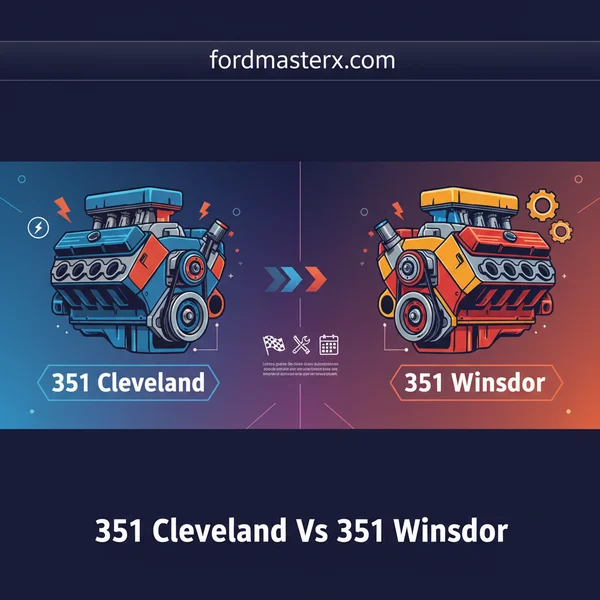
Understanding these differences is critical because almost no major parts are interchangeable. If you buy a Windsor intake for a Cleveland block, it won’t fit. If you want the massive port flow of the Cleveland but the aftermarket support of the Windsor, you have to know exactly what you are getting into. This guide breaks down the mechanical DNA of both engines so you can pick the right foundation for your project car.
Understanding 351 Cleveland vs 351 Windsor
The most important thing to realize is that these engines belong to different families. The 351 Windsor (351W) is part of the 90-degree small-block family, essentially a taller version of the 289 and 302. The 351 Cleveland (351C) was part of the “335” engine series. Because they were developed by different Ford design teams, their physical architecture is unique from the oil pan to the intake manifold.

Visual Identification and Block Differences
You can identify these engines at a glance by looking at the cooling system and the top end. The Windsor follows traditional small-block styling, while the Cleveland looks beefier and more aggressive. Here are the primary physical markers to look for:
- Thermostat Housing: On a 351 Windsor, the thermostat housing is bolted to the front of the intake manifold. On a 351 Cleveland, the thermostat housing bolts directly into the engine block.
- Valve Cover Bolts: Windsors use 6 bolts per valve cover. Clevelands use 8 bolts.
- Timing Cover: The Windsor uses a flat, bolt-on aluminum timing cover. The Cleveland has an integrated timing chain area cast into the front of the block, covered by a flat steel plate.
- Overall Width: The Cleveland is physically wider than the Windsor. This often creates clearance issues in tight engine bays like early Mustangs or Falcons.
The 351 Windsor uses a 9.503-inch deck height, which is significantly taller than a 302 but keeps a slim profile. The Cleveland uses a 9.206-inch deck height. Despite the shorter deck, the Cleveland’s heads make the engine appear much larger. When you are planning your build, remember that the Cleveland’s block-mounted thermostat means you never have to “break” the cooling system just to swap an intake manifold—a small but practical win for the Cleveland.
Key Benefits of 351 Cleveland vs 351 Windsor
The real magic—and the biggest point of contention—lies in the cylinder heads. If the block is the heart, the heads are the lungs. This is where the 70% of your performance difference lives. The Cleveland was designed to breathe like a big-block, while the Windsor was designed to provide consistent, reliable power in a compact package.
The Architecture of the Cylinder Head
The 351 Cleveland features “canted-valve” heads. This means the intake and exhaust valves are tilted at angles toward the center of the cylinder rather than sitting in a straight line. This geometry allows for much larger valve diameters because the valves aren’t competing for space in a straight row. This design also straightens the path of the air entering the combustion chamber, reducing turbulence and increasing flow volume.
In contrast, the 351 Windsor uses “inline” valves. They sit parallel to each other, which limits the maximum valve size you can fit into the bore. While this sounds like a disadvantage, it creates a very efficient combustion chamber for street driving. The Windsor’s ports are smaller, which keeps air velocity high at lower RPMs. This is why a stock Windsor often feels “snappier” when pulling away from a stoplight, whereas a stock Cleveland might feel sluggish until the RPMs climb.
Flow Velocity vs. Port Volume
When discussing Clevelands, you will hear about 2V and 4V heads. The “V” stands for venturi (carburetor barrels), but it refers to the port size. The 4V Cleveland heads feature massive ports—so large you can almost fit a golf ball through them. This allows for incredible top-end horsepower, often seen in Trans-Am racing. However, for most street builds, these ports are actually too big. Unless you are spinning the engine above 6,000 RPM, the air moves too slowly to be efficient.
The Windsor’s benefits lie in its balance. Because the ports are more conservative, the engine maintains high “port velocity.” This means the air-fuel mixture stays atomized and moves quickly into the cylinder even at 2,000 RPM. Consider these factors for your build:

Audible — Listen Free for 30 Days
One free credit a month and thousands of titles included.
Listen Free for 30 Days As an Amazon Associate I earn from qualifying purchases.- Cleveland 4V: Best for dedicated drag racing or high-speed track use. It breathes like a racing engine but requires high compression and deep gears.
- Cleveland 2V: The “sweet spot” for street performance. It offers the canted-valve geometry but with smaller ports that maintain better low-end torque.
- Windsor: The ultimate choice for a daily driver or a heavy truck. It produces peak torque much lower in the powerband.
- Aftermarket Support: The Windsor has a massive advantage here. Because it shares much of its DNA with the 5.0L Mustang engine, you can find thousands of head, intake, and header options at every price point.
The Cleveland’s canted-valve design was so revolutionary that Ford eventually used a hybrid approach. This led to the famous “Clevor” engine—using Cleveland heads on a Windsor block—to get the best of both worlds: the Windsor’s oiling system and the Cleveland’s massive breathing capacity. For most builders today, the choice depends on whether you value the “cool factor” and top-end rush of the Cleveland or the parts availability and torque-heavy nature of the Windsor.
Conclusion
In summary, understanding 351 cleveland vs 351 windsor is essential for success in this area. Apply these insights to see real results.

❓ Frequently Asked Questions
What exactly is 351 cleveland vs 351 windsor?
351 cleveland vs 351 windsor encompasses proven concepts and methodologies that help you achieve better results. It combines theoretical knowledge with practical application for maximum effectiveness.
How can 351 cleveland vs 351 windsor benefit me?
Understanding and applying 351 cleveland vs 351 windsor principles improves your skills, opens new opportunities, and helps you achieve your goals more efficiently.
What resources do I need to get started?
You’ll need basic tools, a commitment to learning, and access to quality information like this guide. Start with fundamentals before advancing to complex topics.
Is this suitable for complete beginners?
Absolutely! This guide is designed to take you from beginner to proficient. Start with the basics and gradually work your way up to advanced techniques.
How do I measure my progress?
Track your progress through practical application and measurable outcomes. Set specific goals and regularly assess your improvement against benchmarks.
Where can I learn more after this guide?
Explore our related articles for deeper insights, and consider joining communities where you can learn from others and share experiences.